Part 2: We Were Searching for a Missing Seven-Year-Old in the Woods — Instead We Found a Dog Chained to a Tree, Half-Dead.
Part 2
I need to tell you about the dog, because by the end you’ll understand that the boy was right about him in a way none of us could see yet.
He was a German Shepherd, the vet later guessed around four years old, though starvation makes them look ancient. Once he was cleaned up and fed back to something like health, you could see what he’d been — a big, handsome dog, black and tan gone dull, with one ear that flopped from some old injury and a deep ring of scar tissue around his neck where the chain had worn through. He had eyes the color of strong tea and a stillness to him, even later, even safe — a watchfulness, like a dog who has learned that the world leaves.
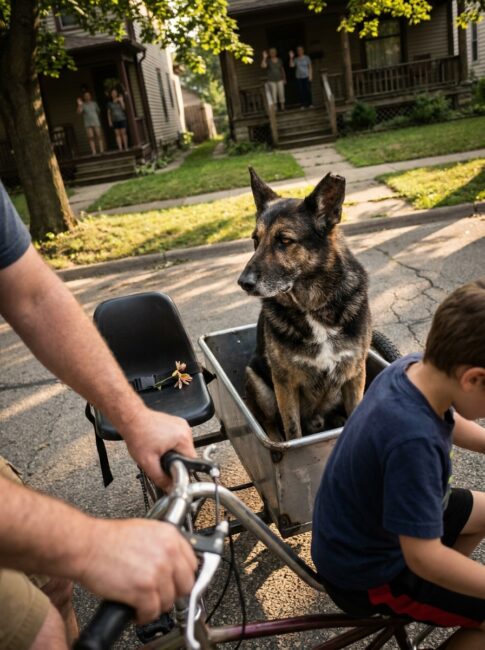
The boy was Eli. Seven years old, small, sandy-haired, with a gap where he’d lost a front tooth. He lived with his mom and his older sister; his dad had left when he was four, the kind of leaving that doesn’t get explained to a four-year-old in any way that makes sense.
Here is the small thing Eli said, that first morning, sitting wrapped in a foil blanket with a paramedic checking him over, that I filed away and didn’t understand.
He kept asking when his dad was coming.
His mom had to tell him, gently, that his dad wasn’t coming — that it was just going to be Mom and his sister at the hospital. And Eli nodded, like he’d expected that, like it wasn’t even a surprise, and then he asked again about the dog.
I thought he was confused. Shock, cold, exhaustion. I thought the dog was just the last thing on his mind before we found him.
It would take a nine-year-old, two years later, to explain to me exactly why a lost, freezing little boy had bonded so completely, in one night, to a dying dog chained to a tree.
Part 3
We got the story in pieces over the next few days — partly from Eli, partly from piecing together the terrain and the timeline.
Eli had wandered off from the campsite chasing a dog.
He’d seen it from the edge of the campground — a German Shepherd, moving through the trees, limping a little. He told us later he thought it was lost. He thought it needed help. So he followed it. Seven years old, no idea that the dog was leading him deeper and deeper into terrain he’d never find his way out of.
The dog wasn’t trying to lead him anywhere. The dog was just a stray, wandering, and a small boy was following. They went in maybe a mile and a half before the boy lost the dog in the laurel.
And then, exhausted and turned around as the light started to fail, Eli stumbled onto something.
A dog. Chained to a tree.
Not the same dog he’d been following — we’re nearly certain of that, from where each was found. A different German Shepherd. The one someone had abandoned back there on the fire road.
A seven-year-old boy, lost and cold and frightened, came through the brush at dusk and found an animal chained to an oak, too weak to stand.
And he stayed.
He told us he tried to get the chain off and couldn’t. He told us he gave the dog his granola bar — the one snack in his pocket — and the dog ate it. He told us he found the bucket and there was no water, so he didn’t know what to do about that.
And then it got dark, and it got cold, and a seven-year-old in a t-shirt did the thing that, the doctors said afterward, probably saved his life.
He lay down against the dog.
He curled up against that filthy, starving German Shepherd’s side, and the dog — what was left of the dog’s body heat — kept him from freezing through the worst of the night. And the boy’s body, in turn, gave the dog a reason, maybe, not to give up in the dark.
They kept each other alive.
In the morning Eli got scared again and went looking for a way out, which is how he ended up a half-mile up the ridge where we found him. But he hadn’t gone far. He kept circling back, he said. Because he didn’t want to leave the dog alone.
I have run search-and-rescue for nineteen years. I have heard a lot of stories about why people survive.
I had never heard one like this.
When we told Eli that we had the dog — that two of our people had found him, that he was alive, that animal control was bringing him out — Eli, hypothermic and IV’d and barely awake on the stretcher, made us promise.
He made us promise we wouldn’t take the dog to be put down.
“He’s not bad,” Eli kept saying. “He’s not a bad dog. He just got left.”
Part 4
The dog very nearly didn’t make it.
By the time animal control got him out of the woods and to the emergency vet, he was severely dehydrated, dangerously underweight, and his body temperature was low enough that the vet wasn’t optimistic. They warmed him slowly. They got fluids into him. They treated the infection in the wound around his neck.
For two days it could have gone either way.
And here’s the thing — Eli, who was kept overnight at the hospital for observation and treated for hypothermia and a dozen lacerations, would not settle. His mom told me. He kept asking about the dog. The nurses kept telling him the dog was at the vet, the dog was getting help, the dog was in good hands.
He didn’t believe them. Why would he? Everyone in his short life who’d said they’d be there had a way of not being there.
So his mom did something I will always respect her for. She got the vet’s number from me, and she held the phone to Eli’s ear, and the vet — a kind, tired woman named Dr. Okafor — described to a seven-year-old, in detail, exactly what she was doing to keep his dog alive.
Eli listened to the whole thing.
Then he said, “Okay.” And he slept.
The dog turned the corner on the third day. He stood up. He ate on his own. Dr. Okafor called it the best kind of surprise.
When she told Eli, over the phone, that the dog was going to live, Eli’s mom said he didn’t cheer. He just went very quiet, and then he said, “Can he come home with us?”
And his mom — a single mother of two with not much money and every reason to say no to a large, traumatized German Shepherd with a long medical road ahead — said yes.
I thought, when I heard all this, that I understood the story. A brave little boy, a rescued dog, a happy ending. A good story. A clean one.
Then, about two years later, Eli explained the rest of it to me, and I realized the deepest part had been sitting right in front of me the whole time.
Part 5
They named the dog Forest. For the place they found each other.
I stayed in touch with the family — you do, sometimes, after a hard search — and on the two-year anniversary, Eli’s mom invited me over. Eli was nine by then. Forest was healthy, big, glossy, the scar around his neck faded to a thin pale line under his fur.
The two of them were inseparable. I mean that literally. They slept in the same bed. Forest walked Eli to school every morning and lay down in the grass by the fence and waited there — the staff knew him, let him stay — and walked him home every afternoon.
I asked Eli, that day, why he and Forest were so close. I expected a kid answer. He’s my best friend. He’s a good dog.
Eli thought about it the way nine-year-olds do, seriously, frowning.
And then he said:
“I love Forest because Forest got left too. Like me. But Forest only got left one night. I know what that feels like.” He scratched the dog’s good ear. “So I’m never gonna do it to him. I’m never gonna leave him.”
That was the twist I hadn’t seen, even though it had been there since the first morning in the woods.
It was never that the boy had rescued the dog, or that the dog had kept the boy warm.
It was that two creatures who had each been abandoned by someone who was supposed to stay had found each other in the dark — and one of them, a seven-year-old whose father had walked out and never come back, had recognized in a chained, starving dog the exact shape of his own deepest wound.
He didn’t refuse to leave the woods without the dog because he was brave.
He refused because he knew, better than any of us, what it does to a living thing to be left behind.
And he was not going to let it happen to Forest.
Part 6
I drove home that day and let every small thing turn over in the light.
Is the dog okay? I’m not going home without the dog. I’d heard a brave child. I should have heard a boy who had already, at seven, decided that being left behind was the worst thing in the world — and was refusing to be the one who did it to someone else.
When is my dad coming? That first morning, wrapped in foil, the question I’d written off as shock. It wasn’t shock. It was the whole story. A boy who had learned, at four, that the people who are supposed to stay sometimes just — don’t. A boy for whom the most natural thing in the world, finding another abandoned creature in the dark, was to lie down beside it and refuse to leave.
He’s not bad. He just got left. Eli had said it about the dog, on the stretcher, half-conscious. But of course he wasn’t only talking about the dog. Some part of a seven-year-old whose father vanished had spent three years quietly wondering if he himself was bad, if that was why his dad left. And here was a dog, chained and starving and discarded — a dog who very obviously was not bad, who had just been left. I think, in those woods, Eli figured something out about himself by figuring it out about the dog.
He’s not bad. He just got left.
I sat in my truck in my own driveway for a while after that.
Eli’s mom told me later that the night terrors Eli had been having since his dad left — the ones no counselor had been able to touch — stopped within a month of Forest coming home. She didn’t fully understand why.
I think I do.
A kid who’s afraid of being left can’t be talked out of it. But he can be shown, every single night, a creature who is still there. Who was left once, like him, and now never is. Who walks him to school and waits at the fence and is in the bed when he wakes from the dream.
You can’t argue a child out of that wound.
But a dog can lie down next to it and stay.
Part 7
Forest is part of the family now, fully, the way the best rescues become.
Here’s the small thing Eli does. His mom told me about it, almost in passing.
Every night, before he gets into bed, Eli fills Forest’s water bowl to the very top. All the way. Even if there’s already water in it, he tops it off.
His mom asked him once why he was so particular about it.
Eli said, “Because when I found him, his bucket was empty. I’m never gonna let his bowl be empty again.”
So every night, the boy who was found in the woods checks the water of the dog who kept him warm, and fills it to the brim, and only then does he climb into the bed they share.
Forest sleeps along the boy’s side. Same side, every night. The same way they slept the one night in the woods.
And every morning, the dog walks the boy to school and lies down by the fence to wait.
Part 8
Eli is nine now. The bad dreams are gone. He talks about the woods sometimes, matter-of-factly, the way kids talk about hard things they’ve already made peace with.
I asked him, that last time, if he was ever scared, that night, alone in the dark.
He said yes.
I asked him what made it okay.
He looked at the dog at his feet.
“I wasn’t alone,” he said. “Neither was he.”
Two left-behind things.
One dark night.
Neither one of them alone again.
Follow this page for more stories about the abandoned ones who recognize each other in the dark.