A Blind Woman Came to the Shelter Looking for the Smallest Dog She Could Manage — Then an Old Pit Bull Led Her Past Every Obstacle and Revealed the Love He Had Learned by Watching a Biker Care for His Blind Wife
Part 2 — The Dog Everyone Thought Was Being Difficult
My name is Mara Ellis, and I had worked in animal rescue for thirteen years by the afternoon Mack crossed our lobby for Evelyn Brooks.
Experience teaches shelter workers to distrust easy explanations. A dog growling behind a gate may be terrified rather than dangerous. A dog asleep during visiting hours may be exhausted rather than lazy. A dog returned for “destroying the house” may have spent twelve hours alone with no safe way to ask for help.
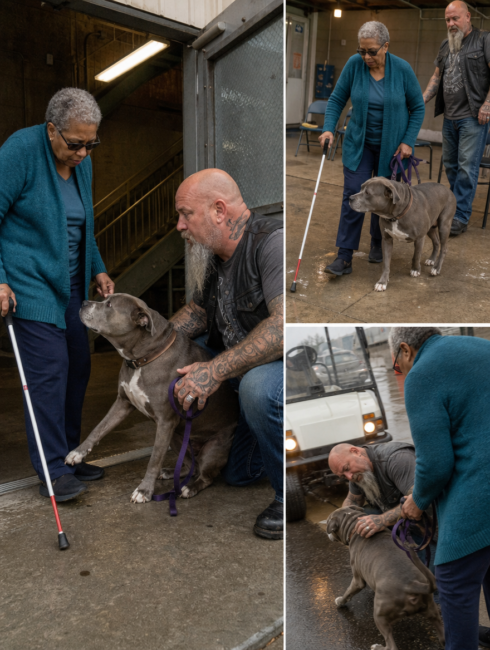
Even so, we failed Mack.
He arrived on a hot June morning after Flagstaff police conducted a welfare check at a rented bungalow near Route 66. Paramedics had removed an older man two days earlier. The landlord entered later, found Mack beside an empty hospital bed, and called animal control.
The man’s identity was not included in our transfer paperwork. Someone had written possible transient tenant in the margin because the lease carried another name.
Mack’s microchip was registered to Ruth Mercer.
Ruth had died twenty-one months earlier.
The telephone number was disconnected, the listed address had been sold, and the emergency contact field contained only the first name Silas. A volunteer called twice, then marked the chip information outdated.
We named the dog Mack because those four letters were scratched into the leather beneath his collar buckle. In reality, it was already his name.
During intake, he refused to enter the kennel until a technician walked through first. He stopped at every threshold, smelled the floor, and waited. When she attempted to pull him forward, Mack planted his feet.
“Stubborn,” somebody wrote.
He blocked people near doorways. If a handler approached a curb too quickly, Mack moved across the person’s knees. When a volunteer carried a box that obstructed her view, he leaned against her until she lowered it.
“Controlling,” someone added.
He disliked being guided from his right side. He became restless when canes, crutches, or walkers tapped along the corridor. He stared at the laundry room because the washing machine’s final alarm sounded almost identical to a pedestrian crossing signal.
Nobody connected those details.
Mack completed three unsuccessful adoption trials. The first family returned him because he stood in front of their grandmother whenever she approached the basement stairs. The second complained that he blocked their back door each time the automatic sprinklers started.
The third family brought him back after one night.
“He won’t let my husband walk while looking at his phone,” the woman said. “He keeps pushing into his legs.”
We laughed about that one.
Mack did not.
By the time Evelyn arrived, he had been available for adoption for ten months. His photograph had slipped lower on our website while younger dogs appeared above him. Volunteers loved him, but affection inside a shelter does not produce a home.
Evelyn’s reasons for wanting a small dog were practical. She could navigate her house with a cane, cook by touch, label medications with raised markers, and travel familiar bus routes independently. What unsettled her was the unpredictable movement of animals.
When she was eight, a loose German Shepherd knocked her down. The dog was playing, but Evelyn remembered the weight, the breath against her cheek, and the helplessness of not knowing where the animal would move next.
As her sight narrowed, that childhood fear returned.
“A little dog can still trip you,” I said.
“A little dog makes a smaller apology afterward,” she replied.
Evelyn possessed the dry humor of someone tired of strangers whispering around her. She rejected pity quickly. She also rejected our first two small dogs because she sensed their anxiety around her cane.
“I won’t ask a frightened animal to spend its life pretending not to be frightened,” she said.
Then Mack found her.
After Bear appeared in the lobby, our director asked him for identification. The biker reached into his vest slowly, aware that two security officers were watching his tattooed hands.
His driver’s license read Silas Mercer.
“People call me Bear.”
Mack knew him.
The Pit Bull smelled Bear’s beard, pressed his forehead against the biker’s chest, and released a long breath. Bear wrapped both arms around him. Leather creaked. The chain at his wallet struck the tile.
For several seconds, the large man and the old dog seemed to disappear inside each other.
Then Mack backed away.
He returned to Evelyn.
Bear watched him settle beside her left leg, and pain crossed his face with such clarity that I looked away.
“I searched every shelter from Prescott to the Utah line,” he said. “The police told my club he’d gone to my stepdaughter. My stepdaughter thought one of my brothers had him.”
“Where were you?” I asked.
“Rehab hospital.”
Ten months earlier, Bear had suffered a stroke while replacing the rear brake line on his Harley. He had fallen inside his garage, struck his head, and remained there for nearly nine hours.
Mack found the neighbor by throwing himself against the front window until the glass cracked. The neighbor called paramedics. Bear remembered the gurney, the oxygen mask, and Mack trying to follow the ambulance.
After that, memory became scattered.
Bear spent twelve days unconscious, six weeks in neurological rehabilitation, and another three months learning to use his right hand. His rental house was cleared while he was hospitalized. The property manager told his motorcycle club that the dog had been collected by family.
Nobody knew Mack had entered a municipal shelter, been transferred during a crowding emergency, and then moved again to our independent facility.
His chip remained registered to Ruth.
Bear showed me photographs. Mack beside a black touring Harley. Mack sleeping under a kitchen table. Mack resting his chin across the lap of a white woman with dark glasses and a folded cane.
Ruth.
In every photograph, Mack watched Bear’s hands.
Bear wanted to take him home immediately.
Our director could not permit it. Ten months had passed, legal transfer periods had expired, and Mack was now owned by the shelter. Bear also lived in a veterans’ transitional residence that prohibited dogs over forty pounds.
The biker’s shoulders seemed to fold inward.
“I lost him on paper,” he said.
Evelyn touched Mack’s ear. “Perhaps we should find out what he was trying to tell everyone before anybody decides where he belongs.”
Bear looked at her.
For the first time, he did not look like a man trying to reclaim property.
He looked like a widower hearing his wife’s voice from another room.
Part 3 — The Walk Behind the Loading Dock
We arranged an evaluation for the following morning.
Evelyn reminded us that she had come seeking a companion, not an improvised service animal. Bear agreed. He knew Mack’s habits but had never asked the dog to work in public.
Our consulting trainer, Marisol Vega, arrived before nine. She specialized in mobility-support behaviors and began by making one point clear: a loving instinct was not the same thing as safe, reliable task work.
“We observe,” she said. “We don’t assume.”
Mack wore an ordinary harness. Evelyn used her cane. Marisol held a second leash loosely from behind while I walked beside Bear.
The route began inside the lobby with overturned wastebaskets, folding chairs, hanging coats, and a wheeled mop bucket placed at irregular intervals. We changed the arrangement so Mack could not rely on memory.
Evelyn gave no directional commands.
“Forward,” Marisol said once.
Mack moved.
He did not behave like a traditionally trained guide dog. His line wandered slightly. He stopped to smell a treat beneath a chair and glanced back at Bear twice. Yet whenever an obstacle entered Evelyn’s path, something inside him changed.
His head rose.
His pace shortened.
He moved between Evelyn and danger.
At a narrow gap between two chairs, Mack chose the wider route. Beneath a low coat rack, he slowed until Evelyn’s cane touched the base, then guided her around the hanging sleeves. When a volunteer crossed unexpectedly, Mack stopped without tangling the leash.
Bear stood behind us with both fists closed.
“He used to do that with Ruth?” I asked.
Bear nodded.
“Did she command him?”
“No.”
“Reward him?”
“Sometimes she gave him bacon because she liked spoiling him. But no commands.”
Outside, the air smelled of wet pine and diesel. A thin March rain had darkened the loading dock. Beyond the fence, traffic moved along Route 66.
Marisol led us toward a practice curb painted bright yellow. Evelyn could not see the color, but her cane found the edge. Mack stopped two feet before it.
“Forward,” Evelyn said.
Mack remained still.
She tested the ground with her cane, located the drop, and stepped down only after Marisol confirmed the path was clear.
Bear turned away.
“You all right?” I asked.
“My wife argued with him too,” he said. “Every curb. She’d tell him she knew what she was doing. He’d wait until she checked.”
That sounded humorous until I noticed Bear rubbing the faded purple strip sewn inside his vest.
The route continued behind the shelter, where delivery vans used a narrow lane beside the veterinary entrance. We had informed staff about the evaluation and placed orange barriers at both ends.
A contractor moved one.
He needed access to an electrical cabinet and assumed the lane was empty. At the same moment, a maintenance worker began reversing a small electric utility cart from the garage.
The cart made almost no engine noise.
Its warning alarm had failed.
I saw it first.
“Stop!”
Rain struck the metal roof. Dogs barked behind the clinic wall. Evelyn did not hear me clearly and continued toward the lane.
Everything happened at once.
Mack crossed in front of her.
Evelyn’s knee struck his ribs. She stumbled sideways. Mack pressed upward beneath her hand, keeping her from falling, then turned his body across both her legs.
The utility cart rolled toward them.
Bear ran.
His boots hit the pavement hard enough to echo beneath the loading dock. The right side of his body still carried weakness from the stroke, but he moved like a man trying to outrun an old nightmare.
“Mack, brace!”
The Pit Bull froze.
Evelyn held the harness and regained her balance. Marisol pulled them backward. The maintenance worker finally saw us and hit the brake less than six feet away.
Silence followed.
Not true silence. Rain still tapped against the roof. The cart’s loose cargo rattled. Somewhere beyond the fence, a truck changed gears.
But nobody spoke.
Mack remained between Evelyn and the cart.
His legs trembled.
Bear reached them, dropped to one knee, and ran both hands along the dog’s ribs.
“You hurt, old man?”
Mack licked his beard.
Evelyn stood with one hand against the wall. Her other hand still held the harness.
“I’m all right,” she said.
Bear looked up. “He shouldn’t have had to do that.”
“He chose to,” she replied.
“That dog has spent half his life thinking every dangerous thing is his to stop.”
Evelyn’s face tightened. “Is that why you told us not to let him guide me?”
Bear did not answer.
Marisol checked Mack’s gait. He had aggravated an arthritic knee but suffered no new injury. She ended the evaluation and ordered rest.
We returned through the veterinary entrance. Mack walked slowly until Evelyn’s cane touched a metal bowl left in the corridor. Even limping, he moved toward her.
Bear blocked him.
“No, boy.”
Mack tried to pass.
Bear placed a scarred hand against his chest. “You’re done.”
The Pit Bull looked at Evelyn. His breathing quickened.
Bear’s voice broke.
“Ruth is gone. You don’t have to keep doing this.”
Evelyn approached the sound of his voice and rested her palm on Bear’s leather shoulder.
“Mack knows Ruth is gone,” she said. “Maybe you’re the one still waiting for permission to stop.”
Bear stood so quickly the chain at his wallet snapped against his thigh.
For one moment, anger hardened his face. Then it vanished.
He removed something from inside his vest.
It was not a photograph.
It was a worn leather handle attached to a six-inch piece of faded purple nylon.
Mack smelled it and sat.
Bear held the strap against his chest.
“This was Ruth’s,” he said. “And it’s why the dog thinks a person carrying a cane belongs to him.”
We believed we had just seen the answer.
We had only seen the last lesson.
Part 4 — What Mack Learned from the Man Walking One Step Ahead
Bear met Ruth Mercer at a diner outside Winslow in 1989.
He was twenty-seven, loud, recently discharged from the Army, and riding a Harley that leaked oil onto the pavement. Ruth was twenty-five, studying accounting at Northern Arizona University, and unimpressed by motorcycles.
“She told me my bike sounded like a washing machine full of wrenches,” Bear said.
He married her fourteen months later.
For most of their life together, Ruth could see. She balanced the club’s charity accounts, worked at a credit union, and developed a reputation for remembering every child’s birthday among Bear’s riding brothers.
Mack entered their lives much later.
Bear found him beneath a motel stairwell during a thunderstorm. The Pit Bull was roughly two years old, underweight, and wearing a length of electrical cord around his neck. Bear brought him home for one night.
Mack stayed nine years.
Ruth began losing her sight when Mack was four. A rare autoimmune condition damaged both optic nerves. Within eleven months, she went from driving to seeing only vague shapes.
She hated asking Bear for help.
He hated watching her collide with things he had forgotten to move.
They learned together.
An orientation specialist taught Ruth to use a cane, count doorways, locate curbs, and listen for parallel traffic before crossing. Bear attended every session. At home, he walked half a step ahead and allowed Ruth to hold the back of his leather vest.
The purple strap had been Ruth’s idea.
She stitched it inside the vest so she could grip something softer than leather. Bear wore it through grocery stores, hospital corridors, parking lots, rallies, and diners where the booths sat too close together.
Mack watched.
He watched Bear stop before stairs.
He watched him angle his broad body around open cabinet doors. He watched Bear stand between Ruth and passing shopping carts, guide her hand toward chair backs, and wait without pulling whenever her cane struck something unexpected.
Bear never trained Mack to copy him.
He did not notice the dog was learning.
The first sign came at home. Ruth left a kitchen drawer open, turned, and nearly walked into its edge. Mack stepped across her knees and stopped her.
She laughed and gave him bacon.
A week later, he blocked the basement stairs after the gate failed to latch. Then he began waiting beside curbs and moving beneath low tree branches.
“He followed my position,” Bear said. “Not my words.”
When Bear stood on Ruth’s left, Mack watched from behind. When Bear used his body to shield her from a passing object, Mack changed sides. When Ruth became disoriented, Bear placed his knuckles beneath her palm and waited for her breathing to slow.
Mack began offering his head.
Still, no one considered him a guide dog.
He lacked the precision, training, and temperament testing. He remained their pet, sleeping on the couch and stealing hamburger buns from the counter.
Then Bear broke his wrist in a motorcycle accident.
For six weeks, he could not safely support Ruth outdoors. She refused to remain trapped inside, so they practiced short walks along the quiet block. Ruth used her cane. Bear followed. Mack walked beside her on an ordinary leash.
At the first curb, Mack stopped.
At the second, he turned his body across her knees.
At the third, he guided her around a parked motorcycle without touching it.
Ruth came home and cried into the dog’s neck.
“She said he’d been taking notes,” Bear whispered.
The motorcycle club began calling Mack “the prospect” because he copied everything Bear did but wore no patch. The men teased him. They also started clearing pathways before Ruth entered a room.
Mack watched that too.
Over the next five years, Ruth’s health declined. She developed neuropathy in her feet and could no longer feel uneven ground. Mack adjusted without instruction. He shortened his steps. He leaned harder when surfaces changed. At night, he slept across the bedroom doorway so she could find him with her toes.
The behavior notes from our shelter suddenly made sense.
BLOCKS HANDLER.
He stopped Ruth from entering danger.
REFUSES FORWARD MOVEMENT.
He waited for her to locate curbs.
CROWDS LEGS.
He used pressure to redirect her.
FIXATES ON DOORWAYS.
He checked whether pathways were clear.
Mack had not been difficult.
He had been doing an old job for people who did not understand it.
Ruth died at home after a stroke. Bear woke before dawn and found Mack lying beside her bed, his head beneath her still hand.
For three months afterward, Mack waited at every curb as though Ruth remained behind them.
Bear stopped walking.
He fed the dog, opened the yard, and sat in the garage beside his motorcycle. Mack carried Ruth’s purple strap from room to room and left it beside Bear’s boots.
The club tried helping. They invited Bear on rides, brought casseroles, and repaired the fence. He refused almost everything.
Then Mack began blocking the garage door whenever Bear reached for his motorcycle keys.
Bear thought the dog feared being abandoned.
The truth was harder.
Bear had started drinking before rides.
Mack had watched Ruth stop him years earlier by standing between Bear and the bike. Now the dog copied her.
“He wasn’t only watching me care for Ruth,” Bear said. “He watched her care for me.”
One rainy night, Bear pushed past him.
Mack seized the purple strap and planted himself across the motorcycle’s front wheel. Bear yelled. Mack did not move.
Bear threw the keys onto the workbench.
The next morning, he entered treatment.
The battered Pit Bull had guided a blind woman for years without training.
Then he guided a sighted man away from a road that might have killed him.
Evelyn held the worn purple strap in both hands.
“You said nobody taught him,” she told Bear.
“Nobody sat him down.”
“That isn’t the same thing.”
Bear stared at Mack.
“No,” he said. “I guess love taught him while we weren’t looking.”
Part 5 — The Voice Ruth Answered Every Thursday Night
The next decision should have been simple.
Bear had found his dog. Mack recognized him. Their history was documented through photographs, veterinary records, and the testimony of club members who had known the Pit Bull for years.
Yet Bear could not take him home.
His transitional residence offered no exception for Mack’s size, and his right hand still lacked enough strength to manage a large dog safely. A permanent apartment might become available in six months, but Mack was already eleven.
Evelyn wanted him.
She was also afraid of wanting him too quickly.
“I won’t turn him into medical equipment,” she told Marisol. “If he lives with me, he gets to be a dog.”
Marisol agreed to conduct a longer assessment. Mack would not be treated as a fully trained guide dog. Evelyn would continue using her cane. Public work would require structured training, health clearance, and proof that he could remain calm around traffic, crowds, food, and other animals.
His age mattered.
So did his choice.
During three supervised visits, Mack behaved differently with Evelyn than he did with other people. He slept beside her chair instead of watching the door. When she rose, he stood slowly and waited. If she used her cane confidently, he followed. If she became disoriented, he moved closer.
He was not compulsively working every moment.
He was listening.
Bear attended each session from across the room.
On the fourth visit, Evelyn mentioned a peer-support telephone line she had called after losing enough sight to surrender her driver’s license. The line connected newly blind adults with volunteers who understood the fear of shrinking independence.
“A woman named Ruth spoke with me,” Evelyn said. “Every Thursday for nearly a year.”
Bear’s coffee cup stopped halfway to his mouth.
“What did she call you?”
“Evie.”
The cup struck the table.
Ruth had volunteered for the Northern Arizona Vision Network during the final three years of her life. Bear knew she made calls from the kitchen, but confidentiality rules meant she never shared surnames.
“What did she say?” he asked.
Evelyn smiled faintly. “She told me not to organize my life around making sighted people comfortable.”
Bear laughed once.
“That was her.”
“She also talked about a dog who kept stealing her slippers.”
Mack raised his head at the word slippers.
Bear covered his eyes with one hand.
Evelyn had never met Ruth in person. They knew each other only through voices moving across a telephone line every Thursday evening. Ruth encouraged her to learn cane skills, return to work, and stop apologizing when strangers offered unwanted help.
On their last call, Ruth sounded tired.
She told Evelyn about an old Pit Bull who had begun stopping at curbs without being asked.
“I thought she was exaggerating,” Evelyn said.
“She usually was,” Bear replied.
“Not about him.”
Mack rose, crossed the room, and placed his head beneath Evelyn’s hand.
The coincidence did not mean Ruth had sent the dog. Neither Evelyn nor Bear believed in arranging grief into a perfect design. Ruth’s telephone work had reached hundreds of people.
But among those hundreds was the woman Mack had chosen in our lobby.
Bear asked to walk with Evelyn privately in the fenced courtyard. I watched through the glass.
He gave her Ruth’s purple strap.
Evelyn folded it into her palm.
Bear knelt in front of Mack, removed the old tan collar, and replaced it with a new blue one. Attached to the buckle was a small metal tag engraved with two telephone numbers—Evelyn’s and his.
“You lose her,” he told Mack, “you call me.”
Evelyn laughed.
Mack licked Bear’s scarred knuckles.
Bear signed the adoption release with his weakened right hand. The letters leaned downward, but every one was legible.
Before leaving, he gave Evelyn a notebook Ruth had kept during the years her sight disappeared. The pages contained tactile labels, bus-route notes, recipes written in thick marker, and descriptions of Mack’s strange behaviors.
One entry read:
Mack stopped me at the curb again. Silas says coincidence. Silas is an idiot.
Evelyn asked Bear to read it twice.
The club prepared her house before Mack arrived. Six broad-shouldered bikers showed up without motorcycles because the engines might unsettle the neighbors. They secured loose rugs, moved sharp-edged tables, installed a gate above the basement stairs, and built a low ramp for Mack’s arthritic knees.
Bear worked slowly with one hand.
Nobody posted photographs.
Nobody asked for recognition.
When they finished, Evelyn walked through every room with her cane. Mack followed. Bear walked behind them both.
At the kitchen doorway, Evelyn deliberately left a cabinet open.
Mack stopped her.
She reached forward, found the wooden edge, closed it, and scratched his silver muzzle.
“Thank you,” she said.
Bear turned toward the window.
That evening, Mack slept beside Evelyn’s bed. At 2:13 a.m., she woke and heard him moving through the house. His nails clicked along the hallway, paused in the kitchen, and returned.
Mack placed something beside her hand.
It was Ruth’s purple strap.
Evelyn held it until morning.
Part 6 — The Biker Who Learned to Walk Behind Them
Training continued for five months.
Marisol taught Evelyn and Mack a consistent set of cues. Mack learned when he was working and when he was free to smell grass, roll beneath the cottonwood tree, or sleep through afternoon radio programs.
He passed health and temperament evaluations. His arthritis limited long routes, so he assisted Evelyn only on familiar short walks. Her cane remained essential. Mack became an additional layer of information, not a replacement for her skills.
Bear attended every Thursday.
At first, he walked ahead.
Habit.
Then Marisol asked him to move behind Evelyn and Mack. Bear struggled with that position more than the dog did. For nine years, caring for Ruth had meant checking the path first, holding doors, moving chairs, and placing his body between her and danger.
Now he had to trust someone else.
At the first curb, Mack stopped. Evelyn located the edge with her cane, listened for traffic, and gave the forward cue.
Bear remained behind them.
His hands shook.
Mack crossed safely.
“So that’s it?” Bear asked.
Evelyn smiled. “That’s one curb.”
Thursday walks became a ritual. They followed the same six-block route from Evelyn’s house to a coffee shop near Route 66. Mack stopped beneath a low branch, ignored the bakery door, and guided her around a cracked section of pavement.
Bear followed in his leather vest, carrying water and pretending not to worry.
At the café, Mack slept beneath the table while Evelyn read Ruth’s notebook using a volunteer transcription. Bear talked about his wife in pieces—never a speech, only small details.
Ruth hated cinnamon.
Ruth cheated at cards.
Ruth could identify each biker by the sound of his boots.
One afternoon, a child asked whether Mack belonged to the blind woman or the frightening biker.
Evelyn answered first.
“He belongs to himself. We’re his people.”
Bear removed his skull ring and let the child examine it.
Mack slept through the entire conversation.
The veterans’ residence eventually granted Bear permission to visit with him. Mack entered Bear’s small room, smelled every corner, and found the old motorcycle jacket hanging behind the door.
The purple strap was missing.
Mack looked toward Evelyn.
She held it out.
He smelled it once, then returned to Bear and rested his head on the biker’s knee.
Bear rubbed the silver fur behind his ears.
“You found another route, old man.”
Mack’s tail moved against the floor.
Part 7 — The Last Curb Before Home
Mack lived with Evelyn for three more years.
His working walks became shorter. By fourteen, he no longer traveled to the café, but he continued guiding her through the house and across the quiet courtyard.
Bear visited every Thursday.
Sometimes he arrived on his Harley, the low engine announcing him before he reached the corner. Mack waited beside the front door, yet he never abandoned Evelyn to run outside. He stayed until she found the handle.
Then they greeted Bear together.
On Mack’s final winter, snow covered the curb beyond Evelyn’s gate. She stepped outside with her cane while Bear followed carrying a blanket.
Mack walked at her left side.
At the curb, he stopped.
Evelyn found the snow-covered edge, listened, and gave the forward cue. Mack remained still.
His legs were tired.
Bear moved closer but did not take Evelyn’s arm.
She knelt and placed one hand on Mack’s chest. Beneath the thin fur, his heart beat slowly.
“We don’t have to cross,” she said.
Mack leaned against her.
They returned inside.
From that day forward, Bear drove them to the café. Mack rode across the rear seat beneath Ruth’s old motorcycle blanket. At the table, he slept with one paw resting on Evelyn’s shoe and his head against Bear’s boot.
When Mack died the following spring, he was at home between them.
Evelyn held the purple strap.
Bear held the old tan collar.
Mack’s head rested beneath both their hands.
A month later, Bear arrived for their Thursday walk alone. He stood at Evelyn’s left side as he once had for Ruth. Evelyn placed her hand on the back of his leather vest but did not use the strap.
They reached the first curb.
Bear stopped.
Evelyn checked the edge with her cane.
Across the street, the café door opened. Traffic moved over wet pavement. Bear waited without pulling, exactly as Mack had watched him do all those years before.
“Forward?” he asked.
“Forward.”
They crossed slowly.
Behind them, Ruth’s purple strap hung from the handlebar of the parked Harley, moving softly in the morning wind.
Mack stopped. Evelyn trusted. Bear followed.
Follow our page for more unforgettable dog stories about quiet courage, second chances, and the animals who learn love simply by watching it every day.