A Young Man Ripped a Tote From an Old Black Lab Outside a Pharmacy—Then One Stitched Name Made Him Drop to His Knees
PART 2
The stitched name was Margaret Hall.
Evan read it without speaking.
The letters had faded after years of washing, but he recognized every flaw in the repair. The “M” leaned too far left, and the last corner was secured by three overlapping stitches because he had run out of thread.
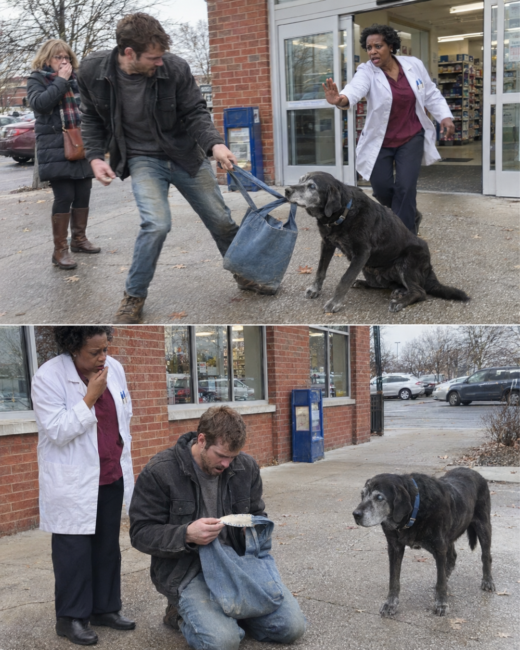
He had sewn that strip onto his mother’s tote fourteen years earlier.
The black Lab stepped closer and touched the canvas with his nose.
“Cooper?” Evan whispered.
The dog’s left ear lifted.
Only then did Evan see the rest of him clearly. Cooper had been seven when Evan last visited his mother regularly. His muzzle had been black then, his eyes clear and his gait easy.
Now the dog was twelve. Gray fur covered his face, his right eye had clouded, and age had reduced the strength in his hind legs.
Evan had not recognized him from behind.
Renee held out her hand for the tote. Evan released it immediately.
She lowered the bag to Cooper’s height. The Lab took one handle carefully but did not move away. He stood near the entrance, watching Evan.
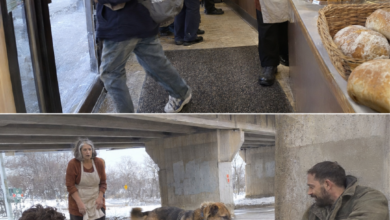
The older woman from the counter came outside carrying a leash.
She was Evan’s aunt Diane.
“What are you doing here?” she asked.
The question held no welcome. Diane clipped the leash to Cooper’s collar, checked his legs and ran one hand over his shoulder.
Evan looked at the tote. “Why does he have Mom’s bag?”
Diane’s face tightened. “Because he always carried it.”
Margaret’s hands had begun trembling two years earlier. Opening bottles and carrying several items at once became difficult, but she refused to stop walking the three blocks to Brookdale Pharmacy.
Renee started placing sealed prescriptions inside the blue tote. Cooper learned to hold one handle while Margaret held the other or kept a hand on his collar.
The arrangement was not a medical service. It was simply a familiar routine between an older woman, her dog and a pharmacist who knew them.
After Margaret died, Cooper moved into Diane’s house.
He ate and slept there, but every Saturday morning he pulled toward Oak Street. Diane eventually resumed the old pharmacy walk because refusing caused him to pace near her front door.
Renee gave him the empty tote while Diane collected a refill for herself.
Evan looked at Cooper’s rear legs. “Did I hurt him?”
“He was already stiff,” Diane said. “But you made him fall.”
Renee suggested that Cooper be examined rather than relying on guesses. Diane agreed and called his veterinary clinic.
Evan reached toward the dog.
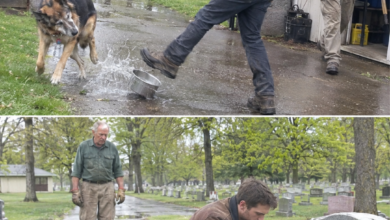
Cooper backed away.
Evan stopped and lowered himself onto both knees. He placed the tote on the pavement, keeping his hands away from it.
“I’m sorry.”
Cooper approached only after Diane loosened the leash. He took the handle, moved one step toward Evan and placed the tote across his thighs.
Then he returned to Diane.
The gesture did not prove forgiveness. It showed only that Cooper still knew where the bag was supposed to go when someone sat waiting for it.
Evan stared at his mother’s name.
Diane folded the leash around her hand.
“The last time she carried that tote,” she said, “she was calling you.”
PART 3
Evan looked up.
“What do you mean?”
Diane had not planned to discuss the call outside the pharmacy, but the tote made avoidance impossible.
Margaret called Evan on a Tuesday afternoon three days before she entered the hospital. She needed someone to collect a prescription because dizziness had made the walk unsafe.
Evan saw her name on his phone.
He let it ring.
They had argued the previous evening about her living arrangements. Evan wanted her to consider an assisted-living apartment. Margaret accused him of trying to move her somewhere convenient so he would not have to visit.
Both said things they later might have changed.
Evan ignored the next call because he wanted her to apologize first.
Margaret then called Brookdale Pharmacy. Renee arranged for Diane to collect the medication, while Cooper waited beside the unused tote at home.
“She didn’t die because you missed a call,” Diane said. “Don’t turn this into that.”
Evan’s hands tightened around the canvas.
“But she called because she needed me.”
“Yes.”
There was no kinder version of that answer.
Margaret was hospitalized later that week after a severe stroke. Evan visited, but she never became alert enough for the conversation he had assumed they would eventually have.
He had spent the six weeks after her death avoiding Diane’s house, the pharmacy and nearly every place that contained an unfinished part of his mother’s life.
Cooper was one of those parts.
Evan had told Diane he could not take him because his work schedule was unpredictable. Diane accepted the dog temporarily, though her own arthritis made longer walks difficult.
“You never came to see whether your schedule was the only problem,” she said.
Cooper sat beside her, holding the tote. His jaw relaxed around the fabric, but he did not release it.
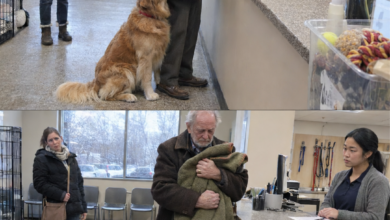
At the veterinary clinic, an examination found no fracture or new injury from the fall. Cooper had chronic arthritis in both hips and age-related vision loss in the right eye.
The veterinarian adjusted his pain-management plan and advised several quiet days. She also demonstrated how to let him rise without pulling on his collar.
Evan paid the bill.
Diane did not treat that payment as proof he was ready to take Cooper home.
“You don’t get him because you feel guilty today.”
“I know.”
“Do you?”
Evan looked toward Cooper, who lay on the clinic floor with Margaret’s tote beneath his chin.
“I want to learn what he needs.”
Diane agreed to let him visit the following afternoon.
She set conditions. Evan would not change Cooper’s food, medication or walking route without consulting her and the veterinarian. He would not pull him into a car or force contact.
Most importantly, he would not disappear after one difficult day.
Evan accepted.
Before leaving, Renee handed him a sealed envelope Diane had brought from Margaret’s desk. It contained no final letter or hidden message—only pharmacy receipts and a handwritten list of pickup dates.
Beside four dates, Margaret had written Evan’s name and crossed it out.
The final date remained uncrossed.
Evan folded the list and placed it inside the tote.
For the first time since the funeral, he decided to return somewhere connected to his mother rather than driving past it.
PART 4
Cooper did not greet Evan at Diane’s house.
The Lab watched from a rug near the kitchen while Evan sat at the table. The blue tote lay between Cooper’s front paws.
Diane showed him the medication schedule, feeding measurements and the rubber-backed runner Cooper used to cross the tile floor. Without it, his rear paws slipped.
When Evan stood too quickly, Cooper tightened his mouth around the tote handle.
Evan sat again.
The first visit lasted twenty minutes.
During the second, Evan placed a piece of veterinarian-approved food several feet away and turned his face aside. Cooper waited until Evan moved farther back before taking it.
Progress came in small distances.
Evan rearranged his work schedule, giving up Saturday overtime so he could join the pharmacy walk. He also spoke to his apartment manager, paid the pet deposit and installed runners through the hallway and kitchen.
Diane inspected the apartment herself.
She noticed that Cooper’s bed had been placed beside a heating vent, which would dry his skin and make the space too warm. Evan moved it near the bedroom door.
The first afternoon visit to the apartment ended early.
Cooper entered, saw Evan lift the blue tote from a chair and backed toward the door. The sudden movement resembled the moment outside the pharmacy.
Evan set the bag down and stepped away.
Cooper did not approach it for fifteen minutes.
Diane watched without intervening. When Cooper finally picked it up, Evan remained still.
“That’s what you should have done the first time,” she said.
“I know.”
Three weeks later, Cooper stayed overnight.
He paced between the front door and the kitchen after Diane left. Evan expected him to choose the new orthopedic bed, but the dog settled beside the tote instead.
At 2:00 a.m., Cooper struggled to rise.
Evan almost reached beneath his body. Then he remembered the veterinarian’s instruction and positioned the rubber runner beneath the dog’s paws. Cooper stood without being lifted.
The following morning, Evan called Diane with a complete report rather than pretending the night had been easy.
That honesty changed her more than a claim of success would have.
A month after the pharmacy incident, Diane agreed to a two-week trial placement. She retained a key and remained Cooper’s backup caregiver.
Evan’s workday still presented a problem. Cooper could not remain alone for ten hours.
Evan arranged a midday visit with a trusted neighbor and returned home during lunch whenever his route allowed. A pet camera showed Cooper sleeping rather than pacing, but Evan did not use one quiet day as evidence that the adjustment was complete.
On the fifth evening, Cooper carried the tote to the front door and waited.
It was Saturday.
Evan understood the routine.
The next morning, he drove Cooper to Diane’s house, and they walked together toward Brookdale Pharmacy.
PART 5
Renee saw them approaching through the pharmacy window.
Evan held the leash loosely, while Cooper carried the empty tote. The Lab’s pace was slow, and they stopped twice before reaching the automatic doors.
Inside, Cooper followed the familiar route to the prescription counter.
Renee placed an empty paper bag inside the tote—not medication, just enough weight to preserve the routine. Cooper took the handle and turned toward the exit.
This time, Evan did not reach for it.
He opened the door.
Outside, Cooper stopped beside him and lowered the tote to the pavement. Evan sat on the bench, and the dog placed the bag against his knee.
Diane watched through the window.
The trial placement became permanent two weeks later. The paperwork for Cooper’s license, veterinary records and microchip information was updated with Evan’s address, while Diane remained listed as an emergency contact.
Cooper still spent one afternoon each week with her.
Evan kept Margaret’s tote on a hook beside the apartment door. He did not wash away the faded scent or repair the crooked name strip.
One afternoon, he returned to Brookdale Pharmacy alone.
Renee expected him to collect a prescription. Instead, he asked about the small delivery sign posted near the counter.
The pharmacy needed a part-time driver for sealed local orders. The position required a background check, training, proof of insurance and fixed availability.
Evan could not simply volunteer to handle medication.
He completed the process.
Two weeks later, he began taking a Saturday route serving customers unable to travel easily. Most were older adults living alone within three miles of the pharmacy.
He delivered only sealed, documented orders and returned undelivered packages directly to Renee.
His first stop was a woman named Mrs. Walsh, who moved slowly with a walker. Evan waited while she reached the door instead of leaving the package unattended.
She apologized for taking so long.
“There’s no rush,” he said.
The words reminded him of every time he had treated his mother’s requests as interruptions.
He did not tell Mrs. Walsh that story. He handed her the package, confirmed the delivery and returned to his car.
Cooper sometimes accompanied him when the weather was mild, secured in the back seat with the tote beside him. The dog remained in the vehicle during deliveries and never handled medication.
At the end of the route, Evan stopped at a quiet park where Cooper could walk briefly on level ground.
One Saturday, Evan returned to the car and found the tote resting on the rear floor. Cooper had moved from his bed and stood over it.
Evan opened the door, then waited.
Cooper picked up the handle and carried the tote to him.
He did not drop it at Evan’s feet.
He placed it in his lap.
PART 6
By spring, Evan’s Saturday route had become a regular part of the pharmacy schedule.
He still worked his weekday job, but he kept Saturday mornings free. Renee knew the arrangement was reliable because he arrived on time, checked every address and called rather than improvising when a customer did not answer.
Cooper came only on suitable days. His arthritis remained, and his cloudy right eye did not clear.
Evan adjusted the car ramp, kept water available and shortened their park walk whenever the dog’s steps became uneven.
One morning, Diane joined them at Brookdale Pharmacy.
She watched Cooper carry Margaret’s tote through the automatic doors and set it beside the counter. Renee placed a lightweight empty bag inside.
Evan crouched but did not take hold of the handle.
Cooper turned and walked toward him.
Six months earlier, the dog had fallen because Evan believed the tote had been stolen. Now Evan waited until Cooper released it voluntarily.
The Lab placed the canvas across his knees.
Diane touched the white name strip.
“You’re still not going to fix those stitches?”
“No.”
“They’re terrible.”
“I know.”
For the first time, they both smiled at the same memory without trying to change what followed it.
Later that morning, Evan delivered to a retired teacher who had missed two previous pickups because she no longer drove. He waited on the porch while she checked the label, then carried a bag of groceries inside after she asked.
He did not turn the delivery into a promise that she would never need help again. He wrote down the number of a local transportation service Renee kept at the pharmacy and left it near the telephone.
At the car, Cooper was resting with his muzzle on the tote.
When Evan opened the door, the dog lifted his head but did not attempt to stand immediately. Evan gave him time.
The pause had become ordinary.
That afternoon, they visited Diane. Cooper carried the tote from the car to her front porch and set it beside her chair.
Diane placed Margaret’s old pharmacy list inside. The final uncrossed date was still visible.
Evan looked at it, then folded the paper once and returned it to the bag.
He could not answer the missed call.
He could answer the next one.
When Renee called later that week asking whether he could add an isolated customer to Saturday’s route, Evan checked his schedule before responding.
Then he said yes.
PART 7
One year after the incident outside Brookdale Pharmacy, Evan arrived shortly before opening with Cooper walking beside him.
The old Lab moved more slowly than before. His muzzle was almost white, and the stiffness in his hips required frequent pauses.
Nobody rushed him.
Renee unlocked the automatic doors and placed the empty tote near the counter. Evan had repaired the handle where the canvas had begun to fray, but he left the white name strip untouched.
The blue stitches remained crooked.
Evan loaded the day’s sealed deliveries into a locked container. Cooper’s tote carried nothing except Margaret’s old list and a folded towel.
Before leaving, Evan sat on the bench outside.
Cooper picked up the tote, walked through the doorway and stopped in front of him.
A year earlier, Evan had taken the bag by force.
Now he kept both hands open.
Cooper stepped closer and lowered the tote into his lap. Then he rested his gray muzzle across the faded canvas.
Evan ran one hand along the dog’s shoulder only after Cooper settled.
Inside the pharmacy, Renee turned on the lights. Diane waited near the counter with two cups of coffee.
The first delivery address belonged to someone living alone.
Evan checked the route, folded the tote beside Cooper’s seat and closed the car door gently.
This time, when a familiar name appeared, he answered.
Follow the page for more grounded dog stories about loyalty, accountability and the quiet routines through which people learn to return.