Part 2: A Dog Lay Motionless Between the Rails as a Passenger Train Closed In — What the Engineer Found Beneath His Body Changed the Station Forever
Part 2 — The Friend He Would Not Leave
The rail stopped trembling once dispatch confirmed that all movement in our block had been held. That protection mattered more than speed. Elena placed a red flag behind us according to procedure, while I remained twenty feet from the dogs and waited for the tan male’s breathing to slow.
He was not attacking. His warnings were economical: a lifted lip, a stiffened shoulder, one bark when I shifted too quickly. Every signal said the same thing: do not reach past me. The black dog beneath him panted with her mouth partly open. Her gums looked pale in the gray light, and her left hind paw dragged when she attempted to reposition herself.
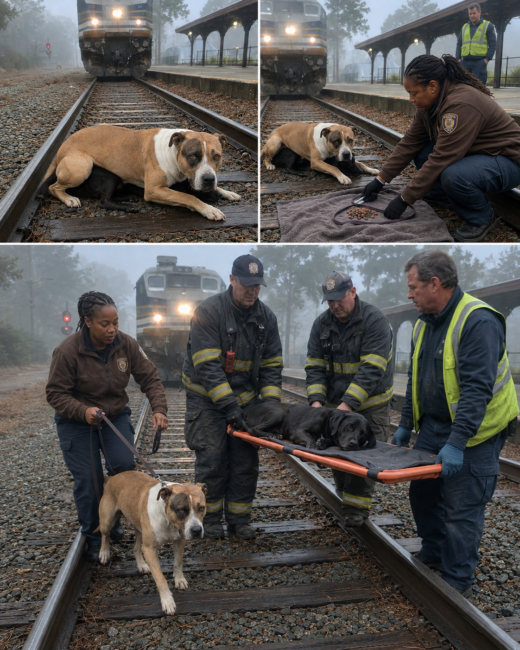
I radioed for county animal control and an emergency veterinary clinic. The nearest officer was fourteen minutes away. We had a blanket, bottled water, work gloves, and a first-aid kit designed for people. None of that made me qualified to straighten a leg or diagnose an injury.
So we did the hardest practical thing.
We waited.
Elena crouched with her body turned sideways and rolled two pieces of turkey from her breakfast onto the ballast. The tan dog watched the first piece land. He sniffed but did not leave the female. When she whimpered, he touched his nose to the base of her ear, then resumed watching us.
“They know each other,” Elena whispered.
We could observe that they were bonded; we could not know how long or how they had reached the tracks. Their coats carried the same reddish dirt. Both had worn fur around their necks where collars might once have been, but neither had one now. The male’s pads were scuffed. The female had a shallow scrape on her right foreleg and a visibly unstable left hip and hind leg, but no open wound.
Passengers had begun looking through the windows. The service manager asked them to remain seated while he checked the one sore shoulder and cleaned spilled coffee. A child in the first car pressed both palms to the glass. I wished he would step away. The dogs did not need an audience, and I did not want the rescue to become a performance.
Officer Maya Brooks arrived in a white county vehicle and walked the last fifty yards beside the track. She was forty-two, compact, and calm, wearing navy work pants and a weathered brown jacket. She stopped beside us, listened to the sequence, and studied the dogs without staring directly at the male.
“If we pull him first, she may panic,” she said. “If we reach for her, he may defend her. Let’s give him another choice.”
Maya made a loop from a soft slip lead and laid it on the ground rather than raising it over his head. She placed a towel beside it, added small pieces of canned chicken, and backed away.
The male stretched his neck. His rear feet remained beside the female’s ribs. He took one piece, then another, but retreated over her each time. Food could bring his head forward; it could not make him abandon her.
The obvious plan—lure him off, secure him, then lift her—was failing because separation was exactly what he feared.
Maya changed the plan.
She spread a second blanket on the ballast level with the ties. Instead of asking the male to leave, she slowly moved the safe surface toward both dogs. Elena and I each held one corner, keeping our hands low and visible. The blanket advanced six inches at a time.
At four feet, the male barked.
We stopped.
At three feet, he smelled the fabric and lowered his head. The injured female tried again to push herself upright. Her front legs worked, but her hindquarters folded. The male immediately moved beside her, pressing his shoulder against hers so she would not roll against the rail.
That was the first moment I understood that his behavior was not simply guarding. He had been physically bracing her body.
Maya called the veterinary clinic again. Based only on what she could see, the dog needed to be moved on a rigid support, not dragged across uneven stone. Fire rescue was requested for a board and extra hands.
The dispatcher told us the route delay had reached twenty-eight minutes.
I looked at the clock, then at the tan dog standing over his friend.
For once, twenty-eight minutes was the least important number on the railroad.
Part 3 — Moving Two Dogs as One
Fire rescue arrived from the county station with two firefighters, a low plastic backboard, and folded quilts used for animal calls. By then the fog had thinned, exposing the silver tops of the rails. The male dog had eaten six pieces of chicken but had not placed a single paw beyond the ties.
Maya named him “Scout” for communication, not ownership. She called the injured female “Nell.” Short names helped everyone coordinate without referring to them as “the tan one” and “the black one.” Neither name carried any claim about their past.
The complication was space. Nell lay inside the gauge, with her body partly against the eastern rail. Scout occupied the only safe approach to her shoulders. The ballast sloped sharply on one side, while the locomotive stood close enough that its idling vibration kept both dogs alert.
I shut the engine down.
The sudden quiet changed the scene. Fans wound to a stop. Metal ticked as it cooled. Somewhere beyond the ditch, a crow called. Scout lifted his head, surprised by the silence where the monster had been.
Maya sat on a tie about eight feet away. She did not reach for him. She tossed food onto the edge of the blanket, then waited until he stepped forward to take it. On the fifth attempt, his front paws landed on the fabric.
Nell gave a thin whine.
Scout turned back immediately.
Rather than prevent him, Maya allowed the return. He smelled Nell’s muzzle, rested his chin briefly against her neck, and looked toward the blanket again. The next piece landed closer to Nell, not farther away. The route to safety no longer required leaving her behind.
The firefighters unfolded a quilt and attached it to the board so hard plastic would not scrape against her. One positioned himself beyond the rail; the other remained beside me. We planned to slide the board parallel to Nell, roll her only enough to support her, and secure her loosely without forcing the injured leg straight.
First, Scout needed a lead.
Maya placed another piece of chicken inside the loop lying on the blanket. Scout extended his neck, withdrew, then tried from another angle. After three minutes, his head passed through. Maya did not tighten immediately. She let him eat, lifted the line slowly, and closed the loop until it rested high behind his ears.
Scout jumped backward.
His paws struck a rail. The lead tightened, and for one dangerous second he twisted toward the ditch. Maya moved with him instead of pulling against him. Elena lowered the blanket between Scout and the drop. I blocked the route toward the train without advancing.
He stopped.
Nobody spoke.
Maya softened the line until it curved again. Scout returned to Nell and stood over her, the lead now trailing toward Maya’s hand. Trust had not been won; panic had simply been given room to pass.
We brought the board closer. Nell tracked it with wide brown eyes. When its edge touched the tie, she snapped once at the air. Scout stepped between the board and her face.
Maya let him smell the quilt. He sneezed, pressed his nose to it again, then looked back at Nell. She placed one strip of chicken on the fabric, close enough for him to take without leaving her.
The firefighters moved only when Scout relaxed his mouth.
One supported Nell’s chest with the folded blanket. The other placed a second towel beneath her pelvis without lifting the injured leg. She cried out once. Scout lunged half a step, and the lead became taut.
I expected him to fight.
Instead, he licked Nell’s muzzle rapidly and stayed beside her head.
“Keep him there,” the firefighter said. “She settles when he’s close.”
We changed positions so Maya could hold Scout within inches of Nell without letting him interfere. Elena kept her hand on the board to prevent it from sliding. I braced one boot against a tie, feeling the absurd intimacy of kneeling on a track my train had nearly turned into a grave.
On a count of three, the firefighters shifted Nell onto the padded board. Her left hind leg remained supported in the position she chose. She panted hard, but the movement was over within seconds.
Scout stepped onto the quilt beside her.
Maya offered food. He ignored it.
He lowered himself until his white shoulder touched Nell’s black one.
The board was wide enough for only one dog, and we could not carry both safely on it. We needed Scout to walk beside us down the ballast to the county vehicle. Maya took two steps. Scout did not move. Nell lifted her head and made a soft sound.
Then Elena picked up the far handles, and the board began to travel.
Scout followed.
Not behind us. Not ahead. Exactly beside Nell’s face, matching every careful footstep as though the rescue would remain acceptable only while he could see her breathe.
Part 4 — The Seven Yards to Safety
The county vehicle could not drive directly onto the track without risking damage to switches and signaling equipment. We had to carry Nell nearly sixty yards over unstable ballast, cross a service lane, and load her through the rear doors. Scout would need to negotiate the same stones while controlled by a lead he had known for less than ten minutes.
The first twenty yards went slowly. Nell’s board tilted whenever one carrier stepped on a loose rock. Scout tried to climb toward her twice. Maya shortened the lead enough to keep him clear of the handles but did not pull him away from her head.
At the service crossing, a maintenance cart waited with its engine off. Two rail workers had arrived to inspect the emergency stop, yet they kept their distance. The passengers watched from behind glass. Nobody cheered. Quiet was the most useful kindness they could offer.
Scout froze at the rubber crossing panels.
The texture changed beneath his feet, and Nell’s board continued forward without him. He planted all four paws and pulled backward. Maya stopped the carriers immediately. She moved close enough for Scout to smell Nell’s cheek. Nell’s nostrils fluttered.
Scout stepped forward.
At the vehicle, we faced another problem. The rear compartment had a secure crate for Scout, while Nell’s board would rest beside it. The metal divider meant he could see her but could not touch her. The moment Maya guided him toward the crate, he twisted away and tried to return to the board.
“Load her first,” I suggested.
Nell was lifted into the padded compartment. Scout placed his paws on the bumper, saw her inside, and climbed without being pulled. Maya removed the slip lead only after the crate door was secured. Scout turned three times, then lay with his body against the divider.
Nell reached her muzzle toward the mesh.
Their noses met through one square of metal.
The emergency clinic was eleven miles away. Maya asked whether one of us could follow because animal control was handling another call and she might need help carrying the board. Dispatch had already arranged a relief engineer. My train would remain where it was until mechanical staff inspected the wheels and brake system, a required check after an emergency application.
I had stopped the train. I intended to see the stop through.
Elena stayed with the passengers while I rode in the front of Maya’s vehicle. In the rear camera, Scout remained pressed to the divider. Each time the van turned, he shifted his feet but returned to the same position. Nell panted, then rested, then panted again.
At Coastal County Veterinary Center, technicians met us with a rolling stretcher. Dr. Aisha Grant examined Nell before anyone attempted to change the leg’s position. Pain medication was given after her weight and vital signs were checked. Scout remained in the adjacent run, pacing whenever Nell disappeared behind a door.
Radiographs showed a fractured left femur and a partially displaced hip. The injuries were serious but treatable. Dr. Grant believed they were recent, perhaps caused by a vehicle impact or fall, but there was no evidence establishing exactly what had happened. Nell also had mild dehydration and bruising along her left side. No internal bleeding appeared on the initial scan.
Scout’s exam found worn paw pads, a small healing cut on his chin, and low body weight, but no major injury. He had no microchip. Nell did have one, although the registration led to a disconnected number and an address that no longer existed.
The clinic stabilized Nell with fluids and pain control while an orthopedic surgeon reviewed the images. Surgery could not happen immediately because swelling around the hip complicated safe repair. She would need monitoring overnight and a decision the next morning.
Scout refused the bowl placed in his run.
He stood at the kennel door, listening.
Dr. Grant allowed staff to roll Nell’s recovery cage into the same quiet room, separated by six feet and secure barriers. When Scout saw her, his shoulders dropped. A technician placed his bowl near the gate.
He ate three mouthfuls, then lay down with his face toward her.
That was the first ordinary thing he had done all morning.
Back at Bellweather, the train eventually moved after a forty-nine-minute delay. The inspection found flat spots within allowable limits, and no passenger required hospital care. My supervisor asked for a written report, including the exact point at which I saw the obstruction, each brake action, and why I left the cab.
I wrote the facts without decorating them.
But one fact did not fit neatly into a railroad form: one dog had used his own body as a red signal because his friend could not stand.
Part 5 — The Night They Slept Six Feet Apart
Nell underwent surgery the following afternoon. The orthopedic team repaired the femur with a plate and screws, then reduced the hip while monitoring circulation and nerve response. Her prognosis was cautiously good, but recovery would require eight to twelve weeks of restricted activity, repeat imaging, and controlled rehabilitation.
Scout could not accompany her into treatment. During the three hours she was away, he paced a track along his kennel gate until his pads reddened. Staff covered half the gate to reduce stimulation, moved his bed away from the door, and sat quietly nearby without forcing contact.
I returned after my shift with permission from animal control. Scout recognized my reflective vest before he recognized me. His body stiffened, perhaps connecting the color with the track, but he did not bark. I sat sideways outside the run and slid a piece of kibble toward him.
He did not eat it.
When Nell returned from surgery, groggy and wrapped in clean supports, Scout stopped pacing. He stood absolutely still as her cage passed. Dr. Grant positioned her where they could see one another, then warned everyone not to confuse his attachment with a medical plan. Nell needed rest more than reunion. Scout needed routine, distance, and proof that she would keep returning.
That night, they slept six feet apart.
Nell’s first forty-eight hours were uneven. She accepted water but showed little interest in food. Her temperature rose slightly, then settled. Staff checked the incision, adjusted medication for nausea, and helped her change position using a support sling. The affected leg remained non-weight-bearing, which was expected.
Scout began eating when his bowl was placed where he could see Nell. He would take several bites, look toward her, and continue. If a curtain blocked his view during treatment, he stood but no longer threw himself against the gate.
Animal control opened the statutory stray hold and attempted to trace Nell’s old chip. The listed owner had moved years earlier. Neighbors at the former address remembered a black dog but could provide no current information. We did not create a villain to explain two dogs on the track. Their past remained a blank space, not permission to invent cruelty.
I visited on the fourth day. Nell was alert enough to follow me with her eyes. Scout approached his gate and smelled my fingers through the mesh, then withdrew. That small investigation felt more important than a dramatic greeting.
“If no owner comes,” I asked Maya, “what happens to them?”
“Medical foster first,” she said. “Then placement. Together if that remains healthy for both.”
The qualifier mattered. A bond visible in crisis does not automatically mean two dogs can share every resource or recover in the same home. The rescue partner would assess them, not turn one morning on the tracks into a sentimental rule.
No verified owner came forward.
On day six, Harbor Lane Rescue accepted responsibility for both dogs. A foster coordinator named Claire Benton had a quiet converted garage with rubber flooring, separate pens, and experience with orthopedic cases. Nell could recover in a large crate with controlled leash breaks. Scout could occupy the adjoining pen and learn household routines without stepping over her.
The transfer happened on a clear afternoon. Scout entered the van only after Nell’s crate was secured. At Claire’s home, he searched the perimeter, checked every door, and returned repeatedly to Nell. He did not seek affection from Claire. He accepted food from a bowl, slept on the concrete rather than the bed, and startled whenever a freight horn carried from miles away.
Nell’s first week brought progress measured in inches. She stood with a sling. She placed the toes of her left hind foot against the floor. She ate full meals. Scout watched each exercise through the divider, often lying with his white shoulder aligned beside her black one.
Then came the setback.
At the end of the second week, Nell began refusing to touch the recovering leg down. The tissue around her hip felt warmer, and she flinched during a gentle range-of-motion check. Claire did not increase exercise or assume stubbornness. She called the clinic.
Radiographs showed the hardware remained stable, but inflammation around the hip had increased after Nell slipped slightly while turning in her crate. Her rehabilitation plan was reduced, medication adjusted, and strict non-slip handling restored. The incident added nearly two weeks to the schedule.
Scout reacted to Nell’s renewed discomfort by returning to vigilance. He skipped one meal and began sleeping against the divider instead of on his bed.
Claire moved his bed beside the divider rather than forcing distance. She fed both dogs at the same time, practiced short individual walks where each remained within hearing range, and rewarded Scout for settling even when Nell was temporarily out of sight.
The lesson was slow: staying close did not have to mean staying afraid.
Part 6 — Learning That Separation Could End in Return
By the fifth week, Nell could place partial weight on her left hind leg during supported walks. The movement was uneven but controlled. Her black coat had regained its shine, and the tension around her mouth softened when Claire entered with the sling.
Scout’s recovery was less visible. He had no fracture to measure, only habits formed around uncertainty. At first, he followed every sound from Nell’s pen. He could not remain in the yard if she was indoors. He abandoned toys whenever a door closed.
Claire worked in minutes, not milestones. Scout stepped into the yard while Nell watched from behind a baby gate. Then he remained outside for thirty seconds after the gate was covered. Then one minute. Each time he returned, Nell was still there.
I visited on Sundays. I left my reflective vest in the car and sat on the back step with a paper cup of coffee. During the first visit, Scout stayed near Nell. During the second, he took a treat from my open palm. During the fourth, he leaned one shoulder against my knee for three seconds and walked away.
No one called it gratitude.
It was a dog making a choice.
The railroad investigation concluded that my emergency stop had been justified under the obstruction and life-safety rules. The company’s initial focus was procedural: sight distance, speed, passenger injuries, equipment inspection, and communication. That was proper. Praise without accountability would have been useless.
Three weeks later, the regional superintendent asked me to attend a safety meeting. I expected more paperwork. Instead, he presented a small commendation for “stopping for life when the safe course required action.” The language was later printed on a plaque at Bellweather Station. I accepted it, but I knew the first warning had not come from me.
Scout had created it.
Nell’s eight-week radiographs showed stable healing. She began short leash walks without the sling, still favoring the left side when tired. Hydrotherapy helped her build muscle without placing full impact through the leg. On her first session, she tried to climb out of the shallow treadmill tank. By the third, she took nine deliberate steps through the water.
Scout waited outside with Claire. He whined once, then lay on the mat.
When Nell emerged, he smelled her damp leg and sneezed. She nudged his cheek. They walked to the car together, but for the first time Scout did not press against her for every step. He trusted the leash, the doorway, and the return.
I had begun the adoption application before Nell’s surgery. My wife, Rebecca, joined the home visit and asked practical questions about stairs, flooring, work schedules, and what would happen if the dogs could not be safely placed together. We lived in a one-story house with a fenced yard and an unused dining room that could become Nell’s recovery space.
Harbor Lane did not approve us because I had stopped the train. They checked veterinary references, inspected the fence, met our elderly cat through a controlled scent plan, and required multiple visits. A rescue was not a reward, and the dogs were not trophies.
Scout entered our house first for a trial afternoon. He checked each room, paused when the refrigerator motor started, and chose the rug near the back door. Nell arrived ten minutes later. She walked slowly, left hind leg still stiff, and found him without pulling the leash.
They touched noses.
Then Nell explored the kitchen while Scout remained on the rug.
That ordinary independence convinced Claire more than their dramatic reunion on the track. They wanted each other, but they could also breathe without constant contact.
The two-week trial began in December. Scout woke at every freight horn during the first three nights. He stood over Nell’s bed, listening until the sound faded. Rebecca placed a white-noise machine in the hallway. I sat beside him without restraining him.
On the fourth night, the horn sounded at 2:13 a.m.
Scout lifted his head.
Nell remained asleep.
After several seconds, he put his head back down.
Part 7 — The Dogs at Bellweather Station
The adoption became final twelve weeks after the emergency stop. We kept the names Scout and Nell because both had begun responding to them, though their chip registrations now carried our address and two current phone numbers.
Nell never regained a perfectly even gait. Dr. Grant expected mild stiffness after long rest and recommended weight control, regular low-impact exercise, and periodic orthopedic checks. She could cross the yard, climb one shallow porch step, and choose her own bed without assistance. Scout learned to wait while she moved at her pace.
I had once said, during the safety meeting, “A dog willing to die rather than leave his friend should not lose that friend after surviving.” The line was repeated more widely than I expected. What mattered at home was simpler: we did not separate them because careful assessment showed they were calmer together and capable apart.
Bellweather Station invited them for a small rail-safety event the following spring. We kept both dogs behind a secure barrier on the platform, far from active track, with harnesses, two handlers, and a quiet room available. Scout wore a tan bandanna without text. Nell wore a black harness that supported her chest without touching the repaired hip.
They did not perform tricks. They did not pose beside moving trains.
They lay on a rubber mat near the station clock while employees spoke to families about crossings, emergency braking, and why nobody should ever enter railroad property. Children drew pictures of the pair. A local artist later made a simple emblem of two dogs lying shoulder to shoulder, and the station adopted it for its annual safety day.
That was how Scout and Nell became the station mascots—not as decorations, but as living reminders used only in controlled, dog-safe appearances. The company placed my commendation beside their emblem. Under it were the words STOPPED FOR LIFE.
Months later, I brought them to the station before opening hours. No trains moved in the protected section. Scout stood behind the platform fence and looked down the silver lines disappearing into morning fog. His ears turned at a distant horn.
Nell leaned against his white shoulder.
This time, he did not lie across a rail. He did not have to make his body into a warning. He simply looked at her, then at me, and walked toward the station door.
Seven yards had once separated them from the locomotive.
Now seven easy steps carried them toward home.
Follow our page for more grounded dog-rescue stories about loyalty, second chances, and the ordinary people who choose to stop when a life needs them.