A Dog Slipped Into Our Church Every Sunday for Nine Weeks and Lay Under the Same Pew — Nobody Knew How He Got In. Then I Counted the Rows.
There was a dog lying under the fourth pew on the left side of our church during the ten o’clock service, and nobody in that building could tell me how he got in.
The doors are heavy. Oak, two of them, with a spring closer on each side that takes a shoulder to open if you’re my size.
I’m eighty-one and I weigh a hundred and nine pounds.
I sit in the sixth row on the left because my hearing went in my right ear about fifteen years ago and that’s the side the organ is on.
The first Sunday I saw him was the twelfth of January.
We’d stood for the opening hymn and I dropped my glasses. They went under the pew in front of me and I bent down to get them, which at my age is a decision and not a reflex.
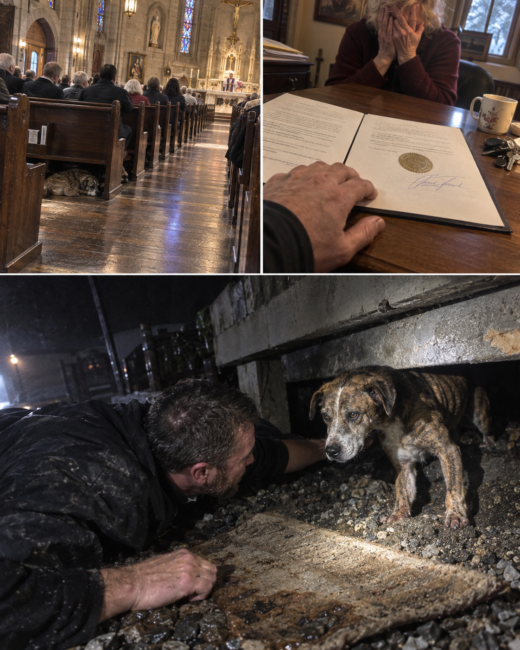
And there was a dog lying under the pew ahead of that one.
Brown. A big square head down flat on his front legs, facing forward toward the altar. Not sleeping. His eyes were open.
I got my glasses. I sat up. I did not say a word to anybody.
I want to explain why, because people ask me that.
It was because of how he was lying.
He wasn’t hiding. A dog that’s snuck in someplace curls up tight and tucks itself in a corner and watches the door. This dog was stretched out flat along the length of that pew, on his belly, chin on his paws, facing the front of the church.
He was lying there the way a person sits in a church.
I got through the service and I did not hear one word of the sermon, which I confessed later and was told was not a sin.
At the end, the organ started the recessional and I turned around to look for him.
He was already going.
He came out from under the pew and he went down the side aisle, along the wall, past the radiator, and out the side door into the vestibule — and he did not run and he did not slink. He walked.
By the time I got out to the parking lot there was nothing.
I told Doris Paffenroth about it in the fellowship hall over coffee and she said I’d probably seen somebody’s coat on the floor.
I have been wearing glasses since 1957 and I know the difference between a coat and a dog.
The next Sunday I got there twenty minutes early on purpose.
The doors were locked until Bill Teegarden opened them at 9:30. I stood in the vestibule and I watched everyone who came in. I sat down at 9:45 and I watched the side aisle.
I never saw him come in.
The processional started and I turned around to look at the fourth pew and he was already under it.
Flat. Chin down. Facing the altar.
That was the second Sunday.
He came the third and the fourth. The fifth Sunday it snowed eleven inches and we had thirty-one people at the ten o’clock and he was there.
He was wet that day. There was a dark patch on the floor under him when he left, and Bill mopped it and complained about it, and I said nothing again.
I counted nine.
Nine Sundays in a row, the same dog, in the same building, under the same pew, and he left the second the organ started the last hymn.
Nobody ever fed him. Nobody ever petted him. Two or three people had noticed by February and the conversation was always the same — huh, that dog again — and then they’d talk about something else.
That is what people do. I’m not judging anybody. I did it too for the first six weeks.
But he was so thin by the middle of February that I could see the shape of his hips from three rows back.
And on the ninth Sunday, the fifteenth of March, Father Emmanuel stood in the vestibule after the service with his coat already on and said he was going to have to call somebody about the dog, because we couldn’t have an animal loose in the church, and somebody could trip, and there were liability questions.
He wasn’t being cruel. He was being a man with a building to run.
I stood there holding my purse in both hands and I heard myself say, out loud, in front of four people:
“Father, that’s Walter’s pew.”
If you have ever walked past the same small thing for two months without once asking what it was — please, read what we found on the last page of a document our parish had already signed.
Part 2
I’m Rosalie. I’m eighty-one years old.
I taught third grade in this town for thirty-four years and there are men on the town council who still call me Mrs. Ferriter and cannot help it.
My husband Denny died in 2009. My son is in Colorado and calls on Sundays.
I have gone to St. Bridget’s in this valley since I was six years old. It’s a small stone church on a hill outside a town of nineteen hundred people in western Pennsylvania, and the congregation on a good Sunday is about seventy.
The dog’s name is Barney.
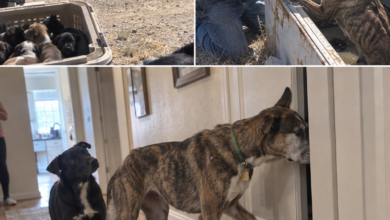
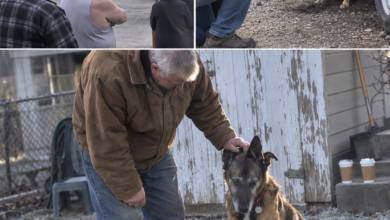
He’s a boxer mix. Nine years old now. Brindle brown with a white chest and a white stripe up the middle of his face, ears that fold over halfway, a gray muzzle that’s gotten grayer since all this.
He has a lump of scar tissue on his left hip from something nobody knows about.
He weighed forty-eight pounds that March. He should weigh sixty-five.
Two things I noticed during those nine weeks and did not ask one question about.
The first: the side door of the vestibule does not latch.
It’s an old door in an old jamb and it swings shut against the strike plate without ever quite catching. It has been that way since at least 1998. You can push it open with a hip.
Or a shoulder. Or a head.
Every person in that parish knows it. It’s on the maintenance list. It’s been on the maintenance list for about twenty-five years.
The second: he was always already there.
I watched that vestibule three separate Sundays and I never once saw him come in. He was under the pew before the processional every single time.
Which means he was getting in before people arrived.
It took me nine weeks to say that sentence out loud.
Part 3
I should tell you about Walter, because none of the rest of it means anything otherwise.
Walter Osiecki was eighty-four when he died.
He was a mechanic. He had a shop on Route 66 outside of town for forty years and then he sold it to a man from Greensburg and worked in it for nine more years for somebody else because he didn’t know what else to do with a Tuesday.
His wife Annamaria died in 1991. They didn’t have children. It wasn’t a choice, is what I understood, though people didn’t talk about that in those days and I never asked.
He came to the ten o’clock Mass every Sunday for right around fifty years.
Fourth pew. Left side. Aisle end.
That was his seat the way the shop was his shop. New people learned it in about three weeks. If somebody sat there he would just sit somewhere else and not say a thing, and then four people would tell that person afterward in the fellowship hall.
He wasn’t unfriendly. He was quiet. He had big hands with the black permanently down in the creases, and he’d shake yours after the service and say “Rosalie” and that was the whole conversation.
He plowed the church lot with his own truck every winter for about thirty years and never once billed the parish.
He was in the hospital for eleven days in January and he died on the ninth.
The funeral was Saturday the eleventh.
Sixty-some people came, which is a lot for a man with no family, and Father Emmanuel said the things you say, and Doris did the flowers, and we all went to the fellowship hall afterward and ate ham.
The dog came the next morning.
I did not know Walter had a dog.
That’s the part I have had the hardest time with, and I’ve had to talk about it with people I trust more than once.
I had known that man since he was in his thirties. I had shaken his hand after Mass probably two thousand times.
And I did not know he had a dog.
It turns out most of the parish didn’t. He got Barney about five years before, from a man who had him tied in a yard down in Derry, and Barney rode in the truck and slept in the house and stayed home on Sunday mornings.
Walter never brought him anywhere in town. He wasn’t hiding him. There just wasn’t anywhere he went where a dog would go.
Now I want to tell you about those nine weeks from my side, because I’ve thought about them a great deal.
The second Sunday I convinced myself it was a coincidence.
The third Sunday I told myself somebody in the parish must be looking after it. There were a lot of us. Somebody must be.
The fourth Sunday a young woman named Kendra, who has three children under six and is doing better than I would, said out loud in the fellowship hall, “Whose dog is that?”
And eleven adults in that room said some version of I don’t know and then somebody put on more coffee.
That’s it. That’s the whole failure. There’s no villain in this.
Eleven people asked a question, got no answer, and let it go, because it was a Sunday and people had roasts in ovens and children in coats.
The fifth Sunday was the snow. Eleven inches overnight and they didn’t get the lot plowed until nine because Walter wasn’t doing it anymore and nobody had sorted out who was.
He was there. Soaking wet, packed snow melting off his chest, under that pew.
I thought about him that whole week for the first time. I’d wake up at four in the morning the way you do at my age and think about that dog in the snow.
And I did nothing.
I want that written down. I noticed on week one. I worried on week five. And I did not open my mouth until week nine, when a priest said he was going to call the county.
Because that’s the other thing about being eighty-one in a parish you’ve been in your whole life. You don’t want to be the old woman who makes a thing out of something.
I have thought a great deal about how much that cost.
By March he was very thin. His coat had gone dull and there was a rough patch on his side. The white on his chest was gray-brown from being outside.
And every single Sunday, he came in through a door that doesn’t latch, before anybody arrived, and he lay down flat under the fourth pew on the left and faced the altar until the organ played the last hymn.
Nine weeks.
Part 4
The fifteenth of March, after I said what I said in the vestibule, nobody spoke for a second.
Then Doris said, “It is his pew.”
Bill Teegarden counted the rows out loud, pointing, which I will never forget. He got to four and he stopped pointing.
Father Emmanuel is thirty-nine years old and he came to us in 2022 from a parish outside Erie. He’s a good man and he’d known Walter for two and a half years, which is not fifty.
He said, “Walter Osiecki had a dog?”
And Doris said, “I guess he did.”
We went back into the church. All five of us.
He was gone, of course. He’d left twenty minutes before.
But we stood in that aisle and looked at the fourth pew and the floor under it, and you could see it — a worn place on the old boards, dull where the finish had gone, about the length of a dog.
Nine weeks of a body.
Father Emmanuel crouched down and put his hand on it and stayed like that for a bit.
Then he said, “I want everybody to go home. I’ll see you next Sunday.”
I went home. I made a piece of toast and I didn’t eat it.
At twenty after four that afternoon my telephone rang and it was Father Emmanuel and his voice was not right.
He said, “Rosalie. Can you come to the office.”
I said, “Father, it’s Sunday.”
And he said, “Please.”
Part 5
There were three of us in that office. Him, me, and Marguerite Dolan, who is the parish secretary and has been for twenty-two years.
There was a folder open on the desk.
Walter Osiecki had left his entire estate to St. Bridget’s.
I didn’t know that. Marguerite knew, and Father knew, and the finance council knew, and that’s about it, because you don’t announce a thing like that from the ambo.
The house on Ridge Road. The lot behind it. A savings account and two certificates of deposit.
It came to a bit over four hundred thousand dollars, which in this valley is an enormous amount of money, and the parish had a roof that had needed doing since 2016.
The will had been probated. The paperwork had gone through in February. There was a contractor coming to look at the roof in April.
It was a clean document. Two pages, typed, from a lawyer in Latrobe. Everything to the parish, no conditions, no restrictions.
Except.
Father Emmanuel turned it around on the desk so I could see the second page.
Under the signature. Under the date. Under the notary’s stamp.
There was one line in blue ballpoint pen, in Walter’s own handwriting, the same handwriting that used to be on the invoices from his shop.
It said:
Please look after my dog.
Marguerite Dolan put her face in her hands.
Because she’s the one who processed it. And she is a careful woman and she has done this job for twenty-two years and she read that document three times and she has no memory whatsoever of that line.
It’s below the notary stamp. Your eye stops at a notary stamp. That’s what a notary stamp is for.
Father Emmanuel said — and he said it very quietly, and he’s a young man and I think he’d been sitting in that office alone for a few hours before he called me —
He said, “It’s been nine weeks.”
Part 6
I sat in that office and every single thing from those nine weeks came back and rearranged itself in front of me.
The fourth pew. Not “a” pew. Not the warmest spot, which is by the radiator on the right. Not the darkest spot, which is under the choir loft.
The fourth pew on the left. Aisle end. Where a man sat for fifty years.
The way he lay. Flat, stretched out, chin on his paws, facing the altar. Not curled, not tucked, not watching the door.
That dog had never once been inside that building in his life. He’d never been to a Mass. He had no idea what the building was for.
He knew where the man went on Sunday morning.
That’s all. That’s the whole of it. Five years of Sunday mornings in a truck and a house — the man puts on the good coat and leaves at 9:40 and comes back at 11:15, every seventh day, and if you’re a dog that’s not a mystery, that’s a schedule.
He went where Walter went. He found the one door in the building that doesn’t latch and he got in before anybody came, and he lay down in the one spot in a seventy-foot building where that man had been.
The door. On the maintenance list since 1998. We’d all been complaining about that door for a quarter century and it turned out to be the only reason that dog wasn’t outside in the snow.
The leaving. Every week, the second the organ started the recessional.
That’s when Walter stood up. Fifty years, every Sunday, that organ meant the man gets up and goes home.
He wasn’t attending anything. He was waiting for a person to come out of a place he’d gone into.
And the part I cannot put down:
He’d done it nine times.
Nine Sundays with no food, no water, nobody speaking to him, getting thinner every week — and he came back. Again and again and again, to a building full of people who stepped over him.
While a piece of paper in a folder eleven hundred feet away, in our own office, that our own parish had already accepted the money from, said please look after my dog.
Walter Osiecki gave us everything he had.
He asked for one thing. He asked for it in his own handwriting, at the bottom, where a man puts the thing that matters most to him and hopes somebody reads all the way down.
And for nine weeks we took the money and let the dog sleep outside.
Father Emmanuel didn’t make a speech about that. He said one sentence in the office that night, looking at the window and not at us.
He said, “We were in the building with him.”
Then he got his coat.
He and Bill Teegarden drove around this valley from six until half past ten that night with a flashlight and a package of hot dogs from the Sheetz on 981.
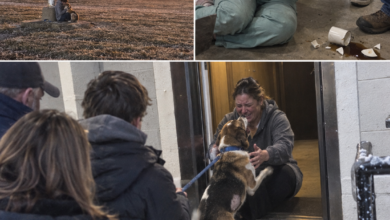
They found him at 10:40 p.m. under the loading dock behind the fire hall on Ridge Road, which is four hundred yards from Walter’s house.
He’d been living there. There was a flattened spot and a piece of carpet he’d dragged under there from somewhere.
Father Emmanuel is thirty-nine years old and he got down on his stomach in a gravel lot in a cassock he’d forgotten to change out of and put his hand in that dark and said the dog’s name.
And Bill says Barney came out.
Just came right out and stood there.
Nine weeks he’d been within four hundred yards of half the people in this parish.
Part 7
The parish adopted him. That was a vote and it was not close.
He has a bed in the sacristy behind the vestment case. There’s a bowl in the kitchen of the fellowship hall with his name written on masking tape on the side because Doris made it in 2025 and nobody has ever replaced it.
He weighs sixty-four pounds.
Father Emmanuel takes him home to the rectory most nights. Bill takes him on Wednesdays. Kendra’s three children walk him in the summer and fight about it.
The roof got done. Walter’s money did that.
And then the finance council did something I did not expect from a finance council.
They set aside a portion of the estate as a standing fund. It pays for food, vet care, and boarding for the pets of elderly parishioners in this valley who can’t manage the cost — and it covers placement and care if the owner goes into a home or dies.
It’s called the Osiecki Fund. Ninety animals so far.
That’s the part that gets people, when I tell it. Ninety.
Here’s the part that gets me.
Every Sunday at the ten o’clock, Barney comes out of the sacristy during the opening hymn.
Nobody brings him. Nobody calls him. The door’s propped and he comes out on his own, down the side aisle, along the wall, past the radiator.
And he lies down under the fourth pew on the left.
Flat. Chin on his paws. Facing the altar.
He does it every single week.
We put a cushion under there the first month, a green one, and he wouldn’t lie on it. He lay next to it on the bare floor.
We took the cushion out.
Nobody sits in that pew now. It’s not a rule. There’s no sign. There are Sundays we’re full and people stand in the back, and that pew stays empty, and I have never once heard anybody discuss it.
Part 8
I am eighty-three now.
I still sit in the sixth row on the left, and I can see him from there if I lean.
Last November I got down on the floor of that church after everyone had gone. It took me some doing and Bill had to help me back up and he was not pleased about it.
I wanted to see what he sees.
You can see the bottom of the altar. You can see feet. And you can see the side door, the one that doesn’t latch, all the way down the aisle.
I lay there on that cold floor for a minute with my cheek on the boards.
He waited nine weeks in a building full of people.
We had the paper the whole time.
Barney is old now. He has trouble getting up.
He still comes.
Follow this page for more stories about the ones who keep the appointment — long after anybody remembers making it.