A Dog With Her Head Trapped in a Paint Bucket Stumbled Across an Empty Lot — What She Had Hidden Inside Sent Three Children Running Home
Part 2 — What We Hid in the Shed
We did not take the dog into the house.
That decision sounds foolish now, but children make plans around the consequence they fear most. We believed that if our parents saw a stray dog and a newborn kitten, they would call someone who would take both animals away.
Malik suggested our garden shed.
It stood behind his family’s duplex, shaded by a pecan tree and separated from the kitchen windows by a row of tall sunflowers. His father stored tools there, but he was working an overnight shift and rarely opened the shed during the week.
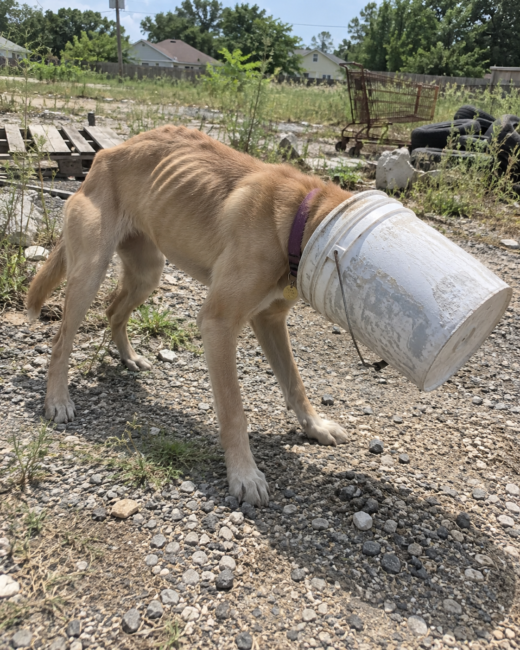
We carried the kitten in Malik’s undershirt. The dog followed us without a leash.
She walked with her head lowered because opening her eyes seemed painful. Whenever Avery moved too far ahead, the dog increased her pace despite bumping into trash cans and fence posts.
She followed the kitten’s smell rather than the path.
Inside the shed, we cleared a space away from fertilizer, gasoline, and sharp tools. We lined a shallow storage crate with towels and placed the kitten inside. The dog immediately curled around it.
She did not try to crush or carry the tiny animal. She formed a loose circle, leaving space around its face, then began cleaning it with slow strokes of her tongue.
We brought water.
The dog drank for nearly a minute, rested, then drank again. Her red eyes remained partly closed. The clear discharge beneath them collected dust whenever she lowered her face.
Avery wanted to wash them.
Malik stopped her from using soap. We searched on his old tablet and found guidance warning that chemical or paint exposure required professional veterinary assessment. For immediate care, the most consistent advice was to move the animal into clean air and flush affected eyes with plenty of clean, lukewarm water or sterile saline—without adding household chemicals.
We used unopened bottles of water and let the liquid flow gently from the inner corner of each eye while Malik held her head over a towel.
She resisted at first.
Then she became still.
Red water did not run from her eyes. Paint did not peel away. The flushing simply removed dust and residue we could see. Whatever irritation remained needed a veterinarian.
The kitten presented another problem.
It was too young to eat solid food. Cow’s milk could make it sick. We pooled our allowance and bought a small container of kitten-milk replacer from a pet-supply store six blocks away. The cashier asked what animal we had. Malik said his aunt had found a kitten.
That was our first lie.
We warmed the formula in a cup of hot water and tested it on our wrists. We fed the kitten belly-down with a small nursing bottle, never on its back. The first attempt was clumsy. Milk bubbled at the corner of its mouth, and we stopped immediately.
The dog watched every movement.
When the kitten finally swallowed, her tail struck the floor once.
We divided the night into shifts.
Avery slipped out after midnight with a flashlight. I went at two. Malik handled the next feeding because the shed was behind his home.
The dog refused the food we brought until the kitten had been returned to the crate. Only then did she eat.
By morning, her breathing sounded normal. Her eyes were still inflamed, and she kept them closed whenever sunlight entered the shed. She needed help we could not secretly provide.
We promised each other we would tell an adult after school.
Then school ended, and we delayed until evening.
The second night became the third morning.
Our rescue had turned into another form of hiding.
On the third afternoon, Malik’s mother, Denise, noticed the missing towels. She followed muddy footprints across the yard and opened the shed door.
The dog stood over the crate.
Denise saw the swollen eyes, the formula container, and three children frozen among garden tools.
Her first words were not angry.
“Move back,” she said. “That dog needs a doctor.”
Then she saw the faded purple collar.
Her expression changed.
She stepped closer, stared at the small brass tag, and whispered a name none of us had used.
“Clover?”
Part 3 — The Name on the Collar
The dog lifted her head.
Her eyes were almost closed, but both ears moved toward Denise’s voice.
“Clover,” Denise repeated.
The dog stood too quickly, bumped the side of the crate, and crossed the shed. She stopped inches from Denise’s knees.
Denise reached beneath the faded purple collar and turned the brass tag toward the light.
Two lines were still readable beneath the scratches:
CLOVER
EVELYN HARPER
Evelyn Harper had been Denise’s mother.
She had also been our grandmother.
Clover disappeared two years earlier, three days after Grandma Evelyn died. Relatives had been carrying furniture through the back gate of her small house. Someone left it unlatched. By the time Denise noticed Clover was missing, night had fallen.
Our family searched for weeks.
We posted photographs. We checked shelters and veterinary clinics. Denise walked the streets around Grandma’s house shaking a treat jar Clover had always recognized.
Several people reported seeing a yellow dog, but none of the sightings led to her.
Grandma’s house was sold six months later. A developer demolished two neighboring buildings, and the vacant land behind Garrison Avenue grew into the dumping ground where we played soccer.
Clover had disappeared into a changing neighborhood full of temporary hiding places.
Denise knelt in the shed.
Clover pressed her head against Denise’s chest. The dog’s body began to tremble—not the frantic shaking we had seen inside the bucket, but a deep movement through her shoulders.
Denise touched the dark left ear and the white star on her chest.
“Mom braided purple thread around this collar,” she said. “She said the store color looked boring.”
A few strands of faded thread remained beside the buckle.
The tag and markings were convincing, but Denise wanted confirmation. Grandma had arranged for Clover to be microchipped when she was a puppy. The number should still connect to old veterinary records.
Recognition did not cancel the medical emergency.
Denise placed the kitten’s crate in her car and spread blankets across the rear seat for Clover. The dog would not climb in until Avery lifted the crate first.
At the clinic, Dr. Lena Morris scanned Clover’s shoulders.
The microchip number matched Evelyn Harper’s records.
The dog our family had mourned for two years was standing in front of us.
Dr. Morris examined Clover’s eyes and respiratory system. The paint bucket had once held water-based exterior paint. Most of the residue was dry, but heat, dust, poor ventilation, and prolonged contact had caused severe irritation.
She diagnosed chemical conjunctivitis in both eyes, with the right slightly worse. The corneal surfaces showed irritation but no deep ulceration. Clover received a longer professional eye flush, medication, and instructions for follow-up examinations.
Her low body condition suggested she had survived on inconsistent meals. Blood tests showed dehydration but no immediate organ crisis.
The kitten was approximately five or six days old, mildly dehydrated, and underweight. Its body temperature had begun improving inside the towels and against Clover’s abdomen.
“Is Clover its mother?” Avery asked.
Dr. Morris shook her head.
Clover was spayed. She could provide warmth, grooming, and protection, but she could not provide milk. The kitten would need bottle feeding every few hours, help eliminating, daily weight checks, and close veterinary supervision.
We told Dr. Morris everything about the shed.
She did not praise us for hiding the animals.
She also did not shame us until we stopped listening.
“You helped them survive the first hours,” she said. “Next time, helping means finding an adult sooner.”
That sentence stayed with us.
Denise originally planned to transfer the kitten to an experienced neonatal foster. Clover could return home after treatment, but keeping the two together might not be practical.
When a technician carried the kitten toward another room, Clover tried to follow. She stumbled into a chair because her eyes remained sensitive to light.
The kitten cried.
Clover answered with a low whine.
Dr. Morris paused at the doorway.
Separating them immediately might create unnecessary stress. If Denise agreed to the feeding schedule and the clinic monitored both animals, the kitten could remain in a supervised foster arrangement at our house.
Denise looked at the three of us.
“You wanted to keep them hidden,” she said. “Now you’re going to learn what caring for them in daylight requires.”
Part 4 — Three Nights Became a Schedule
The kitten came home in a proper carrier.
Clover came home wearing no bucket, no improvised bandage, and no promise that her eyes would recover overnight.
We placed her bed in the quietest corner of our kitchen, away from direct sunlight. The kitten’s warming box sat nearby with a safe heating pad beneath half the bedding, allowing it to move away from the heat if necessary.
Dr. Morris gave us a written schedule.
Feedings.
Eye medication.
Weight checks.
Bathroom stimulation for the kitten.
Short outdoor trips for Clover.
Follow-up appointments.
Rescue became a list of repeated duties.
Malik arrived before school for the first feeding. Avery handled the weight chart. I cleaned bottles and prepared formula under Denise’s supervision.
The kitten gained twelve grams the first day.
Then it lost six.
We panicked.
Dr. Morris asked about its energy, temperature, swallowing, and stool. She adjusted the feeding amount and scheduled an examination. The kitten had no sudden catastrophic illness, but its small body had little room for error.
We named it Button because its nose looked like one.
Clover remained beside the carrier throughout the appointment. Her eyes had improved enough to open halfway, though the whites remained red. She blinked frequently under bright clinic lights.
Medication time tested everyone.
Clover disliked anyone approaching her face. Denise sat beside her rather than restraining her forcefully. Avery offered a small piece of food. I applied the prescribed drops while Denise kept Clover’s head steady.
Afterward, Clover walked directly to Button’s carrier.
She checked the kitten before accepting comfort for herself.
The family started reconstructing Clover’s missing years through neighborhood conversations.
A mechanic remembered a sandy dog sleeping behind his shop during winter. A woman near Grandma’s former house had left food beneath her porch for “a shy yellow dog” that came after midnight.
A construction worker recognized Clover’s dark ear from Denise’s photographs. He had seen her crossing the vacant lots behind Garrison Avenue several times.
She had not traveled across the city.
For two years, Clover had remained within roughly a mile of Grandma Evelyn’s former home.
She avoided leashes, vehicles, and people who approached directly. When buildings were demolished, she shifted between alleys and empty parcels. Sporadic food kept her alive but never brought her close enough for anyone to read the collar.
She had stayed near the last place that still smelled like Evelyn.
Nobody knew where Clover found Button.
There was no mother cat in the lot when volunteers searched. They checked beneath pallets, inside pipes, and along the fence. It was possible the mother had moved the rest of her litter or had been unable to return.
Clover may have heard the kitten crying and carried it toward shade. The bucket was lying on its side beneath boards when we first arrived. Paw marks in the dust suggested the dog had pushed the rag inside.
We could not prove every step.
What we knew was visible: Clover had remained beside Button, entered the bucket, become trapped, and returned to it immediately after being freed.
Her care was not instinct from pregnancy or nursing.
It was a decision repeated each time the kitten cried.
By the second week, Clover’s eye redness had decreased. The swelling around her lids faded. She could follow movement across the room without squinting.
Button began opening its eyes.
The first clear shape it appeared to recognize was Clover’s muzzle hovering above the carrier.
Clover’s recovery had one setback. After a windy afternoon stirred dust from a construction site, her right eye became red again. Denise called the clinic rather than adding more medication on her own.
Dr. Morris adjusted the treatment and advised keeping Clover indoors during dusty periods.
Healing did not move in a straight line.
Neither did trust.
Clover slept near the kitchen door for nearly a month, ready to leave whenever footsteps approached. She accepted food but backed away from raised objects, even harmless grocery bags.
The bucket had been removed.
The fear of becoming trapped remained.
Part 5 — Grandma Evelyn’s Chair
Denise brought Grandma’s old rocking chair down from the attic.
The upholstery had faded, and one wooden runner had been repaired twice. Nobody had used it since Grandma died. Denise placed it near Clover’s bed because she remembered the dog sleeping beneath it every afternoon.
Clover approached slowly.
She sniffed one runner, the seat cushion, and the crocheted cover draped over the back. Then she circled beneath the chair and lowered herself onto the floor.
For the first time since coming home, she slept without facing an exit.
Denise sat on the kitchen tiles and cried quietly.
She had intended to find Clover a different permanent home.
Our house was busy. We already had limited space. Button’s feeding schedule had disrupted everyone’s sleep. Clover’s medical costs, food, and long-term care would continue after the neighborhood’s initial sympathy faded.
Keeping an animal could not be based only on recognition.
But Clover had returned carrying part of Grandma’s life with her.
More importantly, she was beginning to build a life with us.
We held a family meeting at the kitchen table. Denise made us list responsibilities instead of promises.
Who would feed Clover before school?
Who would clean the yard?
Who would attend Button’s future appointments?
What happened during vacations?
What costs could our family manage?
Malik’s family offered to help with occasional care. The mechanic donated a sturdy crate, though Clover was introduced to it gradually with the door secured open. The pet store provided a discount on formula after hearing Button’s story.
The neighborhood contributed toward the veterinary bills, but Denise kept the financial records transparent. Money left after treatment went to the clinic’s neonatal-kitten fund.
Clover’s rescue began helping animals she would never meet.
Button moved from formula to a shallow dish under veterinary guidance. Clover supervised every meal.
The kitten climbed across Clover’s front legs, attacked her tail, and slept against the white star on her chest. Clover corrected rough behavior with a quiet movement of her muzzle but never frightened it.
When Button was old enough for vaccinations and adoption evaluation, Denise asked whether separating them remained the practical choice.
Dr. Morris watched them together in the examination room.
Button explored beneath a chair, returned to Clover, then explored again. The kitten was developing normally and did not panic when separated briefly. Clover also tolerated short periods away.
They did not medically require each other.
That made the family’s decision more honest.
We were not keeping Button because separation would create a dramatic tragedy. We were keeping Button because we had the space, schedule, finances, and commitment to care for both animals.
Six weeks after the empty-lot rescue, Denise signed adoption paperwork for Button and updated Clover’s microchip registration.
The form required an owner’s name.
Denise wrote The Harper Family.
Our last mystery concerned the bucket.
Malik had retrieved it from the lot after volunteers finished searching for more kittens. Its rim was scratched. White paint residue coated the inside, and a strip of Clover’s golden fur remained caught near the handle.
Denise wanted to throw it away.
Avery refused.
“It’s where Button survived,” she said. “And where Clover almost didn’t.”
We washed the bucket outdoors using protective gloves and disposed of the rinse material properly. An adult cut away the damaged rim and drilled drainage holes in the bottom.
Then we painted the exterior yellow.
Not bright warning yellow.
The soft yellow Grandma Evelyn had used on her kitchen walls.
Part 6 — The Pot Beside the Door
The yellow bucket became a flowerpot.
Denise filled it with clean soil and planted marigolds because Grandma Evelyn had grown them along her walkway. We placed it beside our front door, where morning sunlight reached it without turning the plastic into an oven.
Clover avoided it.
For the first week, she walked around the other side of the porch. If the wind moved the handle, she stopped and returned indoors.
Nobody lured her toward it for a photograph.
Nobody placed treats inside.
We allowed the bucket to become ordinary.
Trust grows poorly when staged.
One morning, Clover followed Button onto the porch. The kitten leaped at a fallen leaf, missed, and rolled against the yellow pot.
Clover froze.
Button stood, shook itself, and climbed onto the low step.
After several seconds, Clover approached. She sniffed the outside of the bucket, touched her nose to one marigold leaf, and continued past it.
That was all.
The next day, she passed even closer.
By autumn, Clover sometimes slept in the patch of sun beside the pot.
Her eyes recovered without permanent loss of vision. A faint tendency to squint in blowing dust remained, so Denise kept her away from construction areas and watched for renewed irritation.
Her body filled out slowly. Ribs that had been clearly visible became covered by healthy muscle and weight. The dark left ear remained folded differently from the other, perhaps from old damage or simply the way she was born.
Button grew into a gray tabby with white back toes and no respect for personal space.
The cat slept in Clover’s bed, drank from Clover’s water bowl despite having its own, and once climbed onto her back while she was eating.
Clover stepped away and waited.
The protector from the bucket became the most patient animal in the house.
Our neighborhood learned Clover’s history through a small gathering rather than a social-media spectacle. Denise displayed photographs of Grandma Evelyn with Clover as a young dog beside a current photograph of Clover and Button beneath the rocking chair.
The mechanic recognized the younger dog immediately.
“I fed her for a winter,” he said. “She never let me touch that collar.”
His voice carried guilt.
Denise told him the food may have kept Clover alive. None of us knew what would have happened without the scattered people who left bowls in alleys without ever earning her trust.
The children from our block began keeping a list of stray-animal resources near the community noticeboard: clinic numbers, shelter contacts, low-cost microchip events, and instructions to involve adults quickly.
Our secret shed rescue had become a public plan for the next animal.
Malik still claimed he had been team captain.
Avery still disagreed.
I kept the original soccer ball, though it had split along one seam. Its bad bounce had sent us behind the drywall pile. Without it, we might not have heard the bucket scraping over gravel.
That thought bothered me for a long time.
Not because I believed fate had aimed the ball, but because the lot remained filled with places where another animal could disappear.
The property owner finally approved a cleanup. Adults removed broken glass, chemicals, and unstable boards. Volunteers preserved a small open patch for neighborhood use.
The empty lot stopped being where broken things were abandoned.
It became a place people checked.
Clover accompanied us once after the cleanup. She walked beside Denise on a loose leash, paused where the bucket had been, and sniffed the ground.
Button watched from a secure carrier.
Clover did not search the debris or return to the old hiding place.
She turned toward home.
Part 7 — The Life Inside the Bucket
Two years after Clover returned, the purple collar hung in a small shadow box beside Grandma Evelyn’s photograph.
Clover wore a comfortable new collar with updated identification. The old brass tag remained scratched but readable:
Clover. Evelyn Harper.
Button was now a full-grown cat, though it still kneaded the white star on Clover’s chest before sleeping.
Every spring, we replanted the yellow bucket.
The plastic faded. One side developed a shallow dent where Clover had struck it against concrete. Denise offered to replace it with a ceramic pot, but Avery insisted the imperfections belonged there.
The marigolds grew over the rim and hid most of the scratches.
Visitors sometimes asked why we kept an old paint bucket by the door.
We gave them the short version.
A dog became trapped while checking a kitten she had hidden from the sun. Three children freed her. A collar returned her to a family that had searched for two years.
The longer version lived in smaller details.
It lived in the bottle-feeding alarms, the eye drops Clover resisted, the six lost grams on Button’s chart, and the first night Clover slept beneath Grandma’s chair.
It lived in Denise’s decision to keep two animals only after calculating whether we could care for them properly.
It lived in the neighbors who had fed a dog they could not catch.
Most of all, it lived in Clover’s first action after breathing freely.
She did not run from the object that had trapped her.
She returned to recover the life still inside it.
I was fourteen when I finally understood why that mattered.
Clover had spent two years without Grandma Evelyn, a home, or anyone who knew her name. Yet when she found something smaller and more helpless, she created shelter from the only thing available—a dirty discarded bucket.
The shelter became a trap.
She entered anyway.
Clover grew older beside our front door. Her eyes remained clear, her body strong, and her dark left ear lifted whenever Button cried from another room.
The yellow pot stayed outside between them and the street, filled with flowers instead of fumes.
Sometimes Button slept in its shadow.
Clover always slept close enough to see.
Follow our page for more powerful stories about rescued dogs, second chances, and the quiet acts of loyalty that bring lost lives home.