A Family Passed the One-Eyed Pit Bull—Then Their Daughter Covered One Eye and Made Him Reach Out
Part 2, The Dog Left Beneath an Empty Bed
My name is Leah Bennett. I was forty-two and had coordinated adoptions at Cuyahoga County Animal Services for twelve years when Arlo arrived through our rear entrance on November 12.
An eviction crew found him at 7:41 that morning inside a duplex near East 93rd Street. The tenants had left sometime during the night. The heat was off, the refrigerator door stood open, and pale rectangles marked the walls where framed photographs had been removed.
The crew heard claws scrape beneath a child’s plastic bed.
Arlo weighed fifty-eight pounds. His coat was charcoal gray with white toes, a narrow stripe between his ears, and a crooked white crescent across his chest. The tip of his right ear had split years earlier and healed into two soft points.
His left eye was missing.
The surgery had been performed cleanly at least three years before we met him. No swelling remained, and the scar caused no pain. His other eye was dark brown, clear, and quick to follow movement.
He knew several commands, but none worked in the order we expected.
“Sit” did nothing unless a person first touched the left side of a doorway. “Come” worked after two taps against a hard surface. If someone held out an open hand, Arlo watched it. If that person covered the left eye and smiled first, he placed his paw in the palm.
We did not discover the last part until Nora arrived.
His intake belongings created the first mystery. The blue collar carried no tag, but a red woven bracelet had been tied around its buckle with three tight knots. Black plastic beads spelled only four letters because the remaining beads had broken away:
M-A-T-E.
A second piece of the torn note lay beneath the bracelet inside the property manager’s evidence bag.
Keep him away from bikes.
That sentence, combined with He watches children too closely, made our behavior team cautious. A dog who tracked children and reacted to bicycles required careful assessment, especially one whose breed already made nervous visitors search for reasons to leave.
Arlo passed every controlled test.
He remained loose when adults walked near his bowl. He released toys without resistance. A kennel attendant rolled a bicycle twenty feet beyond the exercise-yard fence, and Arlo followed it with his body rigid but his mouth closed.
He did not chase.
He moved until he stood between the bicycle and the nearest child-sized training dummy.
We tested it twice more.
He repeated the same sequence.
The behaviorist wrote, possible guarding response; trigger unclear.
Another detail seemed less important. Arlo always slept with his missing-eye side against a wall. That made sense. A wall protected the side he could not see.
But when a person walked beside him, he changed positions.
He placed himself on that person’s left.
Even when doing so left his own blind side exposed.
During his first week, I took him into the staff break room at 6:20 each morning. He walked behind my left leg, paused at every doorway, touched his nose to my left hand, and waited until I crossed.
If I switched him to my right, he circled behind me and returned to the left.
I assumed he had been trained to heel poorly.
The shelter receives enough frightened animals that strange routines become background noise. We record what can be observed, test what could become dangerous, and avoid inventing stories that the evidence cannot support.
Arlo gave us no story.
He gave us pieces.
A red bracelet. Two taps. A warning about bicycles. A habit of watching children. A missing eye that had healed long ago.
Every piece was accurate.
Our mistake was believing they warned us about him.
Part 3, The Child Who Said “It’s Still Me”
Erin Hale had researched dogs for five months before bringing Nora to the shelter. She worked as a school-bus driver, left home at 5:10 every morning, and knew what thirty restless children sounded like on wet pavement.
Her husband, Marcus, repaired heating systems. He kept zip ties in every coat pocket and could tell when a furnace fan was failing by listening from the sidewalk.
They approached adoption the way practical people approach a roof replacement. They measured their fence, compared pet-insurance policies, moved cleaning products into a locked cabinet, and saved $1,200 for veterinary emergencies.
Daisy fit their plan.
She was young enough to grow with Nora, calm enough to ride in Erin’s bus during approved school events, and photogenic enough that relatives had already asked for pictures before the family met her.
Arlo belonged nowhere on their list.
Nora noticed him anyway.
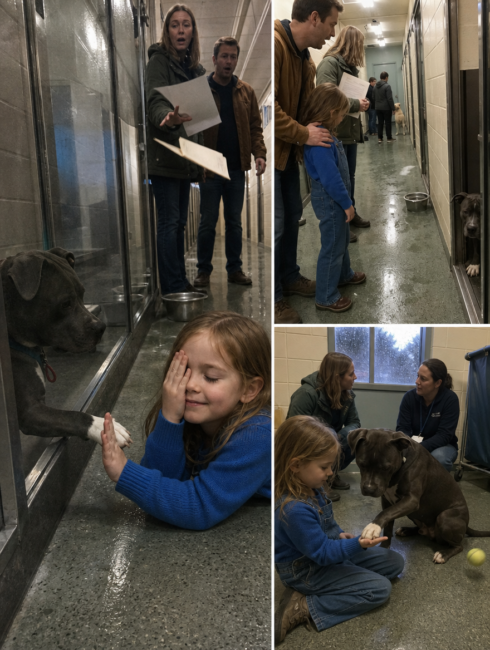
She was small for six, with straight dark-blond hair, gray-green eyes, and a habit of tilting her head slightly to the right whenever someone spoke from across a room. She wore a green sweater, denim overalls, and one purple sock beneath a yellow rain boot because the matching socks had disappeared in the dryer.
When she covered her left eye and Arlo reached out, Erin gripped Marcus’s sleeve.
“I’ve never seen her do that with a dog,” she said.
I had never seen Arlo do it with a child.
We brought Daisy into meeting room two first. She raced after a ball, leaned against Marcus, licked Erin’s chin, and rolled onto her back when Nora touched her ribs.
“She likes you,” Marcus said.
Nora smiled, but her attention kept returning to the narrow window in the door.
Arlo sat outside with a volunteer. His body faced forward. His remaining eye watched the room.
“Can I meet him too?” Nora asked.
Erin looked toward Marcus.
The parents had not rejected Arlo because they were cruel. They had looked at a large dog with a missing eye, read an incomplete warning, and made the same fast calculation many parents would make.
Is my child safe?
Fear often arrives before information.
We returned Daisy to her kennel and brought Arlo into the room on a six-foot leash. He crossed the threshold, ignored the people, and pressed his nose to the left side of the doorframe.
Then he waited.
Nora covered her left eye.
“Come on,” she said.
Arlo crossed.
He walked directly to her left side, turned twice, and sat with his shoulder touching her knee. His white toes curled against the floor, and the skin above his remaining eye loosened for the first time that afternoon.
Marcus held a chicken treat near Arlo’s nose.
The dog did not take it.
Nora tapped the floor twice.
Arlo gave her his paw.
“You know each other’s game,” Erin said.
Nora looked down. “Maybe he needed someone to play it.”
We spent forty-eight minutes in that room. Arlo never jumped, barked, or placed his mouth on clothing. When Nora stood, he stood. When she moved, he followed on the left.
I rolled a tennis ball across the floor.
Nora tracked it until the ball passed her left shoe. Her eyes stayed forward.
Arlo crossed in front of her, caught the ball, and returned it to the same shoe.
We repeated the throw from her right.
Nora followed it immediately.
“Did you see that?” I asked.
Marcus thought I meant the dog.
“Fast catch.”
I did not correct him because I had not yet decided what I had seen.
Nora’s head tilt could have been habit. Children miss rolling balls. One overlooked movement means nothing.
Arlo noticed more than one.
When Erin opened the meeting-room door, Nora stepped toward the hallway without checking left. Arlo moved in front of her as a volunteer passed with a laundry cart.
He did not lunge.
He became a wall.
After the cart passed, he tapped Nora’s shoe with his paw and let her continue.
Erin’s mouth tightened.
“Is that the watching behavior?”
“Possibly.”
“Could it become guarding?”
“Yes.”
“Could it become dangerous?”
“Any dog’s behavior can become dangerous if people misunderstand the trigger.”
Marcus sat beside Nora. “We came for a dog we understood.”
Nora rubbed the white crescent on Arlo’s chest.
“Maybe nobody explained him right.”
The sentence remained with me.
Erin and Marcus requested a forty-eight-hour foster visit rather than signing an adoption contract. It was the most responsible decision available. They could see how Arlo behaved in a home, and we could bring him back without blame if the placement failed.
Arlo refused to enter their car until Nora tapped the seat twice.
He climbed in, circled behind her, and settled on her left.
The family’s first evening went quietly. Arlo inspected every room, drank from the steel bowl Marcus had bought for Daisy, then carried a small braided rug from the hallway into Nora’s bedroom.
He pushed it beside the left side of her bed.
At 8:30, Erin read Charlotte’s Web while Nora built a block tower on the carpet. Arlo lay with his head on Nora’s left ankle. Whenever she reached toward that side without turning her face, his nose touched her wrist.
At 9:16, Marcus entered carrying folded laundry.
Nora did not notice him until he spoke.
He had approached from her left.
“She was concentrating,” Erin said.
Arlo raised his head and watched Marcus.
At 2:07 the next morning, Erin woke to two taps.
She found Arlo standing beside her bed, striking the floor with one paw.
Tap.
Tap.
He led her into the hallway.
Nora was walking toward the basement door with one hand against the wall. She had mistaken it for the bathroom door in the dark. The two doors stood three feet apart.
Arlo moved ahead, planted his body across the basement threshold, and refused to let her pass.
“Nora?”
The child blinked toward her mother. “I couldn’t find the handle.”
Erin turned on the light.
Nora squinted, tilted her head right, and reached with her left hand until her fingers touched the wall.
Arlo stayed in front of the steps.
The family believed he had saved her from a fall.
That part was true.
They did not yet understand how he knew she needed him there.
The next morning, Marcus installed a latch above the basement door and two motion-sensor lights in the hallway. Erin called me at 6:42.
“We’re keeping him,” she said.
“Are you sure?”
A pause followed.
“No. But he was sure about her.”
The forty-eight-hour foster period became an adoption appointment. Nora chose a new red leash but insisted that the old bracelet remain tied to Arlo’s collar.
“It belongs to somebody,” she said.
On the ride back to the shelter, Arlo watched the left side of her body.
Nora covered her eye.
He placed one paw in her lap.
Part 4, The Dog They Almost Left Behind
The adoption was scheduled for November 16 at 4:00 p.m.
Erin arrived early because her afternoon bus route had fewer students. Marcus came late with furnace dust on his sleeves. Nora carried a folded drawing of Arlo beneath a blue sky, although she had drawn two brown eyes because she said the missing one could still be “in the picture if it wanted.”
We reviewed the medical record first.
Arlo’s remaining eye was healthy. His left eye had been removed before any known shelter history, and the surgeon had left no identifying tattoo. He needed sunscreen on the pale scar during long summer walks and yearly pressure checks for the remaining eye.
Then we reviewed behavior.
I explained that the bicycle response should be managed until we knew more. He needed a secure harness, distance from crowded bike paths, and adult supervision around children.
Marcus nodded at every instruction.
Erin asked whether watching Nora’s left side concerned me.
“It concerns me that we don’t know why,” I said. “The behavior itself has been controlled. He doesn’t bite, bark, or chase. He positions.”
“Like last night.”
“Yes.”
Nora sat beneath the table with Arlo. She covered her left eye, smiled, and waited. He placed his paw in her palm.
Two taps followed.
The gesture had become a greeting.
When the last document was signed, I photographed them near the lobby window. Nora sat cross-legged, Arlo pressed against her left shoulder, and both parents stood behind them.
No one posed correctly.
Marcus was looking down. Erin’s coat zipper had caught a strand of hair. Nora’s drawing covered half Arlo’s chest, and the fluorescent light washed the scar above his missing eye almost white.
The picture showed the family as they were.
We posted it with permission at 5:22.
The caption read: They came to meet a Golden Retriever. Their daughter chose the dog who came out only when she covered one eye.
By midnight, it had been shared 12,000 times.
For the Hales, however, the important change happened inside the house.
Arlo refused the expensive memory-foam bed Marcus ordered. He slept on the braided hallway rug beside Nora’s bed. He carried one of her slippers there each night but always selected the left one.
He waited at the bottom of the school-bus steps on weekday afternoons. When Nora descended, he took her left side and walked beside her to the porch.
On Sunday, they visited a small park near Big Creek Parkway. Nora rode a blue scooter while Marcus held Arlo’s leash.
The Pit Bull remained calm until a teenage cyclist approached from behind on Nora’s left.
Arlo’s head snapped around.
His body dropped low.
Marcus tightened the leash, expecting a lunge at the bicycle.
Arlo ran toward Nora instead.
He placed his shoulder against the scooter and pushed her toward the grass seconds before the cyclist passed. The teenager had called, “On your left,” twice.
Nora had not moved.
Her front wheel caught the lawn, and she landed on one knee. Arlo stood over her until the bicycle stopped twenty feet ahead.
The cyclist apologized. Marcus apologized. Nora brushed dirt from her jeans and said she had not heard him.
Erin had been walking behind them.
“He shouted,” she said.
“I was looking at the trees.”
“He came from your left.”
Nora shrugged.
Arlo touched his nose to her left hand.
The family returned home believing the dog’s past had made him protective around bicycles. Marcus told me that Arlo had probably seen a child struck once and now tried to prevent it from happening again.
That explanation fit every fact they had.
It was also incomplete.
At school the following Monday, Nora missed three words written on the left edge of the board. She copied them after the other students began turning in their papers.
During lunch, she reached past a milk carton and knocked it onto the floor.
Her teacher recorded neither event. Six-year-olds spill milk. Six-year-olds miss words.
That evening, Erin noticed Nora sitting three feet from the television with her head turned right.
“Back up, please.”
Nora moved to the couch.
Arlo climbed beside her and positioned himself on the left.
At bedtime, Nora asked whether one-eyed dogs saw darkness where the eye had been.
“I don’t know,” Erin said.
“What if they see nothing?”
“Nothing isn’t the same as darkness.”
Nora considered that.
“My left eye sees fuzzy.”
Erin lowered the book.
“How fuzzy?”
Nora covered her right eye.
The room changed.
She leaned forward, squinted, and tried to read the title on the book held two feet away.
She could not.
Erin’s fingers tightened against the cover.
“Why didn’t you tell us?”
“I thought everybody had one good eye and one sleepy eye.”
Arlo sat up.
He moved from Nora’s left side to her right, the side she could no longer see while covering her stronger eye.
He placed his body against it.
The dog had changed sides because the child’s useful vision had changed.
Erin called the pediatrician at 8:43 the next morning.
Before the office returned her message, another call reached the shelter.
A woman named Celia Ruiz had recognized the bracelet on Arlo’s collar.
She had not called to reclaim him.
She wanted to bring the boy who had tied it there.
Part 5, The Boy With the Matching Scar
Celia and her thirteen-year-old son, Mateo, arrived at the shelter on November 22.
Mateo wore a red winter coat and black-framed glasses with one lens darker than the other. His hair had been cut close above his ears, and a pale scar ran from the corner of his left eyebrow toward his temple.
His left eye was prosthetic.
The red bracelet on Arlo’s collar had once spelled Mateo’s full name.
The family had made it at a children’s hospital four years earlier. Mateo wore the matching bracelet beneath his sleeve.
Erin, Marcus, and Nora waited inside meeting room two with Arlo. The adults had spent the previous night wondering whether the dog’s first family would ask for him back.
Nora asked only once.
“If he misses the boy, do we have to let him go?”
Erin did not promise something she might be unable to give.
“We listen first.”
Mateo stopped outside the meeting-room door. His hand rose to the glass, but he did not knock.
Arlo was facing away.
Mateo tapped twice.
The Pit Bull froze.
Mateo covered his left eye, although the dark lens already concealed it. He smiled.
“It’s still me, Captain.”
Arlo turned.
He crossed the room so fast that the leash slipped from Marcus’s hand. His hind legs lost traction on the vinyl floor, recovered, and kept moving.
He struck Mateo at knee height.
The boy folded around him.
Arlo pushed his muzzle beneath the red coat, pawed once at Mateo’s chest, then placed his white toes against the boy’s open palm.
Tap.
Tap.
Mateo pressed his forehead against the dog’s.
No one reached for a phone.
Celia explained after they had sat down. Mateo had been seven when doctors removed his left eye because of retinoblastoma. He returned to school with a prosthesis, poor depth perception, and a habit of walking into doorframes on his blind side.
Children stared.
Adults looked away too quickly.
Mateo stopped entering crowded rooms unless his mother walked on his left.
Six months later, Celia took him to a rescue event. Arlo was there, two years old and recovering from an eye removal caused by an infection that had gone untreated before animal control found him.
He had no fighting history.
He had no record of attacking another animal.
The missing eye that frightened visitors had once persuaded one frightened boy to sit beside him.
Mateo covered his left eye during their first meeting.
Arlo offered his paw.
Celia adopted him that afternoon.
The gesture became their private greeting. Mateo would cover one eye, smile, and say, “It’s still me.” Arlo would place a paw in his hand and tap twice.
The rest developed without formal training.
Arlo began walking on Mateo’s left. He stopped at doorways because the boy collided with people approaching from that side. He moved between Mateo and bicycles after a rider struck his backpack on a crowded path.
Mateo learned to tap twice when he needed Arlo to cross a doorway with him.
“He wasn’t a service dog,” Celia said. “We never claimed he was. He just watched what happened after he stood in certain places.”
Arlo did not understand retinas, prosthetic eyes, peripheral vision, or depth perception.
He understood outcomes.
When he walked on Mateo’s left, fewer people collided with him.
When he blocked a bicycle, the wheels did not strike the child.
When Mateo covered his eye and smiled, no one was angry.
The behavior became a pattern Arlo could repeat.
Celia’s family lost their apartment after the restaurant where she worked closed. A transitional-housing program accepted Celia and Mateo but prohibited dogs over forty pounds.
She had forty-eight hours to leave the duplex.
Celia called nine rescues. All were full. She left messages with two shelters, but her phone service ended before they returned the calls.
A neighbor promised to take Arlo.
The neighbor changed his mind after seeing the missing eye.
Celia returned to the duplex at 1:00 in the morning, placed food and water beneath Mateo’s old bed, and wrote a note for the property manager. She believed Arlo would be found within hours.
The note had not originally said, He watches children too closely.
It said:
He watches children’s left side closely.
The tear had removed two words.
The bicycle warning was incomplete too.
Keep him away from bikes until he knows which child to guard.
Celia had tried to warn strangers about his strongest habit.
The torn paper turned it into evidence against him.
“Why didn’t you come to the shelter?” Marcus asked.
Celia looked at her hands. “I thought I would have an apartment in two weeks. Then two became six. When I finally found your post, he was sitting beside her the way he sat beside Mateo.”
She had not come to reverse the adoption. The surrender was legally complete, and her new apartment still prohibited large dogs.
Mateo rubbed Arlo’s chest.
“He looks better,” he said. “He was losing weight with us.”
Nora sat on the floor across from him.
“You taught him the eye thing?”
“I started it. He decided it meant hello.”
Nora covered her left eye.
Arlo turned toward her and gave her his paw.
Mateo watched the child’s face.
“Why that eye?” he asked.
“So we match.”
“Can you see okay when you cover the other one?”
Nora looked at Erin.
“My sleepy eye is fuzzy.”
Mateo’s posture changed. He placed one hand on the floor and held up two fingers near Nora’s left side.
“Cover your right eye.”
She obeyed.
“How many?”
Nora turned her whole head before answering.
Mateo moved his hand farther left.
She kept looking straight.
Arlo stepped into the space between them, then shifted until his body marked the place Nora had failed to notice.
Mateo looked at Erin.
“That’s what he did with me before I learned to turn,” he said. “How long has she been missing that side?”
The pediatric ophthalmology office called nine minutes later.
They had an opening the next morning.
Part 6, What Arlo Had Been Watching
Dr. Priya Shah examined Nora at 8:20 on November 23.
Her right eye measured close to normal for her age. Her left eye was severely farsighted, and the brain had gradually begun relying on the clearer image from the right.
The diagnosis was anisometropic amblyopia.
Nothing about Nora’s left eye looked different from the outside. It did not hurt. She had never awakened one morning unable to see. The change had happened quietly while her developing brain learned to ignore the weaker picture.
Nora believed everyone saw that way.
Children often lack the language to describe a difference they have always known.
Treatment began with prescription glasses and a patch over the stronger right eye for several hours each day, forcing the brain to use information from the left. Dr. Shah did not promise perfect vision. She did say that finding the problem at six gave Nora a better chance of improvement than finding it years later.
Erin called me from the hospital parking garage.
“She couldn’t read the top line with her left eye,” she said.
A car door closed somewhere beside her. Then I heard her take one slow breath.
“We thought the dog frightened her.”
Arlo had not diagnosed Nora. He had not smelled a disease or understood what happened inside her brain.
He had recognized a sequence.
Nora turned her right eye toward important objects.
She missed things approaching from the left.
She reached for surfaces before crossing dark thresholds.
She lost sight of rolling balls after they passed one shoe.
She became still when adults approached from the side she could not track.
Mateo had once done the same things.
Arlo knew what followed those movements. A bicycle could strike. A cart could surprise. A doorway could hide a person. Stairs could begin where the child expected a flat floor.
He did not need to know why.
He knew where to stand.
Every early detail returned with a different meaning.
Arlo had slept with his missing-eye side against a wall to protect himself, but he exposed that side whenever he moved to a child’s left. Guarding the child mattered more than keeping his own blind side covered.
He had not watched children “too closely” because he was hunting, controlling, or waiting to attack.
He watched their feet, shoulders, and head movements because those details told him whether they had noticed what approached.
He had not reacted to bicycles because wheels triggered aggression.
A bicycle had once struck Mateo’s backpack from the left, so Arlo learned that fast wheels near a child’s unseen side required intervention.
The two taps were not an obedience trick. Mateo used them at doorways when he wanted Arlo to cross first and make space.
Even the bed carried meaning.
On the night Celia left the duplex, Mateo had knelt beside Arlo beneath the plastic frame. He covered his eye, smiled through a face that had gone stiff from trying not to shake, and tapped the floor twice.
“Stay here, Captain. They’ll come.”
Arlo stayed.
The property manager arrived seven hours later.
At the shelter, another raised bed stood against another wall. Arlo crawled beneath it when the adoption wing became loud and waited for a pattern he knew.
A child covered her left eye.
She smiled.
She tapped.
For Arlo, the instruction had finally continued.
Nora disliked the eye patch at first. It was beige, stiff at the edges, and pulled lightly at her skin when Erin removed it. With her stronger eye covered, the room became soft and uncertain.
She stumbled twice on the way from the clinic to the car.
Arlo changed sides.
He had always walked on her left, where her weak vision required protection. Now the patch covered her right eye, so he moved to her right.
Marcus tested the change in the driveway. He switched the leash to the left.
Arlo circled behind Nora and returned to the right.
“He’s guarding the side she can’t use today,” Marcus said.
The dog had learned the function, not a fixed position.
Mateo visited the Hales the following Sunday. He brought Arlo’s old canvas bed, a dented metal bowl, and a photograph taken after his own surgery.
In the picture, seven-year-old Mateo sat on a hospital floor with a bandage over his left eye. Arlo, still young and thin, rested his missing-eye side against the boy’s shoulder.
On the back, Mateo had written in uneven block letters:
WE HAVE ENOUGH EYES TOGETHER.
Nora read the sentence twice.
“Did your eye get better?” she asked.
“No. Mine had to go.”
“Were you scared?”
“Yes.”
“Did he fix it?”
Mateo shook his head. “He made walking into the next room easier.”
That answer mattered more than a promise would have.
Nora began wearing the patch for two hours each morning and two hours after school. During those hours, Arlo stayed close but did not prevent her from trying. He waited beside steps, intercepted objects approaching from the hidden side, and moved away when Erin said Nora needed to reach for something herself.
The family worked with a trainer to put words around the behaviors Arlo had invented. “Left watch” placed him on Nora’s left. “Right watch” moved him to the opposite side. Two taps invited him through a doorway. “All clear” released him.
They did not register him as a service dog. They did not bring him where pets were prohibited. They simply gave his old observations clear boundaries so his help would remain safe.
The first measurable improvement arrived six weeks later.
Nora covered her right eye and read three letters from the second line of Dr. Shah’s chart.
She missed the fourth.
She read the fifth.
Erin sat with both hands beneath her thighs because they would not stay still in her lap.
Arlo waited at home. When Nora returned, she ran through the door wearing her glasses and patch.
“I saw an E,” she told him.
Arlo did not know the letter E.
He recognized her voice.
He brought the left slipper from her bedroom, placed it at her feet, and tapped it twice.
The adoption photograph continued traveling online. Comments called Arlo a hero, a miracle, and a dog who had diagnosed a child’s condition.
The Hales corrected that story whenever they could.
Arlo had not diagnosed anything.
He had paid attention.
That smaller truth carried more weight.
Thirty-one shelter visitors had seen a scar, an empty socket, and a warning card.
Nora had seen a dog who might understand what it meant to face the world with one useful eye.
Arlo had seen something else—a child already adjusting to a blind side before the adults around her knew she had one.
The family feared Nora would be frightened by what he lacked.
Arlo was the first one to notice what she could not see.
Part 7, The Side They Walk Together
Every Sunday at 4:10, the Hales moved the coffee table against the wall and placed six colored cards across the living-room floor.
The exercise came from Nora’s vision therapist. Erin held up a card on one side, Marcus held another on the opposite side, and Nora practiced finding each color without turning her entire body.
Arlo participated without being invited.
When Nora wore the patch over her right eye, he sat on her right. When the patch came off, he moved to her left. If she located a card, his tail struck the rug once. If she missed, he waited.
Mateo visited on the first Sunday of each month. He never asked Arlo to choose between them. He tapped the floor twice, accepted the paw placed in his hand, then helped Nora arrange the cards.
By spring, Nora’s left eye had improved enough to read larger print. She still turned her head when tired. Arlo still moved before a bicycle passed, but he now looked toward Erin for the “all clear” cue.
On April 6, the family returned to the shelter for Arlo’s six-month check.
Kennel twenty-seven held an older German Shepherd with one folded ear. The plastic bed remained against the wall, but the dog beneath it belonged to someone else’s unfinished story.
A boy of about eight stood near the kennel with hearing aids behind both ears. His father spoke to me quietly, worried that shelter noise might overwhelm him.
Nora heard.
Children hear most things adults say quietly.
She crouched several feet from the kennel, removed her glasses, cleaned one lens on her sweater, and put them back on. She did not cover her eye.
Arlo lay beside her.
The German Shepherd watched from beneath the bed.
Nora tapped the floor twice.
Arlo extended one white paw—not toward her, but toward the dark space where the other dog waited.
A second paw appeared beneath the bed.
Nora smiled.
No one rushed the moment.
The family had once walked past a one-eyed dog because they feared what their daughter might see.
They returned because of what he had seen first.
He had seen her first.
Follow this page for more unforgettable dog stories about overlooked animals, quiet courage, and the small gestures that help families see what matters.