Part 2: A Pit Bull With Almost No Fur Was Found Beneath a Bridge — Then a Woman Arrived to Adopt Her Carrying a Photograph Nobody Was Ready to Recognize
Part 2, The Space Beneath the Bridge
It took fifty-three minutes to bring the dog out from behind the concrete pier. Most of that time looked like nothing happening: a woman sitting on damp gravel, a transport crate waiting nearby, and a dog watching without moving.
The maintenance worker had kept his distance after calling us. He described her position, left water in a shallow bowl, and stayed where he could guide our van to the service access road. By the time I arrived, he had already helped by not trying to drag her out.
My colleague Evan approached the area from the side, checking that we had a safe route back to the vehicle. We were below the roadway, separated from traffic, but the dog could still retreat into brush if we crowded her.
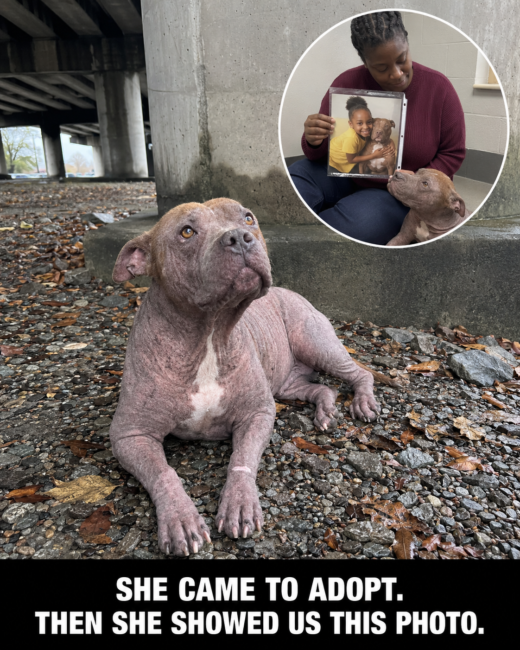
Her skin made ordinary equipment complicated. A strap rubbed across her bare shoulder could hurt. Wrapping her tightly before she trusted us could make her struggle against exactly the surfaces we wanted to protect.
We had to give her a route she could choose.
I placed several pieces of food on a flat lid, then withdrew my hand. She smelled them, looked at the space between my body and the pier, and took one.
Her eyes were amber.
A narrow strip of cinnamon fur remained over the crown of her head, with another sparse patch near the base of her tail. Across the chest, a few pale hairs suggested a marking that had once been easier to see.
Everything else looked unfamiliar because so much of her coat was missing.
When a truck passed overhead, she pressed closer to the concrete. I watched the dry skin along her shoulder tighten, then saw her carefully shift away from the rough surface.
She was not refusing help. She was avoiding contact that appeared uncomfortable.
We moved the crate closer while she watched and lined the entry with smooth, clean fleece. A shallow nonslip board bridged the small lip at its opening. Food went just inside, not so far back that she had to commit before she understood the space.
The first time she approached, she put only her nose through.
The second time, both front feet.
Then she backed out and stood beside the pier for several minutes. Evan and I stayed still. An exit she could use mattered.
On her third approach, she walked inside far enough to turn. She smelled the bedding, lowered her chest, and eased her hips down afterward.
We closed the door quietly.
During the drive, she remained upright for the first few minutes, watching the changing light through the crate. Then the sound of her nails stopped. At the next safe place to check, I found her lying on the fleece without pressing against the walls.
The veterinary team received her in a quiet examination room. Dr. Ana Reyes, who had worked with our rescue for years, began by observing her before handling the irritated areas.
She described what she saw aloud: extensive hair loss, dry thickened skin, and inflammation that required testing. She did not announce a diagnosis from the doorway.
Looking frightening was not a diagnosis.
A technician scanned for a microchip during intake. The reader found one promptly, and we confirmed the number with another pass. It was entered into her record before anyone discussed a possible new home.
The registry led to her original placing organization. Its staff responded, but the adoption information they could retrieve carried an old telephone number and an address that no longer provided a working route to the family.
We began following those leads immediately.
A chip had given us a place to start, not a live voice on the other end of a telephone.
Meanwhile, Dr. Reyes collected samples and treated the dog’s immediate discomfort. We used separate bedding and handling precautions while the clinic established what was causing the skin changes.
That evening, she ate from a bowl held steady on the floor. When I moved to take it away afterward, she looked at my hand and waited.
I paused, letting her smell my fingers.
She touched them briefly with her nose. It was the first contact she initiated herself.
I did not reach over her head in return. I removed the empty bowl and sat nearby, allowing that small choice to remain exactly what it was.
For that night, she had food, treatment, and a surface that did not scrape her skin. Her name could wait until we found someone who knew it.
Part 3, A Patient Before a Photograph
We used Cinder as an intake name while her identity remained unresolved. It was a practical word for medication records, appointment lists, and the quiet conversations that happened around her bed.
The examination and skin testing supported a diagnosis of generalized demodicosis, with secondary bacterial skin infection contributing to the inflammation. Dr. Reyes also assessed whether other health problems might be affecting her recovery.
She explained the plan in ordinary terms. Cinder needed prescribed treatment, careful skin care, repeat examinations, and time. A coat could not return on the schedule of an adoption photograph.
Comfort had to come first.
During the first week, I took her home as an approved medical foster. Our organization continued tracing the chip registration and circulating found-dog information while I followed the clinic’s care plan.
Her room was simple: washable bedding, a quiet corner, water, and a clear path to the yard. There were no rough blankets or tight sweaters covering the areas that bothered her.
When she lay down, she usually lowered her chest first and waited before settling the rest of her body. If a seam caught against her flank, she stood and began again.
I learned to check the bed with my palm.
Soft to my hand was not always soft enough for her skin.
At first, she slept in brief stretches. She would raise a foot toward her neck, hesitate, scratch, and wake fully. We reported changes to the clinic instead of assuming every restless night was simply fear.
Her medical notes and behavior notes stayed together. Eating, sleeping, skin appearance, and tolerance of handling all helped Dr. Reyes judge whether the plan was working.
I photographed the same areas in similar light for her clinical record. We did not turn the images into a daily contest between a damaged dog and a prettier one.
She was the same patient in every frame.
By the second week, she could rest for several hours at a time. She began meeting me at the room’s entrance, then walking back toward her bowl without crouching when I followed.
One afternoon, she brought me a soft toy.
She carried it halfway, dropped it, and looked away as though uncertain what usually happened next. I placed it near her bed and left it there.
The next morning, it was beside my shoe.
Those small moments made it easier to feel hopeful. They did not mean the medical work was finished.
On the twelfth day, she began rubbing her shoulder against the edge of her bed again. The skin looked more inflamed, and she slept poorly that night.
At the recheck, Dr. Reyes collected another sample and adjusted the treatment after reviewing the results. The flare required closer follow-up, not a conclusion that recovery had failed.
For several days, the photographs looked worse before her comfort improved.
We shortened handling sessions and made her room quieter. I stopped asking her to practice unfamiliar behaviors while her body was already demanding so much attention.
She still approached when I sat on the floor. Sometimes she only stood nearby.
I accepted that as company.
The owner search moved less visibly. Calls to the old number went nowhere. The original rescue checked additional records. Our coordinator documented each attempt and reviewed local missing-dog reports, including older reports whose photographs showed dogs with intact coats.
The dog in those pictures might look nothing like our patient.
That possibility shaped the way we wrote her found notice. We described sex, approximate age, surviving coat color, and distinctive physical details without publishing the chip number or private registration information.
We recorded a small healed notch at the tip of her right ear. We also noted a pale crescent-shaped scar just above the left front paw.
Neither mark was a new injury.
Neither told us a story by itself. They were simply details that might matter to somebody else.
By the third week, the flare had settled and Cinder slept more comfortably again. There was still very little hair across her body. Anyone expecting a quick before-and-after transformation would have seen only a dog who looked mostly unchanged.
I saw a dog who could lie down once and remain asleep.
That was enough for the next day.
On the twenty-fourth morning, the coordinator told me a woman had booked a visit through our adoption inquiry system. She had seen our update and wanted to meet Cinder, although she was not asking us to promise a placement.
“She said she’s bringing a photograph,” the coordinator told me.
I carried Cinder’s clean bedding into the visiting room.
We prepared for an ordinary conversation.
Part 4, The Number We Did Not Read Aloud
Natalie Brooks arrived alone, carrying a canvas bag against her side. She was thirty-eight, with dark braids pulled back and a burgundy sweater damp at the cuffs from the rain.
Before sitting down, she asked where Cinder was.
I pointed toward the adjoining quiet room. A gate separated it from the office so the dog could watch without being surrounded. She was lying on the bedding I had brought from home.
Natalie looked for several seconds. Then she took the photograph from her bag.
The child in it wore a yellow shirt and sat barefoot on a kitchen floor. Her arms rested around a cinnamon-colored Pit Bull with a small, slightly off-center white triangle on her chest.
The photograph had been taken nearly two years earlier. The girl’s name was June. She was nine now.
The dog’s name was Pearl.
Natalie said the name softly to me, not as a test directed through the gate.
She was trying not to make a promise.
Their separation had happened eleven months earlier during a flood evacuation. Natalie had reached a temporary transfer point with her daughter, their bags, and Pearl on a harness.
Someone moved a metal barrier as vehicles were being rearranged. Pearl startled, backed out of the harness, and ran between two parked vans.
Natalie handed June to a relative and searched until responders moved everyone out of the area. She returned when access reopened, carrying Pearl’s leash.
For weeks, she checked reports and visited shelters. Friends searched nearby streets. They distributed photographs, then updated them as temporary addresses changed.
She did not claim to know what happened after Pearl ran.
There were eleven months nobody could account for.
The family had changed telephone numbers after losing a phone during the evacuation. Their old home was no longer occupied. Natalie believed updating her veterinary office had updated every record associated with the dog.
It had not updated the old chip-registration contact trail.
Our coordinator compared Natalie’s information privately with what the original rescue had supplied. Several details aligned, but we did not treat that alignment as permission to skip verification.
I asked Natalie to describe any identifying marks that were not obvious in the public photographs.
She mentioned the right ear. Then she pointed above her own wrist.
“A little curved scar on the front left leg,” she said. “Like a moon, but thin.”
The same location. The same shape.
A useful clue, not the final answer.
Natalie authorized her former veterinary practice to send us the relevant records directly. While we waited, she remained seated rather than approaching the gate.
Cinder stood and smelled the air. Natalie pressed her palms together.
I could see how much effort it took not to call the dog again.
The records arrived that afternoon. They included Pearl’s microchip number from a visit that predated the evacuation, along with age, sex, earlier photographs, and a note describing the healed foreleg scar.
We had not given Natalie the number our scanner recorded.
Two staff members compared the record with our intake entry independently. Then we brought the reader into the quiet room and scanned the dog again.
Every digit matched.
We also confirmed the veterinary record’s source and reconciled the adoption information with the original rescue. There was no contradictory history or competing claim in the records we reviewed.
The photograph had pointed us toward a question.
The documentation allowed us to answer it.
I set the scanner down before speaking.
“Natalie,” I said, “the records match. This is Pearl.”
Her mouth opened, but the first breath produced no words. She looked at the gate, then at the photograph, then back at me.
Her hands stopped moving.
We did not open the gate immediately. I explained Pearl’s current treatment, the sensitive areas along her skin, and the need for a quiet meeting with space to retreat.
Natalie nodded through all of it.
“What do I do?” she asked.
“Sit where she can choose to come to you.”
She lowered herself onto the visiting-room floor, turning slightly sideways. I opened the gate and stayed nearby without urging Pearl forward.
The dog stood in the opening. Her nose moved.
Natalie said, “Hi, Pearlie.”
Pearl took three steps, paused, and stretched her neck toward Natalie’s sleeve.
Then she moved closer until her shoulder rested lightly against Natalie’s shin.
Natalie did not wrap her arms around the irritated skin. She held one hand low.
Pearl placed her chin in it.
It was not the evidence that confirmed who she was. That work had already been done.
It was the first moment they were allowed to stop wondering.
Part 5, Before June Came Through the Door
Natalie stayed on the floor for nearly half an hour. Pearl moved between her and the familiar bed, approaching, resting briefly, then returning to the place she already understood.
Nobody treated those retreats as rejection.
The woman had been missing from Pearl’s life for eleven months. The room, the people, and the dog’s own skin all required attention. A reunion could contain uncertainty and still be a reunion.
At one point, Natalie reached toward the bare area behind Pearl’s shoulder. Pearl turned her head quickly and shifted away.
Natalie withdrew her hand.
“She never used to mind that,” she said.
“Right now, that area is sensitive.”
Natalie nodded and placed her hand on the floor instead. Pearl came back a few minutes later and smelled her fingers.
It was the first thing Natalie learned about the dog she had found: love would have to follow the body Pearl had now.
We scheduled another conversation with Dr. Reyes before planning the return home. Natalie needed to understand the treatment schedule, follow-up visits, handling precautions, and signs that should prompt a call.
She asked whether Pearl would regain all her fur.
Dr. Reyes explained that improvement was expected with successful treatment, but the speed and completeness of regrowth could not be promised. Comfort, skin health, and the results of repeat examinations would guide the plan.
Natalie looked toward Pearl.
“I wasn’t waiting for her hair,” she said.
I wrote down the questions she asked afterward, because they mattered more than the sentence: how to arrange bedding, whether their laundry products were suitable, how June should touch her, and what transport would be least stressful.
Wanting her home was only the beginning of preparing.
We also talked about the daughter who had not yet been told.
Natalie did not want June surprised by Pearl’s appearance in front of a room full of adults. Together, they looked at current photographs that evening, in the privacy of their own home.
I was not there for that conversation. Natalie told me about it the following morning.
June had asked whether the dog hurt, whether touching her would make the skin worse, and whether she would still know where her bed belonged.
Then she asked if they could bring the old blue mat.
Natalie found it in a storage box.
The reunion with June took place four days after the first visit, once the identification checks and a practical home-care plan were complete. Dr. Reyes had cleared the planned contact and explained the precautions to Natalie directly.
We chose a quiet room with a nonslip floor and no other animals.
June arrived holding the folded blue mat against her yellow raincoat. Natalie had explained that there would be no running, grabbing, or tight hugs.
The little girl repeated the instructions before entering.
“She can come over if she wants.”
That was the whole invitation.
June placed the mat on the floor and sat beside it, with Natalie close enough to help. I opened Pearl’s gate.
Pearl walked into the room slowly.
She smelled the mat first. Then the hem of June’s raincoat.
June kept her hands on her knees, although her fingers curled into the fabric.
“Hi, Pearl,” she said. “I’m bigger.”
The dog lifted her muzzle toward the girl’s face. June leaned back slightly, giving her space rather than moving in for a hug.
Pearl stood beside her for a moment.
Then she lowered herself onto the blue mat, placing one front paw against June’s shoe.
June looked at her mother.
“Can I do here?”
She pointed to the area Natalie and the veterinarian had shown her was comfortable to touch.
Natalie nodded.
June rested her fingers gently beside Pearl’s cheek.
The dog stayed.
There was no leap into the child’s arms, no instant return to the photograph in the plastic sleeve. Pearl still had irritated skin and almost no coat. June was taller, and the family would be taking her to a different house.
But they remained on the floor together while the rain tapped against the window.
After several minutes, June whispered, “We kept your mat.”
Pearl’s eyes narrowed as her head settled.
Natalie turned her face toward the wall, took a breath, and looked back.
We gave them time.
Nobody asked them to recreate the old photograph.
Part 6, Going Home Was Not the Last Treatment
Pearl went home with Natalie two days after meeting June, following her veterinary review and the completion of the rescue’s reunification paperwork. We updated contact information through the appropriate registry process and made sure the family had copies of the records.
Natalie also entered a second reliable contact.
The chip had worked when we scanned it. The information around it needed to work, too.
The return itself was deliberately quiet. Natalie used a secure, padded transport setup approved for Pearl, and June rode beside her mother rather than crowding the dog’s space.
The old blue mat traveled with the clean bedding.
At the new house, Pearl found a low bed in a room away from the busiest hallway. Natalie had already checked the fabric and arranged bowls where she would not have to squeeze past furniture.
Pearl did not recognize that house.
We had discussed that before she left.
Returning to her people did not make every room familiar.
For the first few nights, Natalie sent short updates. Pearl ate well but woke when someone crossed the hall. She followed Natalie toward the kitchen, then returned to the blue mat instead of settling beside the table.
June wanted to bring her every toy at once. Natalie helped her choose one.
They kept the routine predictable and followed the medical plan without turning each treatment into a family gathering. When Pearl moved away, the adults allowed a pause and contacted the clinic if handling became harder.
A week after going home, Natalie called because Pearl had rubbed one shoulder more than usual after a scheduled bath. The skin looked irritated, and Natalie worried they had done something wrong.
Dr. Reyes arranged a recheck, reviewed the care process, and adjusted the skin-care plan to Pearl’s response. There was no need to improvise a new product or scrub harder.
A setback was information, not a verdict on the family.
At that appointment, Pearl entered with the same bare shoulders and scattered cinnamon patches I remembered from the bridge. The dryness had improved, but the change was gradual enough to escape anyone looking only for a dramatic transformation.
June carried a notebook.
Inside, she had drawn two pictures: Pearl’s water bowl and the blue mat. Natalie explained that June checked those things each morning because they were safe ways for her to help.
The child had also drawn fur on a third picture, then erased part of it.
“I don’t know how much to put yet,” she told me.
“You can draw how she looks today.”
June considered that. Then she added the small notch to the right ear.
She was learning the dog in front of her.
Over the next month, short hair began appearing unevenly along Pearl’s back and sides. Her chest marking became easier to see. Some areas remained thin, and the family kept attending the follow-up appointments even when neighbors said she looked fine.
Natalie asked about the months beneath the bridge.
Had someone fed her? Had she stayed in one place? Had another person taken her in and then lost her again?
I could answer none of those questions.
The maintenance worker had only observed her shortly before calling us. The chip records documented her earlier life, not her route through the missing months.
We did not fill the silence with a villain.
Natalie eventually stopped asking me to solve those months. She began telling me what Pearl did that week instead.
Pearl had found the warm patch of floor beside the afternoon window.
Pearl had learned where June left her shoes.
Pearl had brought the soft toy from one room to another and fallen asleep halfway across the blue mat.
Those were things we could know.
One afternoon, Natalie sent a picture of June reading aloud at the kitchen table. Pearl lay beneath the chair, her shoulder still sparsely covered, one front paw resting against the girl’s sock.
No one was looking at the camera.
There was no printed photograph held beside them for comparison.
Natalie’s message contained one sentence: “She picked this spot herself.”
I saved it in Pearl’s file.
Below the intake photographs of bare skin and concrete, we now had an ordinary place she had chosen to rest.
Part 7, The Photograph They Did Not Replace
I visited Natalie and June twelve weeks after the rescue. By then, winter had settled over Memphis, and Pearl had grown a soft, uneven coat across much of her body.
She was not identical to the dog in the old picture.
A few areas remained thin. The small pale scar above her left front paw was still visible, and the notch at her right ear caught the light whenever she turned her head.
She smelled my shoes at the doorway.
Then she looked behind me, as though checking whether I had brought a crate.
I stood still and let her finish.
Natalie did not call her away or insist that she greet me. After a moment, Pearl turned toward the living room, walked to the blue mat, and lay down.
She could end the introduction herself.
The house was different from the one in the photograph. The family had not returned to the home they evacuated. Some furniture had been replaced, and June’s bedroom faced a different street.
Pearl had a familiar place beside the people who lived there now.
Natalie showed me the folder she had brought to the rescue. It held the old photograph, veterinary records, copies of the verified chip information, and the current treatment plan.
She had added our discharge notes behind the earlier records.
There was finally a bridge between the two histories.
The old photograph had not been thrown away. It stood in a simple frame on the shelf, June at seven with her arms around a dog whose skin nobody could see through the coat.
Beside it was a newer picture.
June sat on the floor with one hand resting near Pearl’s cheek. The dog was still nearly hairless in that image, taken shortly after she returned home.
Natalie had printed it before the fur began coming back.
“That was her homecoming,” she said.
She did not want to wait for a different-looking dog before keeping a record of it.
Pearl had been worth bringing home as she was.
While Natalie made coffee, June showed me the mat by the kitchen. She explained that Pearl sometimes preferred that one to the bed in the quieter room.
Then the girl sat down with a book.
Pearl raised her head from the living-room mat, watched for several seconds, and stood. She crossed the room without hurrying and lowered herself beside June’s feet.
The child continued reading. Her free hand rested open against her own knee.
Pearl did not immediately ask for touch. She smelled the edge of the book, sighed, and settled her head on the floor.
A truck passed outside. One ear moved.
She did not get up.
I thought of the bridge: the concrete pier, the dry skin against a rough surface, the way she turned her face toward the wall when we first approached.
Under that bridge, we had seen a dog who needed somewhere softer to lie down.
We had not known there were people still keeping space for her.
The photograph helped us notice. The scar helped us ask better questions. The records allowed us to reunite the right dog with the right family without gambling on resemblance.
After that came appointments, clean bedding, careful hands, and the daily work no picture could complete for them.
June reached the end of a page and looked down.
“Still here?” she whispered.
Pearl’s tail moved once against the mat.
June turned the page.
When I left, Natalie opened the front door just far enough for me to pass, keeping Pearl safely inside. The dog watched from beside the child’s chair.
Then she lowered her head again.
This time, leaving belonged to someone else.
Follow our page for more dog rescue stories about patient care, carefully found second chances, and the familiar lives waiting beyond an unfamiliar face.