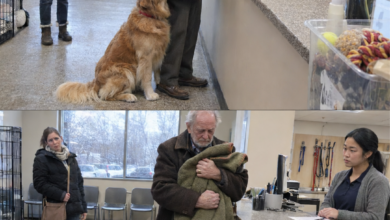
Part 2: A Red-Haired Woman Yanked a Blanket from an Old Golden Retriever in a Laundromat—Moments Later, One Name Brought Her Down Beside Him
Part 2:
“Your mother,” Elena said. “Ruth Lane brought it.”
Tessa’s fingers loosened around the comforter she had been carrying. It slid against her hip and settled on the floor.
“No,” she said.
Elena did not argue. She lowered the blanket completely and smoothed it across the tile. The dog kept one paw on its corner, watching the two women.
“Her name was Ruth,” Elena continued. “Short gray hair, green raincoat, always wore one red mitten and one black one because she kept losing their partners.”
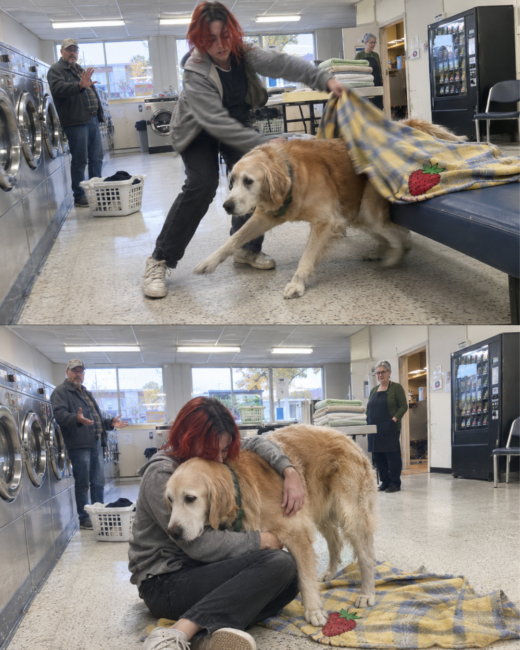
Tessa stared at her.
Those were details a stranger should not have known.
“My mother didn’t have a dog.”
“He wasn’t hers.”
Elena turned toward the Golden Retriever. “Milo.”
The dog’s ears lifted. He looked at Elena, then toward the front door as if the name were part of a familiar sequence.
Elena pointed to the worn blanket. “Place.”
Milo stepped onto it, turned once with visible care in his right rear leg, and lowered himself. His paw returned to the same corner.
The movement answered the first question. The blanket had not fallen from a customer’s basket, and Milo had not stolen it. He had been waiting beside something placed there for him, following a routine that existed long before Tessa entered the laundromat.
It did not answer why her mother had created that routine.
Tessa crouched but remained beyond Milo’s reach. She looked at the corner beneath his paw.
“What’s under there?”
Elena sat on the edge of the bench and held out her hand. Milo lifted his paw after she touched the blanket beside it. She turned back the worn corner.
A small red strawberry appeared against the yellow fabric.
Its green felt leaves were uneven, the black seeds too large, and one side leaned lower than the other. A child had sewn it there with little understanding of straight lines.
Tessa had been that child.
She was nine when she dropped a cup of grape juice on the blanket and tried to hide the stain by cutting a strawberry from her mother’s sewing box. Ruth discovered her hunched over the fabric with a needle and black thread.
Instead of becoming angry, she sat beside Tessa and helped her finish the patch. Ruth had guided the needle through the thicker layers but refused to straighten her daughter’s crooked stitches.
“You’ll know which part is yours,” she had said.
Tessa reached toward the strawberry and stopped before touching it.
“We threw this away.”
“No,” Elena said. “Your mother kept it in her car.”
Tessa looked at Milo. His chin rested several inches from the patch, and his eyes remained open.
“Why would she bring my blanket here for him?”
Elena asked Howard to move Tessa’s comforter away from the walkway. Then she locked the front door for five minutes, turning the sign so new customers would know she would reopen shortly.
The washers continued to turn. Otherwise, the laundromat grew quiet.
“Do you remember Arthur Bell?” Elena asked.
Tessa searched the name. “The man from the apartment above the pharmacy?”
“He lived there for thirty-four years. Your mother started carrying his laundry when his knees became too bad for the stairs.”
Tessa remembered an elderly man who left peppermints in a dish beside his door. She had met him twice as a teenager. She did not remember a dog.
“Milo came later,” Elena explained. “Arthur adopted him after his wife died. When Arthur stopped driving, your mother picked up his laundry every Tuesday morning. Milo rode along because he couldn’t stay alone without barking.”
The first time Ruth brought him into Maple Street Laundry, the floor had been cold and crowded with rolling carts. Milo kept trying to lie on Ruth’s coat. The following week, she brought the old family blanket from her trunk and asked Elena to spread it across the low bench.
After that, Tuesday developed a pattern. Ruth arrived at 8:10 with Arthur’s laundry, Milo walked to the bench, and Elena put down the blanket. Ruth washed two loads, shared coffee with the older customers, then returned Milo and the folded clothes to Arthur.
“She never told me,” Tessa said.
“Did you ask what she did on Tuesdays?”
The question was not cruel. Elena said it with the plain tone of someone confirming a detail.
Tessa looked away.
During the last year of Ruth’s life, most conversations between mother and daughter had become arguments about small things carrying larger weight. Ruth believed Tessa was taking too many night shifts and missing too much of her own life. Tessa believed her mother treated every independent decision as a mistake needing correction.
Neither knew how to end an argument without beginning another one.
Six weeks before Ruth died from a sudden stroke, she called Tessa from Maple Street Laundry. Tessa had been sleeping after work. When she answered, Ruth asked if she could drive her home because the bus route had been delayed and Milo was restless.
Tessa heard only another request.
They had argued the previous evening about Tessa’s work schedule. Ruth tried to explain that Arthur had already gone home in a medical transport and she needed help carrying two bags, but Tessa interrupted her.
“You always find a reason I have to drop everything.”
“Tess, I’m not asking you to drop everything. I’m asking for one ride.”
“I worked all night.”
“I know. I’m sorry. I just thought—”
Tessa ended the call and switched off her phone.
By the time she turned it on that afternoon, Ruth had left a short voicemail saying Elena’s nephew had driven her home. There was no accusation in it.
Tessa never returned the call.
They spoke again after that, but only briefly and about practical things. The unfinished argument stayed between them until Ruth collapsed at home six weeks later.
Now Tessa looked at the strawberry patch and remembered the final voicemail. In the background, a dog had barked once and a dryer door had slammed.
She had never wondered where her mother was calling from.
“What happened to Arthur?” Tessa asked.
“He entered assisted living in August. The building doesn’t allow a dog Milo’s size.”
“Then who owns him?”
“A small local rescue has legal custody. I’m fostering him.”
Elena explained that Ruth had promised Arthur she would help find Milo a suitable home. After Ruth died, Elena took over the calls because she knew Milo and could keep him temporarily. He slept in Elena’s kitchen at night and came to the laundromat during quiet morning hours.
Several families had applied. One wanted a younger dog after meeting him. Another lived up three flights of stairs. A third family seemed kind but worked long days and had no plan for his arthritis medication or midday bathroom breaks.
Elena had not rejected every possibility because she wanted Milo for herself. Her landlord permitted temporary fostering but not another permanent pet. She was still looking.
“On Tuesdays, I bring him here early,” Elena said. “He walks to that bench and waits.”
“For my mother?”
Elena glanced at Milo before answering. “He watches the door at the time she used to arrive. I can tell you what he does. I can’t tell you exactly what he expects.”
That distinction made the scene harder for Tessa, not easier.
Milo was not a symbol placed there for her. He was an old dog whose routine had been broken by events he could not understand. He knew a blanket, a bench, a Tuesday morning and the sound of certain footsteps.
Tessa had taken one of those familiar things from beneath him because she was tired and angry.
She sat down on the tile.
Howard moved as if he might help, but Elena shook her head. Tessa did not need an audience crowding around her.
“I’m sorry,” Tessa said to Milo.
The dog remained on the blanket. His ears shifted toward her voice, but he did not approach.
Tessa looked at Elena. “Can I touch him?”
“Let him decide.”
Tessa opened her hands and rested them on her knees. She did not call Milo or pat the floor. She waited.
For nearly a minute, nothing happened. A washer entered its spin cycle, making the detergent bottles on a nearby shelf vibrate. Milo lifted his head at the sound, then settled again.
Tessa drew the blanket’s loose edge closer to him, moving slowly enough that he could watch her hand. She placed the strawberry patch facing upward and withdrew.
Milo sniffed the patch. Then he sniffed the air between them.
He stood with effort, stepped off the blanket and paused. Tessa kept her hands still.
Milo crossed the short distance. He touched his nose to her wrist, moved along her forearm and stopped beneath the sleeve of her gray hoodie. Ruth had used the same unscented soap Tessa still bought out of habit, though no one in the laundromat could know whether that detail mattered to the dog.
Milo placed one paw across Tessa’s thigh.
She looked at Elena before moving.
Elena nodded once.
Tessa slipped one arm beneath Milo’s chest without pulling. He took another step, lowering his weight against her. Only then did she bring her other arm around his shoulders.
Her face disappeared into the pale fur above his collar.
She cried without making the dog hold all of her weight. Elena moved the folded comforter behind Tessa’s back so she could lean against the machine. Milo stayed for several seconds, then shifted away and returned to the blanket.
Tessa let him go.
The hug did not repair what she had done, and it did not turn grief into ownership. When Tessa immediately asked if she could take Milo home, Elena’s answer was no.
“Not today.”
Tessa wiped her face with her sleeve. “You said he needs a home.”
“He needs the right home. You met him twenty minutes ago.”
“He knew my mother.”
“That doesn’t tell me whether you can care for him.”
Tessa almost argued. She felt the familiar defensive answer rise, the same reaction that had shaped so many conversations with Ruth.
This time, she stopped.
“What would I need to do?”
Elena unlocked the front door and resumed the morning’s work. She gave Tessa the rescue coordinator’s number but did not promise approval. Milo needed a veterinary check, medication twice daily with food, short walks, nonslip surfaces and a home without difficult stairs.
Tessa lived in a third-floor apartment whose lease prohibited large dogs. She worked four overnight shifts each week. Grief did not remove either fact.
She washed her comforter and stayed until the cycle finished. Before leaving, she apologized to Howard for snapping at him and to Elena for taking the blanket.
Then she knelt several feet from Milo.
“I’ll come back next Tuesday if that’s all right.”
Milo looked toward the dryers.
Elena answered for the people who could make the decision. “Ten o’clock. After the early rush.”
Tessa arrived the following Tuesday at 9:52 carrying nothing for Milo. Elena had told her not to buy treats until they knew what his veterinarian recommended.
Milo lay on the familiar blanket. When Tessa entered, his head lifted, but he did not leave the bench.
That was enough.
Tessa helped Elena wipe the folding tables and listened while the rescue coordinator, Marcy Cole, explained the application process. Marcy asked about Tessa’s work schedule, finances, housing and backup plan. She did not ask whether the strawberry patch made her cry.
Tessa admitted that her current apartment would not work. She also admitted she had sometimes accepted extra shifts because staying busy felt easier than going home.
“No dog should be the treatment for that,” Marcy said.
“I understand.”
“Do you?”
“I’m starting to.”
Over the next three weeks, Tessa visited Milo six times. Some visits lasted twenty minutes. Others lasted two hours while she helped Elena carry bags and clean lint filters.
Milo gradually stopped tracking every movement of her hands. During the third visit, he accepted a gentle scratch behind one ear. During the fourth, he lay down beside her chair instead of returning to the bench.
Tessa attended his veterinary appointment with Elena’s permission. The veterinarian confirmed arthritis in Milo’s hips and right knee but found him otherwise stable for his age. He needed controlled exercise, medication, weight monitoring and rugs on slick floors.
Tessa wrote everything down.
She spoke to her landlord, who refused to change the pet restriction. Instead of treating the answer as an injustice, she began looking for another apartment.
A ground-floor unit became available in a duplex owned by one of Elena’s customers. The rent was slightly higher, but it had a small fenced yard and permitted dogs after a deposit and reference check.
Tessa calculated the cost before applying. She moved two weeks later.
She placed washable runners through the hallway, secured the yard gate and arranged for her coworker Nina, who lived nearby, to provide a midday visit during overnight-shift recovery days. On work nights, Tessa planned Milo’s dinner and medication before leaving, while Nina would handle the late walk.
Marcy inspected the apartment and spoke to Nina. Elena attended without commenting on every detail. She checked only the gate latch, the stairs at the back entrance and the place where medication would be stored.
The rescue approved a two-week trial placement.
On the first evening, Milo walked from room to room without lying down. He checked the front door repeatedly and stood beside Tessa’s washing machine when it entered the spin cycle.
She spread the yellow-and-blue blanket near the living-room wall.
Milo stepped onto it and lowered himself beside the strawberry patch.
Tessa slept on the sofa that night. She did not pull the dog’s bed closer when he chose the opposite side of the room.
At 3:10 a.m., Milo stood and walked to the front door. Tessa took him into the yard, waited while he moved slowly across the wet grass, then returned inside.
He settled several feet from the sofa.
On the fourth night, he lay beside it.
During the trial period, Tessa learned that Milo disliked the metal sound of a dropped pan, preferred water from a wide bowl and refused breakfast if his medication was hidden inside peanut butter. He accepted it in a small amount of canned food.
He also knew when Tuesday arrived—not by the calendar, but by the routine Tessa built around it.
Every Tuesday morning, she clipped on his leash and drove to Maple Street Laundry. Milo entered slowly, greeted Elena and walked directly to the low bench.
Tessa spread the old blanket before he reached it.
The first two visits, he lay down immediately and watched the door at 8:10. Tessa noticed but did not interrupt. She folded towels nearby and allowed him to look.
On the third Tuesday, he watched the door for less than a minute before lowering his head.
At the end of the trial, Marcy asked Tessa whether she still wanted to adopt him.
“Yes.”
“Why?”
Tessa looked at Milo before answering.
“Because I know what his ordinary days require, and I can keep doing them.”
The adoption was finalized the following Friday.
Elena gave Tessa the old blanket but asked her to bring it back on Tuesdays. Tessa agreed. The laundromat bench remained part of Milo’s routine, and Elena remained part of his life.
Several days later, Elena handed Tessa a small spiral notebook Ruth had left in the back office. It contained first names, telephone numbers and brief laundry instructions: cold water for Mrs. Greene’s sweaters, fragrance-free detergent for Mr. Collins, no dryer sheets for Elaine Cooper.
Ruth had been picking up laundry for five older residents who could no longer manage the trip easily. Some paid her for gas. Others gave her coffee, tomatoes from a windowsill planter or nothing at all.
After Ruth died, Elena and two customers tried to continue the route, but they could cover only three people consistently.
Tessa did not take the notebook home and begin calling strangers. Elena contacted each person or their family first and asked whether they wanted Tessa to help. Two agreed to meet her at the laundromat.
The first was Mrs. Greene, an eighty-one-year-old widow who used a walker. She studied Tessa’s red hair for several seconds before saying, “Ruth told me you changed the color every time life got too quiet.”
Tessa smiled despite herself. “That sounds like her.”
Mrs. Greene handed over one small bag of sweaters.
“You don’t have to do all of it,” she said.
“I know.”
Tessa began with two Tuesday pickups. She scheduled them after Milo’s morning visit to the laundromat, used labeled reusable bags and wrote down each person’s preferences.
There were no photographs for social media and no speeches about continuing a legacy. Most Tuesdays involved detergent measurements, loose quarters, lint and deciding whether a stain needed another cycle.
The work mattered because it repeated.
By December, Tessa had adjusted her job schedule so Tuesday mornings remained free. Nina helped with Milo when necessary, and Elena kept an emergency key to Tessa’s apartment.
Milo’s arthritis did not disappear. On cold days, he paused before stepping out of the car. Tessa waited instead of pulling the leash.
At home, he slept on the old blanket near the radiator. The strawberry patch faced upward because Tessa always placed that corner where he could reach it.
One snowy Tuesday, Tessa arrived at Maple Street Laundry carrying Mrs. Greene’s clothes while Milo walked beside her in a padded harness. A college student had left a jacket across the low bench, unaware that anyone used it.
Tessa did not throw the jacket aside.
She folded it once, placed it safely on the nearby table and spread Milo’s blanket over the bench.
The student looked up. “Sorry. Was that his spot?”
“On Tuesdays,” Tessa said.
Milo rested his chin near the strawberry patch. Elena poured coffee behind the counter while the washers began their morning cycle.
An hour later, Tessa loaded two clean laundry bags into her car. Before closing the rear door, she checked Milo’s harness and tucked the blanket beside him.
His paw rested over the crooked strawberry.
Tessa waited until he lifted it before folding the blanket.
Follow this page for more stories about dogs, ordinary routines and the quiet choices through which people learn to stay.