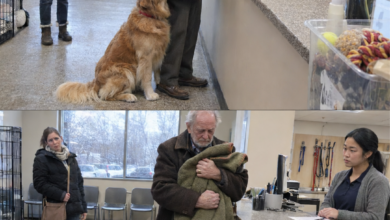
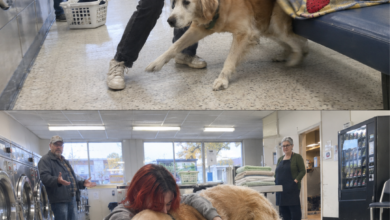
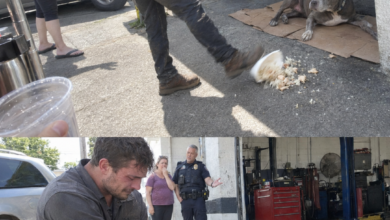
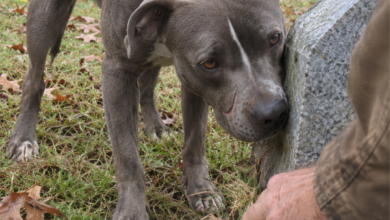
Part 2: A Tattooed Man Kicked a Stray German Shepherd Away from His Motorcycle—Five Minutes Later, He Was Kneeling in the Street, Holding Him and Sobbing
PART 2:
“Ranger?”
The Shepherd’s paw stayed suspended for a moment. Then it settled against Jace’s wrist.
Jace stared at the short scar above the dog’s left eye. His brother used to joke that Ranger had earned it by arguing with a chain-link gate and losing. The torn right ear had come years earlier, before the dog joined the department. The orange cord tied beside the collar ring had once been part of a braided leash Jace made during a summer when his hands were still used for finishing things.
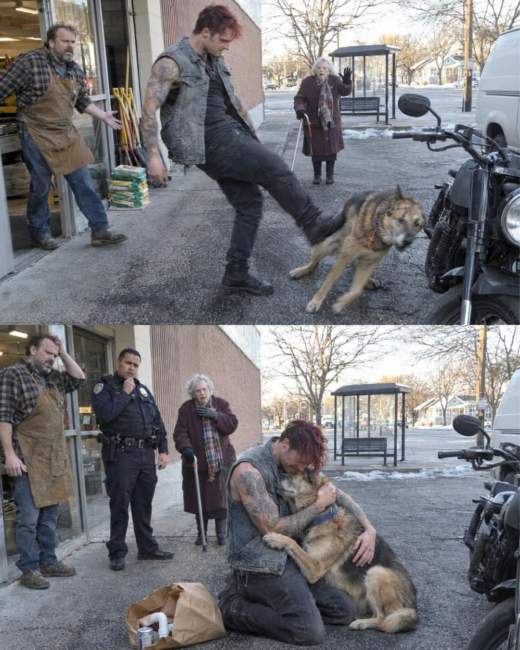
He lowered his closed fist.
“Check,” he whispered.
Ranger pressed his nose beneath Jace’s knuckles twice, then leaned his shoulder against the man’s legs.
It was the private signal Officer Evan Mercer had taught his younger brother. Whenever Jace visited the precinct or rode with Evan to the training field, Ranger greeted him with two nudges beneath the fist. Evan called it checking Jace’s pulse.
Jace’s paper bag fell to the pavement.
He sank to both knees.
The hardware-store clock showed 4:47. Five minutes had passed since he pushed the dog with his boot.
“I’m sorry,” Jace said.
Ranger remained upright between his knees. Jace did not pull him closer immediately. He held both hands where the dog could see them, then touched the faded collar with his fingertips.
Ranger stepped forward and rested his head against Jace’s chest.
That was when Jace folded over him.
The sound that came from Jace was not a single dramatic cry. His breathing broke into short, uneven attempts as he held the dog’s shoulders. Ranger stood against him for several seconds, then shifted his stiff rear leg and sat.
The older woman lowered her cane. Caleb remained beside the store entrance, uncertain whether to step closer.
Officer Ortiz crouched at a careful distance. She had seen Ranger’s photograph on a missing-dog notice shared through the department three weeks earlier. She had never handled him, but the working collar, damaged ear and scar matched the bulletin.
“Are you Evan Mercer’s brother?” she asked.
Jace nodded against Ranger’s fur.
“Jace?”
He looked up. “You knew him?”
“Everyone in the department knew him.”
Jace wiped his face with the back of one hand. “Where has Ranger been?”
“That’s what we’ve been trying to find out.”
Ortiz asked Jace to release the collar so she could examine the dog without crowding him. Ranger had no visible bleeding, but he was underweight, thirsty and favoring the left rear leg. The officer called county animal services and requested a scanner and transport to the emergency veterinary clinic.
Jace stood only when Ranger moved away.
“What happens now?”
“He gets checked,” Ortiz said. “Then we contact the person responsible for him.”
“I’m responsible.”
“You recognized him five minutes ago.”
The sentence landed without cruelty. It was simply true.
Jace looked at the pavement where his boot had struck Ranger’s shoulder. “I kicked him.”
“Yes.”
“I didn’t know.”
“You knew he was an exhausted dog in your way.”
Jace opened his mouth, then closed it.
Caleb brought a wide bowl of water from the hardware store. Ortiz placed it near Ranger and allowed him to approach on his own. The dog drank, paused and drank again.
Animal-control officer Nate Palmer arrived twelve minutes later. He scanned Ranger’s microchip and confirmed the identification attached to the missing-dog report.
Retired Police K-9 Ranger had served for seven years with Officer Evan Mercer.
His registered caretaker was Sergeant Mara Collins, Evan’s former shift partner.
Ortiz called her while Palmer prepared the transport vehicle. Jace heard only the first sentence before the voice on the other end became too loud and too emotional to distinguish.
Collins arrived before Ranger left.
She was a broad-shouldered woman in her early fifties wearing jeans, a winter jacket and two different shoes, as if she had dressed while running toward the door. Ranger stood when he heard her call his name. His tail moved low and fast.
Collins knelt and checked his face, legs and collar. Then she looked at Jace.
“You found him?”
“He was lying here.”
Ortiz answered before Jace could leave out the rest. “Mr. Mercer pushed him away with his boot before recognizing him. Two witnesses saw it.”
Collins’s relief tightened into something harder.
Jace did not defend himself.
“I did,” he said.
Collins clipped a leash to Ranger’s collar. “He’s going to the clinic.”
“I’m coming.”
“No.”
“He knows me.”
“So do I.”
Jace flinched.
Collins had known him before the red hair, the bar fights and the missed work. She had eaten Thanksgiving dinner in the Mercer kitchen and watched Evan teach sixteen-year-old Jace how to change a tire. She had also stood outside the funeral home when Jace shouted at two officers and blamed the department for allowing Evan near the flooded underpass.
“You can follow in your own vehicle,” she said. “You don’t handle Ranger until the veterinarian clears him and I decide he’s comfortable.”
Jace nodded.
Before leaving, Officer Ortiz took statements from Caleb, the woman at the bus stop and Jace. She documented what she had witnessed. Recognizing Ranger did not erase the kick. Jace received a citation under the city’s animal-protection ordinance and instructions about the court date.
He folded the paper and placed it in his jacket pocket.
At the veterinary clinic, radiographs showed no new fracture or internal injury. Ranger had a bruised shoulder, dehydration, weight loss and worsening arthritis in his left hip. The veterinarian estimated that he had been outdoors for most of the twenty-three days since his disappearance.
A windstorm had brought down part of Collins’s backyard fence. Ranger escaped while she was helping a neighbor move a fallen branch. Search teams tracked him for two days before cold rain erased the trail.
His photograph had appeared on neighborhood pages, shelter alerts and department notices.
Jace had seen none of them.
After Evan’s funeral, he unfollowed everyone connected to the police department. He changed his phone number twice, stopped visiting his mother’s old neighborhood and ignored every message Collins sent. When people told him they were worried, he heard only judgment.
Collins sat with Ranger in the examination room while fluids were administered beneath the dog’s skin. Jace waited in the hallway.
After an hour, she stepped outside.
“He can go home with me tonight.”
“Let me see him.”
“You saw him.”
“I need to tell him I’m sorry.”
“He doesn’t understand the sentence the way you want him to.”
Jace looked through the narrow window in the door. Ranger lay on a padded mat with his head near Collins’s boot.
“Why did you have him?” Jace asked.
Collins stared at him for several seconds. “You really don’t remember?”
Jace did remember pieces. He remembered the funeral, the polished wood, the folded flag and Ranger sitting beside Evan’s empty boots. He remembered Collins approaching him afterward with the dog’s leash.
He remembered saying, “Take him away.”
Everything beyond that had become a blur he avoided touching.
“Evan filed a retirement-care plan when Ranger turned eight,” Collins said. “If Evan couldn’t keep him, his first choice was you.”
Jace pressed his back against the wall.
“He wrote my name?”
“He believed you’d get your electrician’s license, find a place with a yard and argue with Ranger about who got the couch.”
“I didn’t have any of that.”
“You had a job, an apartment and a brother who believed you were building something.”
Jace looked down.
After Evan died, the department could not hand Ranger to someone who had refused responsibility and was already missing work. Collins took him instead. She never treated the arrangement as punishment. She sent Jace photographs and offered visits.
He answered none of them.
“I thought looking at him would feel like losing Evan again,” Jace said.
Collins glanced through the door. “So Ranger lost you too.”
Jace’s face tightened, but he did not look away from the words.
The veterinarian discharged Ranger shortly after eight. Collins led him through the lobby. Ranger paused when he reached Jace.
Jace kept his hands at his sides.
Ranger sniffed the front of his jacket, touched his nose once to Jace’s closed fist, then continued with Collins.
That single nudge hurt more than rejection would have.
“I want to help,” Jace said.
Collins stopped beside the door. “Pay the clinic directly if you mean that. Show up for your court date. Then call me when you’ve been sober long enough to make a promise you can remember.”
Jace watched Ranger leave.
The following morning, he called the veterinary clinic and paid what he could toward the bill. He arranged weekly payments for the balance.
On Monday, he appeared at the hardware store before opening. Caleb was stacking bags of soil near the entrance.
“I’m not here to ask you to say it was an accident,” Jace said. “It wasn’t.”
Caleb put down the bag.
“I was angry. The dog was in my way, and I used my boot. You were right to stop me.”
Caleb studied him. “How is Ranger?”
“Bruised. Dehydrated. Home with his caretaker.”
“That’s good.”
“I’m sorry you had to see it.”
Caleb did not tell him everything was fine. “Do better when nobody recognizes the dog.”
Jace nodded. “That’s the part I’ve been thinking about.”
His court hearing occurred three weeks later. He did not dispute the witnesses or ask for the citation to disappear. The judge imposed a fine, required an animal-handling education class and assigned community-service hours through a municipal cleanup program rather than placing him inside an animal shelter.
The rescue organizations contacted by the court did not use frightened animals to rehabilitate people who had harmed them. Jace accepted that boundary.
He also called the grief counselor whose number Collins had sent the year before. Then he contacted a recovery group that met in a church basement on Wednesday evenings.
Those decisions did not make him a different man by Thursday morning. They gave Thursday morning somewhere to begin.
Jace called Collins after thirty sober days.
“I’d like to see Ranger,” he said. “Only if you think he’s ready.”
Collins invited him to the public training field behind the old police academy. Ranger would remain on her leash, and the visit would last fifteen minutes.
Jace arrived early.
Ranger came through the gate wearing a padded walking harness. He had regained several pounds, and his coat was cleaner, but the left hip still moved stiffly.
Jace crouched without calling him.
Ranger looked at Collins.
“Go ahead,” she said.
The Shepherd approached, sniffed Jace’s boots and moved away. Jace did not reach after him. For the rest of the visit, he walked beside Collins while Ranger explored the grass at the end of the leash.
“Did I ruin it?” Jace asked.
“No,” Collins said. “But you don’t get to decide how quickly he becomes comfortable.”
Jace returned the following Saturday and the one after that.
During the third visit, Ranger accepted water from a bowl Jace placed on the ground. During the fourth, he sat beside Jace’s leg when Collins gave the center command.
Jace did not cry or fold himself around the dog. He lowered his fist.
Ranger checked it twice.
Collins turned away long enough to give them privacy without pretending she had stopped watching.
Jace resumed his electrical apprenticeship in April. His former supervisor, Luis Bennett, offered one final probationary period after Jace admitted why he had missed so many shifts.
The conditions were simple: arrive on time, stay sober on the job and call before a problem became an absence.
Jace did all three.
He sold the motorcycle, partly to pay the veterinary balance and court fine and partly because he needed dependable transportation that could carry an aging German Shepherd safely. He bought a used hatchback with a flat rear cargo area and installed a secured travel harness.
None of that meant Ranger would live with him.
Collins remained the legal owner, and she loved the dog. Yet Ranger had become restless during her long shifts, and her injured knee made it harder to help him on bad arthritis days. Before he disappeared, she had already begun discussing a shared-care arrangement with the department veterinarian.
Jace’s return created a possibility, but Collins refused to make Ranger the reward for improved behavior.
“You need a home evaluation,” she said. “A veterinary plan, backup care and more than two good months.”
Jace lived in a second-floor apartment above a bar. The stairs were too steep, the noise continued past midnight and the lease prohibited large dogs.
He found a ground-floor duplex six blocks from the training field. It had a small fenced yard and nonslip flooring in the kitchen. The rent required more hours, so he built a schedule before signing anything.
Luis agreed to keep his shifts predictable. A coworker named Sean offered midday dog visits. Collins agreed to serve as emergency backup only after Jace demonstrated that she would not become the primary caregiver again.
The veterinarian walked Jace through Ranger’s medication, exercise limits and signs of pain. Jace wrote everything in a notebook.
The home evaluation took place in June.
Ranger entered the duplex, inspected every room and stopped beside an empty corner of the living room. Jace unfolded a padded bed there. The old orange paracord leash rested on a shelf above it—not as a memorial Ranger had to understand, but as something Jace wanted to keep.
Collins approved a two-week trial.
The first night, Ranger slept near the front door.
Jace left him there.
At 2:30 a.m., the Shepherd rose and paced toward the kitchen. Jace took him outside, waited while he moved carefully through the yard and returned without turning on every light.
Ranger settled beside the couch.
On the fifth night, he slept on the padded bed.
Jace’s hardest moment came during the second week. A delivery truck blocked the driveway while he was trying to leave for work. He felt the old heat rise before he had even opened the door.
Ranger was standing behind him.
Jace closed his eyes, stepped back inside and called Luis to explain that he might be ten minutes late. Then he waited for the driver to move.
It was a small decision. No one applauded it.
That was why it mattered.
The trial placement became a shared-care agreement. Collins kept Ranger every other weekend and remained part of his veterinary decisions. Jace handled the ordinary weekdays: medication hidden in canned food, short morning walks, brushed fur, washed bedding and slow steps across wet pavement.
Three months later, Collins signed the adoption transfer.
“You understand that this doesn’t make Evan come back,” she said.
“I know.”
“And Ranger isn’t here to keep you sober.”
“I know that too.”
She handed him the leash. “Then take care of the dog in front of you.”
Jace did.
In September, he completed his electrician’s certification. Rather than make an announcement, he volunteered one Saturday with a neighborhood program that replaced smoke-detector batteries and broken porch lights for residents unable to climb ladders.
Evan had participated in the same program.
Jace began taking one Saturday route each month. He checked outlets, replaced bulbs and installed inexpensive motion lights donated by Hanley Hardware. Ranger came only when the weather was mild and the homeowner welcomed dogs. Otherwise, he stayed with Collins or Sean.
At the first house, an elderly man offered Jace twenty dollars.
“Parts were donated,” Jace said. “Keep it.”
“You sure?”
Jace looked at the new porch light, then at Ranger resting beside the steps.
“I’m sure.”
Caleb eventually allowed Jace to place a wide water bowl near the hardware store’s service lane. Jace scrubbed and refilled it whenever he passed. He did not attach Evan’s name, Ranger’s photograph or his own story to it.
It was simply water.
One cold afternoon in November, Jace returned to Hanley Hardware with Ranger secured in the back of his hatchback. As he carried a box toward the store, a small mixed-breed dog limped into the service lane and lay near the exit.
A delivery driver waiting behind the building tapped his horn.
Jace raised one hand.
“Give me a minute.”
He set down the box, brought out the water bowl and crouched several feet from the dog. He did not clap, point or reach. Caleb called animal services while Jace waited.
Ranger watched through the open hatch.
When the frightened dog finally lifted its head, Jace placed both hands flat on his knees. His boots remained behind him.
Ranger stepped down from the vehicle with Sean’s help and sat beside Jace.
Neither man nor Shepherd moved closer until the stray chose to look at them.
Follow this page for more stories about dogs and the quiet actions through which broken people learn to become dependable again.