Part 2: A Six-Year-Old in a Wheelchair Watched My Service Dog Push Me Up a Hill, Then Said Four Words That Started Something I Never Planned
Part 2
I should tell you about the pushing, because it is the whole heart of this, and you need to understand exactly what it was before you understand what it became.
A service dog pulling a wheelchair is not unheard of. But Tank’s pushing was different, and it was his own. Pulling, a dog is out front, leaning away from you. Pushing, Tank was behind me, his head against my spine through the chair, his whole effort traveling forward through the center of my back. I could feel him working. I could feel, through the frame, the exact moment he found his footing and drove, the rhythmic surge of it, the grunt of breath against the canvas.
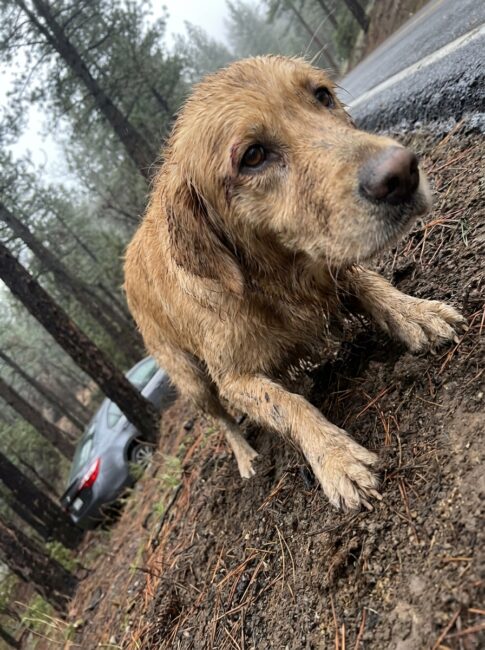
It was the most intimate thing. He was, quite literally, at my back. For eight years, on every hill, Tank was the thing pressing me forward from behind when I had nothing left in my arms.
Here is the small thing about that afternoon. The thing the little girl did that I clocked and didn’t fully understand.
When we came over the hill, she didn’t reach for Tank the way kids do — grabbing, squealing. She went still. She watched the mechanism. Her eyes went to Tank’s head against the chair back, then to his driving feet, then to the wheels turning, then back to his head. She was six years old and she was reverse-engineering it.
She was a kid in a wheelchair watching another kind of wheelchair life, one she had not known was possible, assemble itself in front of her.
And when I stopped, and asked if she’d like to say hi to him, and she very gently put one small hand flat on Tank’s broad head — he held perfectly still for her, the way he always knew to be still for the fragile ones — the first thing she said was not “he’s so soft” or “what’s his name.”
She said, “Why does the dog push your chair?”
I didn’t understand yet what the question was really asking. I’m not sure I’d have understood it at all if she hadn’t followed it up with the four words.
But it mattered. The way she watched the mechanism, instead of the dog. That mattered.
Part 3
So I explained. The way you explain to a six-year-old.
I told her Tank was a special kind of helper dog, a service dog, and that he was trained to do the things my body couldn’t — pick up what I dropped, open doors, and yes, push me up the hills my arms couldn’t manage. I told her he was my partner. I told her some dogs have jobs, and his job was me.
She listened to all of it with the total, unblinking seriousness that small children bring to important information.
Then she looked down at her own chair. The one with the bright green wheels. She looked at her own thin arms resting on the armrests. And she looked back up at me, and she said it, flat, not sad, just stating a fact about the world as she had just discovered it:
“I don’t have a dog.”
I have thought about the exact tone of that sentence approximately ten thousand times since.
It was not a complaint. It was not a hint. It was not a child angling for something. It was a six-year-old in a wheelchair encountering, for the first time, the information that there existed a thing that could push her up a hill — and noticing, plainly, that she did not have one.
Her mom was a few feet away, and she came over, and we did the thing two adults do — the warm laugh, the “oh, isn’t he wonderful,” the gentle redirect. The girl’s name was Lily. She’d been in the chair her whole short life, a condition she was born with. I learned, in the careful shorthand parents use in front of their kids, that a service dog had come up before, and that the cost — twenty, twenty-five, thirty thousand dollars for a fully trained one — had ended the conversation before it started.
I gave Lily’s mom my number. I don’t fully know why. I told her if she ever wanted to talk about service dogs, about training, about programs, I’d been through it, I could help.
We said goodbye. Tank and I went home, down the hill, his head no longer pushing now, just trotting at my wheel.
And I could not stop hearing it. I don’t have a dog. Four words, in that flat little voice, stating a gap in the world as if it were simply the weather.
That night I sat at my kitchen table, and I did the math on what I had, which was not thirty thousand dollars. And then I did a different kind of math.
I opened my laptop, and I started a GoFundMe.
Part 4
I am not a person with a platform. I had maybe four hundred followers anywhere. I expected, honestly, that I might raise a few hundred dollars and have to tell Lily’s mom I’d tried.
I wrote the page in about twenty minutes. I didn’t make it slick. I told the truth. I told them about the accident, about Tank, about the hill, about the pushing. I told them about a six-year-old in a chair with green wheels who had put her hand on my dog’s head and then looked at her own arms and said I don’t have a dog.
I posted a single photo. It was a picture my neighbor had taken months earlier, from behind — Tank with his head down against the back of my chair, both of us mid-climb, the hill rising in front of us into the light.
I set the goal at thirty thousand dollars. I went to bed sure it was too much.
I want to tell you what happened, and I want to be precise about it, because it still does not feel real to me.
When I woke up, it was at eleven thousand dollars.
By that afternoon it was at thirty-one. The goal, met, in less than a day, while I sat at my kitchen table refreshing the page with my hand over my mouth.
People I had never met were leaving comments. Other people in wheelchairs. Parents of disabled kids. People who had never thought about any of this until they read about a girl with green wheels who didn’t have a dog. A man left five hundred dollars and a note that said his late wife had used a chair and that he wished she’d had a Tank. A class of fourth-graders pooled their allowance and sent ninety-one dollars.
I raised the goal. I raised it again.
In two days, the GoFundMe for Lily’s service dog had sixty thousand dollars in it.
Sixty thousand dollars. Enough for Lily’s dog, fully trained, with a wide margin left over.
I called Lily’s mom and I could not get the words out for a while, and when I did she went silent on the line, and then I heard her start to cry, the kind of crying you do standing up in a kitchen with one hand on the counter, and in the background I heard a small voice say, “Mama? Mama, why are you crying?”
And her mom said, “Because you’re getting a dog, baby.”
Part 5
I want to be careful here, because the easy version of this is that I did a wonderful thing, and I did not do the wonderful thing. Tank did. I just held the leash.
Here is what I came to understand over the year that followed.
Tank never set out to start anything. He didn’t fundraise. He didn’t know what a GoFundMe was. He didn’t even know Lily existed beyond one held-still afternoon with a small hand on his head. All Tank did was the thing he had done every single day for eight years — push a wheelchair up a hill with his head — and do it where a six-year-old who had never seen it could watch.
That was the whole engine of it. Not strategy. Not a campaign. Just a dog doing his ordinary work, visibly, in the world, in front of someone who needed to know the work was possible.
Lily didn’t need me to tell her about service dogs. She needed to see one. She needed to watch a dog push a chair up a hill her own arms couldn’t climb, and understand, in her body, that the hill was not the end of the question. Tank answered a question for her that no brochure, no doctor, no well-meaning adult had ever managed to answer, and he answered it just by being himself in public.
I had spent eight years thinking of Tank as my dog, the thing built like something that doesn’t get knocked over, the partner who had my back on every hill.
I was starting to understand he had a wider back than I knew.
The extra money — the thirty thousand over Lily’s dog — I didn’t keep. I couldn’t. It had come in for kids in chairs, and Lily was one kid in a chair, and there were others. I found a small service-dog training nonprofit, the real deal, and I asked if I could route the rest to them as a fund. Earmarked. For disabled children who couldn’t afford a dog.
They said yes. We named it after the only thing it could be named after.
The Tank Fund.
Part 6
A year later, Lily got her dog.
He was a pit bull — the nonprofit had a litter from a service line — and Lily, who was seven by then, got to name him, and there was never any question about what she’d name him. She named him Tank Jr.
I cried when her mom told me. I’m not going to pretend I didn’t.
And then we arranged the thing that I will keep in a specific room of my heart for the rest of my life. We brought them to the park. The same park. The same hill.
My Tank, ten years old now, gray coming in around his muzzle, slower but still strong. And Tank Jr., barely more than a pup, freshly certified, bright-eyed, attached to a small girl with green wheels.
The two dogs met for the first time on the grass at the top of the hill. They did the dog things — the circling, the sniffing, the deciding. And then they did the thing none of us had planned and none of us will ever forget.
We went down the path and turned to come back up the hill, Lily and me side by side. And both dogs, without a command, took their positions behind the chairs — head down, skull against the backrest, feet digging in — and they pushed us up the hill together. Two wheelchairs, two pit bulls, side by side, climbing the same slope into the same light.
An older woman was sitting on a bench near the top. She watched us come up — two chairs, two girls thirty years and one disability apart, two pit bulls pushing with their heads — and as we crested past her, she said, to no one, in a voice I will never forget:
“I thought I’d seen everything this life had to show me. Today I found out I was wrong.”
She stopped me. She asked what it was. I told her about the Tank Fund.
She wrote a check, right there on the bench, against her purse, for ten thousand dollars.
Enough to start dogs for five more children.
Part 7
The Tank Fund kept going.
It was never big. It was never an organization with an office. It was a small fund attached to a real training nonprofit, fed by people who had seen a photo or heard the story or watched two dogs push two chairs up a hill. But it moved.
Over the three years after Lily, the Tank Fund put service dogs with seven disabled children.
Seven. Seven kids in seven chairs who now had a dog to pick up what they dropped, open the doors they couldn’t reach, push them up the hills their arms couldn’t climb. Seven kids who would grow up the way I did not get to grow up, with a partner built like a thing that doesn’t get knocked over, at their backs, on every slope.
And my Tank never knew. That is the part I keep coming back to. He never knew he’d done it. He didn’t know about the sixty thousand dollars, or the woman on the bench, or the seven children, or the fund with his name on it. He just kept pushing me up our hill, every day, gray-muzzled and slowing, with his head against my back, for as long as he had.
He thought he was just my dog.
He was the dog of seven children he never met.
Part 8
Tank died in the spring, at thirteen, in our apartment, on his bed, with my hand on his broad head — the head that had pushed me up ten thousand hills.
I did not want a funeral. I wanted a celebration. So I organized one, at the park, at the top of the hill.
And seven children came.
Seven kids in seven wheelchairs, with seven service dogs — Tank Jr. now grown, and six others, every one of them placed by the fund that a six-year-old’s four words and an old dog’s ordinary work had started. They came up the hill, some of them pushed by their dogs, head down against the backrests, the exact way Tank had taught the world it could be done.
They gathered at the top, in the light, the seven children and their seven dogs, and they looked at me, and I looked at them, and I said the only true thing I had left to say.
I said, “Tank was never my dog.”
I had to stop for a second.
“Tank was these seven kids’ dog. I was just holding onto him until there were enough dogs to go around.”
Lily, eleven now, reached over from her chair and put her hand on my arm.
And the seven dogs lay down in the grass at the top of the hill, in the light that was always the whole point, and we sat with them, and nobody said anything for a long time, because nothing needed saying.
He pushed me up every hill for eight years.
It turns out he was clearing the path for seven kids behind me.
Follow this page for more stories about the ones who push us up the hill, and the children who get to climb it because they did.