A Small Cloudy-Eyed Service Dog Put One Paw on a Trembling Veteran’s Knee — The Crowd Thought He Was Misbehaving Until the Man Could Breathe Again
Part 2 — Before Pip Learned to Look Up
Eighteen months before the station, Pip had no name and no working harness.
A county shelter received him after a delivery driver found him beneath a loading ramp behind a closed restaurant. He was approximately two years old, underweight, and wearing a frayed green collar without identification.
His most visible condition was his left eye. The surface looked cloudy blue-white, while his right eye was clear and brown. Shelter staff could see that he turned the left side of his head away from hands and sometimes bumped objects placed outside his right-eye field.
They did not guess at the cause.
A veterinarian examined him, checked the pressure in both eyes, tested tear production, and referred him to a veterinary ophthalmologist. The specialist determined that an older corneal injury had healed with dense scarring. Pip retained little functional vision in the left eye, but the eye was stable and not painful.
Removal was unnecessary. Treatment would consist of monitoring and prompt examinations if redness, discharge, squinting, or rubbing appeared.
His right eye was healthy.
The shelter placed Pip in a quiet kennel where he could approach visitors with his clear eye leading. He did not bark at the gate. Whenever the hallway became noisy, he tucked his chin and stared at the back wall.
Families passed him for six weeks.
Some wanted a younger dog. Others worried that his eye would require expensive surgery, even after staff explained the veterinary findings. One visitor asked whether the cloudy eye meant Pip would become aggressive when startled.
There was no evidence of aggression.
There was only caution.
A foster volunteer named Lena Ortiz brought Pip home for observation. She discovered that he startled when approached from the left but recovered quickly if given space. He learned household routines within days and followed Lena from room to room without demanding contact.
The detail that interested her most appeared during her father’s visit.
He dropped his keys, became frustrated, and began rubbing both hands against his knees. Pip walked over, touched one paw to the older man’s shoe, and waited.
It was not service work. It was an untrained behavior, and Lena knew not to turn one moment into a claim about temperament.
But she recorded it.
A nonprofit service-dog program working with shelter candidates evaluated Pip several weeks later. The trainers did not choose dogs based on one sympathetic gesture. They tested recovery after sound, comfort with handling, food motivation, ability to settle in public, response to other animals, and willingness to repeat simple tasks without becoming distressed.
Pip’s eye required accommodations. Handlers would approach within his clear field whenever possible. Environments had to be introduced gradually, and the ophthalmologist would continue monitoring him.
He still passed the initial temperament evaluation.
While Pip entered foundational training, I was spending most days inside my Denver home. A clinician had diagnosed my post-traumatic stress disorder years earlier. Therapy and medication had helped, but crowded public spaces remained difficult.
I ordered groceries. I postponed appointments. I drove to the library twice and returned home without leaving my truck.
My older sister, Ruth, brought me an application for a psychiatric service dog.
I left it unopened for eleven days.
When I finally completed it, I requested a large dog. I imagined a German Shepherd or Labrador—something that looked strong enough to stand between me and the world.
The program coordinator read the request but made no promises.
Six months later, she introduced me to an eighteen-pound dog with one cloudy eye.
I nearly walked out.
Part 3 — The Match That Looked Wrong
Pip sat beside trainer Marisol Vega in a plain training room with rubber flooring, two chairs, and no windows facing the parking lot.
He looked smaller than the photograph.
His wiry coat had grown healthier during foster care. Caramel patches crossed his back, the tip of his right ear was black, and the corneal scar covered much of his left eye. A navy harness rested beside Marisol’s chair, but Pip was not wearing it.
“This is the dog you think should help me?” I asked.
Marisol did not defend him.
“He is one candidate,” she said. “You are also one candidate.”
That answer irritated me.
I had spent months completing interviews, medical forms, reference checks, and training preparation. I wanted equipment I could trust, not a small dog strangers might mistake for a pet.
Pip looked at me with his clear right eye.
Then he looked away.
Marisol explained that psychiatric service dogs are trained for specific disability-related tasks. Breed and size affect what work is physically appropriate, but small dogs can perform interruption, retrieval, alerting, route guidance toward an exit, and certain forms of grounding contact.
Pip would never provide standing balance support or bear a person’s weight. His task plan did not require that.
She asked me to sit.
Pip approached from my right side, smelled my shoe, and stepped away. We repeated the introduction three times. On the fourth, he remained beside my foot.
Nothing dramatic happened.
That was the point.
The first two weeks focused on handling skills, reinforcement timing, positioning, and recognizing Pip’s own stress signals. If his ears folded, his mouth closed, or he repeatedly turned his head, I learned to reduce pressure rather than demand more.
He was not a machine.
Neither was I.
Pip’s cloudy eye created practical challenges. I sometimes reached from his left side without thinking, causing him to startle. Once, my boot caught the edge of his mat because he had not seen my foot approaching. He retreated beneath a chair and refused food for several minutes.
I felt I had failed him.
Marisol asked me to turn my chair sideways and wait. Pip eventually emerged with his clear eye facing me. When he smelled my lowered hand, I placed a treat on the floor rather than touching his head.
The next day, he approached again.
His early tasks were simple. He learned to nudge my wrist when my hand remained tightly clenched. He learned to place a paw on my shoe when my leg began repetitive bouncing. Later, those behaviors were linked to more persistent contact.
The first true test occurred during a controlled session in an empty community room. Marisol played a recording of rolling carts and distant public announcements at low volume.
My shoulders tightened.
Pip nudged my hand.
I ignored him—not intentionally, but because part of me had already turned inward.
He placed a paw on my shoe. When that failed, he raised both front paws toward my knee, then dropped back before making contact.
I stood too quickly.
The chair scraped the floor.
Pip recoiled toward the wall.
I removed his lead and told Marisol the match was wrong.
“He’s frightened of me,” I said.
“He was startled by the chair.”
“He can’t do this.”
Marisol watched Pip. He had not hidden. He stood six feet away with his body lowered, looking toward me with his clear eye.
Then he walked back.
Pip crossed the room without being called, sat beside my boot, and placed one paw on it.
The task was incomplete.
The choice to return was not.
I lowered myself onto the floor. Pip remained at arm’s length, close enough for me to see the small scratches on his navy collar buckle.
That was the first day I stopped asking whether he looked capable.
I began asking whether we could learn each other.
Part 4 — Six Months of Small Repetitions
Service-dog training did not transform Pip through affection alone. It required structured sessions, veterinary oversight, public-access standards, rest days, and repeated proof that the work did not cause him distress.
His cloudy left eye remained stable. The program veterinarian checked it every three months, while I learned the warning signs that required an earlier appointment.
I also learned to protect his working side. In crowded places, Pip generally positioned himself near my right leg, where his clear eye gave him the broadest view. I did not allow strangers to pet him while he worked.
The task seen at Union Station developed in stages.
First came the wrist nudge. When my hand clenched, Pip touched it with his nose. Next came a paw placed on my shoe when my leg began bouncing.
Only after Pip showed comfort with both actions did Marisol teach the knee contact.
I sat in a stable chair. Pip placed one front paw on my knee for less than a second and received a reward. Over time, he learned to maintain steady pressure and position his face inside my lowered field of vision.
The purpose was not to force eye contact. It was to present a familiar, practiced cue that I could choose to follow.
Find Pip.
Feel the paw.
Touch the harness.
Name the place.
We practiced first in quiet rooms, then in an empty library lobby, a garden center during slow hours, and the far edge of a grocery-store parking lot. The environments changed only when both of us recovered comfortably from the previous level.
The first grocery-store attempt lasted ninety seconds.
A child ran past with a rattling cart. Pip turned his head, placing the sound within his clear visual field. I tightened the leash without meaning to.
He looked up.
My breathing shortened. Pip nudged my wrist, but I walked directly back outside.
I considered the trip a failure.
Marisol called it information.
The following week, we returned and stood inside the entrance for two minutes. Pip remained on his mat beside a stack of baskets. I bought nothing.
By the sixth visit, I purchased milk.
By the tenth, we crossed two aisles.
Pip had his own setbacks. After a windy outdoor session, he began squinting with the cloudy eye. Training stopped immediately. The ophthalmologist found mild surface irritation but no change to the old scar.
He received prescribed eye medication and rested for five days.
During that pause, I realized how quickly I had begun planning every movement around him. Marisol reminded me that a service dog was one part of my support plan, not the entire plan. I continued therapy, practiced grounding skills without Pip, and arranged people I could call if he became ill or retired.
When Pip returned to work, we shortened the sessions.
He wore protective goggles during high-wind outdoor training, although he disliked them initially. At home, he learned that the medication bottle predicted a reward, not restraint.
Six months after our first meeting, we completed the program’s final team assessment. Pip demonstrated controlled public behavior, task reliability, recovery from ordinary distractions, and safe navigation despite his limited left-side vision.
I demonstrated that I could care for him, recognize his limits, protect his access, and respond appropriately when he tasked.
The program did not claim that I would never experience another panic episode.
Pip had not been trained to erase PTSD.
He had been trained to interrupt specific behaviors, create a practiced connection to the present, and help me move toward a safer or quieter place.
Our first independent trip was to a neighborhood hardware store. I bought one box of screws.
Our second was to the pharmacy.
Three weeks later, I decided to take the train across Denver for Ruth’s birthday lunch.
We completed the outbound trip without difficulty. On the return journey, we reached Union Station during the busiest part of the morning.
At 9:06, the shuttle released its brakes.
The luggage cart struck the post.
And Pip began the task we had practiced hundreds of times.
Part 5 — The Four Minutes Everyone Saw
At the station, I did not perceive Pip’s first nudge clearly. I remember pressure against my wrist, but the sensation seemed far away.
Pip moved to the next trained step.
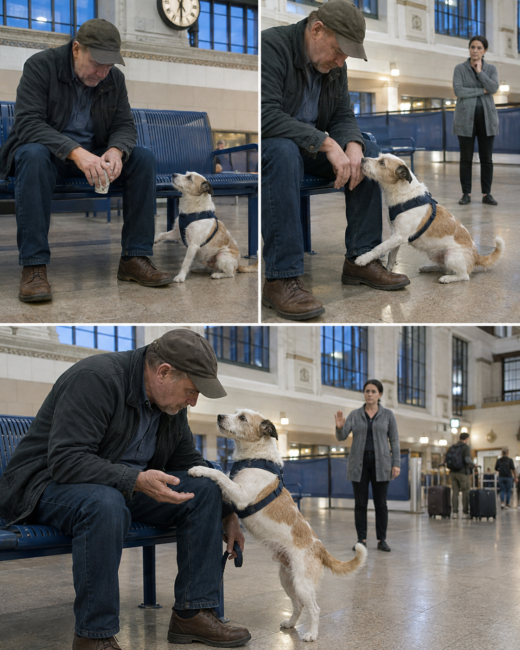
His paw touched my shoe. When my leg continued shaking and my hand remained locked around the paper cup, he rose and placed his right front paw on my left knee.
He had been trained to keep all four paws on the floor unless performing this specific response. That was why a few people assumed he was misbehaving.
A man with a suitcase warned me that my dog was climbing up. When I did not answer, he leaned forward as if he might take Pip’s harness.
Station employee Nora Hale stepped between us.
“Please give them room,” she said.
She did not know our complete task plan, but she recognized two basic rules: do not distract or handle a service dog, and ask the disabled person what assistance they want whenever the person can respond.
Nora moved the luggage cart away, reduced the cluster around us, and asked in a calm voice whether she should call emergency services.
I could not answer yet.
Pip pressed his paw against my knee again.
His cloudy eye was closer to the overhead light than his clear one, making the blue-white scar especially visible. My attention caught on it.
Find Pip.
His wiry fur moved beneath the station ventilation. The black tip of his right ear leaned toward me.
Feel the paw.
The pressure was firm but not painful. Pip released it for an instant, then restored contact when my leg accelerated.
Touch the harness.
My hand moved from the crushed coffee cup to the padded navy handle. I felt the woven fabric, the plastic buckle, and the warmth of Pip’s body.
Name the place.
“Denver,” I said.
Nora heard me and remained where she was.
“Union Station.”
My voice sounded unfamiliar, but it belonged to the room.
Pip lowered onto all four paws. My leg began shaking harder again, so he immediately repeated the task. This time I followed sooner.
I named the blue bench. The departure board. Nora’s gray shoes. Pip’s black-tipped ear.
My breathing did not return to normal at once. The tightness loosened in stages. I could first draw air deeper, then release it more slowly. My fingers opened around the harness.
Nora asked whether I wanted a quieter place.
“Yes.”
She cleared a path to an alcove twelve yards away. Pip moved at my right side, matching my slow pace. He paused once when a suitcase crossed his limited left field, then repositioned without pulling.
In the alcove, Pip placed his front paws across my thighs for a second trained task involving broader pressure. Because of his size, he did not bear weight or provide physical support. He simply maintained contact while I continued the grounding sequence.
After another two minutes, I could drink water.
The woman who had first questioned his behavior waited near the edge of the alcove. She appeared to be in her sixties and held a folded newspaper against her chest.
“I thought he was jumping on you,” she said. “I’m sorry.”
“He was working.”
“Did he know before you did?”
“Sometimes he notices the physical pattern before I can respond to it.”
She looked toward Pip’s cloudy eye. “And he can still do all that?”
“His right eye works. His veterinarian monitors the left.”
Pip had already settled beneath my knees, conserving energy as he had been taught.
The woman asked if she could pet him.
“Not while he’s working.”
She accepted the answer and stepped back.
Nora offered to remain until I contacted someone. I called Ruth, explained that I needed twenty minutes, and stayed seated while the station returned to ordinary movement around us.
Before leaving, Nora said she had never understood what psychiatric service work could look like.
I glanced at Pip.
“He’s not a pet,” I said. “He’s the reason I can leave the house.”
Pip did not react to the sentence. He rested his chin on my shoe, facing the room with his clear eye.
Part 6 — When Pip Had to Stay Home
A traveler’s short video of the station incident circulated online several days later. It did not show my face clearly, but it showed Pip repeating the paw task and Nora creating space around us.
Many people understood what they were watching.
Others did not.
Some called Pip an emotional-support animal. Some claimed any pet would have done the same thing. A few assumed he had somehow sensed a hidden medical event without training.
I chose not to argue with strangers.
Pip was a task-trained psychiatric service dog. His work qualified because it mitigated specific effects of my disability. The task had been shaped, practiced, tested, and reinforced over months.
His bond with me mattered.
So did the training.
Two weeks after the video appeared, Pip developed redness around his cloudy eye. He rubbed his face against the edge of his bed and kept the eye partially closed.
I canceled our plans and called the veterinary ophthalmologist.
The examination found another episode of surface irritation, likely aggravated by Denver’s dry winter air. There was no increased pressure or new injury, but Pip needed medication and temporary relief from working in windy outdoor environments.
For eight days, his navy harness remained on its hook.
The first morning without him, I stood beside my front door for nearly twenty minutes. Pip watched from his bed wearing a soft recovery collar that prevented him from rubbing his eye.
He was ready to follow.
I was not allowed to ask him.
A service dog’s welfare does not become optional because the handler needs support. Pip could not work safely while uncomfortable, and I had promised to protect him from that pressure.
Ruth drove me to an appointment. I used the grounding routine without Pip: identify the room, feel the chair beneath me, loosen my hands, and name visible objects. It was harder.
I still did it.
At home, Pip accepted his medication after a spoonful of food. The redness gradually receded. His left eye returned to its usual stable blue-white clouding, with no squinting or discharge.
The setback changed our routine. I installed a humidifier near his sleeping area, avoided the windiest outdoor routes, and scheduled regular ophthalmology checks. I also carried his prescribed protective goggles when conditions required them.
Most importantly, I strengthened the parts of my support plan that did not depend on Pip.
When he returned to work, our first trip was not Union Station. We walked to the mailbox. The next day, we visited the quiet end of a neighborhood store.
Pip showed no reluctance to wear his harness. His posture remained loose, his appetite normal, and his task responses unchanged.
Three months later, we returned to the station during a quieter hour.
I chose the same blue bench.
Pip settled beneath my knees. A cart rolled across the floor, and his black-tipped ear turned toward the sound. My hand tightened slightly.
Before Pip needed to move, I opened it.
I touched the harness handle.
“Denver,” I said quietly.
Pip looked up with his clear right eye.
His tail tapped the floor once.
He had not performed the full task. He did not need to. The repetition we had built together was already available to me.
We boarded the train eight minutes later.
Part 7 — The Smallest Working Partner
Pip is six years old now.
His cloudy left eye remains stable and painless under veterinary monitoring. His right eye is clear. He still wears protective goggles in heavy wind, and he stops working immediately if he shows discomfort.
His navy harness hangs beside my jacket.
We do not leave the house every day. Some mornings, a walk around the block is enough. Other days, we take the train, buy groceries, or meet Ruth for lunch.
Progress is not measured by how far I can force myself to go.
It is measured by whether both of us can work safely and return home steady.
People still underestimate Pip because of his size. Children sometimes ask why a dog with a “blue eye” is allowed inside. Adults occasionally reach for him without permission.
I give the same explanation.
“He can’t see much through that eye, but he can still see his job.”
At home, Pip becomes an ordinary dog. He rolls onto his back in the kitchen, hides treats beneath his blanket, and carries one worn tennis ball from room to room.
The harness changes the expectations, not his value.
On the second anniversary of our match, Marisol visited during a public-access practice session. She watched Pip settle beneath the same station bench where the video had been recorded.
A luggage cart struck a seam in the tile.
My shoulders rose.
Pip stood, but before his paw reached my knee, I touched the harness and named the room.
He sat again.
Marisol smiled, though she did not call the moment perfect. Training is never a finished object. Pip will eventually retire, and I will need to prepare for that transition long before it arrives.
For now, he remains my working partner.
The scarred eye that once made shelter visitors walk past him has become the first detail I look for when a room begins to disappear. His paw does not erase the past. It gives me something present enough to follow.
At Union Station, strangers saw a small dog place one paw on a shaking man.
They saw four minutes.
They did not see the shelter kennel, the veterinary examinations, the failed sessions, the grocery-store doorway, or the hundreds of quiet repetitions that made those four minutes possible.
Pip is not a miracle.
He is trained, monitored, protected, and trusted.
And when someone asks what he means to me, my answer has not changed:
“He’s not a pet. He’s the reason I can leave the house.