Part 2: A Soldier Came Home from War and Stopped Living — Until His Wife Brought Home a Pit Bull Carrying Another Veteran’s Last Gift
Part 2
The first three days, Daniel barely acknowledged the dog existed.
Rachel named him nothing.
That was deliberate.
She had learned enough in two years of medications, VA calls, sleep clinics, missed appointments, returned calls, and carefully worded “wellness check-ins” to understand that too much hope, too quickly, can sound like pressure to a wounded mind. So she didn’t name him. Not yet. She didn’t put a new bed in Daniel’s room or tie ribbon around the collar or talk about second chances the way people in online adoption videos always seem to.
She just fed him.
Walked him.
Let him learn the layout of the small ranch house one measured step at a time.
The Pit Bull took in everything.
The hallway that Daniel never crossed after sunset.
The recliner in the dark living room.
The kitchen corner where Rachel stood drinking coffee she never finished.
The spot beside the front window where the dog could see both the street and Daniel’s chair without having to choose between them.
He was not affectionate in an obvious way. He did not shove his head into laps or beg for belly rubs. He moved carefully, like an animal trained by uncertainty to study a room before entering it emotionally.
That made Rachel trust him more.
Dogs who come from loss often know how to leave space around pain.
On the fourth afternoon, Rachel came home to find Daniel in the same chair, still in yesterday’s T-shirt, jaw shadowed, eyes bruised with sleeplessness. He had not touched the sandwich she left at noon. The dog lay on the rug three feet away, watching him without staring.
“Did you eat?” Rachel asked.
Daniel gave the tiniest shake of his head.
She wanted to argue. Wanted to ask why it had become easier for him to starve than to toast bread. Wanted to say the thing wives are told not to say to traumatized men, which is that love becomes frightening when it turns into constant monitoring.
Instead she set down her bag, crouched to scratch the dog once behind the shoulder, and said, “Good to see somebody in this house is at least pretending to stay in the world.”
Daniel almost smiled.
Almost.
That was new.
That night, around 2:13 a.m., the first real sign came.
Rachel woke to the sound she hated most now, not because it was loud but because it was quiet in a specific way: Daniel trying not to make noise while losing control of his own body.
When she stumbled into the living room, he was bent forward in the recliner, elbows on knees, both hands braced against his ribs as if he were trying to hold his chest together from the outside. His breathing had gone rapid and shallow. Sweat shone at his temples. His right leg jittered uncontrollably. On the floor near him sat a dropped glass of water, rolling slowly on its side.
She moved toward him too fast.
That was her mistake.
“Danny—”
The word snapped through the room, and Daniel flinched hard enough to make the dog rise at once.
Rachel stopped.
The Pit Bull didn’t.
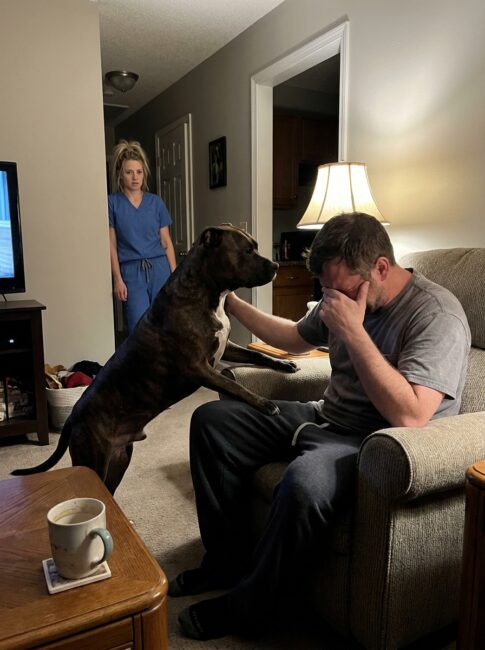
He crossed the space between them with startling purpose, not barking, not panicking, just moving like he had recognized a drill nobody else had announced. He put both front paws on Daniel’s thighs, pushed upward, then climbed with his full weight half across Daniel’s lap and chest.
Rachel sucked in a breath.
“Hey—”
But Daniel did not shove him off.
The dog pressed down.
Not violently.
Firmly.
A dense, steady body against a spiraling one.
Daniel’s hands, which had been clawing at air a second earlier, landed instinctively in the dog’s fur. His breath came fast for three more beats. Then slower. Then slower still. The dog adjusted his weight and settled deeper, chin near Daniel’s shoulder, like this exact position had been practiced before it became necessary.
Rachel stared.
Daniel stared too, though in a different way. Not confused exactly. More like a man hearing a forgotten word spoken in a familiar accent.
Neither of them moved for almost a minute.
Then Daniel, voice scraped thin, whispered into the brindle fur, “What are you doing?”
The dog didn’t answer, obviously.
He just remained there, heavy and calm and unoffended by fear.
Rachel crouched six feet away, careful not to break whatever this was. She had spent months trying to ground Daniel during panic episodes. Counting exercises. Cold washcloths. Medication timing. Breathing prompts learned from therapists whose voices were steady because their homes were not the ones imploding at 2 a.m. Some things helped. Many didn’t. Nothing looked like this.
When Daniel’s breathing finally steadied enough for language to return, he said, not to Rachel, “He knew before I did.”
That sentence stayed in the room.
The next day Rachel looked up pressure therapy dogs PTSD on her lunch break, crouched behind the clinic desk while a copy machine jammed three feet away and her coffee cooled untouched beside a stack of insurance forms. The descriptions felt too precise to ignore. Some trained service dogs interrupt panic spirals by applying full-body pressure. The technique had a name: deep pressure therapy. It could lower heart rate, regulate breathing, reduce dissociation.
She sat back slowly.
The dog had not guessed.
He had performed.
That evening she called the shelter and asked whether they had any background on the Pit Bull beyond intake notes.
“Not much,” said Leah, the manager. “Owner surrender through a county transfer. Hold on.”
Papers shuffled over the phone.
Then Leah’s tone changed.
“Actually… there’s an old note clipped to the back file. It says previous owner deceased. Veteran household. Dog had some training commands.”
Rachel stood up so abruptly her chair rolled into the cabinet.
“What kind of training?”
“I don’t know. It just says ‘basic obedience plus interruption task work.’ It isn’t very detailed.”
Rachel looked through the glass office panel toward the waiting room where a little girl in pink braces was teaching her injured lab mix to shake with the wrong paw. Outside, life still functioned for people who had not been ambushed by a clue at 4:40 on a Thursday.
That night she watched more carefully.
Daniel fell asleep in the chair near dawn. At 6:12 a.m., a delivery truck backfired on the street outside and his whole body jerked before his eyes even opened. The dog was there instantly, pressing his shoulder into Daniel’s shin before panic could fully rise. At 9:00, when a political ad on television flashed sirens and Daniel’s hand began to tremble, the dog crossed the room and laid his head across Daniel’s knee. Not random. Not needy. Timed.
On Saturday, Rachel drove to the shelter in person.
Leah met her with the file.
The paperwork was sparse, administrative, almost offensively dry. But buried in the transfer records was one name: Sgt. Lucas Harlan. Former Army. Honorably discharged. Deceased by suicide eight months earlier. Dog relinquished by extended family unable to manage placement. There was also a photocopy of an evaluation from a veteran support nonprofit that made Rachel’s hands start trembling before she reached the last line.
Dog demonstrates reliable learned pressure response to acute anxiety escalation in handler.
Reliable learned pressure response.
Learned.
Not instinctive.
Taught.
Rachel sat at the shelter desk holding the photocopy while the fluorescent lights hummed above her.
A soldier had trained this dog.
Not just any dog.
This dog.
For this.
For nights like the ones swallowing her husband.
And somehow, through the blind luck or strange mercy of shelter systems, paperwork, waiting lists, and desperation, she had brought home the one animal in three counties who already knew how to climb onto a veteran’s chest and hold him still enough to survive his own mind.
When she got back home, Daniel was sitting on the floor beside the couch, not petting the dog exactly, but allowing the dog’s front paw to remain across his ankle.
Rachel stood in the doorway for a long time before speaking.
“There’s something I found out about him,” she said.
Daniel looked up slowly.
The dog did too.
And for the first time in months, Rachel felt that awful fragile thing she had stopped trusting begin to move again.
Not certainty.
Something much riskier.
Hope.
Part 3
Daniel listened without interrupting, which frightened Rachel more than if he had walked out.
She sat on the couch opposite him with the photocopied shelter papers in her lap, corners already soft from how many times she had unfolded and refolded them on the drive home. The dog lay between them on the rug, head on his paws, amber eyes moving from one human to the other as if language mattered less than breathing patterns and the electrical weather of a room.
Rachel told it in pieces.
Not because she wanted drama.
Because some truths enter wounded people better that way.
“There was a name in the file,” she said quietly. “Lucas Harlan. Army. Former handler.”
Daniel’s jaw shifted once.
Rachel continued. “He wasn’t just a dog someone surrendered. He belonged to another veteran.”
The room went very still.
Even the refrigerator in the kitchen seemed to hum more softly.
“He had training notes,” she said. “Specific ones. Interruption work. Pressure response during acute anxiety episodes.”
Daniel’s hand, resting near the dog’s shoulder, stopped moving.
“He was taught,” Rachel said. “What he did to you the other night wasn’t random.”
Daniel stared at the floorboards for so long Rachel wondered whether he had heard any of it. Then he asked, voice flat with the effort of keeping it that way, “What happened to the man?”
Rachel had promised herself she would not soften facts into something neater than life.
“He died,” she said. “By suicide. Eight months ago.”
The sentence sat there like broken glass.
The dog lifted his head, sensing the shift before either of them moved.
Daniel looked at him then. Really looked. At the white blaze on the chest. The calm mouth. The ears that always seemed half-listening for danger no one else had noticed yet. Rachel watched the thought form in his face before he could hide it: this animal had already failed once.
Or been failed.
With traumatized people, the difference matters more than outsiders think.
“He couldn’t save him,” Daniel said.
Rachel shook her head slowly. “No. But maybe that’s too simple.”
He didn’t answer.
That night Daniel had the worst panic episode Rachel had seen in months.
Maybe because the story had cracked something open. Maybe because grief sometimes triggers grief even when it belongs to strangers. Maybe because Daniel had just been handed a mirror in the shape of another soldier who had not made it through the dark.
It began at 1:46 a.m. with the sound of the bathroom drawer slamming.
Rachel woke and found Daniel in the hallway breathing too fast, one hand at the back of his neck, eyes wide but not seeing the house. He looked trapped halfway between memory and drywall. When she said his name, he flinched but didn’t track her voice.
The dog was already moving.
This time Rachel stepped back before he even reached Daniel.
The Pit Bull rose onto Daniel with a certainty that no longer looked accidental. Front paws against the thighs. Body angled across the torso. Weight distributed low and steady. Not enough to pin. Enough to interrupt the spiral. Daniel staggered backward to the wall, then slid down it with the dog pressed firmly over his lap and ribs.
Breathe in.
Breathe out.
The dog held.
Daniel’s hands found fur.
Held too.
Rachel knelt at a distance and counted silently because the counting was for her now.
After several minutes Daniel bent forward until his forehead rested against the dog’s neck. His shoulders began to shake, and at first Rachel thought panic had returned. Then she realized it was crying.
Not loud.
Not cinematic.
The exhausted, humiliated crying of a man who has spent too long trying not to need things.
When he finally spoke, the words came muffled into brindle fur.
“One of us didn’t make it,” he said. “But he left this dog behind.”
Rachel’s throat closed.
Daniel lifted his face, wet-eyed and raw in a way she had not seen since the week after he came home from Afghanistan. “Do you understand what that means?”
Rachel did.
He said it anyway.
“He’s saving me from the other side.”
There are sentences people remember for the rest of their lives not because they are polished, but because they arrive stripped of every layer except truth. That was one of them.
The next morning Daniel asked for the file.
Not once.
Not tentatively.
Asked.
Rachel handed it over and left him alone with it for almost an hour. When she came back, he was sitting at the kitchen table with the papers flat in front of him and the dog resting a heavy head on his knee. Sunlight from the east window cut across the room in pale bands, and Daniel had not moved the chair into the corner the way he usually did when trapped by open space.
“He was thirty-two,” Daniel said, eyes still on the page.
Rachel nodded.
“Purple Heart.”
Another nod.
“He trained this dog himself.”
“Yes.”
Daniel swallowed once. “Then I’m not calling him ‘the dog’ anymore.”
Rachel waited.
Daniel looked down at the brindle head against his knee. “His name was Lucas,” he said. “This dog carried him. He can carry the name too.”
That was how the Pit Bull became Lucas.
Not because it sounded strong.
Because it was a memorial and a continuation at the same time.
From there the changes did not come in a montage. They came in humiliating little increments, which is how real recovery usually behaves. Daniel agreed to start attending a trauma-focused group at the VA again if Lucas could go through public access training. He made it as far as the truck twice before turning back. On the third attempt, Lucas planted himself in the driveway and refused to reenter the house, sitting squarely in Daniel’s path until Daniel either stepped over him or kept moving forward. Daniel cursed him out under his breath and got in the truck.
At the clinic, two older veterans noticed the dog first.
“Pit bull?” one of them asked, skeptical.
Daniel shrugged. “Apparently he specializes in stubborn infantry problems.”
The man barked a laugh before he could stop himself.
That helped.
So did Lucas’s timing, which remained unnervingly exact. He interrupted nightmares by licking Daniel’s wrist before thrashing escalated. He blocked Daniel from pacing himself into collapse during late-night anxiety loops. He leaned hard into Daniel’s legs when crowds narrowed his vision at the hardware store checkout. He stood between Daniel and the edge of the porch one evening when a helicopter crossed low enough overhead to pull all the blood from his face.
Each time, Rachel saw the same thing happen.
The dog did not erase the PTSD.
He made survival arrive earlier.
That difference saved marriages more often than people realize.
Word spread slowly through the veteran group about the brindle pit bull with pressure skills. One counselor asked where Daniel had found him. When Rachel told the story, the counselor sat down hard in her chair and pressed her fingers to her lips.
“You got matched by accident,” she said.
Rachel looked at Lucas sleeping under Daniel’s chair in the waiting room, one paw over the toe of Daniel’s boot.
“No,” she said quietly, surprising herself. “I don’t think it was by accident.”
A month later Daniel made the first unassisted trip to the mailbox he had made in a year.
It would sound pathetic to some people.
To Rachel, watching from the kitchen window with her hand over her mouth, it looked like a man dragging his life back one ten-foot section at a time. Lucas walked beside him without pulling, without prancing, just shoulder near thigh, present and available. At the curb Daniel froze when a car door slammed two houses over. Lucas leaned against his leg. Daniel stood still until the tremor passed. Then he opened the mailbox with one shaking hand and came back inside carrying junk coupons like a medal.
That night Rachel found him in the living room kneeling beside Lucas with both hands in the dog’s fur.
“He knew,” Daniel said softly.
“Knew what?”
“What panic feels like before it shows.” He looked up at her. “How many nights did that other guy have left because of him?”
Rachel didn’t answer.
Some questions should not be cleaned up.
Daniel rested his forehead against Lucas’s again. “Then I owe him both of you.”
By the end of winter, Daniel had started sleeping in the bedroom again.
Not every night.
Enough.
Lucas slept across the threshold with one ear turned toward the hall.
Visitors who didn’t know better sometimes said the dog looked overprotective. Rachel no longer corrected them. She had learned that what looks excessive to the untouched often looks necessary to the ones who survived.
And once, at a group session, when another veteran in his fifties asked Daniel how he finally agreed to accept help, Daniel answered with the kind of honesty that silences rooms.
“I didn’t,” he said. “It climbed onto my chest and stayed there until I could breathe.”
Then, after a beat, he added, “And the man who taught him that never got to hear whether it worked. So I’m going to keep living loud enough for both of us.”
Part 4
In spring, Rachel took a framed photo to the living room and set it on the bookshelf without announcing it.
It wasn’t of Lucas.
She had never been able to find one.
It was a simple printed card from the veteran nonprofit that had once evaluated him, bearing only Sgt. Lucas Harlan’s name, service dates, and a short handwritten note from an old caseworker who remembered the dog.
He trained that dog with patience and purpose. He believed helping each other stay was a form of service too.
Daniel found the card after dinner while Lucas snored lightly at his feet.
He stood there for a long time, reading the note over and over with one thumb resting against the shelf. Rachel pretended to be busy in the kitchen because some moments do not survive being watched directly.
Later, she turned and saw him crouched in front of the bookshelf, not broken apart, not performing grief, just quietly present with it. Lucas had gotten up and moved beside him, leaning one warm flank against his shoulder.
That became the rhythm of the house.
Not cure.
Companionship with what could not be cured.
Daniel still had bad nights. Still checked windows twice. Still hated fireworks. Still kept the television volume low enough to control it, and still sat nearest the exit in waiting rooms without apologizing anymore. But he ate breakfast at the table now. Answered texts from two men in his unit. Went with Rachel to the grocery store at off-hours. Took Lucas on the same walk every evening past the drainage ditch, the baseball field, and the church sign that changed messages too often to matter.
People in the neighborhood began to revise their opinions, though never as elegantly as they formed them.
The man who had once muttered that Rachel was crazy to bring home a pit bull now asked Daniel what kind of training Lucas had. A woman across the street left a basket of homemade dog biscuits on the porch with a note that said only, For the hard worker. Daniel laughed when he saw it.
“Not sure if she means me or him.”
Rachel looked at Lucas sprawled belly-up on the rug in a beam of sunlight. “Definitely him.”
Summer came slowly. One humid evening, Rachel stood at the sink rinsing dishes while Daniel sat on the porch steps with Lucas’s head in his lap. Fireflies had started stitching green light into the backyard. Somewhere down the block a radio played old country music softly enough to stay harmless.
Rachel watched through the screen door.
Daniel was talking, not to anyone visible, not even quite to Lucas. The way people sometimes speak into dusk when they are finally strong enough to let absent things be present without drowning in them.
When she stepped outside, he did not stop.
He looked up once and said, “I was telling him thank you.”
Rachel sat beside him.
“For what?”
Daniel scratched the soft place behind Lucas’s ear and kept his gaze on the yard. “For carrying instructions from a dead man into the right house.”
There was no good reply to that.
So Rachel leaned her shoulder against his and let the silence honor what words would only flatten.
In September, Daniel spoke at a small suicide prevention event for veterans.
If someone had told Rachel the year before that he would stand under fluorescent lights in a VFW hall and speak into a microphone without bolting, she would have assumed they were either lying or praying too specifically. But he did it. Lucas sat at his feet the whole time, brindle and steady, head raised whenever Daniel’s breathing shifted too fast.
Daniel did not give a polished speech.
He told the truth in plain language instead.
He said war had followed him home in quieter forms than people imagine. He said his wife had saved his life more times than any doctor would ever know, even before a dog entered the picture. He said help often arrives looking unlike your pride. Then he looked down at Lucas, one hand resting on the dog’s head, and told the room about the man whose name the dog now carried.
The room went so quiet you could hear plastic chair legs tick against the linoleum when people adjusted their feet.
At the end, Daniel said, “A soldier I never met trained this dog because he was trying to survive. He didn’t make it. I did. So every day this dog keeps me here, I figure I’m responsible for doing something with that.”
Afterward, three men came up one by one, not all at once, because veterans often line up for vulnerability the same way they line up for medication: cautiously, pretending it’s administrative. One asked about service animal programs. One asked how Daniel’s wife knew to keep trying. The oldest one, hands shaking with age or memory or both, just knelt in front of Lucas and pressed his forehead briefly to the dog’s shoulder before standing again.
No one mocked that.
Some gestures outrank embarrassment.
At home, healing kept choosing small domestic stages. Lucas asleep under Daniel’s feet during telehealth appointments. Daniel refilling the dog bowl before his own glass. Rachel finding the bedroom curtains open one morning and not making too much of it. The first time Daniel laughed hard enough to startle himself, then kept laughing anyway. The first time Lucas dreamed on the rug and Daniel, instead of jolting awake at the twitching paws, just reached down half-asleep and touched the dog’s side until both of them settled.
By winter again, Lucas had a place by the front window and another beside the bed, though he still preferred thresholds. Rachel suspected that part would never leave him, this need to position himself between people and whatever tried to reach them. She didn’t mind. Some souls remain guards even in peace.
One Sunday morning, almost a year after the adoption, Rachel found Daniel in the backyard with a paintbrush and a narrow cedar board across his knees. Lucas lay in the grass nearby chewing a stick into damp splinters. Daniel had written one word on the board in clean block letters.
LUCAS
Rachel sat beside him on the cold step. “For the leash hook?”
Daniel nodded.
Then, after a second, he added, “And for the man.”
He mounted the hook by the door that afternoon. Simple brass. Nothing decorative. But every time Rachel hung the leash there after a walk, she touched the name once with her thumb.
Not ritual.
Acknowledgment.
The house never became perfect after that. That would have made the story less true. PTSD did not evaporate because love arrived with four paws and old training. Grief did not become neat because it was shared across strangers. But the darkness lost its monopoly. That was enough. More than enough, some days.
On the first night of the next thunderstorm season, Rachel woke to distant rumbling and lay still, waiting to see which way the night would lean.
Daniel shifted beside her, then settled.
Lucas rose from the threshold, padded once to the bed, rested his chin on the mattress, and waited just long enough to confirm everyone inside it was staying anchored. Then he turned, circled twice, and lay back down facing the door.
Rachel listened to the house breathe.
Her husband.
The dog.
The storm.
All of it held for one rare, ordinary moment inside the same frame.
In the dark, Daniel reached one hand down from the bed until his fingers found Lucas’s fur.
He didn’t say anything.
He didn’t need to.
Some thank-yous are too large for sound.
If stories like this stay with you, follow the page and come back for the next one.