A Starving Dog Bit Down on a Loaf of Bread and Refused to Eat It — I Broke It Apart in Front of Her and She Still Wouldn’t. Then I Took the Lead Off Her Neck.
PART 2
I’m Ray. I’m forty-four. I run a paint booth at a body shop on Jackson Avenue Monday through Friday, and on weekends and early mornings I do intake for a small rescue that operates out of two barns and about nine foster homes.
We’re not a big operation. We’re four people with trucks.
I got into it the ordinary way. My wife left in 2015 and I had a house too quiet to sit in, and a woman at the shop asked if I’d drive a dog to Little Rock.
That’s it. That’s the whole conversion story.
The dog I’m telling you about, we ended up calling her Ruth. Delphine named her. Delphine names all of them and she doesn’t take suggestions.
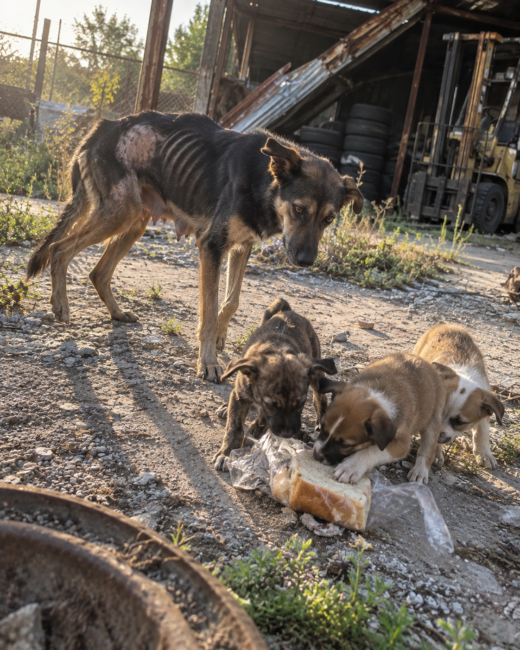
Ruth is about three years old. Black with rust points, one white toe on the back left. She’s got a whip of a tail she carries low and a face that’s more hound than shepherd when you get close — long nose, soft flews, amber eyes set a little too far apart, which gives her a permanently mild expression, like everything is fine and she doesn’t want to make a fuss.
Two things I wrote down that first morning in the truck on an intake sheet on my knee, and then did not think about again for three days.
The first: her mammary chain was slack and empty. Long, stretched, dried out. I wrote “recently whelped, not currently lactating?” and put a question mark on it, and in my head I filed it under starved. A body that’s got nothing coming in shuts the milk off. That’s just physiology. That’s what I assumed.
The second: her two bottom front teeth were worn down almost flat. Not broken. Not rotten. Worn — smooth on top, like a stair tread in an old building. I noticed it when I checked her gums for dehydration.
I remember thinking, that’s a weird way for a three-year-old dog to wear her teeth.
Then I put the pen down, because we had bigger problems.
I wrote both of those things at 6:48 a.m. on a Saturday in September.
It took me seventy-two hours to understand either one of them.
PART 3
Let me back up and tell you about that lot, because none of this makes sense without it.
That tire shop lot has had dogs in it as long as anybody on Chelsea can remember. It’s flat, it’s fenced on three sides, and the back bay is dry even when it storms. There’s a spigot on the side of the building that still runs if you know how to turn it.
Delphine has been putting food out at the hole in the north corner of that fence every evening at nine o’clock for about eleven years.
Not scraps. She buys it. On a fixed income, out of a Kroger on Watkins, forty pounds at a time, and she walks it down there in a rolling cart.
I asked her once why nine o’clock.
She said, “Because that’s when the street quiets and they’ll come out.”
The lot had four regulars that summer. A big white pit mix everybody called Pete. Two tan siblings nobody could ever get near. And a little brindle female, maybe thirty pounds, bat ears, that Delphine called Peaches.
Ruth showed up sometime in the spring. Delphine says May.
Now. Back to that Saturday morning.
When I took the lead off, I’m going to tell you what happened in the next part, because that’s the part everybody shares. But I want to first walk you through the forty minutes before it, because the forty minutes before it are what I actually think about at night.
I tried everything.
I opened a second can, a different brand, and set it eighteen inches from her nose. Nothing.
I got the bag of high-value stuff out of the cab — the freeze-dried liver that will make a feral dog walk into a trap in about ninety seconds. I crushed it into powder and I put it on a paper plate and I held it under her chin.
Her nose worked. Her throat worked. She swallowed twice.
She didn’t open her mouth.
I called our vet, Dr. Amrit Kaur, from the gravel at ten after six on a Saturday, which I don’t do lightly. I said, “Doc, I’ve got a dog at a 2, maybe less, who is refusing food.”
She asked if the dog was neurologic. I said no. She asked about the jaw — trauma, a stick lodged across the palate, something wedged in the teeth. That’s a real thing, it happens, and it looks exactly like this.
So I did what she told me. I got my hands on Ruth’s muzzle, both sides, and that dog stood there and let a stranger put his fingers in her mouth in an empty lot at dawn, and I looked, and there was nothing. No stick. No wire. No swelling. A jaw that worked fine and was choosing not to.
I said, “She’s fine, Doc. She just won’t let go of a loaf of bread.”
Amrit was quiet. Then she said, “Bring her in when you can.”
And that’s when I started noticing the rest of it.
Because once I stopped trying to feed her, I started watching her — and she was not watching me. She was watching the back of the lot. Every twenty, thirty seconds. That collapsed bay with the roof down.
She had a pattern to it. Scan the road behind me. Scan the fence line. Then the back bay. Then back to me.
Like somebody working a shift.
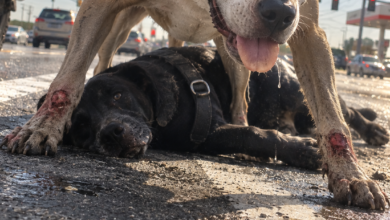
Her pads were wrecked. I got a look at the front two when she shifted her weight — split, dry, one of them cracked down the middle with dirt packed in it. Back pads not nearly as bad.
Her hocks and the whole underside of her chest were dusted gray. Not mud. Fine gray dust, the kind that comes off broken concrete and old asphalt.
And I’ll tell you the detail that I should have solved right there, that I didn’t solve for three days.
That loaf of bread was clean.
Nine years I’ve been doing this. Everything a street dog carries looks like the street. That bag had one tear at the end and the rest of it was intact, and the bread inside it was white and dry and whole.
It hadn’t been dragged. It hadn’t been found in a pile of trash and worried open.
It had been carried.
I stood up eventually and my knees popped and the sun was all the way up over the buildings on the east side of Chelsea, and Delphine was standing at the fence in her house shoes with her arms crossed.
I said, “Miss Delphine, I don’t know what she’s doing.”
And Delphine — and I want to put this exactly how she said it, because she was right and I wasn’t — Delphine said:
“She knows what she’s doing. Let her do it.”
That’s when I bent down and took the lead off.
PART 4
She was gone before the lead hit the gravel.
I mean gone. A dog that hadn’t eaten in days, that had been sitting stone-still for what Delphine says was nine hours, went from zero to flat-out sprint in one stride, straight across that lot, and I am telling you the truth when I say I thought I’d just lost her.
That’s what I thought. Forty-four years old, nine years of this, and my first thought was she’s bolting and I let her.
She ran about sixty yards. Dead straight. Past the pile of rims, past the dead forklift, to the back bay where the roof came down.
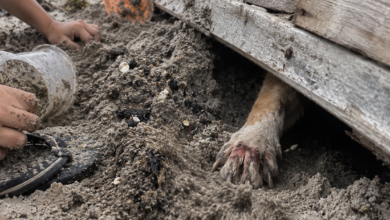
Then she disappeared into the dark under it.
I walked. I didn’t run — you don’t run at a dog in a hole.
I got maybe thirty feet and I heard it.
That noise puppies make. That high, cracked, ridiculous squeaking.
There were three of them.
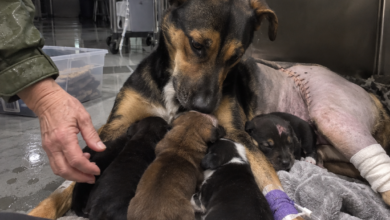
They came boiling out from under a sheet of fallen roof tin, all elbows, going sideways as much as forward, the way they do at that age. Five weeks, Amrit said later. Maybe six.
One brindle with bat ears. Two tan and white.
And Ruth stood in the middle of them, and she lowered her head, and she opened her mouth for the first time in the nine hours anybody knows about.
She put the loaf on the ground.
She didn’t drop it. I want to be specific, because I was fifteen feet away and I saw it. She bent her front legs, put the bag down on the concrete, and let go with her lips.
Then she took two steps backward.
Two.
And she stood there.
The puppies went at that bread like puppies do — over it, into it, one of them standing on it with all four feet. They tore the bag apart in about four seconds flat. White bread everywhere.
Ruth watched.
She was four feet away from food, starving, with nothing left on her frame at all, and she stood in that gravel with her head lowered and her front leg shaking and she watched three puppies eat an entire loaf of bread.
She did not step in once.
When the brindle one dragged a slice off to the side, she turned her head and tracked it and stayed where she was.
I’ve got a picture on my phone from about eleven seconds into it. I didn’t mean to take it. My hand came up on its own.
You can see her eyes in it. She’s not looking at the bread.
She’s counting them.
It took them maybe three minutes. When it was over there was nothing on that concrete but shredded plastic and a few crumbs down in the cracks.
She walked forward then. She put her nose on each one of them, one at a time, that fast businesslike check.
Then she lay down.
And then — only then, with her chin flat on the ground between her paws — she reached out with her tongue and got the crumbs out of the crack in the concrete in front of her.
That was her breakfast.
I went back to my truck and got the can and set it down beside her, and she ate it in nine seconds, and I sat on an overturned bucket in a dead tire lot in North Memphis and did not move for a while.
I thought I understood it. A starving mother wouldn’t eat until her babies ate.
That’s a hell of a story. That’s the story I told at the shop on Monday.
I had it about eighty percent wrong.
PART 5
Day three, Tuesday, Amrit had them all in.
The puppies were doing fine. Worms, fleas, one ear infection, nothing that a week doesn’t fix. Ruth was on a refeeding plan — small meals, every four hours, because you can kill a dog that empty by giving her too much at once.
Amrit had her on the table on her side and she was working her hands down the mammary chain, slow, the way she does.
She did it twice.
Then she stopped and she looked up at me over the top of her glasses.
She said, “Ray. This dog has no milk.”
I said I knew. I said she’s been starving, it dried up.
Amrit shook her head.
She said, “No. This isn’t shut down. This is regressed. This tissue involuted — weeks ago. Four, five weeks, minimum.”
I still didn’t get it. I remember standing there with my hands in my jacket pockets waiting for her to make a point.
She said, “Those puppies are five weeks old.”
And I said, “Okay.”
And she said, “Ray. She never nursed them.”
I want to describe what that was like, because it wasn’t a flash of understanding. It was slow and it was bad. It came in like water under a door.
I said something like, that can’t be right, she’s their mother, she nearly died getting them fed.
And Amrit put her hand flat on Ruth’s shoulder and she said, gently, the four words I’m going to hear for the rest of my life:
“She’s not their mother.”
PART 6
The vet clinic has a little gap between the exam table and the wall and I sat down in it, on the floor, and Amrit let me.
Then we started pulling the thread, and every single thing came apart in my hands.
The coats. Ruth is black with rust points. Those puppies are one brindle with bat ears and two tan-and-white. I’d registered it on day one and dismissed it in half a second, because puppies don’t always look like their moms and I’ve seen litters come out every color of the rainbow.
Bat ears. Brindle. Thirty-pound frame.
Peaches.
I called Delphine from the parking lot.
She got quiet for so long I thought the call dropped. Then she told me that Peaches got hit on Chelsea in the middle of August. She said it happened at night and she found her in the morning, and she said she didn’t tell me because there was nothing for me to come do.
August. Three, four weeks before that Saturday.
And there was a blue nylon collar — the cheap kind, with a plastic buckle — that I’d stepped over twice in that back bay and never picked up, chewed through and lying in the dust next to the roof tin.
It wasn’t chewed through. It was worn through.
The milk. Amrit went back through it with me. Ruth had whelped. Her body had the history written all over it. Then everything shut down and regressed, weeks before that Saturday, which is what happens to a dog’s body when there are suddenly no puppies drinking.
Delphine confirmed it without me even asking the right question. She said Ruth had a litter in a drainage culvert off Ayers in July. She said the rain came through the third week of July, hard, three days of it.
She said, “I never saw those babies again after that.”
So here’s what actually happened in that lot, and I’ve had a year to sit with it and I still have to stop when I get to this part.
Ruth lost her own litter in July.
Peaches died on Chelsea in August and left three puppies under a fallen roof.
And a starving three-year-old dog with an empty body and no milk in her walked over and took them.
She had nothing to feed them with. Her body was done. There was no biology left in her to do the thing mothers do.
So she used her mouth instead.
The teeth. Two bottom incisors worn smooth and flat. The front pads. Split and cracked, the back ones fine. The gray dust on her chest and hocks.
I drove Ruth’s route the following Saturday, because by then I couldn’t not.
There’s a commercial bakery on Jackson that pushes racks out to a dumpster corral behind the building. Day-old goes in a dry rack by the gate before it goes in the bin, because a guy who works there named Marcus told me they’ve always done it that way.
It’s one and four-tenths of a mile from that gate to the tire lot.
Marcus showed me the camera because I asked nice. He scrolled back.
She’s on there nineteen nights.
Same window every time, between 11 and midnight. She comes through the gap in the corral. She goes to the rack. She takes one item.
One.
Then she leaves the frame.
She never eats anything at that gate. Nineteen nights on camera and that dog does not put one crumb in her own mouth on that property. She picks up one item and she turns around and she walks one and four-tenths of a mile back with it, across Chelsea, under a fence.
Marcus said, “We thought she was hoarding it somewhere.”
I said, “She was.”
And that’s why she wouldn’t take my food.
I’d been telling that story wrong all week, the noble-mother version, the she-wouldn’t-eat-until-they-ate version. It’s a nicer story and it’s not the true one.
The true one is that she’d made nineteen trips, and what she knew by then — not in words, she doesn’t have words, she just knew it the way you know the way home — was that food in her mouth arrived, and food in her stomach didn’t.
She wasn’t refusing to eat.
She was refusing to spend it.
PART 7
We got all four out of there. Ruth went to a foster in Bartlett for six weeks and gained nineteen pounds and looked like a different animal by Thanksgiving.
The brindle one went to a family in Southaven. The two tan-and-whites went together to a woman in Midtown who sends pictures I’m not always emotionally prepared for.
I kept Ruth. That was never really a decision.
She’s sixty-one pounds now. She’s got a bed by the back door and a spot on the couch she is not supposed to have and has anyway.
Here’s the thing she still does.
Every meal — every single one, and I’ve been feeding her twice a day since September of last year — she takes the first bite out of her bowl, and she carries it.
Across the kitchen. Onto the rug in the living room. She puts it down. Not drops it. She bends her legs and sets it down, same as that morning.
Then she takes two steps back.
And she waits.
There’s nothing there. There hasn’t been anything there for over a year. There’s a rug and a coffee table and a piece of kibble sitting on it, and a sixty-one-pound dog standing two steps back with her head lowered, waiting.
She waits about fifteen seconds. Then she goes and eats it herself, and goes back to her bowl, and eats like a normal dog.
I stopped trying to break her of it around Christmas.
I thought about it. You could. You could pick the piece up, you could block the rug, there’s six ways to interrupt a behavior like that and I know all of them.
I decided I’d rather have a dog who still sets the table.
What I do instead is I sit down on the floor when she does it. Not every time. Most times.
And I say out loud, “Go on. They already ate.”
PART 8
Delphine still goes down to that lot at nine o’clock every night with her cart.
The bakery started leaving a milk crate by the corral gate in November. Marcus won’t say it was him. He says it was already there.
I took Ruth back to Chelsea one time, last spring, just to see.
She got out of the truck and she walked the whole fence line with her nose down and she went into the back bay where the roof came down and she stood there a minute.
She didn’t lie down. She didn’t get upset.
She came back and put her head against my leg.
Then she got in the truck by herself.
She had a whole loaf in her mouth for nine hours and never took a bite.
Not one.
She still doesn’t eat first.
Follow this page for more stories about the ones who carry things a mile and a half in the dark, and never once stop to take a bite for themselves.