A Starving Mother Dog Swam Toward Our Rescue Boat With a Puppy—Then Tried to Go Back
Part 2 — The White Shape in the Doorway
We couldn’t follow her in a straight line.
The fallen apple tree had spread its branches across most of the yard. Water pushed through them hard enough to make the smaller limbs tremble. A length of wire fencing had caught around the trunk, and beneath the surface there could have been anything: tools, broken glass, another section of fence.
I kept the boat outside the branches while Lena watched the dog.
“Come on, girl. Over here.”
The mother reached a submerged step beside the shed. Her front feet found something solid, and for the first time since we had seen her, she stopped swimming.
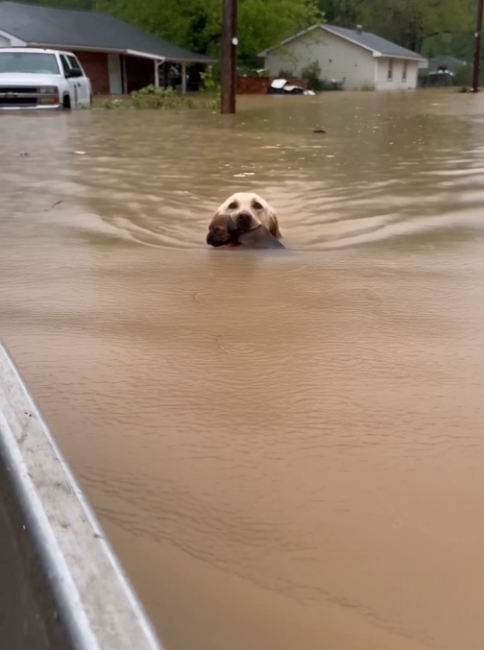
Only her shoulders and head remained above the water.
She stood there breathing.
Her ears lay flat. Her eyes moved from us to the open doorway, then back again.
The puppy against Lena’s chest gave a thin squeak.
The mother immediately tried to come toward us.
Then she turned back.
That small movement settled it for me. Whatever was inside the shed mattered enough to keep her there, even with the puppy making noise behind her.
I radioed our location to the team at the staging area. We already had an animal in need of warmth and assessment. I wanted transport waiting when we reached dry ground.
Then I worked the boat around the outer edge of the fallen tree.
We found a narrow approach from the side, where the shed wall blocked some of the moving water. I held us there with the paddle while Lena used a flashlight.
The white shape resolved into a plastic laundry basket.
It sat on a wooden workbench just inside the doorway. A blue towel hung over one side.
For a moment, I thought the movement had come from the towel dragging in the current.
Then a small black muzzle pushed above the rim.
“There,” Lena said.
Another puppy lifted its head beside the first.
There were two more.
The mother’s behavior changed as soon as Lena pointed toward them. She stopped trying to move between us and the doorway. She stretched her neck upward, looking from Lena’s face to the basket.
We couldn’t know what she understood.
But we could see what she did.
The workbench stood above the water by less than a foot. Muddy ripples slapped against its legs. A short plank ran between the bench and a low storage shelf, creating a narrow place where the mother must have been lying before the water rose.
There was no dry floor left.
I looked at the puppy tucked inside Lena’s jacket. Its coat was pale tan, with a dark patch around one eye. The two in the basket were darker.
She had carried the lightest-colored puppy first.
Whether it had been closest, weakest, or simply the one she could reach, we had no way to tell.
What looked like a dog abandoning safety was a mother returning to an unfinished task.
Lena extended a hand toward the doorway.
The mother’s lips tightened.
A low sound came from her throat.
Lena stopped.
“Okay. I hear you.”
We needed to reach the basket without making her feel cornered. We also needed to avoid tipping a boat beside branches and wire with a cold puppy already aboard.
I checked the workbench again. Its legs appeared straight. The basket wasn’t sliding. We had a little time, but the waterline was still climbing.
I brought the bow alongside the sheltered wall and held it steady. Lena opened our spare towel across an empty crate in the boat, then moved slowly toward the basket.
The mother watched every inch.
When Lena’s hand passed the doorway, the dog raised herself higher on the submerged step.
Her hindquarters trembled beneath the water.
She couldn’t hold that position long.
“Let her see what you’re doing,” I said.
Lena withdrew her hand, opened it, and waited.
The mother sniffed once.
Then Lena reached again, this time keeping her hand below the basket instead of above the puppies.
The dog didn’t relax.
But she allowed the hand to pass.
That was enough to begin.
Part 3 — The Reason She Wouldn’t Board
The basket was heavier than we expected.
Water had soaked through the towel inside, and one handle had cracked. Lena tested the intact handle, then abandoned it and slid both hands beneath the basket instead.
I shifted closer to the bow to counterbalance her weight.
“Coming toward you,” she said.
The mother rose against the submerged step as the basket moved. Her nose followed it through the doorway.
For a second, one of the puppies rolled against the side.
The mother barked.
Lena stopped immediately.
The boat rocked once against my paddle.
Nothing tipped.
“Easy,” I said, mostly to myself.
Lena moved the basket the remaining few inches and set it on the floor between us. The two puppies pressed against each other beneath the wet towel.
All three were out of the shed.
I wanted to leave.
My hands had become clumsy from gripping the cold paddle. The first puppy was still quieter than I liked, and the mother had been standing in moving water while we worked.
Lena held her jacket open just enough for the mother to see the puppy inside.
Then she reached toward the dog’s chest.
The mother backed away.
Not far. The step didn’t give her much room.
But she put distance between herself and Lena’s hands.
We tried turning the boat slightly so the low side came closer. I laid a towel over the edge to give her paws something to grip.
She touched it.
Then withdrew.
Lena waited with her hands down.
The mother stared past her.
I followed that stare to the laundry basket.
We had pulled the wet towel over the puppies while moving it, leaving a small opening at one side. From where the mother stood, the basket looked like a white container with nothing visible inside.
“Uncover them,” I said.
Lena folded the towel back.
A black puppy lifted its head. The other pushed a blunt nose beneath its sibling’s chin.
The mother immediately leaned toward the boat.
We had thought she was refusing our hands.
She had been watching where her puppies disappeared.
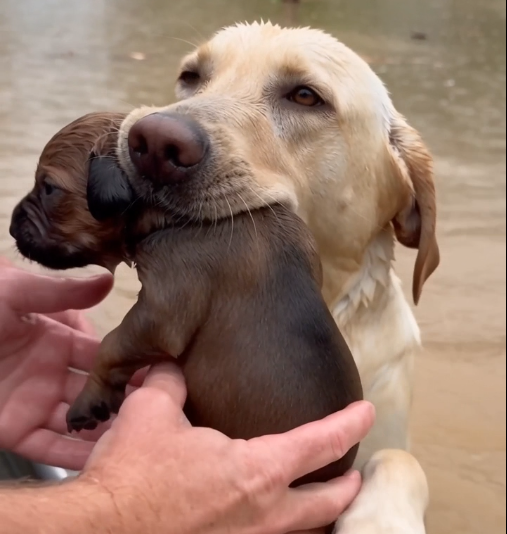
Lena lowered the first puppy into the basket beside the others. For several seconds, the mother stood motionless, her eyes fixed on all three.
Then she put one front foot on the towel-covered edge.
I steadied the boat.
Her second foot followed.
This time, when Lena placed a hand beneath her chest, the dog didn’t pull away. I supported her hindquarters while Lena lifted from the front.
She weighed far less than her frame suggested.
Even allowing for the awkward angle, I could feel the sharp outline of her hips beneath my palm.
We brought her over the side and lowered her onto the floor.
Her legs folded.
She didn’t try to stand again.
Instead, she dragged herself the few inches toward the basket, stretched her neck over the rim, and touched each puppy with her nose.
One.
Two.
Three.
Lena covered the mother’s back with a dry towel without covering her face. The dog flinched at the first touch, then remained still.
I pushed us away from the wall with the paddle.
Only after we had cleared the branches did I restart the motor.
The mother raised her head at the noise. Her ears flattened. She tried to put a front leg across the basket, and Lena moved it gently so she wouldn’t tip the puppies.
“They’re right here.”
We kept the ride slow.
The route back passed a mailbox that showed only its curved top and a porch where someone had left a pair of rubber boots on a chair. A little farther on, a refrigerator rested against a chain-link fence.
The mother didn’t look at any of it.
Her world had narrowed to the basket.
Halfway back, the pale puppy made a stronger squeak.
The mother lifted her head.
She licked its face once, then lowered her chin onto the folded edge of the towel.
It wasn’t sleep. Every change in the motor brought her eyes open.
But for the first time since we had found her, she was no longer holding herself up.
At the landing, I radioed that we had four animals, not one.
A volunteer came down carrying blankets.
Behind her stood an older man in borrowed sweatpants, with one bare foot inside a hospital sock.
The moment he saw the dog, he gripped the railing.
“Oh, thank God,” he said.
Then, looking into the boat, he asked the question we hadn’t expected.
“Did you get all three?”
Part 4 — The Man Who Knew the Number
His name was Walter Bell.
He was seventy-four, and the house beside the shed was his.
Before he could come down the wet ramp, a volunteer put a hand on his arm. He had been evacuated that morning after slipping on his porch steps. His ankle was wrapped, and someone had cut the lower leg of his trousers to check the swelling.
He barely seemed aware of it.
“Three puppies,” he said again. “There were three.”
Lena turned the basket enough for him to see.
He counted without speaking.
Then he sat down hard on the folding chair behind him.
I had already begun arranging the few facts we knew into a story I didn’t like: a thin dog, puppies in a shed, a man who had reached safety without them.
But Walter looked at the mother and said, “I’m sorry, June.”
The dog lifted her head.
Her ears moved toward him.
Walter didn’t reach over the side. He rested one hand on the edge and let her smell his knuckles.
She touched them with her nose.
Then her head went back toward the puppies.
That was the whole reunion.
No jumping. No sudden burst of energy.
Just recognition, followed by the work she still considered hers.
Walter explained in pieces while the transport volunteer made room in her vehicle.
June had appeared beneath his porch five weeks earlier.
She had been thin then, too, and so cautious that she would wait until he shut the door before approaching a bowl. He had begun leaving food twice a day. A neighbor had lent him an old kennel, but June preferred the shed.
Then Walter found the puppies.
He showed us a photograph on his phone.
Three little bodies lay against her belly on a blue towel. The date was a little over three weeks earlier.
There was the pale puppy with the dark eye patch.
There were the two darker ones.
The photograph gave all three a place in the world before the flood.
Walter had been trying to get help with June. He had called a small rescue outside his town and was waiting for a foster opening. He didn’t have a car anymore, and she wouldn’t let him put a leash over her head.
He knew food alone wasn’t everything she needed.
“I should’ve called again,” he said.
The volunteer beside him answered before I could.
“You called. We have your message.”
Walter looked up.
She worked with the group that had received it.
The flood had interrupted a plan already in motion.
By the time the evacuation crew reached his street, water was entering the yard. Walter had tried to move the basket from the shed to his house, but June had blocked the doorway, frightened by the noise and unfamiliar hands.
He had left the basket on the workbench because it was the highest stable surface he could reach.
Then he went for another blanket.
He fell on the porch steps.
The crew helping him had faced a man who couldn’t stand, rising water, and a dog they couldn’t safely reach from the house.
They had passed the animal location to the next boat.
We had come from a different direction before that boat arrived.
Nobody had simply forgotten her.
Knowing that didn’t make the shed less dangerous or June less thin. It changed where we put our energy.
There was no useful reason to stand in a parking lot assigning blame while four animals needed care.
Lena gave Walter the dry towel we had used to lift June. He held it in both hands, then looked embarrassed, as though he had been handed something too personal.
“Can I go with them?”
The vehicle taking the dogs had room for one passenger. Walter still needed his ankle checked properly, and the emergency shelter was arranging that.
He couldn’t go.
I watched him accept this with visible effort.
Instead, he gave the volunteer his phone number, then repeated it because his voice had shaken the first time.
Before we closed the vehicle, he leaned close enough for June to hear him.
“You don’t have to go back there.”
Her eyes stayed on him for a moment.
Then the pale puppy moved under her chin.
She lowered her nose to it.
Getting her off the water had been one rescue. Keeping the family safe would take longer.
Part 5 — The First Night on Dry Ground
The veterinary clinic was operating beyond its usual capacity.
A borrowed generator hummed outside. Wet carriers lined one wall. Someone had taped handwritten names to crates because collars and paperwork had been lost in the evacuations.
June arrived with no records, no known age, and three puppies in a laundry basket.
Dr. Patel examined the pale puppy first.
Its temperature was low. Its movements were weak, and it wasn’t trying to nurse with the same determination as the other two.
We had taken its quietness for relative calm.
It had been the puppy with the least strength to spare.
The staff began warming it gradually and monitoring it. Dr. Patel explained that they needed it warmer and more responsive before deciding how best to support feeding.
Nobody promised it would be fine.
Nobody treated its small sounds as proof that the danger had passed.
Lena stood beside the examination table with one hand resting near June’s shoulder. The mother lay on a pad below, lifting her head whenever the puppy made a noise.
Dr. Patel let her see and smell it between checks.
That helped more than stroking her did.
June’s examination confirmed what we could see: she was severely underweight, with substantial muscle loss. The flood had exhausted her, but it hadn’t made her thin in a single morning.
“She came into this already depleted,” Dr. Patel said.
Nursing three puppies had added to that demand.
Walter’s bowls had helped. They hadn’t erased whatever had happened before she found his porch, and the amount a nursing dog needed had been more than he understood.
The plan wasn’t a giant meal and a bath.
It was measured feeding, repeated assessments, warmth, rest, and attention to what she could tolerate.
Recovery would have to be managed in ordinary portions.
They estimated her age at around three years. Her white chest marking formed an uneven crescent, and the last few inches of her tail were black. Once some mud came off, those details made her look less like part of the river and more like a particular dog.
A scan found no microchip.
There was no quick phone call that could explain her whole life.
The clinic photographed her and sent her details through the local lost-animal network. Walter’s name went down as the person who had been feeding her, not as an owner whose rights anyone could assume.
It was a small distinction, but it mattered.
A staff member set up a quiet enclosure large enough for June to lie beside the basket. They replaced the soaked bedding and positioned the puppies where she could reach them without having to get up repeatedly.
For the first hour, she fought sleep.
Her chin would lower. A footstep would bring it back up.
When someone wheeled a cart down the hallway, she gathered her front legs beneath her as though preparing to move the litter again.
The staff covered part of the enclosure to reduce the traffic she could see. They left room for airflow and observation.
Eventually, her head stayed down.
I called Walter from the hallway.
He had been moved to the emergency shelter after his ankle was assessed. He asked first about the puppy.
“They’re still watching him,” I said.
“And her?”
“She’s resting.”
There was a long silence.
Then Walter said, “I never saw her do that.”
“Do what?”
“Rest without listening.”
I looked through the enclosure door.
June’s ears still moved occasionally, but her body had settled onto her side. One dark puppy pushed against her belly. The other slept with its head across a sibling’s back.
The pale puppy remained under closer observation.
That empty space beside the others kept drawing her eyes.
Near midnight, the clinic sent an update: he was warmer, more responsive, and had begun nursing with assistance.
It was progress, not a guarantee.
I forwarded the message to Walter.
He replied with a photograph of the empty chair beside his shelter cot. On it sat a folded blue sweatshirt.
For her when she comes home, he wrote.
He didn’t yet have a home he could return to.
I didn’t point that out.
By morning, the puppy had managed another feeding.
June ate a small meal, drank, and finally slept through someone opening the enclosure.
The first night ended without a celebration.
A technician wrote down four weights, changed a pad, and tucked a clean towel beneath a tired mother’s chin.
Part 6 — The Food We Thought She Was Refusing
June stayed at the clinic until the veterinarian was satisfied that she and the puppies could continue recovering in foster care.
Lena took them home.
She had a spare room with washable flooring, a low pen, and the kind of schedule that could bend around feedings and clinic visits. Her own dog stayed in another part of the house.
I helped carry in supplies.
The white laundry basket came too.
One handle was broken, and there were cleaner, sturdier things available. But for those first days, the puppies settled inside it, and June lay with her chest against its side.
We decided not to change everything at once.
Safety still needed to look familiar.
Walter visited after arranging a ride. His ankle was improving, but his house remained unlivable. He was staying temporarily with his sister, forty minutes away.
He entered the spare room slowly and sat on the floor with his wrapped ankle stretched out.
June stood when she heard him.
It was the first time I had seen her get up for something other than the puppies or a bowl.
She approached, sniffed his sleeve, and stood beside him.
Walter kept his hands in his lap.
After a while, she leaned one shoulder against his knee.
He didn’t say anything until she moved away.
Then he asked Lena what food she was using.
This time he wrote down the answer, the amount, and the schedule.
Over the next two weeks, the changes were small enough that you could miss them if you expected a transformation.
June stopped flinching when the food scoop struck the container.
She began sleeping with her legs extended.
The pale puppy, whom Walter called Pip, started pushing through his siblings to nurse instead of waiting at the edge.
The two darker puppies became Fern and Otis.
Names made the update messages easier.
They also made everybody more careful about the differences between them.
Three puppies did not mean three identical recoveries.
Pip needed closer weight checks. Fern began exploring first. Otis complained whenever a sibling stepped across his back.
June watched all of it.
Then, during the third week, her food intake seemed to fall.
Lena reported half-finished meals and longer periods spent standing near the pen. June had gained some weight, but she still had a long way to go.
We didn’t decide it was merely stress.
Lena contacted the clinic. June was examined again, and the veterinarian reviewed her feeding record and the puppies’ progress.
There was no obvious new physical explanation.
They adjusted the monitoring plan and asked Lena to watch exactly what happened around meals.
That evening, she placed a camera outside the room and left June undisturbed.
The answer appeared within minutes.
June approached the bowl, took a mouthful, and carried it to the pen.
She dropped the food beside the puppies.
Then she returned for more.
She wasn’t simply leaving meals unfinished.
She was moving them.
As the puppies became more mobile, Lena had begun using a low gate during cleaning and short breaks. June could see them through it, but her bowl stood in the hallway to keep the little ones out of her food.
When the gate was open, she carried pieces back.
When it was closed, she stayed beside it instead of eating.
The arrangement made sense to us.
It didn’t work for her.
Following the clinic’s advice, Lena changed the setup so June could eat in a quiet space beside the pen, with the puppies safely nearby. She offered smaller, supervised meals and continued recording what June actually consumed.
No one scolded her for carrying food.
No one forced her away from the litter to teach independence.
We changed the room before asking her to change her behavior.
Within days, she was finishing more of her meals.
The puppies began eating their own appropriate food as they grew, with June still able to lie near them. Her weight climbed gradually.
By six weeks after the flood, the hollows over her hips were less pronounced. Her ribs no longer caught the light quite so sharply.
She still checked the pen when a puppy squeaked.
She still preferred to see where the basket went.
But one afternoon, Lena lifted the empty basket to clean beneath it, and June stayed on her bed.
Her eyes followed it.
Her body didn’t rise.
That was the progress Lena called me about.
Not a trick. Not a dramatic display of gratitude.
A tired dog had watched something move and trusted it would come back.
Part 7 — The One He Had Come For
Finding homes for the puppies took longer than people following their photographs expected.
There were applications, conversations, veterinary appointments, and visits scheduled around work shifts. Two interested families realized they weren’t ready for a puppy. One had an older dog who needed a quieter household.
Lena thanked them for being honest.
June wasn’t a deadline anyone needed to meet.
As the puppies grew, they spent more time exploring beyond their pen. Their lives widened in small circles: first the spare room, then the hallway, then the fenced yard on dry afternoons.
June’s world widened more slowly.
She walked on a leash with Lena, stopping often to look back at the house. Sudden splashing from a hose made her retreat behind a chair. Nobody dragged her closer to prove the water was harmless.
They turned the hose off.
They tried something else another day.
She didn’t owe anybody a quick recovery.
Walter kept visiting.
He brought clean towels and sat through the loud, clumsy hours when three growing puppies wanted the same toy. He learned how to fit June’s harness and how to wait when she hesitated at a doorway.
His sister drove him at first.
Later, a neighbor helped.
He missed one visit because the temporary housing appointment he had been waiting for finally came through. He called Lena twice to explain.
“She won’t think I’ve stopped coming?”
Lena looked across the room at June, who was sleeping on Walter’s blue sweatshirt.
“I don’t think one afternoon will undo everything.”
The sweatshirt had become her preferred bed covering. We washed it with the others. Walter wore it for a while between visits, then brought it back.
There was nothing mysterious about that.
His smell had belonged to food, quiet, and a porch before the flood.
By the time the puppies were old enough and ready for their placements, June had gained enough weight that strangers meeting her didn’t immediately see the dog from the boat.
We still did.
We saw her in the way she checked every puppy before lying down.
We saw her when a door closed and her head lifted.
But we also saw her roll onto her side in a patch of sun, leaving her belly unguarded while Otis climbed over one front leg.
Fern went first, to a family who had already met her twice.
Otis followed several days later.
Pip stayed a little longer while his veterinarian monitored his growth, then joined a couple who understood that the smallest puppy didn’t need the busiest household.
Each departure was quiet.
The families carried their puppies out in secure carriers with familiar bedding. June was allowed to sniff, step away, and return to her routine.
She checked their sleeping places afterward.
Lena stayed with her.
By then, Walter had moved into a small rental with two shallow steps and a fenced patch of yard. The lease allowed a dog. His sister lived nearby, and he had arranged help with transport and veterinary care.
He arrived at Lena’s carrying a new leash.
I assumed he had come to say goodbye to Pip before the final pickup.
Walter looked toward the pen, then at June.
“No,” he said. “I came for her.”
He had been preparing for weeks.
He hadn’t wanted to make promises while he was sleeping in somebody else’s spare room.
Everyone had been asking about the puppies. Walter had been making room for their mother.
The rescue completed its placement process. The lost-animal notices had brought no verified claimant. June’s follow-up care was scheduled, and Walter had the feeding plan clipped to his refrigerator before she arrived.
Lena drove them over.
I carried in the bed.
June inspected the kitchen first. Then the little living room. At the back door, she stood very still while Walter opened it onto the fenced yard.
There was no water beyond the threshold.
Just damp grass, a bare flower bed, and a plastic chair he had bought secondhand.
She went outside, sniffed along the fence, and returned.
Walter sat down.
June stood beside his chair for a moment, then folded herself onto the sweatshirt at his feet.
He rested one hand near her shoulder.
This time, when a vehicle passed outside, her head stayed down.
Several weeks later, Lena and I visited with a bag of supplies Walter insisted he could pay for. June met us at the door, heavier through the shoulders now, her white crescent clean against her chest.
She sniffed my hands.
Then she went back to Walter.
The old laundry basket stood beside his washing machine. He used it for towels because the broken handle didn’t matter if he carried it from underneath.
As we were leaving, he brought it into the living room and set it down.
June glanced at it.
For a second, I remembered her in the brown water, holding one tiny body above the current, refusing to climb aboard while there was still something left to carry.
Walter picked up the basket again.
June stretched on her bed.
This time, she let someone else carry it.
Follow our page for more compelling dog rescue stories, quiet second chances, and the everyday people who help frightened animals feel safe enough to rest.