A Stranger Saw My Dog’s Teeth on My Jacket—She Didn’t Know He Was Keeping Me From Slipping
Part 2 — What She Saw When She Looked Again
The woman pulled her hand back when I said his name.
“Rusty. Easy.”
His eyes moved toward me without his jaws opening. I could feel a tremor traveling through the stretched sleeve. He was working harder than his planted feet made it seem, and I knew we couldn’t stay that way.
The woman crouched a little farther from the edge.
“My name’s Helen. I’m calling.”
She spoke to the dispatcher, gave the road name, then looked for a house number. A mailbox stood beyond the bend. She described that instead, along with the nearby farm entrance and the direction she had been driving.
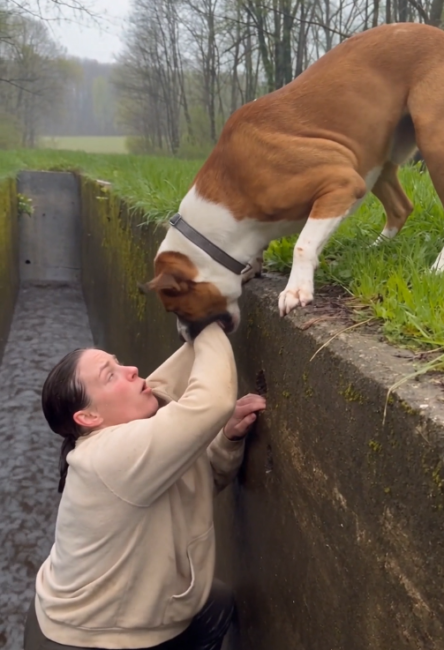
I tried to listen, but my attention kept returning to my left foot.
The rough patch beneath it was scarcely wider than the toe of my shoe. If I pushed too hard, my ankle turned outward. If I stopped pushing, the sleeve tightened and Rusty’s front feet crept closer to the concrete.
I wasn’t hanging from his mouth.
My weight was partly on my foot and partly against the wall. He was giving me just enough tension to keep my chest near the edge.
That small difference mattered.
Helen repeated the dispatcher’s questions. Had I hit my head? Was the water rising? Could I breathe?
I could breathe. I hadn’t lost consciousness. The water wasn’t deep, though I couldn’t see what lay farther inside the culvert.
“My ankle,” I said. “I can’t stand on the right one.”
She relayed that.
Then she looked at Rusty properly.
Not just the teeth. The whole dog.
His ears were back. His hind feet were spread on the firmer grass. Whenever I tried to shift upward, he backed a fraction, then stopped when I stopped.
“Oh,” she said.
It was such a small sound.
But her face changed.
“He’s holding her jacket,” she told the dispatcher. “He’s not biting her.”
I shut my eyes for a moment.
Until she said it, I hadn’t realized how frightened I was of somebody deciding differently.
Helen put her phone on speaker and set it in the grass. She asked what she could do without moving me.
“Stay where she can see you,” the dispatcher told her. “Don’t climb down.”
Helen looked as though that instruction cost her something. She had the hands of a person accustomed to solving a problem by getting hold of it.
Instead, she stayed low and talked.
She told me her husband was coming from their car. His name was Len. They had been driving home from an early appointment when he noticed the dog at the ditch.
They had thought Rusty was struggling with something discarded.
A bag. A piece of fabric.
Then Helen saw my hand.
I looked up at him.
He had been visible from the road while most of me wasn’t.
That was another thing I hadn’t understood. Even before anybody knew what his mouth was doing, his movement had made them stop.
Len arrived with a blanket and stood several feet back.
“Can we put that under his feet?” Helen asked.
“No,” I said quickly.
Moving his paws frightened me more than the cold did. Nobody argued.
My left elbow slid over the rim.
The concrete scraped through the sleeve, and pain ran across my forearm. But now I had a little more of my own weight supported.
“Good,” Helen said. “Right there.”
Rusty adjusted his grip on the fabric without releasing it completely.
My first thought was that the jacket would tear. My second was that his teeth might hurt.
I didn’t have room for a third.
A vehicle slowed on the road. Somebody called out. Len moved away to flag it down and guide the approaching crew.
I heard a siren briefly, then an engine stopping.
Helen stayed where she was.
When I looked up again, her hand rested on the grass near Rusty, open and still. She wasn’t trying to remove him anymore.
“He’s doing good,” she told me.
I nodded, though my jaw was shaking too hard to answer.
A moment earlier, she had wanted his mouth off my sleeve.
Now she was protecting the space he needed to keep it there.
Part 3 — The Moment His Mouth Opened
The first rescuer I saw was a woman with mud already dried around her boots.
She stopped several feet from the ditch and asked Helen to move her phone so the crew could speak with dispatch directly. Then she crouched where I could see her face.
“I’m Erin. We’re going to get you supported.”
I started explaining Rusty before she asked.
“He’s got the jacket. He isn’t biting me.”
“I can see that.”
I hadn’t expected the relief those four words gave me.
Erin didn’t reach for him. She watched the position of my shoulders, the angle of my leg, and the stretch of fabric between us. Another responder checked the bank farther along, looking for a stable place to work.
They asked me to stop trying to climb for a moment.
That sounded impossible.
Climbing was the only thing I had been trying to do.
But Erin explained that each push moved my foot and pulled Rusty closer to the edge. They needed to take over some of that load before either of us slipped.
Helen moved back when asked. Len remained by the road.
Everything became quieter, though there were more people now. The crew gave one instruction at a time and waited for me to show I had understood.
My name. My age. Which leg hurt. Whether I could move my fingers.
I answered what I could.
Rusty watched their hands.
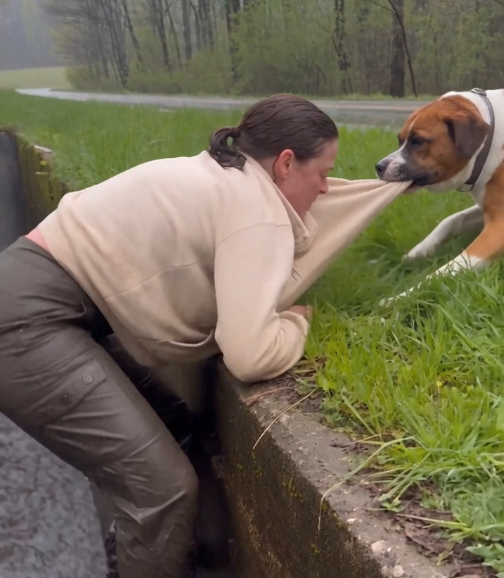
He was panting around the fabric now, short breaths through the sides of his mouth. His jaw stayed closed, and I could see a thin wet line where the sleeve pressed against his lip.
“Somebody needs to help him too,” I said.
“We will.”
The crew used their equipment to secure a support around my upper body, working carefully from stable ground. I couldn’t see every step, and I won’t pretend I understood the arrangement from inside the ditch.
What I remember is the first moment the pressure changed.
Something other than my ankle, my elbow, and my dog began holding me.
Erin asked me to lean into the support.
I did, cautiously.
The sleeve loosened. Rusty’s head rose a little.
For several seconds, he kept the same grip even though the fabric no longer pulled against him.
“Does he know a release word?” Erin asked.
I looked at him.
Fourteen months of walking him away from laundry baskets. Fourteen months of exchanging stolen socks for something he could have.
“Yes.”
I swallowed.
“Rusty. Drop.”
Nothing happened.
I said it again, softer this time.
He looked from my face to the people beside me. His front paws shuffled, but his jaw stayed closed.
Then Erin asked me to stop reaching upward and rest my hand flat where he could smell it.
It seemed like the smallest possible thing to do in the middle of all that equipment.
I put my fingers on the grass.
Rusty touched them with his nose.
I could feel the warm wetness of it.
“Drop.”
His mouth opened.
The sleeve fell against the wall.
I expected him to move away once he was free.
Instead, he pushed his muzzle beneath my hand.
The stubborn grip I had spent months correcting ended the moment my hand stopped disappearing below him.
That didn’t tell us what he had been thinking.
It told us what helped him let go.
Helen took his leash after a responder retrieved it with the rest of my things. She kept him a safe distance away while the crew helped me over the edge.
I did not come out gracefully.
My knee caught. My right foot hurt badly enough to make me swear. I ended up half on the grass, half against somebody’s supported arm, with my jacket twisted around one shoulder.
But I was out.
Rusty pulled toward me.
Helen waited until the crew said it was safe, then brought him close.
He sniffed my face, my jacket, and the hand lying in the grass.
When they moved me onto a stretcher for assessment, he tried to follow.
That was when I noticed something I hadn’t seen from below.
The grass beneath his feet had been scraped into four dark patches.
He had been losing ground too.
Part 4 — The Dog Waiting at the Door
I wanted somebody to check his mouth.
That was the first thing I said once the crew had me settled, and apparently I said it several more times after that.
My ankle could wait a second in my mind. His jaw had held fabric under strain, and I kept remembering the way his feet moved toward the drop.
Erin told me Helen would stay with him while they arranged what came next.
Rusty stood beside the stretcher, breathing hard. There was mud on his white front legs and a little grass caught against his collar.
He looked ordinary.
That almost upset me more than if he had looked heroic.
The road was still there. A truck passed slowly. A bird made a harsh sound in the trees. The ditch kept carrying water beneath the culvert.
Everything that had nearly gone wrong was already becoming invisible.
Helen called my daughter from her phone.
My own phone had been retrieved, but its screen stayed black.
I gave her the number from memory and listened while she explained that I was awake, talking, and being taken for examination.
My daughter, Claire, was two hours away.
She heard injured mother, roadside ditch, emergency crew.
Then she heard dog.
“Did the dog cause it?”
Helen looked at me before answering.
“No. He stayed with her.”
I was grateful she didn’t make a bigger speech than that.
There would be enough time for explaining.
At the hospital, imaging showed an ankle fracture that required immobilization and follow-up, along with a shoulder strain and bruising. The clinician asked about any bite wounds.
“There weren’t any.”
She checked anyway.
My sleeve was marked and stretched. The skin beneath it was bruised from the fall and pressure, but unbroken.
There was a difference, and I wanted it written down.
The dog had held my clothing.
He had not bitten my arm.
Meanwhile, Helen and Len took Rusty to a veterinary clinic after speaking with its staff. I gave permission over the phone, read my payment details from a card in my wallet, and tried not to sound as anxious as I felt.
The veterinarian found tender paw pads and irritated gums but no broken teeth or injury that required a major procedure. Rest and monitoring were advised, along with a return visit if his behavior or appetite suggested pain.
It was the best report I had heard all day.
Still, when Helen offered him food afterward, he turned away.
At first, I thought we had missed something.
The clinic checked what it could. He drank a little. He wasn’t struggling to breathe or showing signs of an immediate emergency.
But he kept returning to the door.
I knew that part of him.
When the veterinarian called with the update, I asked if Helen could keep him until Claire reached my house.
“We’ll work it out,” Helen said.
She had been a stranger less than two hours earlier.
Now she was discussing where to put his water bowl.
Claire arrived that afternoon carrying a phone charger, clean trousers, and the expression she gets when she is trying not to frighten me by being frightened herself.
She listened to the discharge instructions.
Then she asked again about the dog.
I told her everything I could remember.
She sat on the chair beside me and looked at my hands.
“You could have been down there a long time.”
“I know.”
“No, Mom. You don’t have your phone. Most of you couldn’t be seen from the road.”
I looked away.
That was the part I had been keeping at a distance.
The water hadn’t needed to be deep for the ditch to hold me.
A slick wall, a bad ankle, a dead phone, and an ordinary weekday were enough.
When Claire brought me home, Rusty heard the car before Helen opened the door.
He came quickly, then stopped when he saw the walking aid and the bulky support around my ankle.
His ears went back.
I sat down before greeting him.
He sniffed the support, moved to my good side, and pressed his nose into my palm.
Then he ate the food Helen had left in his bowl.
I had thought his refusal meant the ditch had hurt him more than the examination showed.
That evening, with me in the chair beside him, he finished dinner.
Part 5 — The Part Missing From the Picture
The photograph reached my daughter before I had slept through a whole night.
It had been taken by Len from the roadside while Helen spoke to dispatch. He had sent it privately to a neighbor so she would know why he was late bringing back her car.
By evening, someone had posted it in a local group.
The version Claire saw was cropped tightly.
Rusty’s face. His teeth on my sleeve. My arm raised above my head.
Almost none of the ditch remained.
The person who sent it to her asked whether that was her mother.
Claire showed me the screen without speaking.
I recognized the moment immediately.
I also understood how easily somebody could read it wrong.
The caption called it an incident involving a dog. It didn’t name him or me, and it didn’t explain why the sleeve was in his mouth.
Below it, people were filling in the missing space.
Some were worried about me. Some were worried about dogs generally. A few were speaking with certainty about an event they hadn’t seen.
I could feel anger gathering before I knew where to put it.
Then Rusty shifted on the rug and rested his chin against the leg of my chair.
I put the phone down.
We had work to do before arguing with strangers.
Helen contacted Len, and he asked for the photograph to be removed. With my agreement, they provided a brief correction describing what they had actually witnessed.
No story about a dangerous dog.
No story about a dog single-handedly lifting a grown woman.
The truth was enough: he had held my sleeve while I struggled for purchase, remained beside me, and helped keep me close enough to the edge for people to see and assist us.
The crew had completed the rescue.
That distinction didn’t reduce what he had done.
It gave it a shape I could trust.
The corrected account traveled less quickly than the cropped photograph, but it reached someone I hadn’t expected.
A shelter volunteer named Beth called the next afternoon.
She had helped with Rusty’s adoption fourteen months earlier.
At first, I thought she was calling to check on him.
She was.
She also wanted to apologize for something I barely remembered.
“When you asked about the clothes grabbing,” she said, “I gave you the shortest answer.”
I remembered that conversation.
Rusty had caught the hem of my cardigan during our second visit. Beth had redirected him and explained that they were working on it.
There had been other dogs waiting, a phone ringing, and a family at the desk.
Nobody had done anything cruel.
But a few words had followed him out the door.
Needs work. Gets grabby. Can be difficult when upset.
Beth said she had reviewed his intake notes after seeing the photograph.
His former owner had entered long-term care. Rusty had arrived with a bag of food, a blanket, and an old work shirt.
There had been no documented history of biting people.
There had been repeated notes about carrying clothing, holding loose fabric, and becoming distressed when a familiar person left.
“We still needed to teach safer habits,” she said. “But I wish I’d given you the rest.”
I looked down at him.
I had known he lost a home.
I hadn’t known he arrived holding onto part of it.
Beth didn’t pretend the notes explained the ditch. Neither did I.
A shirt in a kennel wasn’t evidence of a rescue instinct. A dog could learn different things from the same action in different situations.
But the call changed something in the way I remembered our first months.
He hadn’t been collecting laundry to inconvenience me.
Sometimes he had been lying with it beneath his chin while I was out of sight.
I had noticed the stolen object more readily than the unsettled dog beside it.
That was an uncomfortable admission.
It was also useful.
I asked Beth to send whatever history could be shared.
Then I called the trainer who had helped us after the adoption.
Not because the photograph had proved Rusty needed to be different.
Because we needed help understanding what both of us would need now.
Part 6 — Learning to Walk Away
The first real setback happened at the back door.
Until then, I had thought recovery meant following the instructions on the papers Claire taped to my refrigerator.
Keep weight off the ankle as directed. Attend the follow-up. Use the walking aid. Ask for help with things that involved carrying and balancing at the same time.
Rusty had his own simpler plan: rest, short outings, and watch for discomfort.
His gums settled. His paws improved. The veterinarian was satisfied with his progress.
Then Helen came to take him for a walk.
She had been helping most mornings because Claire had returned to work and I couldn’t manage him safely outside.
Rusty knew her by then.
He accepted the leash. He approached the open door.
And stopped.
Helen waited.
He looked back at me.
I was sitting in the kitchen with my supported ankle on another chair.
“Go on,” I told him.
He took one step.
Then he backed away and stood beside my knee.
At first, we blamed the weather. Rain tapped against the window, and nobody felt eager to go outside.
The next day was clear.
He did the same thing.
When I shifted forward to rise, he crowded close enough to make moving awkward. If I picked up my beige jacket, his attention sharpened immediately.
We didn’t test him by putting my sleeve near his mouth.
We put the jacket away and called for guidance.
The trainer, Maya, came to the house after speaking with our veterinarian. She watched Rusty during ordinary movements rather than staging another emergency.
She asked when the doorway behavior started, how he slept, whether he ate, and what happened when I left the room.
Then she asked me to describe what I did whenever he hesitated.
“I tell him I’m all right.”
“How many times?”
I thought about that.
A lot.
I would lean forward. He would stand. I would stop, reassure him, touch his head, and begin again.
Neither of us ever quite finished the movement.
We were getting very good at interrupting each other.
Maya didn’t call him stubborn or tell me to show him who was in charge.
She helped us make the routine smaller.
Helen would clip the leash on and remain in the kitchen. Rusty could settle beside her without leaving. Later, they moved a few steps into the hallway and returned.
There were quiet rewards for checking in and relaxing.
No dragging him through the door.
No long farewell from me.
When I needed to stand, we gave him a comfortable place nearby where he could see me without being under my feet. I practiced the same short movements with someone present until we could both get through them calmly.
It felt almost embarrassingly modest.
After the ditch, I expected the difficult work to look difficult.
Instead, some days it was a dog resting on a mat while I carried an empty cup three feet.
Some days it was Helen opening the door and closing it again.
We stayed in touch with the veterinarian and trainer rather than assuming every change was worry. If he seemed painful, stopped eating, or struggled in a new way, that belonged in an examination, not a story I told myself.
Gradually, the walks lengthened.
First to the end of the path.
Then to the mailbox.
Then around the corner while I stayed inside.
The morning he returned with mud on his feet and an ordinary interest in his breakfast, Helen smiled before she spoke.
“He sniffed the whole fence.”
I knew why that mattered.
For ten minutes, he had been busy being a dog.
My recovery moved in similarly uneven steps.
At a follow-up, I was allowed to begin doing more. I celebrated by trying to do too much at once and spent the evening uncomfortable, with Claire reminding me that improvement wasn’t permission to ignore the plan.
Rusty lay nearby while she said it.
He didn’t need another person to save.
I didn’t need to prove I could manage without help.
That was the part we were both slowest to learn.
A few weeks later, I reached for the walking aid.
Rusty lifted his head.
I stood, balanced, and took the first careful step.
He watched.
Then he put his chin back down.
I nearly called Claire.
Instead, I finished walking to the kitchen, filled my cup, and returned.
It was too useful a moment to interrupt.
Part 7 — The Repaired Sleeve
The beige jacket spent most of that spring folded on top of the dryer.
I couldn’t bring myself to throw it away.
I also couldn’t imagine wearing it.
The sleeve had stretched badly. One seam had opened beneath the arm, and there were small punctures in the loose outer fabric where Rusty had held it.
Helen offered to mend it.
I said no the first time because I thought the damage should stay visible.
A week later, I changed my mind.
Keeping every mark exactly as it happened had begun to feel less like remembering and more like refusing to leave the ditch.
She brought the jacket back with the seam repaired and a small patch inside the sleeve.
You could still see where the fabric had pulled.
It was simply usable again.
By then, I was walking farther, following the gradual plan from my appointments. Rusty came with us when Helen or Claire could handle the leash.
We chose different routes.
The ditch wasn’t a test either of us needed to pass.
One Saturday, we walked in a park with wide paths and benches close enough together that I could be sensible about resting.
Rusty spent several minutes investigating a fallen branch.
He watched a squirrel.
He found a smell in the grass that seemed to deserve a second opinion from every dog in Ohio.
Nothing happened.
I hadn’t understood how much I wanted a walk on which nothing happened.
Helen came over that afternoon with Len. We ate sandwiches at the kitchen table while Rusty slept beneath it, occasionally shifting whenever someone moved a foot.
Len asked whether he could keep the uncropped photograph.
I had expected the question to bother me.
It didn’t.
“Yes,” I said. “Just keep the ditch in it.”
He nodded.
That was all.
I didn’t want to erase the teeth, the fear, or the stranger who had misunderstood what she saw.
Helen had stopped. She had listened when I told her she was wrong. She had called, waited, and stayed long after her morning should have resumed.
There was room for all of that in the picture.
Beth visited from the shelter a little later in the season. Rusty greeted her politely, sniffed the bag she brought, and returned to the living room.
She looked almost disappointed for a second, then laughed at herself.
“I think I expected him to remember more.”
“Maybe he does,” I said. “Maybe he’s just comfortable.”
She sat with us while he slept.
Before leaving, she told me the shelter had begun giving adopters fuller written notes whenever they could, including the circumstances behind a behavior rather than only the behavior itself.
It wouldn’t answer every question.
It might help somebody ask a better one.
I thought of the work shirt in Rusty’s intake bag, the one I had never seen.
Then I looked at my jacket hanging beside the door.
I had wanted the ditch to explain him completely.
It couldn’t.
He was still the dog who disliked the vacuum, left water across the kitchen, and occasionally selected a dish towel when a toy lay two feet away.
We still practiced.
We still kept clothes where he couldn’t rehearse habits that caused trouble.
Loving him didn’t mean deciding everything he did was wise.
And what happened that morning didn’t make him responsible for keeping me safe forever.
Near the end of summer, I put the beige jacket on for the first time.
The air had cooled after a storm. Helen was coming over, and we planned a short walk before dinner.
Rusty watched me slide my arm into the repaired sleeve.
I paused.
His eyes followed the fabric.
For a moment, I expected his mouth to reach toward it.
Instead, he approached with his head low and touched his nose to my hand.
I turned my palm upward.
He rested his muzzle there while I rubbed the white fur beneath his chin.
Then the doorbell rang.
He went to see who had come.
I stayed where I was for a second, looking at the little patch inside my cuff.
In the ditch, I had begged him not to let go.
Now he could walk away from my sleeve and expect me to follow.
I picked up the leash.
He was waiting by the door.
Follow our page for more compelling dog stories, unexpected acts of loyalty, and the quiet second chances that change life on both ends of a leash.