A Stray German Shepherd Dug the Same Hole Under an Old Oak in a Stranger’s Backyard Every Morning for Three Weeks, and When the Homeowner Finally Grabbed a Shovel and Dug It Up, He Fell to His Knees
Part 2: The Box Under the Oak
It was an Army ammunition can.
Danny knew it the moment he wiped the mud off. Olive drab steel, a hinged lid with a clamp handle, the kind sold in every surplus store in Missouri. Someone had wrapped it in two black trash bags and sealed them with duct tape before burying it. The bags had rotted, but the can was intact.
Scratched into the lid with a nail or a knife, crooked and shallow, were two letters.
D.R.
Danny stared at them. Those were his initials.
Coincidence, he told himself. Lots of people have the initials D.R.
He hauled the can up out of the hole. It was heavier than it looked. When he set it down on the grass, the German shepherd did something that made the hair on Danny’s arms stand up.
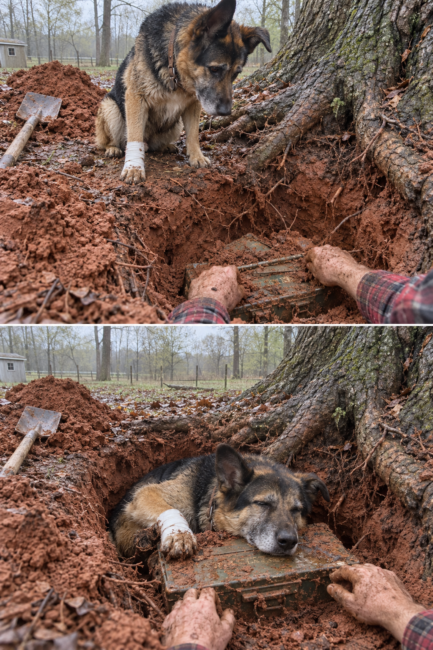
The dog walked over, lay down beside the can, and put his chin on top of it.
Then he sighed. A long, deep, exhausted sigh, like a man setting down a heavy load after a very long walk.
He closed his eyes.
“That’s it?” Danny whispered. “This is what you were looking for?”
The dog didn’t move.
Not a bone. Not a dead animal. Three weeks of bleeding paws for one rusty box.
Danny crouched down. Up close, he could see how bad it was. The dog’s pads were split open. Dirt was ground into the raw flesh. One claw was torn half off.
“Okay,” Danny said quietly. “Okay, buddy. Come on.”
He carried the ammo can to the porch. The dog followed right at his heels, never taking his eyes off it.
For the first time in three weeks, Danny opened the back door and let the dog inside.
The shepherd didn’t sniff around the way a strange dog does. He didn’t hesitate. He walked straight through the kitchen, into the living room, and lay down on the rug in front of the brick fireplace. Right in the corner, by the hearth, where the floor dipped a little. As if that spot had always been his.
Danny stood in the doorway and watched him for a long moment.
Then he got a bowl of warm water and an old towel. He sat on the floor and cleaned the dog’s paws one at a time, picking out the grit, wrapping the worst one in gauze from the bathroom cabinet. The dog let him do it without a sound. When Danny finished, the dog licked his wrist once.
Right over the thin white scar on the back of Danny’s left hand.
Danny pulled his hand away.
He went to the kitchen and poured himself a whiskey. His hands were shaking. He set the glass on the coffee table and sat down on the couch with the ammo can at his feet.
Before he could pick the glass back up, the shepherd got up off the rug, walked over, and nudged the glass with his nose. Slowly and deliberately. Right off the edge of the table.
It shattered on the floor.
“Hey!” Danny jumped up. “What is wrong with you?”
The dog looked at him calmly. Then he lay down at Danny’s feet, between Danny and the broken glass.
Danny stared at him. Then at the can.
He knelt and pulled the clamp handle. The lid groaned open.
Inside, everything was wrapped in plastic freezer bags. On top was a worn olive-green wool watch cap. Beneath it, a thin chain with two stamped metal dog tags. And beneath that, a thick bundle of envelopes, maybe two dozen of them, tied together with brown twine.
On the very top of the pile, in a freezer bag of its own, was an old color photograph.
Danny lifted it out.
It showed a German shepherd sitting on a front porch. A black-and-tan shepherd, younger, without the gray muzzle, wearing a red service-dog vest. Beside him, just at the edge of the photo, were the legs of an old man in jeans and work boots sitting in a rocking chair.
The dog had one ear that flopped over at the tip.
And the porch was this porch. The same white railing. The same chipped green step. The same rusty mailbox in the background with the number 214.
Danny looked from the photo to the dog lying at his feet.
This dog wasn’t a stray.
He had lived here.
Part 3: The Man Who Lived Here Before
Mrs. Ada Pruitt had lived across Oak Hollow Road for fifty-one years. She was eighty-three, sharp as a tack, and she missed nothing.
When Danny knocked on her door that afternoon with the German shepherd at his side, she put a hand over her heart.
“Gunner,” she said. “Oh, sweet Lord. Gunner.”
The dog’s tail swept back and forth. She bent down, and he pushed his gray face into her hands.
“You know him,” Danny said.
“Know him? I fed him every time Walt had a doctor’s appointment.” She looked up at Danny, eyes wet. “Where on earth did he come from?”
“He’s been digging in my backyard for three weeks.”
Mrs. Pruitt sat down slowly on her porch swing. “Then he came home,” she whispered. “He came all the way home.”
“Who’s Walt?”
She looked at him strangely. “Walt Reese. The man who owned your house. Forty years he lived there. Didn’t the realtor tell you?”
Danny’s face went pale. He didn’t answer.
“He was a Vietnam vet,” Mrs. Pruitt went on. “Marine. Came back from the war in pieces, the way a lot of them did. Nightmares. Temper. And he drank, Lord, he drank. For years.” She shook her head. “His wife died young. He was a hard man to be around.”
Danny sat down on the porch steps. He didn’t look at her.
“But about fifteen years ago, he got sober,” she said. “Went to the VA. Did the therapy, the meetings, all of it. Then eight years ago, they gave him Gunner.” She smiled down at the dog. “A psychiatric service dog. Trained just for veterans like Walt. That dog woke him up from his nightmares. Lay on his chest when he panicked. And if Walt ever reached for a bottle, Gunner would knock it right out of his hand.”
Danny thought of the whiskey glass shattering on his living room floor.
“Gunner saved that man’s life,” Mrs. Pruitt said. “Walt told me so himself. More than once.”
“What happened to him?”
Her face fell. “Cancer. He found out a year and a half ago. Last summer he got too sick to live alone, so he sold the house and moved into the VA hospice up in Columbia.” She hesitated. “They let him bring Gunner.”
“Is he still…”
“I don’t know,” she said. “I called a few times. He didn’t want visitors. Said he didn’t want anybody to see him like that.” She looked at the dog. “But if Gunner’s here, wandering on his own, then I’m afraid…”
She didn’t finish.
Danny looked down at his hands. At the thin white scar across the back of his left one.
“Mrs. Pruitt,” he said quietly. “Did Walt ever… did he have any family?”
The old woman was quiet for a long time.
“He had a son,” she said finally. “Walt didn’t talk about him much. Only once, really, one Christmas, after he got sober. He said he’d had a boy, and that he’d done something unforgivable, and the boy left and never came back. Said he’d ruined it. Said it was the worst thing he ever did in his life.”
“Did he say the boy’s name?”
“No.” She shook her head. “Never once. I think it hurt too much.”
She was looking at Danny now. Really looking. Her eyes narrowed. She leaned forward on the swing.
“Funny,” she said slowly. “I keep thinking it. Ever since you moved in. You look so familiar. Something about your face.”
Danny didn’t say anything.
“You’ve got his eyes,” Mrs. Pruitt said. “You’ve got Walt’s eyes exactly.”
The coffee mug she’d handed him slipped out of Danny’s fingers and shattered on her porch steps.
Part 4: Twenty-Six Letters
“My name is Daniel Walter Reese,” Danny said.
He was sitting on Mrs. Pruitt’s porch steps with broken pottery at his feet. He couldn’t look at her.
“I grew up in that house. I left when I was nineteen. I haven’t spoken to my father in twenty-six years.”
Mrs. Pruitt pressed both hands to her mouth.
He told her the rest, slowly, staring at the gravel road.
His mother died of a heart attack when Danny was fifteen. After that, it was just Danny and his father in that little white house, and his father’s drinking got worse. Much worse. The nightmares. The shouting at three in the morning. The holes punched in the hallway wall.
The night of Danny’s nineteenth birthday, his father came home drunk and found Danny packing. He’d enlisted in the Navy. Wanted to get as far away as he could.
“He went crazy,” Danny said. “Said I was abandoning him, like everybody else. He threw a bottle. It shattered on the counter and a piece caught my hand.” He touched the white scar. “I said I hated him. He said, ‘Then get out and don’t ever come back.'”
So he didn’t.
Twenty years in the Navy. A marriage. A divorce last spring. Somewhere along the way, he heard from a cousin that his father had moved to Florida with some woman. Danny believed it. It was easier to believe.
“After the divorce, I couldn’t sleep,” Danny said. “One night I was scrolling real estate listings, and there it was. Our house. ‘Estate sale, elderly owner relocating to care.’ I figured Dad had sold it from Florida. I bought it that same day.” He laughed, a broken sound. “I don’t even know why. I think I wanted to stand in that kitchen and prove to myself I’d survived it.”
“And the oak,” Mrs. Pruitt said softly.
“My tree fort was in that oak,” Danny said. “Dad built it for me when I was eight. Before Mom died. Before everything.” His voice cracked. “I couldn’t make myself walk over there.”
That evening, Danny sat on the living room floor in front of the fireplace with the ammo can open in front of him. Gunner lay beside him with his head in Danny’s lap.
Danny untied the twine.
There were twenty-six envelopes. Each one was addressed in the same blocky, careful handwriting.
Danny.
No stamps. No address. Each one was dated. The same date, every year.
His birthday.
The first was from twenty-five years ago. The handwriting was shaky, the paper stained.
Danny. You’ve been gone a year today. I’m drunk writing this. I don’t know where you are. I’m sorry about your hand. I’m sorry about everything.
The next year. And the next. Some were only a few lines. Some were pages.
Fifteen years ago, the handwriting changed. It got steadier.
Danny. I’ve been sober 90 days. The VA has me in a program. I think about you every single day. I picked up the phone four times this week. I couldn’t do it. I don’t have the right.
Eight years ago:
Danny. I got a dog. His name is Gunner. The VA trained him for guys like me. Last night I had the dream about the river again, and he climbed up on my chest and licked my face until I woke up. First time in forty years somebody pulled me out of that dream. I wish you could meet him. You always wanted a dog. I never let you have one. I’m sorry for that too.
Danny read every letter. One after another. By the fireplace, until long after midnight.
Every single one ended the same way.
I love you, son. I always did. I just didn’t know how to show it.
Danny was crying so hard he couldn’t see the words. Gunner pushed his head against Danny’s chest and held still, his warm weight pressing down, the way he’d been trained. The way he’d done for Walt on a thousand bad nights.
When Danny could breathe again, he wiped his face and looked at the empty can.
His father had been in the VA hospice in Columbia last summer. Sixty miles away. Maybe he was still there. Maybe there was still time. He reached for his phone.
Then he noticed something at the very bottom of the ammo can. Wedged flat beneath where the letters had been.
One more envelope. Thick. White. Official.
Printed in the corner was the seal of the U.S. Department of Veterans Affairs.
Part 5: Twenty-Three Days
Inside the official envelope were two pieces of paper.
The first was a letter from an oncologist at the Harry S. Truman VA Medical Center in Columbia, dated the previous July. Danny read it twice before the words made sense.
Stage IV pancreatic cancer. Metastatic. Prognosis approximately six months. Recommend hospice care.
The second paper was handwritten. In his father’s blocky, careful print.
It was a funeral notice. The kind they print in the local paper. His father had written it himself.
Walter James Reese, 78, of Rolla, Missouri, passed away on ________. He served his country in the United States Marine Corps in Vietnam. He was preceded in death by his wife, Margaret. He is survived by his son, Daniel, and his dog, Gunner.
The date was blank.
Danny’s hands were shaking so badly he dropped the paper.
He grabbed his phone. It was one in the morning. He called the VA hospice in Columbia anyway.
A night nurse answered. Her name was Teresa. When Danny said his father’s name, she was quiet for a long time.
“Are you family?” she asked gently.
“I’m his son.”
A longer silence.
“Oh, honey,” Teresa said. “I’m so sorry. Walt passed away twenty-three days ago.”
Danny sat down on the floor.
Twenty-three days.
Three weeks and two days. The same day a German shepherd had appeared in his backyard and started to dig.
“His dog,” Danny whispered. “Gunner. How did he…”
“After Walt passed, a VA volunteer took Gunner to foster. She lives out near St. James.” Teresa sighed. “He got out the very first night. Squeezed under her fence. She searched for weeks. We all thought…” She paused. “St. James is over twenty miles from Rolla.”
Twenty miles. With no collar tag. On roads he’d only ever traveled in the back seat of a truck.
He had walked home.
“Was anybody with him?” Danny asked, his voice barely a whisper. “When he died?”
“Gunner was,” Teresa said. “Right there on the bed with him. And me. And the chaplain.” She hesitated. “We held a small service at Jefferson Barracks National Cemetery. Two VA volunteers came. That was all.”
Danny closed his eyes.
His father had been buried with no one there. And Danny had been sixty miles away, sleeping in his father’s house, drinking at his father’s window, walking past his father’s oak tree every day without knowing.
“Mr. Reese?” Teresa’s voice was soft. “There’s something you should know. Every single day he was here, Walt asked me the same question. Every morning, when I brought his medicine.”
“What question?”
“‘Did anybody call for me today?'” She swallowed. “And every day I had to tell him no.”
Danny couldn’t breathe. He hung up without saying goodbye.
He sat on the living room floor in the dark, the funeral notice in one hand and his phone in the other. Twenty-six letters scattered around him. Twenty-six years of I’m sorry and I love you, and not one of them sent.
And now there would never be an answer.
He got up. He walked into the kitchen. He took the whiskey bottle down from the cabinet, his hands shaking, and unscrewed the cap.
Gunner was on his feet instantly. He crossed the kitchen in three strides and pushed his body between Danny’s legs and the counter, pressing hard.
Danny looked down at him. Then at the bottle.
He didn’t pour it.
But he didn’t put it down, either.
He stood frozen in his father’s kitchen at two in the morning, holding the same kind of bottle his father had held, at the same counter, where a broken bottle had once cut his hand open.
Back in the living room, under the scattered letters, one envelope was still sealed.
The last one. Dated August.
Part 6: The Last Letter
Gunner turned and walked back to the living room.
He stopped by the scattered letters, nosed through them, and picked one up gently in his mouth. Then he brought it back to the kitchen and set it at Danny’s feet.
The envelope from August. The only one Danny hadn’t opened.
Danny set the whiskey bottle on the counter. He picked up the letter and slid down the cabinet to sit on the kitchen floor. His hands were shaking so much he tore the envelope in half getting it open.
Danny,
The realtor came to the hospice today with the papers. She told me who bought the house.
I made her say your name three times. I thought the morphine was playing tricks on me. Then I cried like a baby in front of her.
You came home, son. After all this time. You came home.
I wanted to call you so bad. I had the phone in my hand. But I’m dying, Danny, and I look it. I didn’t want the first time you saw me in twenty-six years to be an old man in a hospital bed begging you to forgive him. You’d feel like you had to. That’s not fair to you.
So I’m doing it this way. I’m burying these letters under the oak. Right where your tree fort ladder used to stand. I figure if you ever make peace with that tree, you’ll find them.
There’s one more thing.
When I’m gone, they’ll take Gunner somewhere. He’s a smart dog. Smarter than me. He watched me bury this box. If he ever finds his way back to you, please take him.
He’s the only thing I have left to give you.
He’s the reason I got sober. He’s the reason I stopped wanting to die. Every time I reached for a bottle, he stood in my way. Every time the nightmares came, he pulled me out. He gave me fifteen good years I didn’t deserve.
Let him do the same for you.
I know about the drinking, son. Your cousin told me, after your divorce. I know what it does to a man. I know what it did to me. I know what it did to you, because of me.
Don’t let it take you like it took me. Let the dog stand in your way.
I love you, Danny. I always did. I just didn’t know how to show it.
Dad.
Danny read it until the words blurred. Then he put his face in his hands on the kitchen floor and cried the way he hadn’t cried since he was fifteen years old, the night they told him his mother was gone.
Gunner lay down against him, his heavy body pressed along Danny’s side.
Danny finally understood.
The dog hadn’t been digging for a box. He’d been digging for Walt. For the last thing Walt had touched, the last place his scent was in the ground. The wool watch cap. The dog tags. Twenty miles on bleeding paws, twenty-one days in the rain, because he’d lost his person and the only piece left of him was buried under that oak.
And then, when he finally got it out, he’d walked into the house and knocked a glass of whiskey off the table.
Doing his job. The job the VA had trained him for. The job he’d done for Walt for eight years.
Except now, he was doing it for Walt’s son.
Danny looked over at the bottle on the counter. Three weeks of watching the rain from that kitchen window, three glasses a night and climbing. He knew exactly where that road went. He’d grown up at the end of it.
His father had seen it coming, from a hospice bed sixty miles away. And he had sent the only help he had left.
Gunner hadn’t come home to be rescued.
He’d come home to rescue Danny.
Danny stood up. He picked up the bottle. He walked to the sink and poured every drop down the drain, while Gunner watched, his tail thumping slowly against the floor.
Then Danny sat back down on the kitchen floor and pulled the old dog into his arms.
“Okay,” he whispered into the gray fur. “Okay. You can stand in my way.”
At nine the next morning, the VA foster coordinator called. They’d heard Gunner had been found. They could pick him up that afternoon.
“No, ma’am,” Danny said. “He’s not lost. He’s home.”
That afternoon, Danny put the dog in the passenger seat of his truck and drove two hours east, toward St. Louis.
There was someone they both needed to see.
Part 7: What He Dug Up
Jefferson Barracks National Cemetery stretched across the green hills above the Mississippi River in long, perfect white rows.
It took Danny almost an hour to find the right one. Gunner found it first. He pulled ahead on the leash, nose to the grass, and stopped in front of a new white marble headstone, the sod still fresh around it.
WALTER JAMES REESE. CPL. U.S. MARINE CORPS. VIETNAM.
Gunner lay down on the grass in front of the stone and put his chin on his paws. He didn’t dig. He just lay there and sighed.
Danny knelt beside him.
From his jacket pocket, he took out an envelope. On the front, in his own handwriting, it said Dad.
He’d stayed up all night writing it. The first letter in twenty-six years that went the other direction.
He read it out loud. About the Navy. About the divorce. About the night of his nineteenth birthday, and how he’d been angry for so long that he’d forgotten the tree fort, and the fishing trips, and the way his father used to sing off-key in the truck before Mom died. About the twenty-six letters. About pouring the bottle down the drain.
“You were right, Dad,” he said, his voice breaking. “He stood in my way.”
Then he folded the letter and tucked it into the grass at the base of the stone.
That spring, Danny went to his first meeting at the VA in Rolla. Then his second. Then every Tuesday. He hung his father’s dog tags from Gunner’s collar, right beside the old frayed brown one. The new tag he had made said simply: GUNNER. Home.
On the first warm Saturday in April, Danny walked out to the oak tree with a shovel.
Gunner followed and sat beside the hole he’d spent three weeks digging.
This time, it wasn’t a dog digging alone in the mud, desperate to bring something up out of the ground.
It was a man and his dog, side by side, putting something in.
Danny set a young lilac bush into the hole. His mother’s favorite, the kind that used to bloom along the porch before she died. He packed the dirt down around it with his hands. Gunner nosed the soil and then lay down beside it, perfectly still.
Then Danny stood, wiped his hands on his jeans, and looked up into the branches.
High above, nailed into the crook of the oak, two weathered gray boards still hung. All that was left of a tree fort an old Marine had built for his eight-year-old son, a long time ago.
That evening, Danny sat on the back porch with a glass of iced tea. Gunner lay with his head on Danny’s boot, watching the oak tree in the last of the light.
For twenty-one mornings, that dog had dug in the dirt to bring a father back to his son.
He didn’t need to dig anymore.
Everything he’d been looking for was right here.
If this story touched your heart, follow our page for more stories that remind us why dogs are the best of us. ❤️