Part 2: A Three-Legged Pit Bull Hid Beneath an Unused Bus During a Cold Snap — When He Finally Came Out, the Retiring Driver Called His Wife Instead of Going Home
Part 2, The Question Janet Asked
Janet let me finish before she said anything. I told her about the bus, the missing leg, and the paw resting on my knee. Then I said the sentence that had seemed perfectly reasonable until I heard it aloud: “I think he chose me.”
“Maybe he chose somewhere steady to sit,” she said gently. “We can start there.”
She wasn’t dismissing what had happened. She was making it small enough to be real. We had shared a house for thirty-six years, and she knew that I sometimes mistook a strong feeling for a complete plan. She also knew there was a frightened animal beside me who would have to live with whatever we decided after the feeling passed.
Our old dog, Lou, had died three years earlier. We still owned his bowls, but we had donated the bed and given away the unopened food. Bringing another dog into that space required more than remembering how much we had loved the first one.
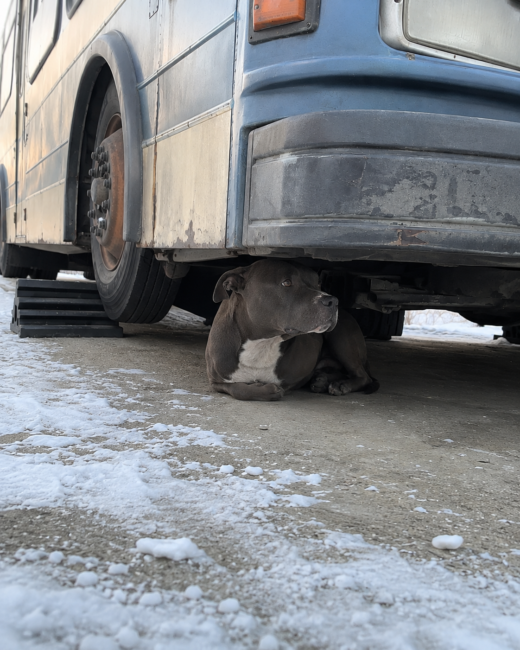
“Ask what he needs tonight,” Janet said. “Then tell them we can talk about tomorrow.”
Marisol was kneeling several feet away. I repeated Janet’s words, and she nodded toward the carrier, a rigid, low-sided transport box she had lined with dry blankets. The dog would need an examination before anyone discussed placement. He also needed a safe way across the yard, because the runner ended several feet short of her vehicle.
I looked at the paw again. Its nails were long, with a little depot grit pressed around them. When I adjusted my leg, he removed it immediately. He remained beside me, but the moment had not granted me permission to touch everything he owned.
That distinction became important.
Marisol brought a padded harness into view and let him investigate it. She did not slip it over him while he was distracted. When he turned away, she paused. We used small pieces of food and several quiet minutes to let the equipment become another object on the ground instead of something arriving at his neck.
He allowed the harness after a second pause, with Marisol working beside his right shoulder. She checked the fit carefully around his altered chest and kept the attached lead loose. There was no missing leg to thread through, and she adjusted the equipment for the body actually in front of her.
Then the wind lifted one edge of the runner.
His right paw skidded half an inch. He dropped his chest and scrambled backward toward the bus, bumping my boot with his hindquarters. I reached out by instinct and stopped before my hand touched him.
Marisol lowered her hand instead of following him.
We had not lost every bit of trust. We had found the edge of what he could manage.
She weighted the runner and asked a maintenance worker to bring another mat. He approached from the far side, set it down, and withdrew. The route to her vehicle became a connected strip of rough rubber with no exposed ice between sections.
The dog watched it being built.
We could have tried to walk him the whole way. Marisol didn’t think the extra effort was necessary. Once he had returned to the runner, she positioned the carrier beside him, allowed him to sniff its blanket, and explained how we would lift him together if he tolerated our hands.
He stiffened at the first touch beneath his chest. We waited. At the next gentle contact, his head turned toward me, but he did not pull away.
We supported his chest and hindquarters together, keeping him level, and lowered him into the carrier without lifting by the harness. His right paw found the folded blanket. His ears stayed back. This wasn’t comfort yet, but it was safer than the ground.
Marisol secured the carrier in her vehicle. Before closing the door, she gave him a moment to see where I stood.
I called Janet again.
“He’s going to the clinic,” I said.
“Then that’s where you should go.”
For the first time that evening, going home and doing the next necessary thing were two different directions. I put my thermos on the passenger seat and followed the rescue vehicle out of the yard.
Part 3, A Body With Its Own History
At the clinic, I discovered how little we actually knew. We had a dog, an approximate age, and a place where somebody had noticed him. Everything else was blank space that people were already trying to fill.
One technician asked whether he had been abandoned. I said I didn’t know. Another asked when he had lost the leg. I didn’t know that either. Finding him frightened did not explain his past, and I was beginning to understand how easily sympathy could turn guesses into facts.
The veterinarian, Dr. Patel, examined him on a padded floor because he became rigid when the staff approached the table. I sat near the wall, outside her working space. He watched me, but when she offered him food, he watched her too.
That was encouraging in a way I hadn’t expected. I wanted to matter to him. I also needed him to be able to accept help from someone else.
Dr. Patel estimated that he was around four years old. His left foreleg had been surgically removed at the shoulder, and the site was well healed. She could not tell us why it had been removed without records. There was no new wound beneath the fur, and the missing limb was not something the evening’s treatment would change.
He was chilled, tired, and mildly dehydrated. Staff warmed him gradually and monitored him while the examination continued. His remaining front paw had superficial irritation from rough ground, but there was no visible deep injury. The veterinarian checked how he shifted his weight and how he responded when she examined his other limbs.
“Three legs aren’t the emergency,” she told me. “The cold, the fatigue, and getting him somewhere suitable are what we’re dealing with now.”
I wrote that down on the back of my final week’s route sheet.
They scanned for a microchip and found none. Marisol documented where he had been found and arranged the required found-animal reporting and owner search. Someone might still be looking for him. A wish to keep him was not proof that he was ours.
Janet arrived carrying my dry socks and a plastic container of stew. She had brought neither a new collar nor an adoption speech. She asked the technician where she could sit.
The dog lifted his head when she entered, then pulled his right paw closer beneath his chest.
“He does that,” I said.
“Then I’ll stay here.”
She sat beside me and set the food on a chair. For twenty minutes, she talked quietly about the route home, the state of our driveway, and the fact that my thermos had somehow leaked into the passenger seat again. The dog eventually lowered his chin.
Janet noticed before I did. She stopped moving the zipper on her coat.
Later, the clinic placed him in a quiet overnight enclosure with thick bedding and nonslip flooring. I didn’t like leaving him, which was not a medical reason for taking him away. The staff wanted to observe him after warming and make sure he could rest, eat, and move comfortably.
I stood outside the enclosure too long.
He stood up.
When I crouched, he leaned toward the gate, then withdrew his paw again. I could feel myself trying to manufacture a second version of the moment beside the bus.
Janet touched my elbow.
“He doesn’t have to do it again.”
We left our numbers, confirmed the morning update, and walked out. In the car, I told her that I had thought retirement would mean finally being available whenever something needed me.
“It might,” she said. “But being available isn’t always the same as staying in the room.”
At home, we moved a stack of magazines from the downstairs hallway and measured the step at the back door. We did not dismantle the house that night. We made a list and waited for information.
The clinic called the next morning while I was buttoning my uniform. He had eaten a small meal, rested, and allowed staff to take him outside with support available.
Then the technician added a detail that stayed with me all day.
When she returned him to his enclosure, he had gone straight back to the blanket and put his chin down without watching the door.
He had slept without needing my knee.
Part 4, The Room We Thought Was Ready
He spent the next several days with the rescue while the owner search continued. Marisol photographed him from both sides, including the healed left shoulder, and recorded the white comma near his right nostril. The depot shared the found notice through its ordinary channels. Nobody published a story about a cruel owner, because we did not have one to tell.
Janet and I visited when the staff said it would be useful. On our first visit, he accepted food from her but avoided my outstretched hand. I had come directly from work in my thick winter gloves. When I removed them and stopped reaching, he approached on his own.
It was a useful correction to the story I had been telling myself. He hadn’t recognized a good man beneath a bus. He had tolerated a particular man who was sitting quietly in a particular way.
We would have to learn each other elsewhere.
The rescue called him Otis after one of the staff suggested it during intake. He turned toward several names because people usually said them while offering something interesting. There was no revelation in the choice. Still, when Janet tried “Otis” in the car afterward, we both knew which dog she meant.
Before approving us as temporary fosters, the coordinator asked about work hours, transport, stairs, and money. My approaching retirement helped with time, but it didn’t answer everything. Janet still worked three mornings a week at the library, and neither of us could safely carry a medium-sized dog up our narrow staircase.
We agreed to a life on the ground floor.
A home visit followed. The coordinator looked at our fenced yard, the back-door threshold, and the places where our rugs shifted. She suggested a ramp for the step and securely backed runners across the kitchen. We arranged a quiet resting area where Otis could observe the room without being surrounded by people passing.
I bought the most expensive orthopedic bed in the pet store.
It was thick, soft, and large enough to make the corner look occupied before he arrived. I pictured him stretching out on it while I drank coffee after my final shift. Janet pressed a hand against its edge and asked whether it would move.
I said the label called it supportive.
She turned it over and checked the bottom.
We brought Otis home under a foster agreement after the rescue cleared the arrangement. The owner search and required process remained the rescue’s responsibility; we were providing care, not declaring the search finished. His written plan included follow-up examinations, controlled activity, secure footing, and ways to help him rest without crowding.
He entered through the back door using the ramp with a worker beside him. Inside, he paused where the kitchen runner met the hallway mat. His right paw tested the join before he committed his weight.
I had never watched flooring so closely in my life.
He inspected the water bowl, the open crate, and the space beneath the kitchen table. He did not lie down on the expensive bed. Instead, he folded himself onto the flat mat near the wall, with his left shoulder turned away from the main path.
Nobody moved him.
The first evening passed in ordinary fragments: a meal, a short trip outside, a dishwasher opening too loudly. He lifted his head at each sound. When Janet walked through the room carrying folded towels, he stood, waited for her to pass, and lay down again.
At bedtime, I started to settle in the chair beside him.
Janet asked whether the rescue had told us to stay awake all night. They hadn’t. We had arranged to sleep downstairs at first, but that didn’t require staring at him until morning.
We lowered the lights. Otis watched us settle, then rested his chin on the mat.
For five days, the house got easier by inches. He began drinking while we were in the room. He followed Janet to the back door. He accepted a brief scratch along his right shoulder, then walked away when he had enough.
On the sixth evening, I decided it was time to show him how comfortable his new bed could be.
I moved it closer and placed a treat at the center.
He stepped onto the edge with his remaining front paw. The foam compressed, the base slid across the floor, and his chest dropped.
The bed moved. Otis stopped trusting the room.
Part 5, Six Inches Backward
He scrambled off the bed and hit the runner at an angle. His hind feet found traction first; his right front paw slipped before it caught. He stood trembling beside the kitchen table, with his head low and his body pointed toward the back door.
I said his name and took a step.
He backed away.
Nothing about his reaction was confusing, but I still felt the urge to explain myself. The bed was supposed to help. The treat was supposed to encourage him. I had spent five days trying to make the house comfortable, and one moving object had made all that intention irrelevant.
Janet asked me to stop where I was.
She cleared the route to his original mat and moved the bed out of sight. We gave him space instead of trying to persuade him across the same patch of floor. After several minutes, he settled behind the table, but he kept his right paw tucked tightly beneath his chest.
We contacted the rescue and followed its advice about the evening. Because the stumble could have strained a limb he relied on heavily, we arranged a veterinary reassessment. I didn’t want to decide that everything was behavioral simply because there was no blood.
At the clinic, Otis walked cautiously but bore weight on his right front leg. The veterinarian examined him and found no evidence of an acute injury at that visit. She gave us signs to watch for and adjusted the short-term activity plan. If his movement changed or discomfort persisted, we were to contact her again.
“Don’t make him prove he’s fine,” she said.
At home, that sentence turned out to apply to more than walking.
For two days, he avoided the middle of the kitchen. He would eat on his familiar mat, but he would not follow me across the floor. Once, when I lowered myself beside him, he rose and moved away.
I sat there after he left.
Janet found me looking at the empty mat as though it might explain what had happened to the dog who had chosen me beside the bus.
“He’s still here,” she said. “And you’re still allowed to get something wrong. You just have to change what you’re doing.”
The rescue’s behavior worker came to the house. She watched the route from Otis’s resting place to the door, pressed the edges of our runners, and asked us to stop placing treats on surfaces we wanted him to attempt.
An invitation needed somewhere safe to end.
We replaced the sliding bed with a firm, low resting pad on a secured nonslip base. The walkway became continuous. We kept the furniture still and let Otis investigate changes without calling him toward them.
The worker suggested that I spend quiet time nearby without making his approach the purpose of the session. Read something, she said. Fold laundry. Do an ordinary thing that didn’t require him to participate.
I brought my book into the kitchen.
The first afternoon, he stayed behind the table. The second, he lay along the wall. On the third, he slept for fifteen minutes while I read about a baseball season I barely remembered.
There was no paw on my knee.
There was a dog asleep in my company, which I had been too busy waiting for another moment to appreciate.
My final shift arrived that Friday. Coworkers brought a grocery-store cake, and my supervisor handed me a framed photograph of the depot taken before half its current buildings existed. Somebody asked whether I had retirement plans.
“I’m improving our floors,” I said.
They laughed, and I let them.
At home, Otis watched me set the frame on the counter. I changed out of my uniform and put my boots in the usual place. When I returned to the kitchen, he was smelling one of them.
I did not turn it into an invitation.
That evening, he crossed the repaired route to his water bowl without pausing at the old gap. On the way back, he stopped beside my chair and smelled my trouser leg.
Then he went to his mat.
It was less dramatic than the first hour beside the bus, and it took much longer to earn.
I left the floor exactly as it was.
Part 6, A Route With No Timetable
The first Monday without a shift, I woke at four forty-five and lay still, waiting for the familiar calculation of coffee, weather, and drive time. Downstairs, a collar tag clicked once against a water bowl. Otis had been fitted with identification for his foster placement, and I was still learning the sounds it added to the house.
I got up because I was awake, not because he needed breakfast immediately.
That difference mattered. The rescue had asked us to keep a routine he could rely on after the novelty of my retirement wore off. Janet would still work mornings. I would still have appointments. Being home more often did not mean never leaving.
We practiced brief, manageable absences using the plan the behavior worker helped us establish. Sometimes Janet stayed while I went to the garage. Sometimes I read in the front room while Otis rested in the kitchen. We watched for distress and adjusted the pace instead of treating a closed door as a test he had to pass.
He learned where we went.
We learned that he preferred watching the hallway from the side, where nobody had to step over him. We moved his mat there once, with him free to observe the change, and left it there.
Outside, the cold remained a practical concern. His missing left foreleg had not made him incapable of moving, but icy surfaces and unnecessary distance asked more of the limbs he had. We kept the cleared route short, used the ramp, and let his energy and veterinary guidance shape the day.
I had spent thirty-one years apologizing for running late.
With Otis, I started noticing when a shorter route was enough.
He liked a particular patch of fence where neighborhood dogs had left news I couldn’t read. He would investigate it carefully, shift his weight, and turn toward the house. I stopped asking whether he wanted to go farther when his body had already answered.
At a follow-up visit, the veterinarian reviewed his movement and the condition of his remaining front paw. The irritation had settled. His comfort, weight, and activity would need ongoing attention, as they would for any dog with his particular demands on three limbs. There was no dramatic treatment ending, just a plan we could keep using.
I asked whether he needed special equipment forever.
She asked what problem I wanted equipment to solve.
I thought about the expensive bed and answered more carefully than I would have a month earlier. At present, his secure harness, stable surfaces, and accessible doorway were doing useful work. We could reassess other supports if his needs changed.
We could adapt his home without filling it with equipment.
By the fourth week, Otis had developed opinions unrelated to being rescued. He disliked the vacuum standing in the hallway but ignored it in the closet. He would carry one of Janet’s garden gloves to his mat if she left it within reach. He preferred drinking from the kitchen bowl even when another bowl was closer.
One afternoon, he gave a short, surprised bark at his reflection in the dark television screen, then looked behind it.
Janet laughed into her sleeve. He wagged once at the sound.
Those were the updates we began sending Marisol: not only whether he ate or walked, but whether he had investigated something, chosen a resting place, or asked to go outside.
His life was getting larger than the rescue.
The required owner-search process ended without a verified claimant. The rescue continued keeping his found records, and we continued to acknowledge that someone else’s part of his history remained unknown. Neither the missing leg nor his fear told us who had cared for him before.
When the coordinator asked whether we wanted to discuss adoption, Janet and I sat at the kitchen table with our budget, his care plan, and the name of a nearby friend willing to learn his routine for emergencies.
Otis lay on his firm pad a few feet away.
I waited for the rush I had felt beside the bus. It didn’t come. What I felt instead was familiarity: the location of his lead, the turn he made before lying down, the extra mat we kept drying by the back door.
We already knew what tomorrow would require.
“Yes,” I told the coordinator. “Let’s talk about keeping him.”
Part 7, The Knee Beside the Kitchen Chair
The adoption became final eight weeks after I found him. By then, the snow had begun shrinking into dirty ridges along the depot fence, although our back steps still needed checking every morning.
Marisol came to the house with the paperwork. Otis watched her enter, smelled the hem of her coat, and returned to his mat. She accepted the greeting without calling him back.
The forms listed a male Pit Bull mix, approximately four years old, slate gray with white markings, missing his left foreleg at the shoulder. They recorded what the rescue knew, what the clinic had found, and the follow-up care we had agreed to provide.
There was no box for the first hour.
There was also no box for the bed that had slid, the kitchen book, or Janet reminding me that one paw on my knee did not require Otis to spend the rest of his life confirming my interpretation of it.
I signed where Marisol indicated. Janet signed after me. Otis slept through both signatures.
Before leaving, Marisol asked whether we had questions.
I asked if she thought he remembered the bus.
She considered that for a moment. “We can’t know how he remembers it,” she said. “We can pay attention to what helps him here.”
It was the kind of answer I had come to trust: useful without pretending to know more than the dog could tell us.
I visited the depot the following week to return a borrowed maintenance mat. I had cleaned it twice, and the corner still held a narrow line of dog hair.
Bus 214 remained in the secured area, waiting for removal. In daylight, without Otis beneath it, the space behind the axle looked lower and smaller than I remembered. Wind moved an empty paper cup across the concrete.
A coworker asked whether I wanted a photograph beside the bus with the dog.
I said no. Otis was at home with Janet, asleep after his morning outing. Bringing him back for a picture would have served a story about him, not anything he needed.
Instead, I showed my coworker a photograph Janet had taken through the kitchen doorway.
Otis was lying on his pad with a garden glove between his paws—his right front paw and one hind paw drawn forward. His left shoulder was plainly visible. One ear had folded inside out.
He looked occupied, not grateful.
My coworker smiled and handed the phone back.
At home, retirement settled into activities too ordinary to have appeared in the speeches at my farewell lunch. I learned which runner needed checking after we mopped. I kept veterinary appointments on the kitchen calendar. I discovered that Otis could hear the lid of his food container from the far end of the house but sometimes ignored his name from three feet away.
Janet continued going to work. I continued leaving for groceries and the occasional lunch with old drivers. Our friend learned the harness and the route through the yard. We gave Otis a life with more than one pair of hands available to him.
He was allowed to belong without depending on one person for everything.
One evening, I sat in the kitchen chair mending the loose seam of a winter glove. Janet was rinsing mugs at the sink. The radio was low, and rain tapped against the window above her.
Otis got up from his pad, made his careful turn around the chair leg, and stopped beside me.
I put the needle on the table.
He settled onto his haunches, adjusted his hind feet beneath him, and rested his right front paw on my knee. This time there was no ice beneath us, no vehicle overhead, and no worker waiting with a carrier.
I let my hand rest loosely beside his paw.
Janet glanced over. “Do I need to answer the phone?”
“Not tonight.”
After a few seconds, he lowered his paw, crossed back to the pad, and lay down facing the room. I picked up the glove again.
He had somewhere warm to go without leaving us.
Janet dried the last mug. I checked that the walkway was clear. Outside, the rain continued, but there was nothing under the bus that I still needed to bring home.
Follow our page for more dog rescue stories about patient beginnings, practical kindness, and the ordinary moments that make a new home feel safe.