Part 2: A Three-Legged Pit Bull Refused to Sleep on His New Kennel Bed — But Every Time Staff Removed It, One Paw Stopped Them Before They Reached the Door
Part 2 — The Dog Who Measured Every Surface
Miles arrived on a Tuesday afternoon in late October, before the blue bed existed. An animal control officer found him sheltering behind a boarded machine shop after a nearby business owner reported a dog crossing the service road on three legs.
The officer did not chase him through the lot. She blocked access to traffic, opened a transport crate, and used food and time until he approached closely enough to be secured. Intake recorded a brindle male, approximately six years old, forty-nine pounds, with a healed left hind-limb amputation at mid-thigh.
No collar.
No registered microchip.
No owner came forward during the required search period, and no available record explained his surgery. We resisted filling that blank with a cruel story simply because cruelty would have been easy to write.
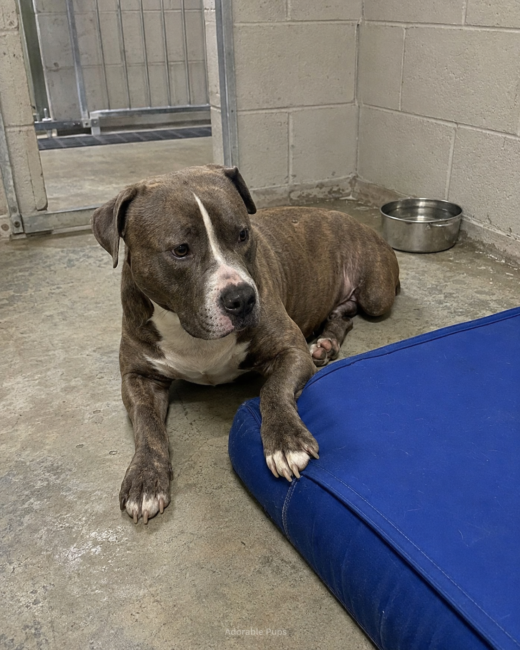
The veterinarian examined Miles on nonslip flooring. His healed surgical site showed no open wound or current skin breakdown. His remaining limbs carried extra work, as anyone could see from the way he spread his front feet before changing direction. The medical team checked his joints, gait, body condition, and comfort, then gave us an activity and flooring plan while follow-up continued.
Three legs were his body, not his tragedy.
The practical problem was balance. Miles crossed dry rubber mats with care and avoided loose fabric. If a towel folded beneath his right hind foot, he stopped rather than stepping through it. If a door track interrupted the floor, he lowered his head before crossing.
He also slept lightly.
During his first nights, Miles curled against the rear wall and woke whenever the latch clicked. His ears moved before his head. His right front paw slid forward as though testing whether the floor had changed while he slept.
I began sitting outside Kennel 18 after the first cleaning round. I faced sideways, read intake notes, and occasionally placed a piece of food where he could approach without passing my knees.
On day three, he ate while I was present.
On day five, he lay down before I left.
Trust arrived as a sequence of smaller decisions.
The donated blue bed entered the kennel on day four. It was rectangular, thick, and covered in washable fabric with a raised seam around the edge. We positioned its long side against the left wall, far enough from the gate to preserve a clear route.
Miles inspected it immediately. He smelled the far corner, the wall-facing edge, then the corner nearest the gate. When he pressed his right front paw into the foam, the surface sank and tilted his chest toward his missing side.
He stepped off.
We did not place him back on it. We left it available and recorded what he chose.
That night he slept on the concrete, parallel to the bed. His spine followed its long edge. His nose rested almost exactly two inches from the near blue corner.
The following morning, I opened the divider. Miles rose, moved to the clean side, drank, turned clockwise, touched the bed, and lay down.
I wrote the order on his behavior sheet.
The routine repeated after lunch. It repeated after evening cleaning. Even when he chose a different patch of floor, he touched the bed before settling.
Dana, our behavior specialist, asked whether the bed had shifted.
“Not that I know of.”
“Start marking its position.”
We placed two small pieces of removable tape outside the kennel, where Miles could not reach them, aligned with the bed’s corners. Staff documented the position after cleaning and avoided moving it unless necessary.
That might sound excessive for one cushion. In a shelter, small patterns can be information. A dog cannot tell us that a surface feels unstable or that an object helps him predict a room. We watch posture, timing, avoidance, approach, sleep, appetite, and recovery after stress.
For three days, the bed stayed between the marks.
Miles slept longer.
He still chose concrete.
Then a volunteer, trying to help, rotated the bed so the cleaner side faced the gate. Miles entered, completed his clockwise turn, reached toward the familiar corner, and found the seam running in the wrong direction.
He did not lie down for forty-seven minutes.
Once we returned the bed to its recorded orientation, he touched the corner and settled within six.
The bed was telling him something.
We just didn’t know what.
Part 3 — One Paw Is Not Possession
Shelter stories grow quickly around repeated behavior. By the end of the second week, half the kennel team had a theory about Miles and his blue bed.
One person thought he had once been punished for climbing onto furniture. Another thought the bed resembled something from his former home. A volunteer believed he was saving it for someone.
None of us had evidence.
Dana asked us to remove those explanations from the written record. We could describe what Miles did: slept beside the bed, avoided loading his weight onto its foam, touched the near corner after transitions, and interrupted removal by placing a paw on it.
We could not write his memories for him.
The distinction kept our observations useful. It also kept Miles from becoming a character in a story more dramatic than the dog in front of us.
His actual progress deserved attention.
He began approaching the front of Kennel 18 when I arrived. He accepted the fitted harness used for walks, although he turned his body so I fastened it from the right. Outside, he preferred level pavement and chose shorter loops after busy mornings.
When he returned, he drank, turned clockwise, and touched the bed.
Every time.
A volunteer named Calvin began working with him twice a week. Calvin was sixty-seven, moved slowly after knee surgery, and never tried to prove that Miles liked him. He sat outside the kennel with one hand resting on his own leg while Miles decided the distance.
On their fourth session, Miles lay against the gate.
Calvin did not reach through.
They shared six quiet minutes before another kennel door opened and Miles stood.
The bed ritual intensified only when the bed moved. During routine cleaning, we normally opened the divider and worked in the empty side. One afternoon, a leak inspection required the entire cushion to come out. Dana supervised so we could observe without forcing conflict.
I lifted the far handle while Miles remained behind the divider. He watched. His mouth closed, his ears angled backward, and his weight shifted onto his front legs.
When the divider opened, he crossed directly to the bed.
His right front paw landed on the corner.
He did not stiffen over the whole cushion. He did not hover above it or block us with his shoulders. His body stayed angled toward the route between the water bowl and gate.
One paw was enough.
Dana asked me to release the handle. Miles smelled the corner, walked to his strip of concrete, and lay down.
We repeated nothing that day.
Instead, Dana reviewed the overnight camera and our position notes. Miles touched the corner after sudden sounds, after waking, and after entering from the outdoor run. He rarely touched the far half of the bed.
The pattern looked less like ownership and more like checking.
To test the safer part of that idea, Dana changed one item that was not the bed. She moved the water bowl six inches to the left while the cushion remained aligned with its markers.
Miles entered.
He turned clockwise, approached the place where the bowl usually stood, and stopped. Then he stretched his paw toward the bed. He touched the near corner, repositioned his body, and located the water.
After drinking, he returned to the same corner before lying down.
The bed helped organize the room.
That conclusion remained provisional. Dogs may repeat actions for several reasons, and one short observation did not prove an elaborate thought process. But it gave us a practical question: could we provide a surface stable enough for him to use without taking away the fixed landmark he relied upon?
The original bed failed the first half of that question. Its foam compressed too deeply beneath a three-legged stance. When Miles tested it, his chest tilted and his remaining hind leg had to correct quickly.
We tried securing the base with a nonslip liner.
The bed stopped sliding, but the top still sank.
We offered a thin mat elsewhere in the kennel. Miles walked across it, proving that fabric itself was not the problem, yet he still returned to the blue corner before sleeping.
Dana proposed a firm, low platform pad cut to the same footprint, with the familiar blue cover fitted tightly over it. The medical team reviewed the plan and agreed that a stable, accessible surface was reasonable to try.
A local volunteer who repaired kennel equipment built the base. Nothing about it was decorative. It sat less than two inches high, had rounded edges, a sealed surface, and a nonslip bottom.
The blue cover was washed, measured, and secured so it could not bunch beneath Miles’s feet.
We planned the exchange for a quiet Tuesday morning. Before moving anything, I marked the exact position of the near corner and photographed the layout for staff reference.
The old bed came out while Miles waited safely in the other side.
The new one went down.
Same color.
Same footprint.
Same corner.
But when Miles entered, one inch had changed.
Part 4 — The Inch We Put Back
The new pad looked right to me.
Its blue cover followed the same wall. Its near edge lined up with the tape marker. The distance to the water bowl appeared unchanged.
Miles knew before I did.
He entered through the divider, made his clockwise turn, and reached with his right front paw. His nails brushed the floor instead of fabric. The custom pad had been placed one inch farther from the gate than the original bed.
Miles stopped.
His weight moved forward, then backward. He searched again with the paw, found the edge, and stood with his head low. He did not settle on the concrete.
Dana asked everyone to remain still.
I looked at the marker and saw that I had aligned the wooden base, not the padded blue seam that Miles actually touched. The object was technically in the place we had documented, but his landmark was not.
I apologized to a dog who did not need the word. Then I waited for Dana’s instruction.
We opened the divider again and allowed Miles to move away. While he watched from the other side, I shifted the pad exactly one inch toward the gate. The blue seam met the original point.
When Miles returned, he turned clockwise.
His paw reached.
Fabric answered.
He smelled the corner, then followed the long edge with his nose. At the center of the pad, he pressed his right front paw down. The surface gave only slightly. He brought his left front paw up, adjusted his right hind leg, and paused.
His missing left hind leg did not reappear, and the movement did not become easy simply because we wanted a good ending. He stood on three limbs, testing how the firm surface returned his weight.
Then he stepped fully onto the pad.
Nobody spoke.
Miles turned once. The turn was wider than it would have been on concrete, but his feet remained stable. He lowered his chest first, shifted his hip, and settled with his right hind leg folded beneath him.
For the first time in twelve nights, his entire body rested on the blue surface.
Calvin happened to be standing at the end of the aisle. He lifted one hand toward his mouth and left it there. I could hear a washer running in the utility room and a dog shaking a stainless bowl two kennels away.
Miles put his chin down.
The kennel kept making ordinary noise, and he stayed.
We watched through the camera rather than crowding the gate. Five minutes passed. Then ten. Miles lifted his head when a cart rolled by, touched the near corner with one front paw, and lowered it again without leaving the pad.
The first photograph we took was for his behavior record, not publicity. It showed his brindled body curled on the custom surface, his healed left thigh visible, and the blue seam beneath his right paw.
Dana wrote the time: 9:18 a.m.
The staff treated it as useful information. A stable, low surface in a consistent position allowed Miles to rest in a way the thick cushion had not. The veterinary team added no miracle to the note. His physical difference remained permanent; our environment had become more compatible with it.
We had changed the bed, not the dog.
That afternoon, Miles used the pad again after his walk. He slept for forty-three minutes without moving to the floor. At dinner, he carried one piece of food to the near corner before eating it.
The next morning, he chose concrete for his first nap.
I felt disappointed for three seconds, then caught myself. Access meant giving him a usable option, not requiring him to prove our design had succeeded.
The pad stayed.
Miles alternated between it and the floor. When he slept on concrete, he remained alongside the blue edge. When he slept on the pad, one front paw often touched the seam.
Both choices were his.
Word of the moment spread through the staff because shelter workers notice when a dog finally rests. Somebody called it a breakthrough. Dana used a less dramatic phrase: a repeatable reduction in uncertainty.
She was right.
For the next week, we kept the layout constant and recorded the same sequence. Miles drank, turned clockwise, touched blue, and chose a resting place. His sleep periods lengthened. His body loosened. He began lying on one hip instead of keeping his chest ready to rise.
The apparent ending seemed simple. Miles needed a firmer bed. We built one. He used it.
A photograph of him resting on blue fabric would have supported that story perfectly.
But Dana kept reviewing the footage.
She noticed that Miles touched the corner even when he had no intention of lying down. He touched it before drinking, after startling, and sometimes before approaching a person at the gate.
Then Calvin dropped a glove outside Kennel 18.
Miles looked at the glove, touched the blue corner, and walked toward it.
Dana watched the clip twice.
“The bed isn’t only helping him sleep,” she said.
It is helping him decide where everything else is.
Part 5 — The Bed Was an Anchor
That sentence changed the meaning of every night we had watched.
Miles had not spent eleven nights rejecting comfort while claiming ownership of it. He had been using the bed’s fixed edge as a reliable reference point, then choosing the firmer floor because the original cushion could not support his three-legged balance.
The contradiction belonged to us.
His behavior had been consistent all along.
Dana did not claim that Miles understood geometry or assigned the word anchor to the blue corner. She described the observable pattern: after transitions or startling sounds, he sought the same tactile location before moving toward other resources.
The pattern made sense beside his physical adaptation. With his left hind limb absent, a turn required deliberate placement of the remaining hind foot. Unstable surfaces increased the work. A known edge gave him a repeatable starting position.
The bed served a function even when his body stayed off it.
We tested that conclusion carefully, changing only harmless details and avoiding unnecessary distress. The water bowl returned to its original spot. A toy moved from the rear wall to the gate. Calvin’s glove sat outside the bars during another quiet session.
Each time, Miles touched the blue seam before orienting toward the changed item.
When the kennel layout remained familiar, the touch was brief.
When something moved, his paw stayed longer.
The overnight clips offered the clearest evidence. Miles woke after hallway sounds, reached toward the seam, then relaxed. He did not patrol the whole kennel or stand over the bed. Contact appeared to answer a smaller question: was the fixed thing still where he expected it?
I thought about all the times we had tried to remove the cushion because he wasn’t sleeping on it. We had measured its value by the amount of dog placed on top.
Miles had measured it differently.
Use is not always visible as use.
The realization changed our care plan. Staff preserved the blue corner during cleaning. The custom pad remained secured against movement. We marked the entire seam position rather than the base alone, and every shift received a short note explaining why an apparently unused object should not be rearranged casually.
We also began teaching Miles that more than one stable reference could exist. Dana introduced a low rubber target near the outdoor divider, far enough from the blue pad to remain distinct. She rewarded voluntary investigation without taking the bed away.
At first, Miles touched blue before approaching the target.
Later, he touched the rubber target after returning from outside and went directly to his water bowl.
The room was gaining a second dependable point.
This mattered because adoption would change every wall, door, and distance. Sending Miles home with one irreplaceable cushion as his only source of predictability would make loss or damage to that cushion a future crisis.
We wanted continuity without making him dependent on a single object forever.
Calvin helped with the sessions. His movements were slow and consistent, which Miles appeared to find easier to track. Calvin placed the rubber target, sat outside the gate, and waited for Miles to choose whether to approach.
During one session, Miles touched the target, then came to the gate and rested his white chin against the lower bar.
Calvin kept his hand on his own knee.
Miles stayed.
A week later, Dana invited Calvin inside under supervision. He sat sideways on the concrete, leaving the route to the bed open. Miles touched the blue corner, walked a small arc around him, and settled near his boot.
Not against him.
Near him.
Distance was becoming another choice.
Calvin had volunteered for four years. He did not announce that Miles was meant for him. He asked questions about floors, stairs, transport, veterinary follow-up, and what would happen if the dog never preferred a conventional bed.
Dana answered each one.
Calvin lived alone in a small ranch house with two steps at the front and a level door from the garage. He had runners left from his own recovery after knee surgery. His sister lived three streets away and already served as his backup for foster animals.
He submitted a foster application.
Nobody approved it because the story sounded good. The shelter reviewed his home, schedule, finances, support, and experience. The medical team discussed Miles’s long-term need to protect his remaining limbs through appropriate activity, body condition, and follow-up care.
The custom pad would go with him if the placement moved forward. So would a second rubber target, his harness, records, and the exact measurements of his current layout.
On the morning the foster plan was approved, Calvin stood outside Kennel 18 while I prepared Miles for a walk.
Miles drank.
Turned clockwise.
Touched the blue seam.
Then he walked past the bed and placed his paw on the small rubber target near Calvin’s shoe.
Calvin looked at me.
I looked at Dana.
No one called it destiny.
We wrote it down.
Part 6 — Moving the Anchor Home
Calvin prepared his house before Miles arrived.
He secured the runners so their edges could not fold, added a ramp at the garage entrance, and cleared a direct route from that door to the living room. Dana helped him choose a place for the blue pad where Miles could observe the room without being trapped between furniture.
They measured the route.
We laughed about that, but we measured it twice.
The foster move happened on a quiet Thursday morning. Miles traveled in a secured crate lined with a flat mat, not on the loose blue cushion. The pad rode separately so Calvin could place it before the crate opened.
At the house, the near blue seam faced the path from the garage. The rubber target sat beside the water bowl. Furniture remained still. Calvin opened the crate and stepped away.
Miles waited for ninety seconds.
Then he came out.
Three-legged movement filled the quiet room: front paws forward, right hind foot placed beneath him, healed left thigh shifting without touching the floor. He smelled the runner, followed it toward the living room, and stopped four feet short of the pad.
He turned clockwise.
His paw reached into empty space.
Calvin’s face changed.
We had measured the bed’s position from the wall. Miles appeared to be measuring it from the doorway he had just crossed. In the kennel, those references had formed one familiar relationship. Here, our careful copy meant nothing because the room itself was new.
We had brought the object, not the map.
Dana asked us not to move everything at once. Calvin placed the rubber target within Miles’s reach. He touched it, smelled the air, and looked toward the blue pad.
I sat near the garage door. Calvin sat near the living-room wall. Nobody called Miles across the gap.
After six minutes, he advanced along the runner. He touched the target again, found the blue seam, and walked around the pad without stepping onto it.
Then he lay on the floor beside the near corner.
Calvin exhaled.
The first choice looked familiar.
That night, Miles slept in the living room with access arranged according to the foster plan. Calvin rested in a nearby recliner. Camera footage showed Miles waking twice, touching the blue seam, and returning to the floor.
On the second night, he placed his front half on the firm pad and left his right hind leg on the runner.
On the fourth, he slept entirely on the pad for twenty-two minutes.
The foster plan did not measure success by mattress hours. Miles ate, rested, moved through the house, accepted harnessing, and recovered after ordinary sounds. Those patterns mattered together.
The setback came during the second week.
A hard rain pushed water beneath the garage door. Calvin moved the pad six feet away while drying the floor and forgot to replace it before opening the living-room gate.
Miles entered, turned, and searched.
He touched the usual place twice. His breathing quickened. He walked the perimeter without lying down.
Calvin did not chase him with the bed. He reduced noise, placed the familiar rubber target nearby, and called Dana. Following the plan, he restored the pad to its established position once the area was dry and safe.
Miles found the seam.
His body loosened within minutes.
A setback became information, not failure.
Afterward, Calvin created another fixed resting area away from the garage route. He introduced it gradually with a second firm surface and distinct textured marker. Miles learned it over repeated calm sessions while the original blue pad remained available.
Three weeks later, rain entered again during a storm.
This time, Calvin closed access before cleaning and set the second area as arranged. When Miles came into the living room, he touched its textured edge and settled there.
The blue pad was temporarily elsewhere.
Miles noticed.
He did not unravel.
One anchor had become two.
His relationship with Calvin grew through routines that did not require constant touch. Morning harness. Short level walk. Water. Rest. Evening check of both sleeping areas. Calvin waited for approach and ended interactions when Miles moved away.
Sometimes Miles rested against his boot.
Sometimes he chose the other side of the room.
Calvin sent the shelter videos without music or captions. Most were uneventful. A brindled dog crossed a runner, smelled a chair leg, touched a blue seam, and lay down.
Those clips showed exactly what we needed.
By week five, Miles used both firm pads and sometimes slept on the floor between them. He could orient after Calvin moved a chair, provided the fixed routes and tactile markers remained clear.
His missing leg remained missing.
His world became easier to read.
The foster review was scheduled for the following week. Calvin arrived with a folder of logs, veterinary follow-up notes, and one question written at the top of a page.
“If he always needs a corner,” he asked, “is that a problem?”
Dana looked at the records.
“No,” she said. “The question is whether we keep giving him safe ways to find one.”
Part 7 — The Corner That Stayed
Calvin finalized the adoption six weeks after Miles left Kennel 18.
The paperwork took place at the shelter because the dog still needed an individual record, medical history, and care agreement. Miles did not attend a celebration in a crowded lobby. He stayed at Calvin’s house, sleeping after his morning walk.
I signed the staff section of the file.
Under behavior notes, Dana wrote that Miles benefited from stable flooring, predictable routes, low firm resting surfaces, and tactile landmarks. She did not write that he was obsessed with beds or broken by an unknown past.
The record described the dog we could observe.
Calvin kept the original blue cover, though it no longer carried the entire job of making a room predictable. One firm pad remained near the living-room wall. The second sat beside his reading chair. Each had a distinct edge Miles could locate without stepping onto unstable foam.
The thick donated cushion had been retired from use. We kept the fitted blue cover because its texture was familiar and could be secured safely around the new base.
Nothing was preserved merely for sentiment if it created a hazard.
Miles still chose concrete-like surfaces sometimes. In summer, he preferred the cool kitchen tile. On tired evenings, he rested fully on the blue pad. After a busy walk, he often lay with his chest on the firm surface and his right hind foot on the runner.
Comfort did not have one correct shape.
Calvin developed a quiet ritual. Before changing furniture or cleaning beneath a pad, he showed Miles the second resting place and left its marker available. He returned the first pad to its recorded position before reopening the room.
The procedure took less than a minute.
It prevented forty-seven minutes of searching.
At the shelter, we changed our own routine. An unused bed no longer disappeared automatically during the morning round. Staff first checked whether a dog touched it, slept beside it, hid behind it, leaned against it, or used it to organize movement.
Not every unused bed carried a hidden function. Some dogs simply preferred another surface. But we started asking before removing.
Three months after the adoption, Calvin brought Miles for a scheduled follow-up. The lobby floor had been rearranged, so we placed a nonslip mat along his route and kept the visit quiet.
Miles recognized my voice before he reached the exam-room door. His head turned. He took two careful steps toward me and stopped.
I crouched sideways.
He approached, smelled my sleeve, and rested his chin against my knee for one breath. Then he walked back to Calvin.
He did not owe me a reunion.
The medical team assessed his remaining limbs and reviewed his activity. His healed left hind amputation remained unchanged. Calvin discussed the usual long-term goals: appropriate body condition, suitable exercise, secure footing, and reassessment if his gait or comfort changed.
No one suggested a fourth leg was necessary for a good life.
At home that evening, Calvin sent me a photograph. Miles was asleep beside the reading chair, entirely on the second firm pad. His right front paw rested on its textured corner. The original blue pad was visible across the room.
He could find both.
Weeks passed. The photographs became less frequent because Miles’s life became less noteworthy in the best possible way. Calvin still logged changes in sleep, movement, or appetite, but most days produced only a check mark. Miles no longer needed every ordinary hour translated into a rescue update.
He watched delivery trucks from the window. He carried one gardening glove into the kitchen. He learned that Calvin opened a cabinet after dinner and that waiting beside it did not make the biscuit arrive faster.
On Tuesdays, Calvin volunteered at the shelter.
Before leaving, he checked the runners and both corners. Miles watched from his pad. When Calvin returned, the dog met him halfway down the hall, turned carefully, and led him toward the living room.
The map now included a person who came back.
I still worked the early kennel shift. Kennel 18 eventually held another dog, a young shepherd mix who dragged every blanket into the outdoor run. We recorded that behavior too.
The blue tape marks outside the kennel remained for several months. One morning, maintenance asked whether they could remove them.
I took a photograph for the training file, then peeled them from the floor.
Miles no longer needed those marks.
At Calvin’s house, he woke from an afternoon nap, extended his right front paw, and touched the secured edge beneath him. He shifted onto his side without opening his eyes.
The corner stayed.
Follow our page for more dog stories about patient observation, quiet trust, and the small choices that help rescued animals feel safe again.