An 80-Year-Old Widower Found a Senior Dog Abandoned on His Porch — The Note on His Collar Led Me Back to the Grandson I Thought I Had Lost
Part 2 — The Dog I Once Gave Away
Scout was four when I gave him to Nathan.
That surprises people. They imagine a puppy with oversized paws and new teeth, but Nathan did not need a puppy then. He needed a dog who had already learned patience. He needed a body beside him that would not ask questions, and a head on his knee when the grown-ups in his life turned their hurt into weather.
Nathan was my daughter Lydia’s son.
Lydia and I had always loved each other poorly. I can say that now. At eighty, truth has fewer decorations. After her mother died, Lydia wanted distance from the house where grief had learned every room. I wanted her to stay close enough that I could pretend I had not lost two women at once.
We argued over small things because the large thing had no handle.
Nathan got caught between us.
He was sixteen the year I found Scout at a rescue fair in Savannah. The dog had been surrendered by a family moving north. He had soft ears, steady eyes, and a habit of sitting beside the quietest person in any room. When Nathan knelt, Scout rested his chin on the boy’s shoulder as if they had met before arriving.
That was the first time I saw Nathan cry without hiding his face.
I paid the adoption fee.
Lydia said I had no right to make a decision for her household.
She was not wrong.
But Nathan held the leash with both hands and whispered, “Please, Mom.”
Scout went home with him.
For one year, I saw them every Saturday.
Scout lay under Nathan’s chair while I taught him to clean clock gears with a soft brush. Scout waited outside the bakery where Nathan bought lemon cookies with money he had earned mowing my neighbor’s lawn. Scout slept across Nathan’s feet during storms, because Nathan had hated thunder since his father left.
Then came the argument that ended all ordinary contact.
It started with college money, or so we said. It was never only money. Lydia accused me of buying Nathan’s loyalty. I accused her of punishing a boy for missing a grandfather. Nathan stood in the doorway with Scout’s leash wrapped around his hand until the leather left a mark.
The last words I said to my daughter were foolish and sharp.
The last thing Nathan did was look back from the sidewalk.
Scout looked back too.
That detail stayed because dogs do not understand family pride. They only understand who is leaving and who is standing still.
After that, birthdays became cards returned unopened.
Christmas became quiet.
Phone numbers changed.
Years passed with the slow cruelty of clocks.
I repaired watches for tourists, clocks for old families, and a music box for a woman who cried when it played. I kept living because life keeps putting dishes in the sink. Clara died six years before Scout came back. Lydia did not come to the funeral. I told people I understood.
I did not.
In the tenth winter of silence, I had become an old man who warmed one bowl of soup at a time and spoke more to the kitchen radio than any living person.
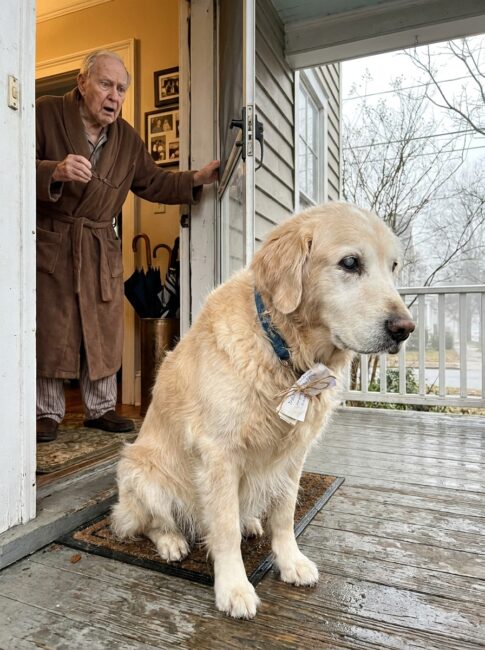
Then Scout sat on my porch.
Fourteen years old.
Stiff hips.
Clouded eyes.
The same velvet ear Nathan used to fold between two fingers when he was thinking.
And on the inside of his blue collar, hidden beneath the note, was a worn brass tag I had bought myself.
SCOUT — NATHAN’S DOG
Under that, smaller:
If lost, call Grandpa Walt.
The phone number was dead.
The promise was not.
Part 3 — The Shelter Form
The false ending came with a shelter form.
I drove Scout there the next morning because fear makes a man reach for paperwork. That is the plain truth. I had spent one night with him, one night listening to his slow breathing on the rug beside my bed, and by dawn I knew the danger.
Not that I would be unable to care for him.
That I would care.
Scout had eaten half a bowl of soft food, drunk water like it hurt to swallow, and fallen asleep with his chin on Clara’s blue quilt. Twice in the night, he woke and gave one soft whine. Both times, I reached down and touched his head before I remembered he was not mine.
Or not mine anymore.
At the Savannah shelter, a young intake worker named Rebecca sat across from me with a clipboard. She was kind in the careful way people are kind when they have seen too many animals arrive with stories no one wants to finish.
“Senior male Golden Retriever,” she said. “Possible arthritis. Cloudy left eye. No visible aggression. Found abandoned?”
I looked at Scout.
He sat beside my chair, leaning against my knee with the full weight of old trust.
“Yes,” I said.
The word tasted wrong.
Rebecca scanned his microchip. The machine beeped. Her face changed, just slightly.
“His name is Scout.”
“I know.”
She looked up.
“You know him?”
“I used to.”
Those three words are smaller than the room they open.
She read the registration details slowly. Nathan Brooks. Last known address outside Charleston. Emergency contact: Walter Ames. Secondary note: If Nathan cannot be reached, please contact his grandfather.
My hands went cold on the clipboard.
“Can you call Nathan?” I asked.
Rebecca’s fingers paused over the keyboard.
“There’s a flag on the account,” she said.
“What kind of flag?”
She looked toward a staff door, then back at me. “I can’t give details without confirming identity. But the account was updated nine months ago by a veterinary clinic.”
Nine months.
Scout pressed his head harder against my leg.
Rebecca handed me a release form, but I could not read the lines. Not because the print was small. Because the dog beside me had begun to shake.
In the kennel area, another dog barked.
Scout flinched.
Not with fear of dogs.
With the tired fear of being left again.
I put the pen down.
“I’m taking him home.”
Rebecca did not smile. She only nodded, like she had been waiting for me to say the correct sentence.
“Then let’s update his file.”
On the way out, Scout moved slowly, but when we reached the parking lot, he pulled me toward my truck with a strength that surprised us both. He climbed in with help, turned twice on the blanket across the seat, and rested his muzzle on my folded hand.
That should have been the story.
Old man finds old dog.
Old man keeps old dog.
A small rescue at the end of two lives.
But as I drove home, my phone rang from a Charleston number I did not recognize.
And the woman on the other end asked if Scout was still alive.
Part 4 — The Name I Had Avoided
Her name was Emily.
Emily Brooks.
Nathan’s wife.
I did not know my grandson had a wife.
That sentence still feels wrong in my mouth.
A whole marriage had happened outside my knowledge. Rings. vows. a small apartment. bills. a dog sleeping beside their bed. A man I remembered as a boy in my workshop had become a husband while I sat in Savannah holding old grudges like they were family photos.
Emily’s voice shook when she said my name.
“Mr. Ames?”
“Yes.”
“I’m sorry. I should have called sooner.”
I pulled the truck to the curb and turned off the engine. Scout lifted his head at the sound of her voice coming through the speaker. His tail tapped once against the blanket.
“Do you know this dog?” I asked, though I already knew the answer.
“He was Nathan’s.”
Was.
There are words that do not knock.
They enter.
I closed my eyes.
Emily told me Nathan had died nine months earlier from an aneurysm while driving home from work. No long illness. No warning large enough to name. One morning he kissed Scout on the head, forgot his travel mug on the counter, and never came back to the apartment.
I sat in my truck outside a closed dry cleaner and listened as a stranger described the end of my grandson’s life.
Scout pushed his nose under my wrist.
Emily said she had kept him as long as she could. She was twenty-eight, working double shifts at a pharmacy, moving into a smaller apartment that would not allow large dogs, drowning in grief and rent and guilt. She had called three rescues. All were full. She had considered the shelter, then found my name in Nathan’s old papers.
“He talked about you,” she said.
I almost dropped the phone.
“No, he didn’t.”
“He did.”
That was the first twist.
The boy I thought had erased me had carried me forward.
Emily said Nathan kept a small wooden box in their closet. Inside were photos, old birthday cards, a broken pocket watch I had given him, and letters he had written but never mailed. My name appeared on several envelopes.
“I left Scout at your porch,” she whispered. “I know that was wrong. I panicked. He wouldn’t get out of the car at any shelter we tried. He shook so hard. But when we reached your street, he stood up before I even parked.”
Scout knew.
That was the second twist.
He had not simply been abandoned at the nearest old house. Emily had driven him to the address Nathan had written again and again on unsent letters.
Then she said the third thing.
“There’s one letter I think you need to read. Nathan wrote it after your wife died.”
My wife.
Clara.
I had assumed Nathan did not know.
Emily’s voice lowered.
“He tried to come to the funeral. His mother stopped him. There was a fight. He wrote to you after.”
I looked at Scout’s collar.
At the note.
At the worn tag under my thumb.
The old dog had not come back only because he had nowhere else to go.
He had come carrying ten years of words nobody had delivered.
Part 5 — The Letters in the Box
Emily came to Savannah three days later.
She was smaller than I expected, though I do not know why I expected anything. A white American woman with brown hair tied low, tired green eyes, a black coat too thin for the damp cold, and both hands wrapped around a wooden box as if it might float away.
Scout heard her before I did.
He lifted his head from Clara’s quilt and gave one sound.
Not a bark.
Not a whine.
A name without language.
Emily knelt in my hallway and opened her arms. Scout walked to her slowly, stiff with age, then pressed his whole head into her chest. She held him and shook quietly. I stood by the door because old men sometimes mistake standing still for giving privacy when they are only afraid to join grief already in progress.
“He looks better,” she said after a while.
“He ate eggs this morning.”
“Nathan made him eggs on Sundays.”
That was how I learned my grandson’s life.
In small ordinary facts.
Nathan became a middle school art teacher. He wore mismatched socks on Fridays because his students liked it. He fixed broken picture frames badly but proudly. He listened to old jazz records because I had played them in my workshop. He married Emily in a courthouse with Scout as the only witness who behaved well.
He had a scar on his left thumb from my chisel.
He still had the pocket watch I gave him, though it had stopped ticking years ago.
“He said you could fix anything,” Emily said.
I looked at my hands.
“Not anything.”
She set the wooden box on my kitchen table.
Inside were ten envelopes.
Some addressed to Grandpa Walt.
Some to Mr. Ames, as if Nathan had been angry that day.
Some never sealed.
The first letter was from the year after our fight. Nathan wrote about college, Scout eating a whole meatball sub, Lydia refusing to discuss me, and how he had started working in a hardware store. He wrote that he missed Saturdays in the shop.
The second letter was shorter.
I heard you’re still repairing clocks. I hope your hands are okay.
The third had a coffee ring on it and one line crossed out seven times.
I don’t know how to come back without blaming Mom.
The letter after Clara died was folded around a photo of Nathan and Scout at the beach. Scout was younger, gold and strong. Nathan was kneeling beside him, one hand on the dog’s head, the same way he had been at sixteen.
Grandpa,
I heard about Clara. I wanted to come. Mom said it would only make things worse, and I let her decide because it was easier than being brave. Scout kept bringing me his leash all morning. I think he knew I should have gone.
I am sorry.
I read that sentence three times.
Not because I did not understand it.
Because a person can spend years building a wall, then discover the other person had been standing on the other side with a door in his hand.
The last envelope was addressed but never mailed.
Emily said Nathan wrote it two weeks before he died.
Grandpa,
If this ever reaches you, it means I finally got tired of being proud. Scout is old now. So are you, probably, though I hope you’d throw a wrench at me for saying it. I want you to know I never stopped telling people you taught me how to listen to broken things before fixing them.
Scout is still my best proof you loved me.
I kept the paper flat with both hands.
Scout rested his chin on my slipper.
The smallest details returned with new weight.
The way he walked straight to Nathan’s chair.
The way he trembled at the shelter.
The way Emily said he stood up before she parked on my street.
The worn tag that said If lost, call Grandpa Walt.
He was the message.
Not because Nathan planned his death.
Because love sometimes leaves enough signs for the living to follow after the road breaks.
That afternoon, Emily called Lydia.
My daughter.
I had not heard her voice in ten years.
When she answered, Emily said, “Your father has Scout.”
Silence.
Then my daughter asked, “Is Dad okay?”
Dad.
Not Walter.
Not him.
Dad.
Scout lifted his head from my foot as if he had heard the first hinge move.
Part 6 — Tuesdays With Scout
Lydia came the next Tuesday.
That became our day, though none of us planned it.
She was fifty-six, my daughter and almost a stranger, with gray at her temples and Clara’s mouth when she tried not to cry. She stood on my porch holding a casserole dish like a shield. For one second, neither of us moved.
Scout solved it.
He pushed past my leg, stepped onto the porch, and leaned against her knees.
Lydia covered her mouth.
“He’s so old,” she said.
“So am I.”
That almost made her laugh.
Almost was enough.
We did not fix ten years in one afternoon. People like clean scenes because clean scenes let them believe damage is polite. Ours was clumsy. Lydia apologized for some things and defended others. I apologized for words I had sharpened on purpose. Emily sat at the kitchen table with both hands around a mug, translating grief between generations when we got stuck.
Scout slept under the table.
Each time a voice rose, he lifted his head.
Each time someone softened, he sighed.
That became his work.
Not fetching.
Not guarding.
Holding the room together by being too old for nonsense.
On Tuesdays, Lydia came with soup or bread or mail she had helped me sort. Emily came when she could, sometimes with Nathan’s old students’ drawings, sometimes with stories that made me meet a grown man I had missed. We read one letter each week. Only one. I learned not to rush what grief had waited ten years to say.
After the letters, we walked Scout around the block.
Slowly.
Savannah winter softened into spring. Azaleas opened. The air smelled of wet brick and jasmine. Scout’s pace grew shorter, but he insisted on passing the mailbox, the oak tree, and the corner where schoolchildren waited for the bus. A little boy named Aaron started calling him “Grandpa Dog,” and Scout accepted the title with dignity.
Our ritual settled into the house.
Tuesday soup.
One letter.
One walk.
One old dog sleeping with his head on Nathan’s quilt, which Emily brought from Charleston because Scout would not leave it folded in her car.
I took the pocket watch from Nathan’s box and brought it to my worktable.
The mainspring was worn. The crystal was scratched. The back still held the tiny dent from when Nathan dropped it on my shop floor at seventeen and looked ready to confess to murder.
I repaired it over six Tuesdays.
Not fast.
Not for money.
Lydia watched me fit the hands back into place.
Emily held Scout’s collar while he nosed under the table for dropped crumbs.
When the watch began ticking again, the room went still.
Tick.
Tick.
Tick.
A small sound.
A stubborn one.
I placed it beside Nathan’s photo.
Scout stood, walked over, and rested his nose next to it.
That was the first time I let myself say my grandson’s name without anger standing guard.
“Nathan,” I said.
Scout closed his eyes.
Part 7 — The Week Between
Scout stayed with me two years.
People call that a gift, and it was.
It was also pills hidden in cheese, rugs on slippery floors, vet visits, lifting his back legs into the truck, midnight water bowls, and learning which sigh meant pain and which sigh meant he wanted my sandwich.
Old love has chores.
I was grateful for every one.
Scout turned sixteen in my house. Lydia baked a plain little cake safe for dogs, Emily brought Nathan’s favorite blue blanket, and I placed one candle on the table because sixteen looked better in firelight than in math.
Scout ate frosting from my finger.
Then sneezed.
We all laughed.
By then, Lydia called every morning. Emily came every other Sunday. Nathan’s students sent drawings after Emily told them his dog had found his grandfather. One showed Scout with wings, which I put in a drawer because I was not ready for that kind of picture.
The end came quietly.
Scout stopped finishing breakfast.
Then stopped asking for walks.
One Thursday, he lay beside Nathan’s chair and would not rise. I sat on the floor with him, which took time and made my knees swear at me, but I got there. His head rested in my lap, the same way it had rested on Nathan’s shoulder ten years before.
Lydia came.
Emily came.
The vet came to the house because kindness sometimes has keys and a medical bag.
Scout left with my hand on his folded ear.
A week later, I followed.
That is how Emily tells it.
I cannot tell that part myself, except to say I had not been afraid for some time. My last week was full of small sounds: the repaired pocket watch, Lydia washing dishes, Emily reading Nathan’s final letter once more, wind moving the porch swing, and the memory of Scout’s paws crossing the hallway.
They buried my ashes beside Clara’s for a while.
Then Lydia made a different decision.
A better one.
She placed part of me near Nathan’s grave in Savannah, where Emily moved him after the family chose to come home. Scout’s ashes rest there too, under a small brass marker shaped like the tag I bought him.
It says:
Scout. Nathan’s Dog. Grandpa Walt’s Messenger.
Three names.
One circle.
The dog I gave my grandson found his way back.
He brought Nathan with him.
Not in a miracle.
In a collar.
A note.
A box of letters.
A tired old body on my porch.
I opened the door.
Scout came home.
So did we.
Follow this page for more unforgettable dog stories about loyalty, second chances, and the quiet ways animals bring families back together when people have lost the words.