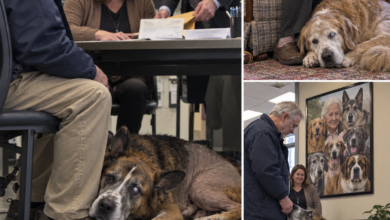
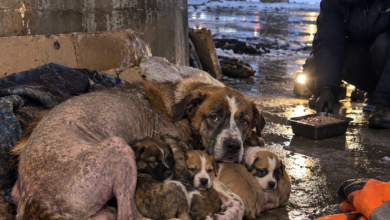
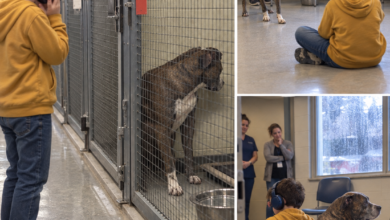
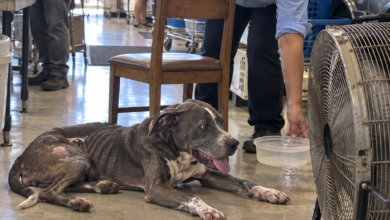
An Elderly Woman Could Take Only One Shelter Dog, So the Old Saint Bernard Gave Her His Smaller Friend—Then She Returned With Two Leashes
Part 2 — The Woman Who Arrived With One Blue Leash
My name is Olivia Hart. I was forty-two and had spent fourteen years coordinating adoptions at Three Rivers Animal Center when Evelyn March walked into my life on November 6, 2025.
Our shelter sat between a tire warehouse and an abandoned plumbing-supply store west of Pittsburgh. The front hallway always smelled faintly of bleach, wet coats and the peanut butter volunteers pressed into rubber toys. The kennels held fifty-eight dogs that week, nine above our comfortable limit.
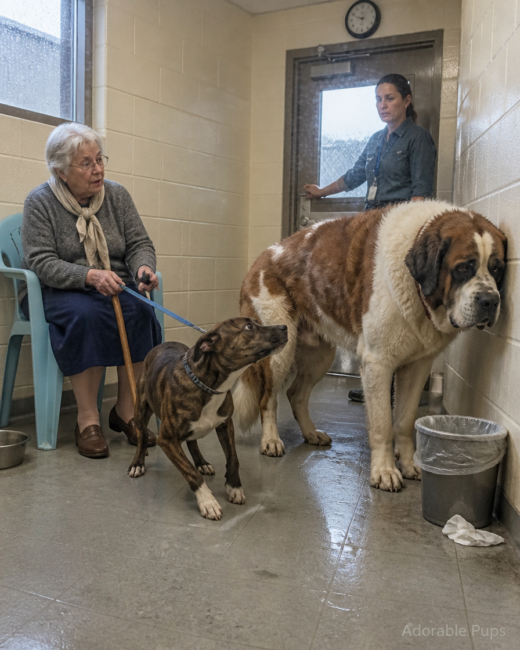
Otis and Marnie arrived at 2:19 on a Sunday afternoon.
A county humane officer named Paul Reyes brought them from the home of Lillian Cross, a sixty-eight-year-old retired school custodian who had died after a stroke. Her mail had collected for three days before a neighbor called police.
Marnie was found lying beside Lillian’s bed.
Otis stood between the bedroom door and both of them.
The officer needed twenty-two minutes to persuade him to move, not because he growled or showed his teeth, but because each time Marnie shifted, he repositioned his body between her and the stranger. Paul finally placed both dogs on separate leads. Marnie walked six inches ahead. Otis followed her shoulder.
That detail appeared nowhere on the first page of their file.
The paperwork described Otis as a male Saint Bernard, approximately ten years old, 132 pounds, altered, stiff rear gait, severe dental wear and suspected vision loss. Marnie was listed as a female Pit Bull mix, approximately four years old, thirty-six pounds, spayed, friendly after slow introduction and “possible anxiety when separated.”
They came with a brown grocery bag containing two orange prescription bottles, a dented steel cup and an envelope folded lengthwise. Water had blurred most of the writing. Someone stapled it behind their vaccination forms and placed everything in the medical tray.
We were short-staffed.
I wish that were not important.
During their first night, we put them in adjacent kennels because our large runs were occupied. Marnie scratched the divider until two nails split. Otis walked into his water bowl three times, then stood with his nose against the metal partition while she pressed her body to the other side.
At 1:40 in the morning, our overnight attendant moved them together.
Both dogs lay down within four minutes.
Otis slept with his back against the wall. Marnie curled against his chest, her white paw resting on the loose fur beneath his throat.
The next morning, I watched them cross the exercise yard. Marnie moved on Otis’s left side. When she turned, her shoulder touched his. When the path narrowed near a wheelbarrow, she slowed until his ribs brushed hers.
I assumed they were attached.
I did not realize she was steering him.
Otis had another habit. Several times each day, he pressed his nose against the lower edge of Marnie’s rib cage and remained there for two or three seconds. Then he either walked away or placed his body beside hers.
Our veterinarian thought he was checking her scent.
Marnie never objected.
On the fourth day, a family with two boys asked to meet her. Otis remained in the kennel. Marnie lasted forty-seven seconds in Visiting Room One before she threw her body against the closed door.
The family left.
On the sixth day, a young couple met both dogs but chose Marnie. They had a third-floor apartment and could not manage a Saint Bernard with weak hips. When I brought out the adoption leash, Otis pushed Marnie toward them.
She refused to leave the hallway.
The couple chose another dog.
By the time Evelyn arrived, I had begun to think the pair was simply unadoptable together and unhappy apart. One was too large, too old and too expensive. The other was young, gentle and wanted by families who could not take both.
Evelyn understood that arithmetic before I explained it.
Her husband, Frank, had died seventeen months earlier. They had been married for fifty-one years and had owned three dogs, never more than one at a time. Evelyn waited a year after his death because she believed adopting sooner would mean she was trying to replace him.
“That was foolish,” she told me. “A dog cannot replace a man who labeled every drawer in the garage. I only want the house to need me before noon.”
Her son, Daniel, had agreed to help with food and veterinary visits, but he set one condition: one small dog.
He had reasons.
Evelyn did too.
She watched Marnie move beside Otis, heard his nails drag across the floor and understood that desire was not the same as ability. Then Otis made the choice appear simple.
He pushed Marnie forward.
What Evelyn saw as generosity was only the first layer.
Part 3 — The Quiet Language Between Two Dogs
Daniel March called the shelter at 9:17 that Thursday night.
His voice was controlled, the way people speak when they are trying to turn fear into a practical list.
“My mother says she left two dogs there.”
“Yes.”
“She went for one.”
“Yes.”
“She says the big dog gave her the little one.”
I looked through the office window toward Kennel 18. Otis lay facing the wall. Marnie had wedged herself between his spine and the kennel door.
“That is what it looked like,” I said.
Daniel breathed into the phone. “Dogs do not do that.”
“I would have said the same thing yesterday.”
He asked about Otis’s weight, food cost, hip medication and life expectancy. I gave him honest numbers. A Saint Bernard could eat sixty to eighty dollars of food each month. Bloodwork, radiographs and eye testing might cost hundreds. His hips might improve with medication or might continue failing.
“How long would he wait?”
“I don’t know.”
“Would anyone else take him?”
“I did not answer immediately.
Daniel heard the answer anyway.
His father’s death had changed the shape of his relationship with Evelyn. Frank collapsed in the garage while Daniel was working in Erie. Evelyn called six times, but Daniel’s phone was inside a locked tool cabinet. By the time he saw the calls, his father had died.
After that, Daniel began trying to remove every risk from his mother’s life. He replaced her bathtub with a walk-in shower. He installed motion lights and sent her a medical-alert pendant. He wanted her to sell the brick house and move into the apartment above his workshop.
Evelyn refused.
The more he tried to keep her safe, the less she told him.
A 132-pound dog looked like another risk.
At 10:06, Evelyn sent Daniel the photograph she had taken through the visiting-room glass. Otis stood in the corner with his forehead against the wall. Marnie faced him from the end of the blue leash.
Daniel called his mother.
“What do you expect me to do with that?”
“I expect you to look.”
“I am looking.”
“No. You are calculating.”
The line went silent.
Then Evelyn told him something she had not told us. When Frank was dying in the hospital, he had asked her to take home his brown work shoes. He knew she could carry only one bag on the bus, so he put her scarf and his watch inside the shoes and pushed the bag toward her.
Evelyn had tried to return it.
Frank pushed it back.
“He gave me the things he thought I would need,” she told Daniel. “That dog did the same.”
Daniel later said the comparison irritated him. His father had understood death. Otis was a dog in a shelter.
Still, at 11:28, Daniel opened his garage and began cutting plywood.
He built a ramp.
The work took four hours. He used three-quarter-inch exterior-grade wood, added cross strips every six inches and covered the surface with rubber-backed carpet left from a church renovation. At 3:51 in the morning, he loaded it into his truck.
That was the first smaller turn none of us expected.
The second occurred inside Kennel 18.
Our overnight attendant, Simone, heard Marnie’s water bowl strike the floor at 2:36. She found the Pit Bull standing rigidly beside the bedding. Her front legs were straight, her head tilted slightly to the right and her lips pulled tight.
Otis stood across her path.
He did not push her. He lowered his chest against her shoulder and kept her from reaching the metal gate. After nine seconds, Marnie blinked, shook her head and sat down.
Simone wrote “brief anxiety episode” in the overnight log.
Otis touched Marnie’s ribs with his nose.
Then they returned to bed.
At 7:16, I took both dogs into the exercise yard. Thin rain darkened the concrete. Marnie walked to Otis’s left, brushing him at each turn. When she moved toward a puddle, he followed. When she stepped around the drain, his front paw changed direction at the same point.
I stood still and watched more carefully.
I rolled a yellow tennis ball across the ground. Marnie followed it with her eyes. Otis did not.
I raised one hand near his face. His gaze remained past my shoulder.
When I opened a bag of treats, he turned immediately toward the sound.
The cloudy left eye was not the only problem.
I called Dr. Lena Patel, our veterinarian. She tested his menace response, pupil reaction and ability to follow movement. Otis could detect strong light and broad shapes in his right eye. His left eye gave him almost nothing.
“He isn’t losing his vision,” she said.
The sentence stayed between us.
“He has already lost most of it.”
Marnie entered the examination room. She walked beside the table, touched Otis’s shoulder and turned toward the door. He followed without striking the cabinet he had collided with ten minutes earlier.
Seed number one had been in front of us since intake: she always walked on his left.
The second rested in Simone’s overnight note: he always touched her ribs before she became still.
We had interpreted both behaviors as affection because affection was easier to explain.
At 8:07, a silver pickup stopped outside. A newly built ramp extended beyond the open tailgate. Daniel climbed out wearing a dark green work jacket dusted with sawdust.
Evelyn stepped from the passenger side with two blue leashes coiled over her arm.
They had not yet agreed on how two dogs would fit inside her life.
They had only agreed that neither dog would face the wall alone.
Part 4 — The Morning Two Leashes Crossed the Floor
Evelyn entered Kennel 18 first.
Otis heard the cane before the gate opened. His head lifted at each wooden click. Marnie stood, pressed her white paw against his front leg and waited.
Evelyn knelt outside the gate.
“I brought the correct number this time,” she said.
Daniel did not smile. He stood behind her holding a folder, a tape measure and the kind of expression people wear when responsibility has arrived before certainty.
I brought both dogs into Visiting Room Two.
The scene repeated, but the room was different now. Two leashes rested across Evelyn’s knees. Daniel sat beside the door. Dr. Patel’s report lay on the table between us.
I explained Otis’s vision.
Daniel rubbed one hand across the back of his neck. “My mother uses a cane. The dog cannot see. He outweighs her.”
“Marnie guides him,” Evelyn said.
“We do not know that.”
“She just did it in the hallway.”
Daniel looked through the glass. Marnie had stopped beside a chair. Otis stopped with her, his chest one inch from the metal leg. She moved. He moved.
Evelyn clipped the first leash to Marnie.
Otis lowered his head.
Then she clipped the second to him.
The old Saint Bernard froze.
He did not step forward when she called. His nose moved from one clasp to the other, tracing the leather and metal. He turned toward Marnie, found the side of her neck and pressed his muzzle there.
Marnie’s tail struck the floor.
Once.
Daniel unfolded the adoption budget he had made at 4:30 that morning. He had listed food, monthly arthritis medication, annual vaccines, emergency care and a line labeled things I forgot. The total exceeded what Evelyn could pay.
“I’ll cover the big dog,” he said.
Evelyn looked at him. “His name is Otis.”
“I’ll cover Otis.”
The next obstacle was the house. Evelyn had four steps at the back door, polished floors in the kitchen and a narrow turn near the bedroom. Daniel showed me photographs of the ramp he had built and a sketch for nonslip runners.
He had also written a separate address on the application.
His.
“What is this?” Evelyn asked.
“The apartment above my workshop has stairs,” Daniel said. “Your house does not. I’ll stay with you until we know what they need.”
“You hate my couch.”
“I hate the springs.”
“You hate my coffee.”
“I’ll bring coffee.”
The distance between them had taken seventeen months to build. Two dogs did not erase it in one sentence, but Daniel’s overnight bag was already behind the truck seat.
Dr. Patel examined Otis once more. Arthritis had narrowed his movement, but no injury made walking unsafe. Bloodwork showed mild anemia and an underactive thyroid, both manageable. The large mass I had feared near his shoulder turned out to be a harmless fatty growth.
Marnie’s examination appeared normal except for a small scar inside her lower lip and worn patches along both elbows.
At 10:42, Evelyn signed two adoption forms.
Otis approached the room’s threshold and stopped. Marnie stepped ahead, but this time he did not push her away. She touched his left shoulder and waited until his front paw reached the hall.
The two blue leashes crossed between them.
We moved slowly toward the exit. Otis followed the sound of Evelyn’s cane and the pressure of Marnie’s side. Daniel walked behind him with both hands ready near the dog’s hips.
At the front door, Marnie hesitated.
Otis nudged her forward.
The glass opened. Cold air entered. Otis lifted his face into it, and his nostrils widened at the smell of wet pavement, fallen leaves and the river.
Marnie descended the portable ramp first. Otis followed.
Evelyn sat in the rear seat between them. Marnie rested across her lap. Otis settled with his head against the woman’s shoulder, leaving a streak of white hair across her gray coat.
Daniel closed the door.
Before he entered the driver’s seat, he looked at me.
“If this goes wrong, call me before you call her.”
“It already went right,” Evelyn said through the open window.
The truck left at 11:09.
We stood beneath the shelter awning until its brake lights disappeared.
Everyone thought we had reached the ending: an old woman had returned, a reluctant son had made room, and two dogs had left together.
At 1:37 the next morning, Otis began striking Evelyn’s bedroom door.
Part 5 — The Sentence Hidden Behind the Medical Forms
Evelyn woke to three heavy blows.
The first shook the thin wooden door. The second knocked a framed photograph crooked. The third brought Daniel from the couch with a flashlight in one hand.
Otis stood in the hallway, panting.
Marnie was not beside him.
The Saint Bernard turned toward the kitchen, took four steps and stopped when his shoulder struck the wall. He pawed once at the floor. Daniel guided him around the corner.
Marnie lay beneath the table.
Her legs had stiffened, her jaw moved without sound, and a thin line of saliva darkened the floor near her mouth. The seizure lasted fifty-eight seconds.
Otis lowered himself beside her before Daniel could move the chairs. He placed his chest against her spine, blocking her body from striking the cabinet, and kept his muzzle near her ribs.
Evelyn called the emergency clinic.
By the time Marnie lifted her head, Otis had stopped panting. He touched the same place below her rib cage that he had checked in the shelter.
The veterinarian diagnosed a likely focal seizure progressing into a generalized seizure. Bloodwork showed no poisoning or organ failure. The orange bottle found in Lillian Cross’s grocery bag had contained levetiracetam, an anti-seizure medication.
The printed label was damaged.
We had assumed it belonged to Otis because his name was the only one still readable on the second bottle.
At 7:04, I searched the medical tray again. I removed the vaccination forms, the county report and the water-stained envelope nobody had unfolded completely.
A second sheet had adhered to the back.
The handwriting belonged to Lillian.
Otis sees light, not edges. Marnie walks on his left and takes him around things. Do not separate them.
Below that, another line had been underlined twice.
Marnie has seizures. Otis warns me three or four minutes before they start. She is his eyes. He is her warning.
I sat on the examination-room floor.
The note continued. Otis had begun losing his vision two years earlier. Lillian taught Marnie to walk beside his left shoulder using pieces of boiled chicken and a cloth loop connecting their harnesses. Within three months, Marnie guided him without the loop.
Nobody trained Otis to detect seizures.
He began doing it after Marnie’s second episode. Before each seizure, he pressed his nose against her ribs, followed her closely and blocked her from steps or hard furniture. Lillian believed he noticed a change in scent or breathing.
The pattern inside our shelter became clear.
The nose against Marnie’s ribs.
The body across her path.
The moment beside the water bowl at 2:36.
Otis had recognized a seizure beginning before any human saw it.
Marnie guided a nearly blind dog through the world. Otis warned her before her own body stopped obeying her.
Neither was only the helper.
Neither was only the one being helped.
Then I understood what he had offered Evelyn in the visiting room.
Otis knew what one leash meant. He had watched dogs leave the adoption hall on one leash for eleven days. He had heard the clasp close around Marnie’s collar. He could smell Evelyn’s hands on her fur and feel Marnie leaning toward the woman.
So he pushed her forward.
He was prepared to surrender the dog who served as his eyes, even though separation would leave him moving by walls, sound and memory.
The final line on Lillian’s note was written in darker ink.
If only one can be saved, take Marnie. Otis will make that choice too.
He had.
Part 6 — The House Where Neither Dog Had to Choose
I called Evelyn at 7:26 that morning.
Daniel answered from the emergency veterinary clinic. Marnie slept beneath a warmed blanket while Otis lay across the doorway, facing the sound of her breathing.
I read Lillian’s note aloud.
Daniel said nothing until I reached the final line.
Then a chair scraped across the clinic floor.
“My mother is asking whether you can make a copy,” he said.
“I’ll bring the original.”
“No. Keep the original with their record. She says they may need it if someone forgets again.”
The words landed where they belonged.
We had not harmed the dogs on purpose. We had fed them, treated them and kept them together after the first difficult night. Yet our rushed intake process had nearly separated two animals whose medical safety depended on the behaviors we dismissed as attachment.
Dr. Patel rebuilt both treatment plans. Marnie restarted seizure medication twice daily. Otis began thyroid medicine, joint support and a low dose of anti-inflammatory medication. Daniel programmed four alarms into his phone—two for Marnie, two for Otis.
Evelyn programmed none.
She placed the pill bottles beside Frank’s old coffee mug and tied each dose to something she never forgot: morning coffee and the six o’clock news.
Daniel stayed in her house for what he called “the first week.”
He remained for three months.
He installed rubber runners through the hallway and small textured pads before each doorway. He placed a wind chime beside the back door so Otis could find the exit by sound. Water bowls stayed on dark mats with raised edges. Daniel added short wooden rails to the ramp and covered the sharp corners of the kitchen cabinets.
Marnie learned the house in one afternoon.
Otis learned her path.
On the first evening, she walked him from the living room to the back door seven times. She kept her left shoulder beneath his jaw and slowed before each turn. Otis bumped the wall twice, the sofa once and Daniel’s toolbox hard enough to close the lid.
By the third morning, he crossed the house without striking anything.
Evelyn refused to move the furniture afterward.
“Not one chair,” she warned Daniel. “The dog has memorized what we adults keep changing.”
Otis developed a route around her life. At 6:15 each morning, he followed the smell of coffee to the kitchen. At 8:30, he slept beneath the table while Evelyn answered crossword clues in pen. At noon, he waited near the refrigerator because Marnie received medication inside a piece of turkey.
At 3:00, both dogs walked the level section of sidewalk along Chartiers Avenue. Evelyn held Marnie’s leash. Daniel held Otis’s for the first month, then taught his mother to use a waist belt with a short safety line.
The arrangement looked backward to strangers. The small Pit Bull guided the huge Saint Bernard. The old woman walked between them while her son followed three feet behind carrying waste bags and pretending not to supervise.
Each dog watched something the others could not.
Ten days after the adoption, Otis warned of Marnie’s second seizure.
He was sleeping beside the radiator when his head rose. He crossed the room, touched her ribs and blocked the hallway. Marnie appeared normal. She wagged her tail when Evelyn called.
Evelyn trusted him anyway.
She dimmed the lights, moved a chair and placed a folded blanket on the floor. Three minutes and fourteen seconds later, Marnie’s legs stiffened.
She fell onto the blanket instead of the hardwood.
Otis lay beside her until it passed.
Daniel stood in the kitchen with both hands gripping the counter. His father had died while Daniel missed six phone calls. Since then, he had treated every danger as something he could prevent through locks, lights, schedules and measurements.
Otis showed him another kind of preparation.
You could not stop every fall.
You could clear the space where someone might land.
In December, Daniel returned to his own house for two nights. On the third morning, he arrived with lumber and began turning Evelyn’s unused dining room into a ground-floor bedroom for himself.
“I thought you hated the couch,” she said.
“I solved the couch.”
He built a narrow Murphy bed against the far wall. Evelyn did not ask how long he planned to stay. She cleared one drawer in the bathroom and began buying the coffee he preferred.
That was another quiet change the dogs made without entering the center of it.
Otis’s medical results brought a new concern in January. His hips responded to medication, but his dental disease required surgery. Three broken molars had infected the tissue beneath his gums. Anesthesia carried added risk because of his age and size.
Evelyn sat beside him in the veterinary waiting room at 6:20 on January 14. Marnie remained at home with Daniel because the clinic feared separation would upset Otis before surgery.
The opposite happened.
Without Marnie, Otis would not cross the treatment-room threshold.
He pressed his side against the wall and searched the empty air with his muzzle. Evelyn called his name, tapped her cane and placed both hands against his chest. He trusted her voice, but his feet could not find the path.
Daniel drove Marnie to the clinic.
She entered at 6:47, walked to Otis’s left and touched him below the jaw. He followed her into the treatment room.
The procedure removed three teeth and cleaned the infection. Otis woke slowly at 11:26. Marnie lay outside his recovery kennel, her white paw pushed between the bars.
When he lifted his head, he searched until his nose found that paw.
Evelyn looked away toward the vending machines. Her fingers tightened around the top of her cane.
“I almost took only her,” she said.
“You came back.”
“One night later.”
“That is what coming back means.”
In March, the shelter received a video from Lillian Cross’s neighbor. She had found it on an old phone Lillian left in a kitchen drawer.
The recording showed a summer afternoon two years earlier. Otis stood at the top of three porch steps, uncertain. Marnie climbed one step, returned, pressed her side against his chest and descended again.
Otis followed.
Lillian’s voice came from behind the camera.
“That’s it, little girl. Bring him down.”
At the bottom, Otis turned and touched Marnie’s ribs with his nose.
She guided him.
He checked her.
The same exchange had repeated so often that neither dog needed a command.
Evelyn watched the video fourteen times.
Daniel watched it once, walked into the garage and cut two small brass plates. He attached one above each leash hook by the back door.
The first read: SHE SHOWS THE WAY.
The second read: HE KNOWS WHEN TO STOP.
Evelyn traced the letters with one finger.
“Your father would say the screws are crooked.”
“They are not crooked.”
“He would still say it.”
For the first time since Frank’s death, they laughed in the same room without stopping when they remembered why he was absent.
By spring, Otis had gained eleven pounds. His coat thickened after the thyroid medicine began working, and the tremor in his rear legs eased. He could not see Evelyn’s face, but he recognized the pattern of her cane, the smell of her hand cream and the soft click her hip made when she stood after sitting too long.
Marnie’s seizures became less frequent. Otis still warned before each one.
He never missed.
Evelyn stopped thinking of herself as a woman who had been strong enough to adopt two dogs. Strength had not solved the problem. One leash had represented the life she believed she could manage. The second represented all the help she had refused to accept.
Daniel carried the heavy food bags.
Marnie guided Otis.
Otis guarded Marnie.
Evelyn kept the schedule.
Each life held one corner.
Part 7 — The Two-Leash Promise
On the first Thursday of every month, Evelyn and Daniel return to Three Rivers Animal Center.
They arrive at 8:12 in the morning.
Otis rides across the rear seat on a thick orthopedic pad. Marnie sits beside him with her white paw resting over his front leg. Evelyn brings coffee for the overnight attendant, and Daniel carries a plastic bin filled with matching pairs of leashes.
They donate two at a time.
Never one.
The leashes go home with bonded dogs, senior pairs and animals whose dependence cannot be explained by sharing a bed. Each set includes a small card with one sentence: Please watch what they do for each other before deciding what either one needs.
Evelyn does not tell adopters they must take two dogs. She knows money, housing and health can make that impossible. She tells them only to watch closely before interpreting sacrifice as rejection.
Otis still visits Kennel 18.
Marnie walks him through the doorway and stops beside the corner where he once placed his face against the wall. Otis smells the cinder block, turns and follows her back toward the hall.
He has never faced it again.
On November 6, 2026, we marked their first year with a small gathering in the exercise yard. Evelyn brought two blue leashes with new leather handles because the originals had softened and cracked. Daniel brought the plywood ramp he built the night before their adoption.
He had painted one sentence beneath it.
Room is something you make.
Otis walked across with Marnie touching his left shoulder. At the bottom, he pressed his muzzle against her ribs for two seconds, found nothing wrong and moved on.
Evelyn stood between them.
Daniel stood behind her.
Before leaving, she placed the original single leash on my desk. The clasp still carried one strand of Otis’s white fur from the afternoon he pushed Marnie toward her.
“I brought the wrong number,” she said. “Keep it for the next person who does.”
The single leash now hangs above our adoption desk.
Two blue leashes hang beneath it.
No leash hangs alone now.
Follow this page for more gripping dog stories about rescue, sacrifice, second chances, and the quiet choices that bring two frightened lives home together.