An Abandoned Pit Bull Kept Turning Its Face to the Wall Every Time a Family Came — Until One Woman Sat Down and Turned Away Too
Part 2
The shelter at night did not look like the same place.
During the day, Briar County was all motion and noise. Barking. Leashes clipping on and off. Front-desk phones ringing. Volunteers talking too loudly in the lobby because they thought cheerful voices made fear less contagious. But once the lights dimmed and the public doors locked, the building softened into something else.
You could hear the vents.
The hum of the refrigerators in the clinic wing.
The occasional metal click of a dog shifting against a kennel gate in its sleep.
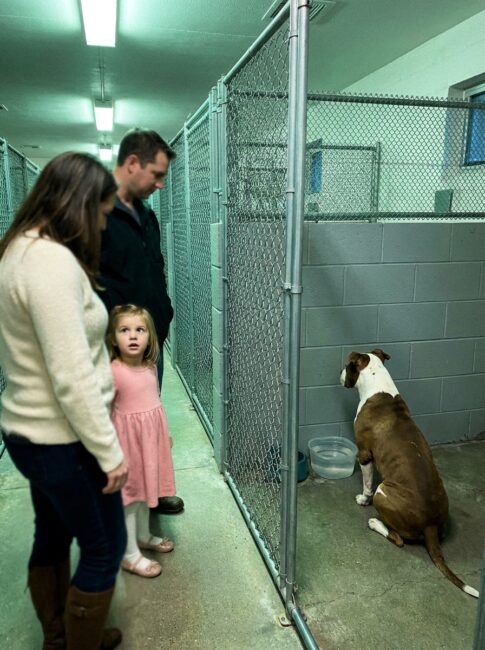
Kayla sat alone in the cramped staff office with a paper cup of stale coffee and the camera feed open across two grainy monitors. Winston’s kennel was on the far row near the dog meet-and-greet room, not one of the best spots, not one of the worst. She scrubbed through the daytime footage first. Family after family came and went in sped-up silence. A girl in pink sneakers crouched near the gate. Winston turned away. A retired couple paused longer than most. Winston turned away. A father lifted his toddler to wave. Winston turned away.
Nothing new.
Kayla exhaled, rubbed the heel of her hand across one eye, and clicked forward to 10:42 p.m.
At first she thought she had opened the wrong kennel.
Winston was moving.
Not pacing in distress, not circling with the brittle repetition of a dog unraveling, but moving with loose, ordinary ease. He picked up a rope toy and tossed it once, badly, then pounced on it with a clumsy sideways hop that looked almost young. He carried the toy to the gate and dropped it in front of the neighboring kennel, where an old hound mix lifted his head and thumped his tail twice. Winston wagged back.
Kayla leaned closer.
At 11:03 p.m., he rolled onto one hip and chewed lazily on a rubber bone. At 11:17, a volunteer doing final rounds passed with a mop bucket, and Winston stood, stretched, and trotted to the front of the kennel, tail swinging. At 11:44, he pressed his shoulder companionably against the bars nearest the shepherd mix next door and stood that way for almost a minute, just breathing.
No wall.
No withdrawal.
No bitterness.
No sign of the dog visitors described in the daytime.
Kayla went back and watched again.
Then again.
The details only made it stranger. Winston was normal when no one wanted anything from him. More than normal, actually. There was a goofy dignity to him, a quiet pleasure in his own body, a softness in the face that disappeared every morning as soon as the public arrived.
At 12:12 a.m., he even wagged at his own reflection in the kennel glass.
Kayla sat back slowly.
“Okay,” she whispered to an empty room. “So what are you doing?”
The next day, she changed nothing.
That was important.
If you suspect a frightened animal is hiding a pattern, you do not rush at it with interpretation. You watch. You become less interesting. You let the truth come toward you at its own speed.
So Kayla watched.
At 9:04 a.m., before opening, Winston greeted her at the front of the kennel and accepted a biscuit from her hand without hesitation. His tail moved once, twice, then settled. She crouched, spoke softly, and he held eye contact longer than usual. Not affectionate exactly, but open.
At 9:58, the first family entered the dog wing.
Winston heard the voices before he saw them. That was clear from the footage. His ears shifted first. Then his posture changed. Not all at once, not dramatically. A tightening through the shoulders. Tail still. Eyes no longer resting anywhere. By the time the family reached his kennel and smiled at him, he had already turned and walked to the back wall.
Kayla stood off to the side pretending to reorganize clipboards, watching without letting him catch her staring. The little boy asked if the dog was in timeout. His mother laughed apologetically and led him away.
At 10:31, the same thing happened again.
And again.
Always the same sequence. Voices. Attention. Stillness. Turn away.
It was not dislike.
It was anticipation.
That difference took Kayla another day to admit.
On Thursday afternoon she pulled Winston’s paper file from the intake cabinet. Shelters, like people, often reduce pain to forms because forms are easier to stack than grief. Name, if known. Approximate age. Medical notes. Surrender history.
Surrender history.
There it was.
Winston had not simply been found abandoned once, full stop, as the abbreviated public card suggested. He had been through the system before. Not once. Three times.
First adopted from a city shelter at around eight months old.
Returned after eleven days: “Too clingy. Whines when left alone.”
Second adoption six months later.
Returned after three weeks: “Not a good match for our lifestyle.”
Third adoption through a breed rescue at age two.
Returned after four days: “Won’t settle. Doesn’t seem happy here.”
The final note was handwritten in different ink, quick and irritated: Owner dropped dog at boarding facility and never came back. Facility contacted animal control after 9 days.
Kayla stared at the page until the words blurred.
Too clingy.
Not a good match.
Won’t settle.
Didn’t seem happy here.
The language was ordinary enough to pass unexamined. That made it worse. Each phrase smoothed over a rupture. Each one turned rejection into logistics. But the timeline told its own story. Winston had not failed one home. He had survived being chosen, then unchosen, again and again until the act of being noticed probably felt less like hope than a countdown to abandonment.
That evening Kayla carried his dinner down the aisle herself.
Winston came forward at once, tail low but wagging.
“Hey, buddy,” she murmured, setting the bowl down. He nudged her wrist with his nose, just briefly, then ate with the tidy seriousness of dogs who learned not to trust abundance. Kayla remained crouched outside the kennel longer than necessary.
“You don’t hate people,” she said quietly.
Winston glanced up.
“You hate what happens after they pick you.”
He went back to eating.
No revelation flashed. No movie-perfect moment passed between them. But Kayla felt that old rare click shelter workers live for, the one when behavior stops looking inconvenient and starts looking like language.
The next week, she stopped introducing Winston as shy.
Stopped calling him stubborn.
Stopped apologizing for him.
Instead, she changed the kennel card.
Not dramatically. No melodrama. Just truth in a form the public could bear.
Winston takes time to trust. He may turn away at first. Please don’t mistake that for indifference.
It helped a little.
It did not help enough.
People still preferred the easier dogs. The lab mix who leaned in. The beagle who spun in circles. The shepherd puppy with paws too large for its body. Winston remained the dog who turned his back when hope arrived, and that is not a story most adopters know how to enter.
So Kayla did the next thing modern shelters do when reality resists neat outcomes.
She posted him.
Not a sales pitch. A confession.
She wrote about the wall.
About the night footage.
About a dog who seemed to protect himself by refusing to be chosen at all.
She did not use sad music or dramatic filters. She posted a split video instead: Winston at night, tossing a toy and wagging at the neighboring dogs; Winston during the day, hearing footsteps and slowly turning his face to the cinder-block wall.
By morning, it had gone viral.
Strangers filled the comments with the full range of human projection. Some called him broken. Some called him manipulative, which is what people often say when pain behaves inconveniently. But threaded through all of it were quieter responses, mostly from women, mostly late at night.
“I used to do this as a kid.”
“I stopped unpacking my bag at new foster homes.”
“I’d pretend I didn’t care first.”
“If you don’t reach for love, it hurts less when it leaves.”
Kayla read them all.
One of those comments came from a woman named Mara Ellison.
She did not write much.
Just this:
I know exactly why he turns away. Please tell me if he’s still there.
Part 3
Mara came to the shelter on a Tuesday afternoon in a denim jacket and scuffed brown boots, carrying nothing except a folded printout of Winston’s post and the look of someone who had already decided not to perform optimism for anybody.
She was thirty-nine, white, fine-boned, with light brown hair pulled into a low knot that had started slipping loose by the time Kayla met her in the lobby. She had the kind of face that might once have been called pretty more often if life had not taught it caution so early. Her eyes moved carefully around the room, taking in exits, doorways, other people’s moods. Not nervous exactly. Practiced.
Kayla had seen that before too.
Not in dogs.
In adults who apologize to furniture after bumping into it.
“You’re Mara?” Kayla asked.
Mara nodded and handed her the printout, though there was no need.
“I saw the video at one in the morning,” she said. “Couldn’t stop thinking about him.”
Kayla offered the polished version first. “I should tell you, he may not engage. He tends to—”
“Turn away,” Mara said.
Not impatiently. Just like someone finishing a sentence she already understood.
Kayla led her down the kennel aisle anyway, talking softly as they walked. Winston was lying near the front of his run when they approached. He lifted his head at Kayla’s voice, then saw the unfamiliar woman beside her.
Kayla felt it happen in real time.
That inward shift.
The stilling of the tail.
The slight lift of the chin.
Then Winston stood, turned, and faced the back wall.
Mara stopped two kennels short.
For most visitors, that moment produced either embarrassment or determination. They cooed louder. Knelt lower. Called the dog’s name as if affection could be forced through repetition. Mara did none of that. She looked at Winston’s back for a long quiet second, and the expression on her face was so unguarded it made Kayla step away instinctively, as if she were intruding.
“That’s exactly it,” Mara said.
Kayla kept her voice gentle. “Exactly what?”
Mara didn’t answer right away.
She reached up and tucked one loose strand of hair behind her ear. Her fingers shook once, then steadied. “When I was a kid,” she said, still looking at the dog, “my mother had a way of leaving that always sounded temporary until it wasn’t. A weekend with an aunt. A few days with a neighbor. A month with family friends. After a while I stopped waving goodbye. Then I stopped unpacking. Then I stopped making eye contact when people said things like, ‘Let’s see if this works out.’”
Kayla said nothing.
Mara gave one small breath of laughter with no humor in it. “You learn weird tricks to survive being returnable.”
Winston did not move.
But one ear twitched.
That was all.
It was enough.
Kayla unlocked the visitation room and asked if Mara wanted to try meeting him there. Most adopters said yes immediately. Neutral space. Less kennel stress. A chance for the dog to loosen up.
Mara surprised her.
“No,” she said. “Not yet.”
She walked to the end of Winston’s kennel, lowered herself onto the concrete floor outside it, and sat with her back to him.
Not angled.
Not half-turned.
Fully turned away.
The whole aisle seemed to hold its breath.
Kayla, standing two runs down with a volunteer clipboard she was no longer pretending to read, felt something primitive and careful move through her. The gesture was so exact it bordered on unbearable.
Mara rested her forearms on her knees and spoke toward the opposite wall.
“I’m not going to make you look at me,” she said. “I know that trick too.”
Winston stayed facing the cinder block.
Mara nodded once, like she had expected that. “I used to do it in foster homes. If I didn’t seem excited, maybe it wouldn’t hurt when they changed their minds. Or when I did.”
The shelter was not silent—somewhere a terrier was complaining about existence in general—but within that one narrow slice of aisle, the air felt altered.
Kayla watched Winston’s breathing.
It had slowed.
Mara kept talking, not in a performance voice, not in the bright emotional register people use when they want healing to happen on cue. She sounded tired. Honest. Like someone sitting on a porch too late with no reason left to polish a truth.
“I’m not going to tell you I’m different,” she said. “You don’t know me. You shouldn’t have to trust me because I showed up once. But I can sit here. I can do that.”
Winston’s head lowered half an inch.
His back remained turned.
Minutes passed.
A child somewhere in the lobby laughed. A volunteer wheeled a laundry cart by the clinic door. The fluorescent lights hummed above them. Mara stayed where she was.
After twenty minutes, Kayla approached with a folding chair.
Mara shook her head without turning. “If I get comfortable, he’ll think I’m temporary.”
Kayla went back to the desk and pretended to handle emails while keeping Winston’s kennel in view the entire time.
Thirty-seven minutes in, Winston looked over his shoulder.
Just once.
A quick glance. Then he turned back again.
Mara didn’t react.
That mattered.
At fifty-two minutes, Winston stood and walked a small circle inside the kennel. He did not come forward. He did not return to the wall either. He simply stood sideways, uncertain, caught between habit and curiosity.
Kayla texted the shelter manager from three rooms away: He’s moving. Don’t come down here.
At one hour, eleven minutes, Mara shifted because her foot had gone numb. Winston froze. Mara immediately stilled again and murmured, “Sorry.”
No baby talk. No pleading.
Just respect.
At one hour, forty-three minutes, Winston came to the front bars.
Not to Mara’s hand.
To her back.
He stood there breathing, close enough for the fabric of her jacket to stir with each exhale. Mara did not turn. Her shoulders tightened, then softened.
“I know,” she said.
Winston sniffed once at the seam near her shoulder blade. Then again.
And then, with the gravity of something much larger than the motion itself, he touched his nose to the center of her back.
Kayla had seen dogs survive surgery, neglect, storms, euthanasia queues, and transport chaos. She had watched reunions and breakdowns and every flavor of desperate human promise. But that tiny contact—one dog choosing to break his own ritual of refusal—was one of the purest acts of courage she had ever witnessed.
Mara closed her eyes.
Not crying yet.
Just receiving.
“I know,” she whispered again, and now her voice was gone at the edges.
It took another ten minutes before she turned slowly enough not to spook him.
Winston did not retreat.
He stood there, head slightly lowered, tail still, not offering joy exactly but offering access. Mara rested the backs of her fingers near the kennel bars and let him decide the rest. He sniffed her hand. Pressed once into it. Then leaned the whole hard warm shape of his head against her knuckles like a door giving way.
Kayla had to walk to the supply room for a full minute because suddenly the aisle was too bright and her face had become impossible.
When she came back, Mara was still on the floor, and Winston was still there.
By the end of the afternoon, the adoption paperwork was on Kayla’s desk.
The shelter manager asked all the practical questions. Rental? Fenced yard? Vet reference? Work hours? Mara answered them cleanly, almost absently, because something more important had already happened in the aisle.
Kayla asked one final question she did not ask most adopters.
“If he turns away again at home,” she said carefully, “what will you do?”
Mara signed the last page and looked up.
“I won’t take it personally,” she said. “And I won’t leave because he needed a wall that day.”
Winston went home before sunset.
There was no magical final shot of him bounding into the car like the shelter had finally been a bad dream. He hesitated at the door. Stopped halfway to the parking lot. Looked once over his shoulder at the building that had held him and disappointed him less than homes had.
Mara did not tug the leash.
She stood beside him facing the same direction he did until he chose to move.
That was how they began.
Not with triumph.
With patience.
With two creatures who understood that love is often most truthful in the moment it refuses to rush.
Part 4
For the first week, Winston slept facing Mara’s apartment door.
Not near it.
Facing it.
That detail told her more than anything else.
At night he would lie on the living room rug with his body angled toward the exit, eyes half open, as if he expected the room itself might decide against him while he slept. During the day he learned the shape of her routines. Coffee at 6:10. Work calls at the kitchen table. Laundry on Thursdays. Soup on Sundays. No shouting. No sudden hands. No one arriving to “see how it goes.”
Mara lived alone in a second-floor unit over a florist shop on the edge of downtown. It was small but quiet, with old hardwood floors, too many books, and the kind of windows that turned late afternoon light soft and forgiving. She did not overwhelm Winston with toys or commands or declarations about forever. She gave him structure instead. Meals at regular times. Walks before traffic thickened. A blanket in the corner by the radiator. A crate with the door left open, never latched. Choice everywhere choice could be offered.
He still turned away sometimes.
That was the part people online would not have liked.
They prefer the version where the wounded dog meets the right person and immediately understands safety. Real trust is slower. Less photogenic. There were mornings Winston refused eye contact if Mara moved too quickly toward the leash. Evenings when she came home from work and found him not destructive, not distressed, just sitting with his face toward the wall beside the entry table, as if something in the day had brushed against an old bruise.
When that happened, Mara did exactly what she had promised.
She did not take it personally.
Sometimes she sat on the floor six feet away and read aloud from whatever novel she was halfway through, not to soothe him exactly but to fill the room with a human presence that did not demand. Sometimes she cooked while he watched her from his corner, body still, ears tipped forward. Sometimes she simply turned her own chair in the same direction and worked on her laptop with her back partly to him, sharing space without pressure.
By the third week, Winston had learned one new habit.
He began following her from room to room, but only when he believed she would not notice. Mara would walk into the kitchen for a glass of water, then glance sideways and see him stationed at the doorway pretending he had always intended to be there. If she met his eyes too directly, he would look away at once, embarrassed by attachment as if it were a thing caught in public.
At six weeks, he brought her a toy for the first time.
Not during play.
At 2:14 in the morning when a thunderstorm rolled over the city and Mara, half asleep, woke from the old familiar dream of being left somewhere temporary. She sat upright on the couch, chest tight, not yet fully in the room. Winston climbed onto the rug in front of her and dropped a frayed rope toy against her bare foot.
An offering.
Or a question.
Mara laughed softly through the last of the dream and picked it up.
“All right,” she whispered. “Me too.”
They sat through the storm together that way, not facing each other directly, the rope toy between them, both pretending the other one had needed company more.
Six months after the adoption, Kayla came by with a bag of donated treats and the mild anxiety shelter workers carry forever, even after a good placement. She braced herself before ringing the bell. You never fully stop fearing the answer to the door.
Mara opened it in socks and a gray sweater, hair loose, looking less sharpened by solitude than she had in the shelter aisle. Winston was beside her before the door cleared the frame.
Not behind her.
Beside her.
His coat shone now. The white patch on his chest looked brighter somehow. He had gained weight in the proper places, the ridge of his spine softened under muscle. Most striking of all, he did not turn away.
He looked at Kayla.
Really looked.
Then he walked forward and pressed his head lightly into her thigh in greeting.
Kayla had to blink too many times before speaking.
“Show-off,” she managed.
Mara smiled. “He does that now.”
The apartment held evidence of a life joined properly. A leash by the door. A dog bed under the window and another, older blanket clearly preferred instead. Photos on the fridge: Winston at the park standing uncertainly in grass higher than his ankles; Winston on the couch pretending not to enjoy being covered by one corner of a throw blanket; Winston asleep on his side, belly exposed, the posture of an animal whose body has finally accepted that unconsciousness will not be punished.
Over tea, Mara told the small truths.
How Winston still disliked suitcases.
How he watched the front door closely when guests left, as if departures needed monitoring.
How he had once panicked when she moved a kitchen chair too suddenly, then spent the next hour ashamed of his own fear.
How he no longer faced walls when delivery people came.
“He still steps back,” she said. “But he doesn’t disappear anymore.”
Kayla nodded, because that was not a small thing.
That was the thing.
Later, as she stood to leave, Winston walked with her to the door. Mara clipped on his leash for the afternoon walk, and for one suspended second the three of them stood in the tiny entryway where so many lives begin and end without ceremony.
Kayla reached down to scratch Winston’s chest.
“You fooled us,” she said softly.
Mara corrected her without edge. “No. He warned us.”
That line stayed with Kayla on the drive back to the shelter.
He warned us.
Not of aggression.
Of cost.
Of what it means to ask a living thing to hope after it has learned what selection can do.
Months later, the shelter still used Winston’s story in staff training, though never as a sentimental success piece. They used it to teach observation. To remind volunteers that shutdown can look like defiance, that withdrawal can be self-protection, that the dog refusing your hand may not be rejecting love at all but negotiating the risk of it.
And Winston himself kept changing in the quiet, unmarketable ways healing usually happens.
The first time Mara packed a suitcase for a weekend conference, he watched from the bedroom doorway with his body gone suddenly still. She saw it. Unpacked the suitcase in front of him. Repacked it slowly the next day. Left for one night. Came back exactly when she said she would. The second trip was easier. The third, easier still.
One evening, in early fall, Mara came home later than usual after a difficult day and found Winston asleep on the couch with his back not to the wall, not to the door, but open to the whole room. Head tilted. Paws twitching slightly with whatever soft dream had claimed him.
She stood in the doorway for a long time without turning on the light.
Some victories are too quiet to disturb.
He woke eventually, blinked at her, and thumped his tail once against the cushion.
No panic.
No retreat.
Just recognition.
Mara set down her keys, crossed the room, and sat beside him. Winston shifted, sighed, and rested his head in her lap as if he had been doing it his whole life instead of learning, inch by inch, that a person could stay.
Outside, traffic moved past the florist shop. Somewhere downstairs a delivery truck rattled the alley gate. Inside, the apartment held only lamplight, dog breath, and the sound of one woman absentmindedly tracing the edge of a torn ear that no longer had to explain itself.
For the first time in his life, Winston was not turning away before the leaving came.
Because the leaving had finally stopped.
If stories like this stay with you, follow the page and come back for the next one.