An Elderly Vendor Watched a Dog Carry the Same Child’s Backpack to School for an Entire Year — Then She Learned Why No Child Ever Returned for It
Part 2 — The Dog Who Followed the Bell
My name is Ruth Ellis. I was seventy-two when Milo began appearing beside my cart, though I did not learn his name until winter.
I had been selling food outside Maple Ridge Elementary for nineteen years. My husband, Clarence, started the cart after retiring from a tire plant. When he died, I continued because remaining home made the mornings too long.
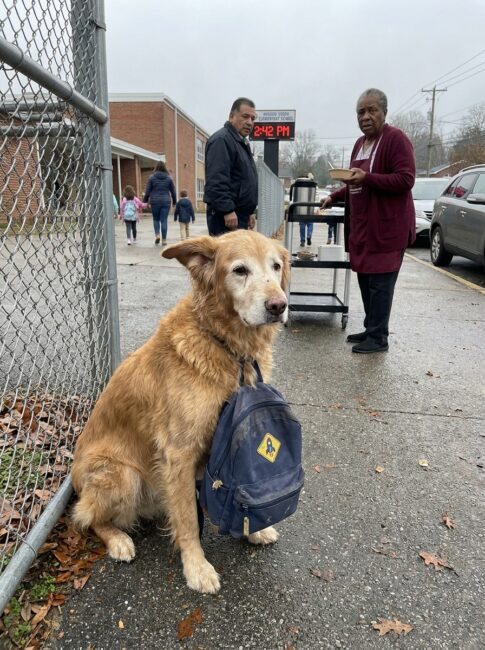
The school gave shape to my days.
I arrived before the buses and left after the teachers. I knew which children needed an extra napkin, which parents forgot cash until Friday, and which crossing guard kept peppermint candy inside his jacket.
Milo became another part of that routine.
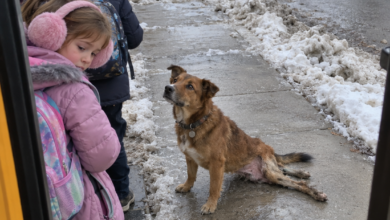
His coat was the color of old honey, darker along the spine and pale around his face. One ear stood normally, while the other folded at the tip. A thin crescent scar crossed the bridge of his nose. His paws were broad but worn from miles of pavement.
The backpack looked too small beside him.
Its navy fabric had faded around the zippers. A yellow rocket patch covered one side pocket, while the top handle bore the shape of Milo’s teeth. He carried it gently enough that the cloth had not torn further.
During the first month, I watched his schedule.
He arrived at 7:37.
He sat three feet left of the main gate, never blocking children. At the first bell, he moved beside the brick pillar. Once the doors closed, he carried the bag away.
He returned at 2:42.
If dismissal ran late, he waited. If students left early because of weather, he seemed unsettled and searched the sidewalk longer. On teacher-training days, he appeared at the usual hour, discovered no children, and sat until the security guard locked the gate.
Weekends were different.
He did not come.
That detail told me his behavior was not random. Milo understood the school calendar as well as some parents did. Someone had walked the route often enough for the pattern to settle into his body.
The security guard, Carlos Alvarez, knew more than he wanted to say. He was a sixty-three-year-old Mexican American man who had worked at Maple Ridge for eleven years. Whenever Milo arrived, Carlos filled a water bowl and placed it near the booth.
He never touched the backpack.
“Why?” I asked.
“He won’t like it.”
“You’re twice his size.”
“That isn’t the point.”
One January morning, a new substitute teacher tried bringing the bag into the office. Milo stepped in front of her and took the handle from her hand without growling.
Carlos walked outside.
“Leave it with him.”
“What if it contains identification?”
“We know who it belongs to.”
The teacher looked between Carlos and the dog. She returned the bag.
Milo carried it back to his place.
That afternoon, Carlos finally showed me a photograph kept inside the security booth. It showed an eight-year-old boy beside Milo at the gate. The boy had dark curls, a front tooth still growing in, and a red jacket zipped unevenly. Milo held the backpack while the child rested one hand on his head.
“Noah Bennett,” Carlos said.
Noah had attended third grade at Maple Ridge. He loved astronomy, disliked beans, and volunteered to carry lunch trays for younger students. His teacher described him as a child who apologized to desks after bumping into them.
Milo walked him to school every morning.
At the corner, Noah placed the backpack’s top handle between Milo’s teeth. The dog carried it for the final block. Parents assumed it was a trick Noah had taught him.
It was more practical than that.
Noah was small for his age, and the backpack was heavy with library books. Milo began grabbing the strap during one walk. Noah laughed and allowed him to keep it.
The task became theirs.
At the gate, Noah took the backpack and scratched behind the folded ear.
“You brought me,” he always said. “Now go home.”
Milo waited for Noah each afternoon.
Six months earlier, a driver lost control near a wet intersection two blocks from the school. Noah did not survive. Milo was knocked into the grass but suffered only bruising.
When Carlos reached the scene, the dog was sitting beside the backpack.
Milo refused to release it until he heard the school bell.
Then he carried the bag to the gate.
Noah’s desk remained empty.
Milo watched every child leave that afternoon.
He returned the next morning.
And the morning after that.
The dog was not confused about the school.
He was faithful to the last instruction Noah had ever given him.
Bring me.
Go home.
The first half was still possible.
Milo did not understand why the boy never completed the second.
Part 3 — The House With No Child Inside
The Bennett family remained in Knoxville for eleven weeks after the accident. Elena Bennett, Noah’s mother, stopped opening curtains. Her husband, David, returned to work because their health insurance depended on it, but he sometimes sat in his car outside the warehouse until his shift ended.
Their daughter, fourteen-year-old Emma, stopped attending school for a month.
Milo moved between them.
He slept outside Noah’s bedroom, carried one of the boy’s socks through the house, and waited beside the front door at 7:30 each morning. Whenever the school bell sounded faintly across the neighborhood, he lifted his head.
Elena could not bear it.
Milo’s folded ear reminded her of Noah’s hand resting there. The sound of his nails in the hallway made her expect her son’s bedroom door to open. When Milo brought the backpack from a closet, Elena locked herself in the bathroom.
She later described the dog as “a living doorway into the worst morning of my life.”
David wanted to keep him.
Emma did too.
But grief had turned the family into four separate rooms. Every decision became an argument, and every argument felt like betrayal.
Elena’s sister Monica offered to care for Milo while the family moved to Charlotte for a new start. The arrangement was supposed to be temporary. Elena packed his bed, bowls, food, and veterinary records.
The backpack was not included.
She had placed it inside a sealed box.
On moving morning, Milo found it.
He tore open the cardboard, removed the bag, and carried it to the front door. Elena saw him waiting there and broke down. She left before Monica arrived because she could not watch the dog follow the car.
Milo escaped from Monica’s yard three days later.
He walked to the empty Bennett house, slept on the porch, then appeared at school before the first bell. Monica collected him that afternoon.
He escaped again.
She changed the gate latch. Milo dug beneath the fence.
She kept him indoors. He slipped past her when groceries arrived.
Seven times, Monica brought him home.
Seven times, he returned to Maple Ridge.
The final time, he refused food for two days after being confined. Monica contacted Elena, but Elena was receiving treatment for severe grief and panic attacks. Her therapist advised her to avoid decisions made during crisis.
Monica told Carlos that Milo seemed calmer near the school. She arranged for him to sleep in a sheltered area behind her garage but stopped restraining him during the day.
Milo created his own routine.
Before sunrise, he walked to the empty Bennett house and retrieved the backpack from the porch, where he had hidden it beneath a loose board. He carried it to school, waited through both bells, and returned it at night.
The neighborhood filled the gaps.
Carlos provided water. I gave him breakfast. A crossing guard checked his paws during winter. Monica continued paying for veterinary care but kept her distance because Milo ran whenever he saw her car near the school.
Everyone cared for him.
No one could release him from the route.
I began following him after dismissal. At the empty house, Milo placed the backpack beside the front door and sat facing the street. Some evenings he remained for an hour. On others, he slept there until Monica coaxed him toward her garage.
He was waiting at two places.
At the school, he waited for Noah.
At the house, he waited for the family.
The backpack traveled between both.
In February, I examined the plastic luggage tag attached to its zipper. Rain and teeth had scratched the surface, but a phone number remained visible.
Carlos asked what I intended to do.
“Call his mother.”
“She knows Milo is here.”
“Does she know what he does?”
Carlos looked toward the dog.
“No.”
“Why not?”
“Monica thinks it would hurt her.”
“It will.”
“Then why call?”
I watched Milo lift his head as a boy in a red jacket approached the gate. For one second, his tail moved. When the child turned toward another parent, Milo lowered his head onto the bag.
“Because she left believing he would forget,” I said. “He deserves for someone to tell her he didn’t.”
Elena answered on the fourth ring.
I introduced myself carefully. I expected anger, but when I said Milo’s name, her voice became thin.
“Is he sick?”
“No.”
“Did something happen?”
“He comes to the school every day.”
Silence.
I described the morning arrival, the backpack, the dismissal bell, and the empty house. Elena did not interrupt.
When I finished, she asked the same question three times.
“Every day?”
“Yes.”
“Even in winter?”
“Yes.”
“With Noah’s bag?”
“Yes.”
The phone remained quiet except for her breathing.
Then she whispered, “I thought leaving him would stop me from seeing Noah everywhere.”
I looked at Milo.
“He kept seeing him for you.”
Part 4 — The Mother Who Could Not Return
Elena did not immediately agree to come back.
The first call lasted forty-eight minutes. She told me about the accident, the move, the panic attacks, and the mornings when Milo’s presence made her expect Noah to enter the kitchen.
“I know how it sounds,” she said. “A mother left her son’s dog.”
“It sounds like you were drowning.”
“That doesn’t make what I did right.”
“No.”
She accepted the answer.
Elena did not need a stranger to erase responsibility. She needed someone to speak without turning her grief into either cruelty or innocence.
She had believed Milo was safe with Monica. She knew he escaped repeatedly, but Monica eventually said he had “settled into a neighborhood routine.” Nobody described the backpack or the bells.
Emma knew even less. She thought Milo had bonded with Monica and stopped asking because every conversation made her mother withdraw.
David carried his own guilt. He had wanted to return for Milo but feared the argument would undo Elena’s fragile progress. The family avoided the subject until silence became easier than correction.
“Does he look healthy?” Elena asked.
“He is thin, but people feed him. His paws are worn.”
“Does he sleep outside?”
“Sometimes.”
She began crying again.
“I left because looking at him made me remember my son.”
“Yes.”
“And he spent six months looking for my son.”
“Yes.”
“What kind of mother does that make me?”
I watched children crossing the street beside their parents.
“A mother who made a decision she cannot change,” I said. “But tomorrow is still available.”
Elena asked for photographs. I sent three: Milo holding the backpack before school, Milo sitting beneath my cart during snow, and Milo waiting at the empty house.
She called again that evening.
Emma had recognized the gray stitching on the backpack handle. Noah repaired it himself after Milo’s teeth loosened the fabric. He used the wrong kind of thread and tied several knots inside the bag.
“He was proud of that repair,” Elena said.
Milo had protected it through rain, snow, and 124 school days.
Elena wanted to return Friday, but she feared Milo might reject her. She had been absent longer than Noah had ever been.
“Dogs remember scent,” I said.
“What if he remembers that I left?”
“He may remember both.”
The family drove from Charlotte before dawn.
Elena asked us not to tell anyone. She did not want cameras, announcements, or a crowd watching her apology. Carlos arranged for her to wait near my cart shortly before dismissal.
At 2:39, Milo appeared carrying the backpack.
He noticed the unfamiliar car but continued toward the gate. Elena remained inside with David and Emma, one hand gripping the door handle.
Milo sat.
The bell had not yet rung.
Elena stepped from the car.
She wore a plain green coat and held nothing. Her dark hair was shorter than it had been in the school photograph, and six months of grief had changed her posture.
Milo looked at her.
He did not move.
Elena stopped twenty feet away.
“Milo.”
The folded ear rose.
The dog stood but left the backpack on the ground. He smelled the air. Then he took one step, stopped, and looked back toward the school doors.
Elena lowered herself to the sidewalk.
“I’m sorry.”
Milo approached slowly.
He smelled her hands, coat, shoes, and face. Elena did not reach for him. She remained still while he decided what the familiar scent meant now.
His tail moved.
Once.
Then Milo turned away.
Elena’s shoulders folded.
But the dog was not leaving.
He returned to the gate, picked up Noah’s backpack, and carried it to her. He placed the handle inside her open hands.
Elena pressed the bag against her chest.
Milo rested his head across it.
At that moment, the dismissal bell rang.
Children began filling the sidewalk, but Milo did not look toward them.
For the first time in six months, he had found someone from home.
Part 5 — The Bag Returned to the Right Hands
Emma exited the car next.
She had grown taller since Milo last saw her, and her hair had been dyed dark red at the ends. Milo recognized her before she reached the curb.
He pulled away from Elena and ran.
Emma dropped to her knees. Milo struck her chest hard enough to make her sit on the sidewalk, then circled her while making a soft sound deep in his throat.
David remained near the car, covering his mouth.
When Milo reached him, the dog smelled both shoes and pressed his shoulder against David’s legs. David knelt and placed one hand behind the folded ear.
“I should have come back,” he said.
Milo licked his wrist.
No one asked whether the dog understood apologies. His body understood that three familiar people had returned.
The family stayed through dismissal. Milo watched the school doors once, but he did not resume searching every child. He remained beside Elena, touching the backpack with one paw whenever she loosened her grip.
Carlos opened the security booth and removed Noah’s photograph from the wall. He handed it to Elena without speaking.
She studied the image.
Noah stood beside Milo at the gate, one hand resting on his head. The backpack hung from the dog’s mouth.
Elena placed the photograph inside the front pocket.
“Come home,” she told Milo.
The dog looked toward the empty Bennett house.
Their original home no longer belonged to them. Charlotte was three hundred miles away, filled with unfamiliar streets, a new apartment, and no route to Maple Ridge.
Milo approached the car but refused to enter.
David opened the rear door. Emma climbed inside and called him. Milo backed toward the gate.
Leaving the school meant abandoning the place where Noah might still appear.
Elena understood.
She placed the backpack on the rear seat, then sat beside it. Milo looked between the gate and the bag.
Carlos brought the water bowl.
“Take your time.”
For thirty-seven minutes, the family waited. No one pulled Milo with a leash. No one tried lifting him.
At 4:06, Elena removed the backpack from the car.
She walked with Milo to the gate and stood in his usual place. Together, they faced the closed school doors for one minute.
Then she said the words Noah had used.
“You brought him. Now we can go home.”
Milo followed her to the car.
During the drive to Charlotte, he kept his muzzle on the backpack. Emma sat beside him with one hand resting on his shoulder.
At their apartment, Milo hesitated in the parking lot but entered after Elena carried the bag through the door. He inspected every room, checked behind curtains, and returned repeatedly to the entrance.
That night, Elena placed Noah’s backpack beside Milo’s bed.
The dog did not sleep there.
He lay outside Emma’s room, where he could hear the family breathing.
Elena sat with him until morning.
Over the following weeks, Milo struggled whenever school buses passed. At 7:37 each morning, he moved toward the front door. At 2:42 each afternoon, he waited beside it.
Elena began walking with him.
They found a small elementary school six blocks from the apartment. They did not approach the gate because Milo became confused by unfamiliar children. Instead, Elena stopped at a quiet corner, placed one hand behind his folded ear, and waited for sixty seconds.
Then they returned home.
The ritual did not ask Milo to forget Noah.
It gave his waiting an ending.
One evening, Elena finally opened the backpack. She had avoided doing so since the accident.
Inside were two library books, a pencil case, a flattened granola-bar wrapper, and Noah’s unfinished spelling sheet. In the smallest pocket, beneath a collection of smooth stones, she found a folded drawing.
Noah had drawn himself beside Milo at the school gate. The proportions were wrong, the dog was larger than the building, and the backpack floated between them.
Above the figures, Noah had written one sentence:
Milo carries the heavy things.
Elena sat on the kitchen floor.
Milo approached and rested his head in her lap.
For six months, he had carried the heaviest thing the family left behind.
Now he allowed them to hold it with him.
Part 6 — One Minute at the Gate
The Bennett family eventually returned to Knoxville.
Not to move back, but to finish what had remained open.
Elena contacted Maple Ridge and asked whether the family could visit quietly on the anniversary of Noah’s accident. The principal suggested a small memorial, but Elena declined speeches and assemblies.
“Noah hated standing in front of crowds,” she said. “He would think we had punished him.”
Instead, the school placed a simple wooden bench near the gate where Milo had waited. The inscription read:
FOR THOSE WHO ARE STILL WAITING
A small rocket was carved beneath the words, matching the patch on Noah’s backpack.
The ceremony lasted less than ten minutes. Noah’s former teacher brought his class photograph. Carlos stood beside the security booth. I closed my cart during the first bell for the only time in nineteen years.
Elena arrived holding the backpack.
Milo walked beside her.
He was older, heavier, and healthier than he had been during those months outside the school. His coat had been brushed until it shone, though the muzzle remained white and the bent ear still leaned forward.
At 7:37, they stopped in his old place.
Milo looked toward the doors.
Children entered. Several recognized him from the previous year, but teachers had asked them not to crowd. One little boy placed his hand over his heart as he passed. Milo watched him, then returned his attention to Elena.
After one minute, she touched his ear.
“You brought him.”
Milo turned away from the gate.
They sat together on the new bench.
Elena later began visiting every month. Sometimes David and Emma came. Sometimes only Elena and Milo made the drive. They stood for one minute, touched the bench, and returned home.
The ritual changed gradually.
At first, Milo carried the backpack from the car.
Then Elena carried it while he walked beside her.
One spring morning, he refused to take the handle. He smelled it, looked toward the gate, and placed his paw on Elena’s shoe.
She understood.
The backpack remained in the car.
Milo no longer needed to complete Noah’s walk every day. The family could carry the memory without asking the dog to perform it.
I continued selling breakfast outside Maple Ridge. Whenever the Bennett car appeared, I prepared a plain scrambled egg for Milo.
He began allowing me to touch the backpack after Elena returned. Later, he allowed Carlos to carry it to the bench. The object he once guarded stopped feeling like the final piece of Noah he could lose.
It became something the family shared.
Elena never softened her description of leaving Milo.
“I thought his face would keep me trapped in that morning,” she once told me. “I did not understand that he was trapped there too.”
She did not call herself disloyal or ask Milo to prove forgiveness. She fed him, walked him, returned when she promised, and sat beside him during thunderstorms.
Apology became routine.
So did coming home.
Part 7 — The Last Bell of the Morning
Milo was twelve when he stopped climbing into the car easily. David built a low ramp, and Emma—now attending college—sent him a padded harness.
The family reduced the Knoxville visits because long drives made his hips stiff. Maple Ridge mailed photographs of the bench each autumn, and Carlos called whenever the first snow covered the gate.
On Noah’s birthday, Elena still took Milo to the elementary school near their Charlotte apartment. They stood on the quiet corner for one minute.
She carried the backpack.
Milo carried nothing.
One October morning, Ruth received a package at her cart. Inside was a photograph of Milo sleeping beneath the backpack, no longer holding it in his mouth. Elena had written a short note on the back.
He waits for us now, not for the bell.
That sentence stayed inside my cash box.
The following spring, the Bennett family returned to Maple Ridge one more time. Milo moved slowly, but he recognized the street before the car stopped. His head lifted, and the folded ear rose.
Elena helped him down the ramp.
At 7:37, they reached the bench.
The first bell rang.
Milo watched the children enter, but he did not search their faces. He sat beside Elena and rested his head against her knee.
She placed Noah’s backpack between them.
“You brought him,” she whispered.
Then she added the words the family had finally learned to keep.
“And we came back.”
After one minute, Elena stood.
Milo rose with her.
He did not remain at the gate.
They walked together toward the car while children filled the school behind them. The backpack hung from Elena’s shoulder, light enough now for one person to carry.
Carlos raised one hand from the booth.
I watched until the car turned the corner.
The bench remained beneath the maple tree, waiting without asking anyone to stay.
Follow this page for more stories about dogs whose quiet loyalty carries memory, reunites grieving families, and patiently teaches wounded hearts how to return home.
The final bell rang.
This time, Milo went home.