An Emaciated Mother Dog Refused to Enter the Rescue Van — Her Puppies Were Already Inside, but She Kept Looking Toward the Drain Everyone Thought Was Empty
Part 2, The Space We Had Not Seen
Marcus asked the municipal worker to leave the cover open and keep the barriers where they were. It was a small request, spoken without urgency in his voice, but everyone stopped packing. The mother remained beside me, her weight shifting forward whenever he approached the opening and settling back when he stood still.
We had not found her because anyone was searching for this particular family. The delivery driver, Dennis, had come to check an address at the neighboring loading dock. He heard a thin sound while pulling a hand truck over the broken sidewalk and called the number posted on the county animal services website.
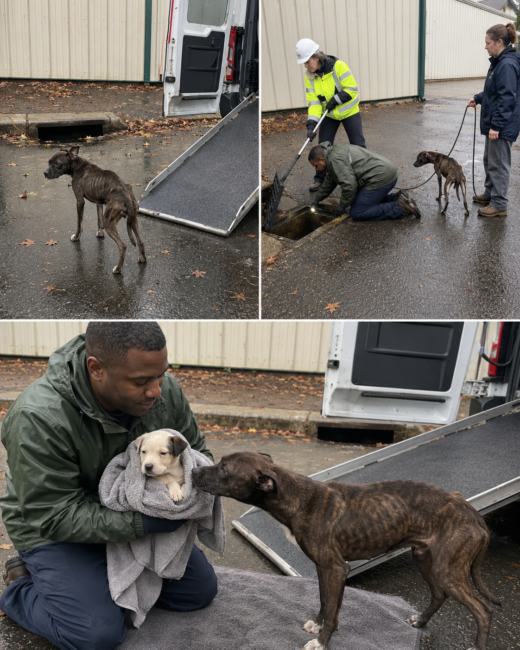
By the time we arrived, he had placed two cones near the curb and moved his truck out of the access lane. He had not climbed down or tried to pull the mother away. She stood between the inlet and the wall, watching him with her head lowered, while the sounds below came and went.
We learned the rest slowly. A warehouse employee had seen her in the area twice during the previous week. Someone had left a water bowl under an awning, but nobody knew where she slept or whether she belonged to someone nearby. The building behind her was closed; the loading businesses farther down the street were still operating.
There was no collar mark I could confidently read, no story written across her skin. There was simply a dog with too little weight on her frame and young puppies beneath a sidewalk. We recorded what we could see and left the rest unanswered.
Now Marcus threaded the inspection camera back toward the narrow shelf. The municipal worker, a woman named June, controlled the light and checked the view beside him. Both stayed above the opening. Nobody was going to enter a drain chamber because a dog had looked toward it.
The rain was light, but the water channel below the shelf carried a steady trickle. June had already checked upstream conditions before the first retrieval. She checked again over her radio while Marcus angled the camera toward the black panel.
From the first direction, it looked like a flat wall. From the second, a narrow gap appeared.
The plastic was a broken storage-bin lid, bent into a shallow curve. Its upper corner rested against the chamber wall, while a mound of wet leaves held the bottom away from the concrete. Behind it was a pocket of dry space that our earlier view had not reached.
Marcus did not move it immediately. He worked the camera around the exposed edge and waited for the image to settle.
I watched his shoulders change.
“There,” he said.
June lowered the beam. On the small monitor, a pale curve moved against the dark concrete. It disappeared, returned, and became an ear when Marcus adjusted the angle again.
A fifth puppy lay behind the lid.
He was cream-colored, with a dark patch over his right ear. His body was curled into a shallow recess beyond the shelf where the others had clustered. He lifted his head once, then rested it again.
The mother made a low sound beside my knee.
I could not say she saw the monitor or understood what Marcus had found. She could hear us moving at the opening. She could smell things I could not. What mattered was simpler: her attention had stayed on a place our inspection had not cleared.
Nobody said she had counted better than we had. We had counted the puppies we could see. The mistake was letting that number become an answer to a different question.
Had we checked every accessible space?
Not yet.
Marcus asked June how the lid could be removed without pushing it farther into the recess. She studied its position, then called a second worker over with a smaller light. The puppy was close, but closeness was not the same as safe access.
Behind me, the four puppies rustled inside their carrier. Their mother turned toward them, then back toward the opening.
For the first time, I understood the two directions of that movement without having to invent a thought for her. Part of her litter was beside the van. Another part was still beneath the road.
Part 3, Five Was Not Yet Safe
Finding the puppy did not immediately put him in our hands. The lid leaned across the direct route, and its lower edge sat on a wedge of gritty leaves. A careless pull could send the panel toward him. A careless reach could frighten him deeper into the recess.
Marcus described the view to the second city worker while June kept the camera steady. The worker secured the near edge with a tool designed for retrieving debris. They tested its weight gently, watched what moved around it, and stopped when the leaves shifted beneath the puppy’s shelf.
I stood several feet away with his mother. Her legs were beginning to tremble again.
We had put a folded mat beside the van so she would not have to stand on cold pavement, but she would not settle on it. She stepped onto one corner, lowered her hips a little, then stood before her body reached the ground.
I did not press her down. I moved the mat closer to where she had chosen to wait, outside the workers’ space, and let the safety lead hang loose.
This time, she placed both front feet on it.
The four puppies could not stay exposed while we watched the drain. Marcus had returned their secured carrier to the van, where the doors shielded them from the drizzle and I could still see them through the open side. A volunteer remained with them and checked the towels.
Their mother watched the carrier move. I gave her time to follow it with her eyes before guiding her back out of the work area. She did not resist that short adjustment. She only turned toward the curb again when the worker raised the lid.
It came away a few inches at a time.
Underneath, the concrete shelf extended farther than it had appeared from the original opening. The puppy lay close to the back wall, pressed beside a curled piece of packaging. Nothing held his body fast. He was hidden, chilled, and unwilling or unable to follow the disturbance toward us.
Marcus called our receiving clinic and described what we could see. The veterinarian asked about the puppy’s responsiveness, the water level, and how soon we could transport him once he was free.
“Keep him supported,” she said. “Bring him straight here.”
June shifted the light away from his face. Marcus used a shallow padded rescue basket through the safe access opening while the worker kept the plastic secured. No one dragged him by a leg or lifted him by his collar; he did not have a collar to begin with.
For several minutes, the difficult part was doing less.
The puppy turned away from the basket. Marcus waited. A passing truck shook the cover resting on the pavement, and the puppy flattened his chin. June asked the driver at the loading dock to hold his next departure for a moment.
Then the little dog shifted forward.
Marcus moved the basket only when there was room beneath his body. June watched the camera feed and gave directions in short, ordinary words. Left a little. Stop. The back foot is clear.
The basket rose level through the opening.
I remember the mother’s ears before I remember the puppy’s face. They lifted, then flattened halfway as she leaned toward the towel Marcus unfolded. Her tail stayed low. Her mouth opened briefly, but she made no sound.
The puppy was smaller than the others, though the difference was not dramatic. His cream coat was damp along one side, and the dark ear lay folded against his head. He moved when Marcus adjusted the towel and made a faint complaint.
I let the mother approach at her own pace.
She smelled the exposed edge of his face. Her nose touched his cheek once. Then she drew in another breath and followed as Marcus turned toward the van.
We did not prolong the moment for a photograph.
The puppy needed a warm, protected trip and a veterinarian. His mother needed the same destination. The four others needed us to stop treating the open van as a waiting room.
But before we loaded anyone, June and her coworker checked the newly exposed recess, the shelf, and the accessible side channel again.
This time, when we said five, we also knew what had been checked.
Part 4, The Door She Finally Crossed
Marcus held the smallest puppy securely while I brought the mother beside the carrier containing his siblings. She approached without pulling. Her head moved between his towel and the small sounds behind the carrier door, and for a few seconds she seemed unable to choose where to put her nose.
We made room for her to look.
The carrier stayed on a dry, stable surface inside the van, its door controlled by the volunteer so no puppy could tumble out. From the ramp, their mother could see the fawn puppy lifting his dark muzzle and the black one wedged against the brindle shoulders of his sister.
The brown puppy had pushed herself beneath a fold in the towel. The volunteer eased the fabric back without taking her out. Four small bodies were visible.
Then Marcus lowered his arms enough for the mother to smell the cream puppy again.
She touched the towel with her nose. Her eyes followed him as he was placed into a separate, secured padded carrier beside the others, where we could monitor him during the trip. We did not insist she understand a number. We showed her the family we were taking.
The ramp had not changed.
It was still the same shallow incline, covered with the same nonslip runner. The van still smelled of disinfectant, damp fabric, and unfamiliar animals. The mother still had a body that shook after standing too long.
What changed was the direction of her next step.
She put one front foot on the runner.
Then the other.
I stayed beside her shoulder without drawing the lead forward. Marcus stood out of her path. When she paused halfway up, we paused too, leaving her room to look back without losing her footing.
She glanced toward the drain.
June and her coworker were still there, completing their equipment check. The barrier remained in place. The opening was no longer a place we were leaving unfinished; it was a place we had looked into again.
The mother turned back toward the carriers.
She walked the last few feet into the van.
Inside, we had prepared a larger secured kennel with thick, stable bedding for her weakened body. Its position let her hear and smell the puppies nearby without an unsecured litter moving under her feet during transport.
She entered, turned once, and remained standing.
I closed the kennel door gently, watching her face as the latch settled. She did not throw herself against it or cry. She simply looked through the bars toward the little carriers, following each shuffle and squeak.
Marcus checked every latch. I checked them again.
We had been careful that morning. We had also missed something. Those truths could exist beside each other, and neither would be helped by pretending the second one had not happened.
Before leaving, I told Dennis we had found a fifth puppy behind the plastic. He looked toward the drain, then down at the empty towel in his hands.
“I only heard one,” he said.
“One was enough to call,” I told him.
The drive to the clinic took twenty minutes. Our volunteer sat where she could observe the secured carriers, and I drove without music. Each time we stopped, I heard the mother shifting on her bedding behind me.
At the second red light, the smallest puppy made a thin squeak. The mother answered with the same low sound she had made beside the curb.
At the third, she lay down.
Our volunteer told me quietly, as though saying it loudly might undo it. The mother had folded her front legs beneath her and lowered her narrow chest onto the blanket. Her eyes stayed open, facing the carriers.
That was the first rest we had seen her take.
At the clinic entrance, Marcus met us after bringing the remaining field equipment back. He carried the cream puppy inside first because the veterinarian was ready for him. I stayed with the mother while the others followed.
When his carrier disappeared through the clinic door, she stood.
We did not make her watch an empty doorway longer than necessary. Staff brought us directly into the prepared intake room, where all five puppies could be accounted for within her sight.
Only then did she lower her head again.
Part 5, A Mother Also Needed a Patient Chart
Dr. Priya Menon examined the smallest puppy while a technician recorded the others’ weights. He was cold, mildly dehydrated, and quieter than she wanted him to be. Those were findings, not guesses from a picture, and they changed the pace of the room.
The team began supportive care and monitored his response. I stood out of their way with the mother’s lead loose in my hand. She watched the examination table, her ears shifting toward every small sound, but she did not try to jump.
The other puppies were chilled and hungry, though more active. Their estimated age was about five weeks. They still needed their mother, but they were also beginning the messy, determined business of investigating anything that smelled like food.
When the cream puppy was stable enough to rest in the nearby monitored space, Dr. Menon knelt to examine his mother.
We had been calling her Mama because it was the only name anyone knew. The veterinarian asked us to keep talking softly while she checked her, then stood to review the notes with the technician.
“She needs her own plan,” she said.
The puppies had occupied every urgent thought since the drain opened. It would have been easy to treat their mother as transport, shelter, and reassurance, then forget that her body had paid for all three.
Dr. Menon assessed severe low body condition, reduced muscle mass, dehydration, and the physical demands of nursing. She ordered the tests she considered necessary and arranged a monitored feeding plan rather than allowing a large meal simply because the dog looked desperately hungry.
We did not need a dramatic diagnosis to justify care.
Her hips were sharp beneath my palm when she finally allowed a brief touch. Her thighs tired while she stood for examination. When the technician offered a resting surface within sight of the puppies, she lowered herself cautiously, as though lying down required attention too.
No microchip was found. We submitted the location, photographs, and identification details through the appropriate found-animal process. Rescue staff checked reports and posted notices without inventing an explanation for why the family had been living beneath the sidewalk.
The mother did not become abandoned because that word made a stronger story. We did not know.
We named her Mabel after a technician read several possibilities aloud and the room agreed on the simplest one. The fawn puppy became Otis, the black puppy Pip, the brindle puppy June, and the brown puppy Dot. Our human June laughed when we told her.
The cream puppy with the dark right ear became Finch.
For the first night, Mabel and her litter remained at the clinic. The puppies had a warm, protected nursery space, and staff supervised contact according to their condition and her comfort. Finch required closer observation, but his station was arranged nearby whenever care allowed.
Mabel ate the portion offered to her, then looked toward the puppies.
She did not get up immediately.
That pause mattered more than an empty bowl.
I returned the following morning with clean supplies. Finch was more responsive, lifting his head when the technician approached, though nobody promised us a smooth recovery. His temperature and hydration still needed monitoring, and he was not ready to leave simply because we wanted a happier update.
Mabel lay on her side with three puppies pressed against her and two asleep in the adjacent warmed nest after their checks. A technician was sitting nearby, entering notes.
When she lifted Pip for a weight check, Mabel raised her head.
The technician stayed where Mabel could see the puppy. She placed him on the small scale, read the number, and returned him to the blanket before reaching for another.
Mabel watched the whole process.
By the fourth puppy, her chin had lowered halfway to the bedding.
By the fifth, it rested there.
The technician did not call it a breakthrough. She simply wrote that Mabel had remained settled during care.
I liked that sentence enough to remember it. Nothing about it claimed we had repaired her life overnight. It said only that, for several minutes, she had not needed to stand guard to know where her puppies were.
Part 6, The Cost of Staying on Her Feet
After three nights, the veterinary team cleared the family for an experienced foster home with a written care plan and scheduled checks. I had an unused ground-floor room, washable flooring, and permission to rearrange my work shifts. Marcus delivered the pen while I covered the traffic areas with nonslip runners.
We kept the room quiet. The puppies had a protected sleeping area, and Mabel had a separate resting space she could enter without stepping over them. Food and water were placed within easy reach, with feeding managed according to the clinic’s instructions.
Nothing about the arrangement looked like the drain.
Still, she stood whenever a puppy disappeared behind the edge of the low bedding.
For the first several days, I moved slowly enough for her to follow what was happening. Before I carried a puppy for a weight check, I let her see which one I had. I stayed in the room whenever possible and brought the puppy back before starting another task.
It was not a performance of asking permission. Veterinary care still happened when needed. But there was no reason to make a tired mother solve unnecessary mysteries created by our hands.
I kept a notebook on the dresser.
Not because I thought the story needed one. I needed to remember meals, weights, medication instructions, and the changes the clinic had asked me to report. Between those entries, other details appeared.
Ate without leaving the bowl.
Rested while Dot explored.
Stayed lying down when the door opened.
On the ninth day after the rescue, the notebook changed.
Mabel stood through most of the afternoon. The puppies had become more active, and every squeak drew her up from the bed. She would inspect them, take a few steps toward her resting space, then return before lowering herself.
At her next meal, she ate less than expected.
When she turned, her hind legs trembled.
It would have been easy to call the behavior devotion and leave it there. Instead, I called the clinic and described the reduced intake, the standing, and the weakness. They asked me to bring her in for reassessment that day.
Dr. Menon examined her and reviewed the feeding records. Mabel had not developed the emergency we feared, but she was still depleted and using more energy than her small reserves could comfortably support. The recovery plan needed adjustment, not applause.
The clinic revised her feeding support and helped us manage supervised breaks from nursing as the puppies moved gradually toward appropriate meals of their own. They were growing, and Mabel needed chances to rest without five busy bodies climbing across her.
At home, we altered the pen so she could watch them from her bed without following every movement. The sleeping area stayed close, and I sat nearby during the first breaks to monitor everyone.
She stood anyway.
Then she sat.
Eventually, she lay down with her head raised and watched Pip wrestle a towel fold while the others slept.
No one called that less mothering.
Over the following week, her appetite improved and the trembling became less frequent. Her weight changed gradually, and the muscles beneath her coat took longer. We sent updates to the clinic and kept the follow-up appointments even on days when she seemed brighter.
Finch had his own slower rhythm. He remained the smallest, but he began competing for the front of the pen whenever footsteps approached. The dark patch over his right ear made him easy to find in the shifting pile.
One evening, he pushed behind a rolled towel and vanished from Mabel’s view.
Her head lifted.
I reached to move the towel, then stopped because his cream nose had already appeared at the other end. He waddled into the open and sat down against Dot.
Mabel watched him.
She did not stand.
I wrote that down too.
Not because it meant she had forgotten the drain. I had no way to know what she remembered. It meant that, in this room, a puppy briefly going out of sight no longer always required her whole exhausted body to respond.
That night, I heard her dreaming through the open doorway. Her feet twitched against the blanket, and when Finch squeaked, she opened her eyes, looked toward the pen, and went back to sleep.
Part 7, Nothing Left Behind the Door
By the time the puppies were ready for their next homes, their world had expanded beyond Mabel’s reach. They followed footsteps, investigated paper bags, and fell asleep in positions that made no sense until you remembered how little they had once been able to move.
They were not sent away on the strength of an appealing photograph. The rescue completed its found-animal requirements, veterinary work, and placement process. Each puppy had a separate record, and each adopter received the information needed to continue care.
Mabel had gained weight, though her ribs were still more visible than we wanted. Her coat looked less dull. She could walk through the house without stopping after every change of direction, and her hind legs no longer trembled simply because she stood beside the back door.
She also began doing things that had nothing to do with the litter.
She sniffed the laundry basket.
She carried one of my slippers three feet and abandoned it.
She discovered the sunny rectangle that reached the kitchen floor after lunch and chose it even when the puppies were playing in the next room.
Those were not grand transformations. They were small signs that her day contained more than keeping five other bodies alive.
I worried about the first adoption.
Dr. Menon and the rescue’s behavior coordinator helped us plan the transition according to the puppies’ development and Mabel’s behavior, not according to the ending people might expect from a roadside video. Keeping all six together forever was not automatically the kindest or most practical answer.
The puppies were gradually weaned, comfortable with short independent experiences, and old enough for the placements the team approved. Mabel had a predictable routine and places to rest away from them.
Even so, I prepared for distress.
Otis left first with a couple who had visited twice. I met them in the front room while Mabel rested behind an open interior gate with me nearby. She smelled him before he went into his carrier, then followed us with her eyes.
After the car left, she checked the puppy room.
She smelled the blanket.
Then she returned to the kitchen and lay down.
We watched her appetite, sleep, and behavior in the days that followed. The remaining puppies left in stages as their placements were ready. We adjusted when anyone needed more time rather than arranging a single dramatic farewell.
Finch went last.
His adopter, a retired school custodian named Elena, sat on my floor during her visits and let him climb onto her shoes. He had become a sturdy little dog with an uneven way of folding his dark ear and a habit of carrying the corner of a blanket nowhere in particular.
When she brought his carrier, Mabel investigated it.
Elena waited.
Finch walked inside after a familiar towel, turned around, and sat with his nose near the opening. Mabel smelled him once, then stepped back toward me.
The door closed.
This time, there was no drain behind it.
Afterward, the house was quieter than I expected. I washed the puppy bowls, folded the extra towels, and found a piece of kibble beneath the dresser. Mabel followed me into the room, made one slow circuit, and rested on the blanket nearest the window.
I did not rush to fill the space.
Her adoption became final a few weeks later. Mine was the name on the paperwork, though the decision had arrived less like an announcement than a series of ordinary adjustments: another dog bowl, work arranged around appointments, her bed no longer called the foster bed.
At a later veterinary visit, I opened the car door and laid down the short ramp.
Mabel stood beside it.
For a moment, she looked over her shoulder, and I felt the old morning return: the wet curb, the empty-looking chamber, my hand around a lead I had almost used to hurry her.
Behind us was only the clinic parking lot.
I waited.
Mabel looked back at me, put her front feet on the ramp, and walked toward the blanket on the secured seat. She turned once, settled, and let her chin drop.
I closed the door after she was comfortable.
There was no one left for her to ask us to find.
Follow our page for more dog rescue stories about patient care, second chances, and the small moments that help frightened animals feel safe again.