An Emaciated Senior Pit Bull Was Chained to a Fence in a Blizzard—The Woman Who Couldn’t Free Him Refused to Let the Porch Go Silent
Part 2 — The Distance a Chain Allowed
The woman in the green coat introduced herself as Lena. Her partner, Sam, set a equipment bag inside my porch and asked whether the dog had tried to bite. I told him the dog had turned away from my hand, and that I had stopped reaching. Lena nodded as though that was useful information rather than another thing I had failed to do.
“Keep your chair there,” she said. “He knows where you are.”
I sat down again. The porch boards had carried cold through the soles of my boots, and my knees ached from holding them rigid. I loosened the quilt around my shoulders and tried to sound ordinary. Sounding ordinary took effort. Outside, the dog’s breathing made small pale clouds that disappeared against the snow.
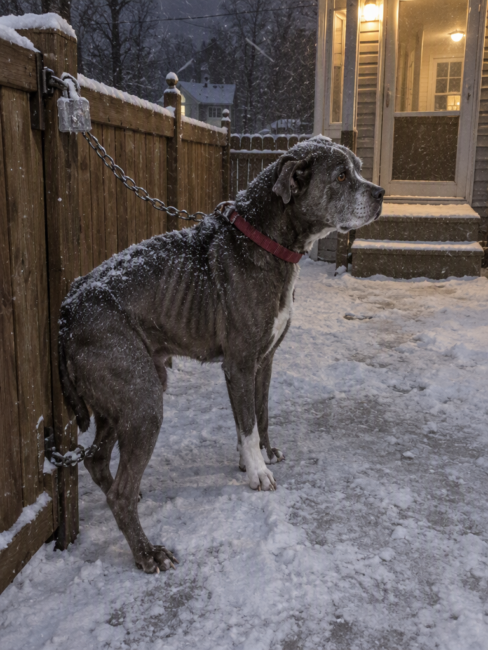
Sam moved their light so it illuminated the ground without shining directly into the dog’s eyes. For the first time, I could see the whole chain. It passed around the fence post, and one section had caught beneath the gate’s lower corner. When the dog turned, that trapped length made his available space even smaller.
Lena crouched several feet away, with her body angled rather than facing him squarely. She spoke quietly and let him watch her. His ears flattened when she moved her hand, but he did not come forward or lunge. He shifted his weight backward and looked toward the porch. I resumed my account of the bird feeder, though I could no longer remember where I had left off.
“He may be too cold and tired to show us much,” Lena told Sam.
That sentence changed the way I watched him. I had wanted his stillness to mean he trusted us. Stillness could mean other things. His thin body shook beneath the collar, and each time he tried to sit, he stood again before his hindquarters reached the icy ground.
Sam cleared a small patch beside him and laid down a folded mat. He did not try to push the dog onto it. After a moment, the white front paw stepped across the edge. The other followed. It was only a few inches of movement, but it brought his feet off the frozen slush.
I heard myself say, “That’s better,” in the voice I used when someone found a misplaced button.
Lena asked Sam for a harness. The dog recoiled when she first brought it near his shoulder, and she paused. They needed a way to control and support him once the tether was cut, especially with an open street behind them. Nobody wanted freedom to become another danger he could run into.
They worked slowly enough that I could see each adjustment, but not so slowly that they forgot the weather. Sam held a blanket as a windbreak while Lena introduced the equipment, speaking before she touched. The dog watched her hands, then the door, then her hands again. I kept talking from the chair.
At one point, my voice cracked. I had been speaking for so long that the back of my throat felt scraped.
Lena glanced up. “You can take a breath, Ruth.”
I had told her my name without remembering it. Hearing it from somebody who knew what to do steadied me. I swallowed, took a sip of the water Sam had brought from my kitchen, and began again.
“There’s somebody here. We’re working on it.”
The phrase felt more honest than promising that everything would be all right.
Once the harness was secure, Sam examined the chain near the fence. They did not need to open the padlock. They needed to cut a suitable link away from the dog and keep the tether from snapping or dragging when it separated.
The dog suddenly raised his head toward the outer door. I realized I had stopped.
I started describing the kitchen again, the yellow curtains and the worn place beside the sink. Beneath the porch light, his ears shifted toward me. Lena placed a steady hand on the harness, and Sam positioned his tool.
For the first time that night, the chain was about to lose the argument.
Part 3 — When the Metal Fell Quiet
The cutting tool closed with a blunt crack. The dog flinched, and Lena kept the loosened chain from dropping against his legs. Sam lifted the severed length away from the fence. Nothing remained between the post and the collar now, but the dog stood in exactly the same place.
I had expected him to move toward the open door. I had pictured something simple: the chain gone, the dog inside, a blanket around him. Instead, he lowered his head until his nose nearly touched the mat and began to shake harder.
Freedom did not look the way I had imagined.
Lena did not pull him forward. She checked the harness and looked at the steps. There were only two, shallow by a younger person’s standards, but the dog’s front legs trembled when he tested his weight. Sam brought a padded transport stretcher from the van while Lena kept him sheltered from the wind.
“Can he come into the porch first?” I asked.
“Yes,” she said. “We’ll get him out of this wind while we prepare the vehicle.”
They brought the stretcher close, supporting his body during the transfer. His muscles tightened when they lifted him, and his head swung toward the fence. I almost called out, but Lena spoke first, low and even. Sam watched his hands and the dog’s feet, making sure nothing caught.
I stayed beside the doorway and said the only sentence that still came easily.
“I’m here.”
His head turned toward me.
They carried him up the steps and set him down inside the enclosed porch, leaving enough room for the outer door to close. The wind vanished so abruptly that I could hear water dripping from his collar onto the floor. I had listened to the storm for hours. Now I heard the dog breathing.
He did not look around. He stared at the lower edge of the door, where a thin line of snow had blown beneath the seal.
Sam secured the remaining chain so it would not drag. They would remove the old collar once he was in a more controlled setting. Lena covered most of his body with a dry blanket, leaving his face clear, and checked him again. When she lifted the fabric briefly, his hips looked painfully narrow.
He had been thin before the storm. Whatever had happened at my fence was not the beginning of his trouble.
I asked whether he was dying. The question escaped before I could soften it.
“He needs a veterinarian now,” Lena said. “We’re calling ahead.”
I appreciated that answer later. At the time, I wanted something she could not honestly give me.
Sam went to arrange the warmed transport area. Lena remained with the dog, recording what she had found. She asked again if I had seen a vehicle or heard voices before the scraping. I thought of the television I had turned down, the kettle, the evening news. I had heard nothing I could describe with confidence.
“I should have checked earlier,” I said.
Lena looked up. “You checked when you heard him.”
I started to explain all the things I might have done sooner. She let me finish, then repeated the same sentence. She did not let my guilt become another emergency.
When Sam returned, they prepared to carry the dog to the van. I rose from my chair, and the dog lifted his chin. His eyes followed me as I moved to make room. For the first time, I noticed the small notch in his left ear, almost hidden by wet fur.
“What should we call him?” Sam asked.
I looked past him at the cedar fence, then away from it.
“Cedar,” I said. “Unless somebody already knows his name.”
Lena wrote it down as a temporary name. I liked that she made room for a life we knew nothing about.
At the van, I stood inside the porch door while they settled him. I could not ride with them, and the roads were no place for me to drive. Lena took my number and promised an update when they had one.
I spoke until Sam closed the vehicle’s rear door.
“Cedar. There’s somebody here.”
Then the van pulled away, and I was left with the chair, the quilt, and a patch of meltwater where an old dog had finally stopped standing in the snow.
Part 4 — The First Night Without the Fence
After they left, I remained on the porch for several minutes. The gate stood crooked, and the severed chain lay inside an evidence bag that Sam had taken with him. Only a flattened rectangle in the snow showed where Cedar’s mat had been. I could not stop looking at it.
Eventually, I went inside and turned on the kitchen light. My gloves had dried into stiff shapes beside the radiator. I put the kettle on, forgot why, and sat down before it boiled. The house had become too quiet.
Lena called shortly after midnight.
Cedar was at the emergency veterinary hospital. The veterinarian had confirmed that his body temperature was dangerously low and that he was dehydrated and severely underweight. They were warming him under supervision, checking his circulation and breathing, and assessing whether the cold had injured his feet or ears.
“He’s still with us,” Lena said. “They’re watching him closely.”
I held the phone in both hands. It was not a promise about tomorrow, but it was something I could carry through the next hour.
The next update came in the morning. His temperature was improving. He had become more responsive as he warmed, and the staff had removed the burgundy collar. Beneath it, the skin was irritated but intact. The veterinarian estimated he was around eleven, possibly older. There was no readable tag and no microchip they could find.
Nobody knew whose dog he had been.
I went to the hospital that afternoon after the roads were cleared enough for my neighbor, Gail, to drive. I carried a clean towel because I could not arrive empty-handed, although the hospital certainly had towels. At the desk, I said I was the woman from the porch.
The receptionist knew who I meant.
Cedar lay on thick bedding in a quiet ward. Without the snow and chain, he looked smaller. His white chest crescent rose and fell beneath the edge of a blanket, and the white front paw rested near his nose. A staff member asked me to sit beside the enclosure and let him decide whether to approach.
I began with his temporary name.
One ear moved.
Then his head lifted, slowly, and turned toward me. He did not stand. He did not wag. But his eyes followed my hand as I lowered it to my knee, and his chin remained raised while I spoke.
Recognition, if that was what it was, arrived without a performance.
The veterinarian, Dr. Patel, joined us. She explained that Cedar needed continued monitoring, careful feeding, and time before they could understand the full extent of his condition. His low body weight had made the exposure more concerning. They would not know everything from one examination, especially while he was still recovering from the cold.
I asked whether a large dinner would help him.
She explained that his meals needed a plan, and I was glad I had asked before bringing the chicken sitting in my refrigerator. There were things kindness could do badly when it hurried.
Cedar lowered his head while we talked. Dr. Patel watched his breathing, then the way his shoulders rested.
“He seems comfortable hearing you,” she said.
I asked if that meant he remembered me.
“It means your voice is familiar right now.”
Familiar was enough.
I stayed for twenty minutes, mostly telling Cedar about Gail’s terrible parking and the squirrel that had emptied the feeder while I was away. When a cart rattled past the ward, he raised his head sharply. I paused, let the sound pass, and spoke again. His chin returned to the blanket.
Before leaving, I told him where I was going. I knew he could not understand an explanation about visiting hours, but speaking kept me from disappearing in a rush.
At the door, I turned back. He was watching the place where my chair had been.
I went home with the unused towel and sat at my kitchen table. For the first time since the rescue, I did not wonder whether I had done enough that night.
I wondered what would happen after the hospital was finished doing its part.
Part 5 — A Place to Recover
Cedar moved to a rescue organization’s medical foster program once the hospital considered him stable enough to leave. His new room was warm, quiet, and close to the staff office. There was a thick washable bed, a water bowl, and enough space to walk without navigating slippery floors.
I visited on the fourth day.
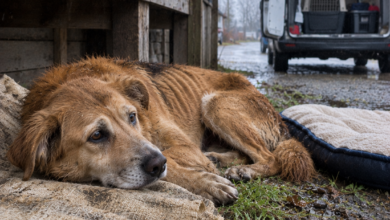
His coat had dried to a soft charcoal gray. The white paw was clean, and his ears no longer carried little beads of melting ice. His ribs were still stark beneath the skin. That would not change in a few meals, and the staff were careful not to make his progress sound faster than it was.
A volunteer named Marisol showed me his daily chart. Small improvements had their own column. He had finished his measured breakfast. He had slept for longer stretches. He had walked a short distance outside with support and supervision, then returned willingly to his bed.
“He’s doing better,” she said. “He’s also very tired.”
Cedar stood when he heard me, then sat again almost immediately. I pulled a chair close to the gate and spoke until he lay down. Marisol noticed that he watched the doorway whenever someone left, even when other people remained in the room.
They were recording that behavior without pretending to know its entire history.
The local animal control officer called me later in the week. They had documented the tether, the lock, Cedar’s condition, and where he had been found. They were checking reports and speaking with nearby residents. Nobody had produced an owner who could explain the fence.
I wanted the story to have an answer. A reason would not have warmed him, but it might have given my anger somewhere definite to go.
Instead, we had observations and unanswered questions.
The officer asked me not to fill the gaps with guesses. I thought about the people already sharing Cedar’s photograph online, certain about things I did not know despite having sat ten feet from him. I told the officer I understood.
Over the following days, I kept visiting. I brought a book and read a few pages aloud, which was easier than inventing conversation every afternoon. Cedar learned the sound of the chair legs moving into place. Sometimes he lifted his head before I spoke. Sometimes he slept through my arrival and I let him.
Once, halfway through a chapter, he rolled onto one hip and stretched his front legs across the blanket.
It was the first time I had seen him make himself longer.
I stopped reading.
Marisol, passing the doorway, saw why. She smiled without coming in, and I began again before my silence woke him. There were improvements worth protecting from celebration.
By the second week, the rescue asked whether I would consider fostering him when his medical team approved it. I said yes too quickly, then spent the night listing every reason I might be unsuitable. I was seventy-nine. My hands were unreliable. The front steps were difficult in winter. I could not lift him alone.
The foster coordinator did not dismiss any of those concerns.
She visited my house with me and Gail. We looked at the side entrance, where one shallow threshold led into the kitchen. Gail offered help with transport and heavier tasks. The coordinator discussed Cedar’s appointments, ongoing costs, and the rescue’s support during fostering.
Love would need arrangements.
We put nonslip runners across the kitchen and moved a low bed away from the draft beneath the outer door. My old kitchen chair came back from the porch and settled beside it. I had other chairs, but that one seemed to belong there now.
Cedar came home nineteen days after the storm.
He sniffed the side entrance, paused at the threshold, and looked toward the kitchen. I sat down instead of reaching for him. The coordinator held his lead loosely and gave him time.
“Hello, Cedar,” I said.
He stepped onto the runner with his white paw.
Then he brought the rest of himself inside.
Part 6 — The Sound of Someone Returning
The first evening, Cedar inspected only the kitchen and the short hall beside it. I had imagined him touring the house, finding the sofa, perhaps looking out the front window. He preferred the runner, the water bowl, and the space between his bed and my chair.
We let that be enough.
He ate his scheduled meal, went outside briefly with the coordinator, and came back to stand beside the bed. He smelled it several times before lowering himself onto the edge. Half his body remained on the floor.
I did not rearrange him. Having a bed and trusting a bed were separate things.
For the first three nights, I slept downstairs on the sofa. The rescue had helped me make a gradual settling plan, and Gail came each morning to take over while I showered and rested. Cedar followed us with his eyes. If I moved beyond the kitchen doorway, he stood before I had gone two steps.
At first I answered every movement by returning immediately. Soon I was barely leaving the room.
When the coordinator called, I admitted that I had begun carrying my tea, mail, medication, and sewing basket to the chair so Cedar would not have to wonder where I was. She heard the affection in it, but she also heard the problem.
“We want him to learn that you come back,” she said. “And you need to be able to live in your house.”
She arranged help from a qualified behavior professional, who visited and watched us together. We worked on tiny, manageable absences, keeping Cedar comfortable rather than waiting for him to become frantic. Some days progress meant I could stand at the sink while he remained on his bed.
Six feet could be a great distance.
Then, during the third week, a delivery arrived at the front door.
I had been told to leave the package outside, but habit moved faster than memory. I opened the inner door, and a gust caught the outer one. It slammed against the frame with a noise that shook the porch glass.
Behind me came the scramble of paws on flooring.
Cedar had pushed past the edge of his runner and was trying to follow. His feet slipped on the uncovered section of hall. He did not fall hard, but he folded awkwardly onto his side, then struggled to stand.
I shut the door gently and called Gail.
While we waited, I stayed beside him without pulling at his collar or trying to lift him. He was trembling, his eyes fixed on the porch. I heard myself starting the old sentence too quickly, almost pleading with him to believe it.
“I’m here. I’m here. I’m here.”
Then I slowed down.
He needed my familiar voice, not my panic.
The veterinarian examined him that afternoon. There was no new injury found, but his discomfort and mobility plan were reviewed, and we adjusted the hall so there was no slippery gap in the route he was likely to take. We also returned to easier steps in his settling routine.
I cried in Gail’s car afterward. I had wanted home to mean the end of fear.
Gail kept both hands on the wheel. “Home means you noticed,” she said. “And you changed something.”
Recovery resumed in smaller pieces.
Cedar began resting his whole body on the bed. He could hear me wash dishes without getting up. When Gail arrived, he lifted his head and watched her set down her bag, then sometimes went back to sleep.
One afternoon I walked to the pantry and realized, halfway there, that I had not announced it.
I turned.
Cedar’s eyes were open. He had watched me leave the chair, but his chin remained on the blanket.
I took the oatmeal from the shelf and returned.
Nothing dramatic happened. No tail thumped. No music seemed to rise from anywhere. An old dog stayed in his bed while a woman crossed her kitchen.
I sat down and let that ordinary thing be as large as it was.
Part 7 — The Chair Beside His Bed
The rescue completed its ownership checks and required process before Cedar became available for adoption. By then, I had learned his medication schedule, which paths were easiest for him, and how to tell the difference between a sleepy pause and a movement he found uncomfortable.
I had also learned that he disliked blueberries and enjoyed listening to Gail complain.
Nobody had come forward with a history we could verify. His former name remained unknown. I sometimes wondered whether Cedar was a poor choice because it came from the fence, but he had begun turning toward it when I spoke.
The name had acquired more than one evening.
I signed the adoption papers at my kitchen table. Gail was listed in the care plan we had made with the rescue, along with arrangements for help if I became ill. I was old enough to know that loving a dog included thinking beyond the days I expected to manage by myself.
The coordinator reviewed everything with us. Cedar slept beside my chair while we talked.
When she asked whether I had any final questions, I looked down at his gray back. His ribs were still discernible, but his body was filling out gradually under veterinary supervision. His fur no longer looked stretched over every angle. He rested more easily, and he could enjoy a short walk without spending the rest of the day recovering.
“Do I have to take a picture?” I asked.
She laughed. “Only if you want one.”
We took it another day, when Cedar was awake and comfortable. In the photograph, half my face is turned toward him because he was investigating a biscuit in Gail’s hand. It is not a beautiful portrait. It is an accurate afternoon.
Winter continued around us.
We changed the front gate latch and repaired the crooked section of fence. The lock and chain did not come back to my house. I did not want them framed, saved, or turned into proof of anything. I had the chart of Cedar’s weight on the refrigerator and a box of clean blankets beneath the hall table.
Those were the objects that mattered now.
On cold evenings, he preferred the kitchen bed to the living-room rug. I read aloud while he slept, although I no longer felt required to fill every silence. Sometimes I put the book down and listened to the refrigerator humming and his slow breathing.
Silence was becoming something we could share.
In late February, another storm arrived after supper. Wind pressed snow against the porch windows, and the gate rattled once before I secured it. Cedar raised his head from the bed.
I stopped beside him.
“We’re indoors tonight,” I said.
He watched me put on my coat to check the side entrance with Gail, who had come over ahead of the weather. She remained in the kitchen while I stepped into the enclosed porch. I was gone only briefly.
When I returned, Cedar was still lying down.
His head had turned toward the doorway, but he had not risen. The blanket remained smooth beneath his front paws. I took off my coat, crossed the runner, and sat in the chair.
He reached his nose toward my hand.
I let him smell it before resting my fingers lightly against his cheek. His eyes closed for a moment, and the weight of his head settled into my palm. He did not need to hold me there.
Later, I went to the pantry for tea. The old grocery receipt fell from a book I had left on the counter, its ink fading along the fold.
Milk. Tea. Oatmeal. Pears.
I stood with it in my hand and remembered reading those words through the gap in the porch door, trying to keep a frightened dog from hearing another empty house.
From his bed, Cedar sighed and stretched out his white paw.
I put the receipt back inside the book, filled the kettle, and returned to my chair. Outside, the wind moved through the cedar fence. Inside, the dog kept sleeping.
Follow our page for more dog rescue stories about patient kindness, second chances, and the ordinary people who make room for a life worth saving.