An Old Golden Left a Flower on My Wheelchair Ramp Every Morning—When I Followed Him, I Found the Woman He Was Still Waiting For to Return
Part 2, The Dog Who Always Left Turning Space
I want to describe Elliot’s routine, because the truth would make little sense without its smallest details.
Elliot was eleven years old and weighed sixty-two pounds. His left ear folded lower than the right, six white hairs grew from a dark spot beneath his chin, and a narrow crescent-shaped scar crossed the top of his muzzle.
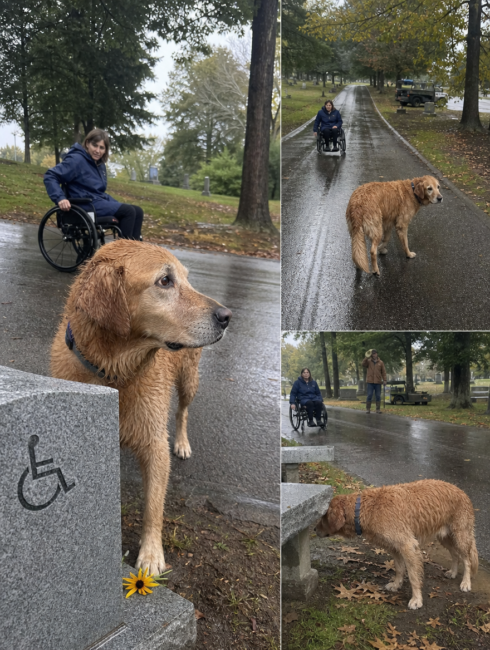
His blue collar had been repaired with gray thread.
Each morning he approached my ramp from the east, even though that route added nearly four blocks to his walk. He never cut through the empty lot behind my house or used the steps beside the porch.
He chose the ramp.
At the bottom, he paused until both front paws rested on the first strip of ribbed aluminum. Then he climbed at my chair’s usual speed, carrying a flower between his teeth.
He never brought roses from gardens or blossoms from the flower shop near Gallatin Avenue. He chose common plants growing beside sidewalks: clover, asters, coneflowers, black-eyed Susans, goldenrod.
Flowers a person could take without stealing something somebody had planted.
He placed each stem sideways across the threshold. A stem pointing toward the house could catch beneath my front caster. A stem pointing outward might roll down the slope.
Sideways meant safe.
After lowering it, Elliot tapped the ramp twice and moved backward forty-two inches.
I measured the space on the eighth morning.
The turning circle of my wheelchair required forty inches if I kept my elbows close. Elliot allowed two extra.
That was the first clue.
The second involved doors.
Elliot would not enter without hearing the word inside. I did not know that command during his first week, so he remained on the porch even when I left the door open.
The morning after the storm, I said it by accident.
“You can come inside if you want.”
His ears rose at the final word.
He crossed the threshold.
Elliot inspected the living room without touching anything. He walked beside the wall until he found the kitchen, smelled the water bowl, then returned to my chair and waited with his shoulder aligned beside my right wheel.
He had been taught to walk next to a wheelchair.
That seemed obvious.
What I could not explain was why he kept watching the door.
He rested inside for twenty minutes, but every sound from the street brought him upright. When a woman’s voice carried from the sidewalk, he went to the porch and searched the corner.
At 8:03, he left.
The following morning, he returned with another flower.
I called the microchip company again. The registration listed Elliot as a neutered Golden Retriever owned by June Elena Morales. The emergency contact was June’s brother, Rafael, who had died in 2019.
The secondary number belonged to a disconnected landline.
A representative could give me no more information, so I drove to the address with my neighbor, Marcus Reed, a fifty-two-year-old city-bus mechanic who had been helping with groceries since my accident.
June’s house sat on a narrow street in Madison, six miles north of mine. An estate-sale notice remained taped inside the front window, though the sale had ended weeks earlier. The flower beds had gone brown beneath the September heat.
A woman across the street saw Elliot through the van window and came outside without shoes.
“Ellie?”
Elliot lifted his head.
The woman stopped beside the curb. Her name was Teresa Alvarez, and she had lived across from June for seventeen years.
“We thought he was dead,” she said.
June had been diagnosed with pancreatic cancer in January. When treatment stopped working, a home-hospice nurse began visiting in July.
Elliot remained beside her wheelchair.
After June died on August 28, a distant nephew named Caleb arrived to settle the estate. Teresa offered to foster Elliot, but Caleb said a rescue organization was collecting him.
No rescue ever came.
Three days later, Elliot disappeared.
“Did June walk him near East Nashville?” I asked.
Teresa looked at me for several seconds.
“She practiced a route there,” she said. “Every morning for nearly a month.”
“What route?”
“She never told me. She said Elliot needed to learn it before she ran out of time.”
Behind us, the Golden stood inside Marcus’s van, his nose pressed toward the road leading south.
He already knew the way home.
I just did not know whose home he meant.
Part 3, The Route June Practiced Without Me
Teresa unlocked June’s backyard gate with a spare key the estate attorney had not yet requested.
Elliot stepped from the van and crossed the yard without searching. He walked past a dry birdbath, around two overturned planting pots, and stopped beside the wheelchair ramp leading to the back door.
Tap. Tap.
His paw struck the metal.
Nobody answered.
He waited forty-two inches from the door.
Teresa turned away and pressed the heel of her hand beneath one eye.
June’s house remained mostly empty, but several pieces of furniture had not sold. A narrow hospital bed stood in the front room. Wheel marks darkened the floor beside it, and a blue ceramic bowl rested in the corner.
Elliot drank from that bowl.
Then he walked from room to room.
He checked behind the shower curtain. He smelled June’s closet. He stood beside the unused hospital bed and listened to the oxygen concentrator that no longer ran.
After each room, he returned to the ramp.
Tap. Tap.
He waited.
“He did that for two days after she died,” Teresa said. “Front door, back door, bedroom. He kept asking someone to open something.”
Elliot did not understand death as a medical fact. He understood that doors opened, people emerged, and departures ended with someone coming home.
June had disappeared behind a bedroom door. Paramedics had carried her through the front entrance beneath a white sheet pulled only as high as her shoulders.
Elliot had followed the ambulance for six blocks before Teresa caught him.
The next morning, he began walking south.
Teresa followed by car once. Elliot went through Madison, crossed beneath Interstate 65, and reached East Nashville before she lost him near the railroad bridge.
“He came back with a flower missing from June’s yard,” she said. “I thought he’d dropped it somewhere.”
He had not dropped it.
He had placed it on my ramp.
June’s neighbors helped us reconstruct her final month. Mr. Walsh from number twenty-seven saw her leaving at 6:20 every morning with Elliot walking beside her chair. A grocery clerk remembered that she bought only one bottle of water, then gave most of it to the dog.
A crossing guard on Douglas Avenue had watched June teach Elliot to stop at every curb. She would tap her footplate twice, roll backward, and say, “Give her room.”
“Give who room?” I asked.
The crossing guard did not know.
A barista near the railroad bridge remembered June because she ordered black coffee and carried a handwritten map beneath her wheelchair cushion. Elliot would lie under the outdoor table while she marked curb cuts, broken sidewalks, construction zones, and places where the slope became too steep.
June was not merely teaching him an address.
She was building a route another wheelchair could use.
Marcus and I followed it the next morning.
The direct road between June’s house and mine measured 4.1 miles. Her route measured 5.8. It avoided a staircase beneath the railway, two sidewalks without curb cuts, and an intersection where the pedestrian signal changed too quickly.
A person walking could take the shorter road.
June had chosen the one I could travel.
On October 2, the estate attorney called. Teresa had told him about Elliot, and he wanted to inspect the dog before deciding whether Caleb still held legal ownership.
Caleb arrived first.
He was thirty-eight, wore expensive running shoes, and seemed embarrassed by the entire situation. He said the rescue had failed to return his calls. He had left food in the backyard and assumed Teresa would monitor Elliot.
“You left an eleven-year-old dog alone beside an empty house?” I asked.
“I had three days to clear everything,” he said. “Aunt June had papers everywhere. She didn’t make any of this easy.”
Elliot stood behind my chair.
Caleb held out a hand.
“Come on, Ellie.”
The dog did not move.
The attorney, Marcia Bell, examined June’s veterinary records. Elliot had severe arthritis in both hips, early kidney disease, and a prescription that had not been refilled since July.
Caleb wanted to surrender him immediately.
I said I would foster him.
The decision frightened me after the words left my mouth. My hands worked well enough to feed and brush a dog, but transferring from my chair remained difficult. I could not lift sixty-two pounds if Elliot fell. My disability benefit barely covered my mortgage, and I had not returned to work.
Marcus found a low-cost veterinary program. Teresa brought Elliot’s orthopedic bed. Marcia arranged temporary legal custody while the estate was reviewed.
That evening, Elliot entered my house after I said inside.
He ate beside the refrigerator, walked one slow circle around the living room, and lay near the front door.
At 3:46 the next morning, I woke to the scrape of his nails.
Elliot stood beside my bed with a wild aster in his mouth.
I had closed every door and window. He could not have collected it during the night.
The stem was dry.
I followed him into the living room. He placed the flower on the floor beside my wheelchair, tapped one front wheel twice, and backed away.
The flower had been hidden beneath his old bed.
June had packed it there before she died.
I still thought the flowers were memorials.
I had not yet learned they were instructions.
Part 4, The Grave Where Elliot Kept Looking Behind Him
The following Thursday, Elliot refused breakfast.
He stood beside the front door at 6:58, a black-eyed Susan held between his teeth. When I opened it, he descended the ramp and waited at the sidewalk.
The sky had cleared after three days of rain. Water remained in the gutters, and yellow leaves clung to the pavement.
I called Marcus.
He could not leave work until noon.
I went alone.
Elliot followed June’s long accessible route through East Nashville, but at the railroad bridge he turned south instead of north. He checked my position at every intersection, waiting until both large wheels cleared the curb before moving ahead.
The journey to Mount Olivet took forty-three minutes.
Samuel Pike was trimming grass near the lower garden when he saw us. He shut off the mower and came toward Elliot with both hands visible.
The Golden carried the flower past him.
June’s grave lay beneath a young cedar tree. Rain had darkened the headstone around the engraved wheelchair, and a few grains of fresh soil remained trapped along its base.
Elliot set the flower beside June’s name.
Then the search began.
He checked the cedar first. He pushed his muzzle through the lower branches and smelled the ground beneath them. He walked around the bench, looked under it, and inspected the path behind the neighboring headstones.
He returned to June.
His body becomes still.
He listens.
A groundskeeping cart rattles beyond the trees, and Elliot turns toward it. A woman speaks near the cemetery entrance. He takes three steps in that direction, waits, then comes back.
He touches his nose to the stone.
Nothing happens.
He searches again.
Samuel removed his cap. “He does this every time.”
“How often has he been here?”
“Every Thursday since the funeral.”
I looked at the date engraved above the wheelchair.
June had died five weeks earlier.
Elliot had spent every Thursday returning to the last place where he had seen people gather around her. He brought the same kind of flower June once carried for strangers, placed it beside her name, and checked every path.
He was not visiting a grave in the human sense.
He was testing possible places from which June might return.
I transferred onto the damp bench using my folding board. Elliot watched but did not approach until I settled.
“Come here,” I said.
He walked to me.
I placed one hand on his shoulder. Beneath his coat, I felt the points of his bones and a small tremor traveling through the tired muscles of his rear legs.
“She isn’t coming back.”
Elliot lowered his head.
I could not tell whether he understood the sentence. He understood my hand. He understood that I remained beside him when the cemetery emptied.
We stayed for eighty-seven minutes.
At 9:02, Elliot stopped checking the paths. He lay between my chair and June’s headstone with his muzzle resting across one front paw.
When I moved, he rose.
We returned home together.
That seemed to be the end of the mystery. An elderly dog had lost his owner, searched for her, and attached himself to another woman whose wheelchair, voice, and movements resembled the life he understood.
I agreed to adopt him once the estate released custody.
For four days, Elliot slept beside my bedroom door. He ate his medication in peanut butter, followed my chair through the kitchen, and waited beside the shower until I finished.
He stopped leaving the house alone.
The flowers stopped too.
On the fifth morning, Samuel called.
“I found the notebook,” he said.
“What notebook?”
“The one June left for you.”
I gripped the phone tighter.
“I never met June.”
Samuel was quiet.
“She believed you would say that.”
Part 5, The Name Written Beside Room 314
Samuel arrived at my house at 4:20 that afternoon carrying a brown composition notebook sealed inside a freezer bag.
June had written my name on the front.
CLAIRE BENNETT—ONLY IF ELLIOT FINDS HER.
Beneath it, she had added my address, my former job at Hume-Fogg High School, and Room 314 at Vanderbilt Stallworth Rehabilitation Hospital.
My room.
I had spent ninety-one days there after the crash.
I searched my memory for June’s face and found nothing. The first month remained a mixture of ceiling tiles, medication, metal bedrails, and people explaining what I might never do again.
Samuel waited while I opened the notebook.
The first pages contained June’s medical schedule and Elliot’s feeding instructions. Later entries described the route between her house and mine.
On page nineteen, June had drawn my porch.
On page twenty, she had written:
Claire does not want anyone pushing her chair. Elliot must stop before the landing. Forty-two inches gives her room to turn.
My throat tightened.
Page twenty-three explained the flowers.
June had volunteered with a peer-support group for adults with new spinal-cord injuries. She visited patients after discharge, never during the first weeks, and never without being invited.
She brought one flower from her yard.
Not a bouquet. Not a card. One common flower that required no vase and created no obligation.
Elliot carried it.
June tapped her wheelchair twice when they reached a ramp. Elliot placed the flower sideways, stepped backward, and waited for the person inside to decide whether to open the door.
The ritual had never been about delivery.
It was about consent.
A person could accept the flower without accepting a visit. They could close the door. They could ask June to return another day.
Elliot had learned the outcome, not the reason: flower at threshold, two taps, room to turn, wait for June.
My name appeared because I had registered for June’s peer-support program after leaving the hospital.
I had canceled four visits.
The last email I sent contained one sentence June copied into her notebook:
Please don’t send anyone who will tell me to be brave or try to push me somewhere before I’m ready.
June wrote beneath it:
She does not need pushing. She needs someone who can wait.
June’s cancer worsened before the fifth visit.
She knew she might not reach my door.
For twenty-six mornings, she practiced the route with Elliot anyway.
Her final instruction was not an order that I take him. She had underlined that twice. It was a request that Samuel bring me the notebook only if Elliot found my house by himself—and only if I opened the door more than once.
At the bottom of the final page, June had written:
If Claire chooses him, tell her Elliot is not replacing anyone. He is finishing the visit.
Part 6, What Every Flower Had Actually Meant
I read the notebook twice before speaking.
Samuel sat at my kitchen table. Elliot lay beside the front door with his paws pointing toward the ramp.
“I thought he chose me because of the wheelchair,” I said.
“He did,” Samuel answered. “Just not in the way you mean.”
The chair had not confused Elliot into mistaking me for June. My voice, smell, house, and movements were different. He had walked beside June for nine years. A dog who noticed the angle of a ramp would not fail to notice that I was another person.
Elliot came because June had taught him my route.
Every strange detail now had a place.
He approached from the east because June’s accessible map entered Hawthorn Avenue from that direction. The empty lot offered a shorter path, but it ended at three wooden steps.
He never used it.
He placed flowers sideways because June had learned that loose stems could catch beneath small front casters. During her first peer visit in 2018, a daisy rolled under her wheel and snapped. She laughed, but Elliot watched her stop and retrieve it.
After that day, he turned every stem.
The forty-two inches were not a trick. June had measured the turning space during a practice visit when I was at physical therapy. Teresa had driven her, and June had remained on the public sidewalk because I had not invited her onto the property.
She measured from a distance.
“Give her room,” she told Elliot.
That explained why he backed away from animal control. He was not using my wheelchair as protection by accident. June had taught him that the space around a chair belonged to the person sitting in it.
Nobody entered that space without permission.
The word inside came from the peer visits. Elliot waited outside until each person invited him across the threshold. Some patients were afraid of large dogs. Some had medical equipment or other animals. June never assumed.
The two taps came from her footplate. June’s fingers had weakened during chemotherapy, so striking the metal with her knuckles hurt. She tapped it with the side of her shoe instead.
Elliot heard the same note every time they arrived.
Tap. Tap.
Flower down.
Step back.
Wait.
The most difficult clue was the way he watched the corner.
After Elliot placed a flower during a visit, June always followed twenty or thirty seconds behind. She moved slowly on steep pavement and sometimes stopped to rest before the final slope.
Elliot learned to deliver first.
Then he looked back for her.
During the twenty-six practice trips to my house, June sent him up the final section alone while she remained near the corner. She wanted to know whether he could reach the correct ramp if fatigue prevented her from completing the hill.
He always placed the flower.
He always turned around.
June always appeared.
Until September 6.
That morning, Elliot left her empty house, followed the route they had practiced, placed a black-eyed Susan on my threshold, and watched the corner.
June did not come.
He returned the next morning and repeated the sequence because repetition had always produced the outcome he wanted. A flower led to an open door. The open door led to June joining him.
He did not know why the chain had broken.
He knew only where it broke.
Even the flower hidden beneath his bed belonged to the pattern. June had dried several asters during her final week because she was too weak to take Elliot outside. Teresa saw her place them beneath the blanket but assumed she was preserving them.
June was preparing him.
I closed the notebook.
For months after my accident, people told me that survival had given my life a new purpose. They expected a lesson from my body, as if damaged nerves had made me responsible for improving strangers.
June never wrote that I was brave.
She wrote that I was angry.
She wrote that anger made sense when every doorway, bathroom, sidewalk, and conversation demanded planning that other people never had to perform.
She did not want Elliot to cure me.
She wanted him to sit beside the door until I decided to leave.
That distinction was why I signed the adoption papers.
Elliot’s first night as my dog was October 14. Marcus installed a second handrail beside the ramp, Teresa brought June’s blue ceramic bowl, and Samuel gave me the metal tag she used during peer visits.
The tag carried no name.
One side showed a small flower. The other showed an open door.
I attached it to Elliot’s collar.
At 7:12 the next morning, he stood beside my bed.
No flower rested in his mouth.
He walked to my wheelchair and tapped one front wheel twice.
Tap. Tap.
Then he backed away.
I transferred into the chair. Elliot led me to the front door, where morning light crossed the floor in a narrow strip.
For twenty months, I had opened that door only when an appointment, delivery, or emergency required it. I had stopped going outside without a reason I could explain to somebody else.
Elliot waited.
I opened the door.
He descended the ramp, reached the sidewalk, and looked back.
This time, he was not watching the corner.
He was watching me.
I followed.
We walked seven blocks to Shelby Bottoms Greenway. Elliot kept his shoulder beside my right wheel, slowing at cracks and stopping where branches narrowed the pavement.
Near the river, he left the path and approached a patch of black-eyed Susans.
He smelled three flowers before choosing one.
He closed his teeth around the stem and pulled.
Then he carried it back to me.
I expected him to place it across my lap.
He did not.
Elliot turned toward home.
The flower was not for me.
At 10:26, he placed it beside June’s blue bowl.
He lay down and watched the front door.
I understood then that his route had changed, but his search had not ended. He could live with me, follow my chair, and learn another house while still waiting for the woman who had taught him how to arrive.
Adoption did not erase the person before me.
It gave her work somewhere to continue.
Part 7, The Door We Open Every Thursday
Every Thursday at 7:12, Elliot and I leave one flower at a door.
The first belonged to a retired mechanic named Paul, who had lost both legs below the knee after an infection. He had declined three visits from the peer-support program and stopped answering his daughter’s calls.
Elliot placed a white clover blossom across Paul’s threshold.
Tap. Tap.
He backed away forty-two inches.
The door remained closed for nine minutes.
Then it opened three inches.
Paul looked at Elliot and said, “That dog going to give me a speech?”
“No,” I said. “He doesn’t give speeches.”
The door opened farther.
The next Thursday, Paul waited on his porch.
We have visited fourteen people since then. Some invite us inside. Some accept the flower and say nothing. One woman closed the door, then called six weeks later and asked whether Elliot could return.
He did.
I never tell them to be brave.
Elliot never crosses a threshold without hearing inside.
On the final Thursday of each month, we visit June instead.
Mount Olivet replaced the soft soil around her grave with grass last spring. Samuel planted black-eyed Susans beneath the cedar after receiving permission from the cemetery.
Elliot still checks behind the tree.
He still looks beneath the bench and watches the path when a woman’s voice carries between the headstones. The search lasts less time now. His hips have weakened, and gray fur has spread past his muzzle to the skin around his eyes.
He places one flower beside June’s name.
Then he lies between her grave and my chair.
I read one page of her notebook aloud.
Some pages contain medication times. Others contain notes about cracked sidewalks or Elliot’s food. June wrote about people she visited, but never included details they might not want remembered.
The last page always ends the same way:
Leave room. Let them choose.
After I read it, Elliot taps the side of my wheel twice.
We go home.
On September 6, one year after his first visit, I placed a flower across my own threshold before sunrise. Elliot approached from the living room, saw it, and stopped.
He smelled the petals.
Then he backed away forty-two inches.
I opened the door.
For several seconds, neither of us moved. Morning traffic passed at the end of the street, and the metal tag on Elliot’s collar clicked once when he turned his head.
He looked toward the corner.
Nobody appeared.
Elliot looked at me.
I rolled onto the ramp.
He walked beside me.
The flower remained across the threshold until we returned, its stem turned sideways so neither wheel would crush it.
June never reached my door.
Her kindness did.
Follow our page for more unforgettable dog stories about quiet loyalty, second chances, and the lives that change when someone finally understands what a dog is asking.