Part 2: Every Morning My Rescue Dog Carried My Shoes, My Wallet, and My Keys to the Front Door and Stacked Them in a Neat Little Pile — It Took Me Weeks to Understand Why.
Part 2
His name stayed Buddy, but by the end I thought of it differently — not as a generic dog name, but as a job title. Because that’s what he turned out to be.
Let me tell you about him, because the whole thing only makes sense once you know him.
He was a shepherd-lab-something mix, two years old, around fifty pounds, with a short brown coat and that one white front foot that looked like he’d stepped in paint. He had a notch in one ear and a way of tilting his head when you talked to him that made you feel, irrationally, like he was actually listening. His eyes were the thing, though. Brown, calm, patient. The shelter had him listed as “easy.” They weren’t wrong.
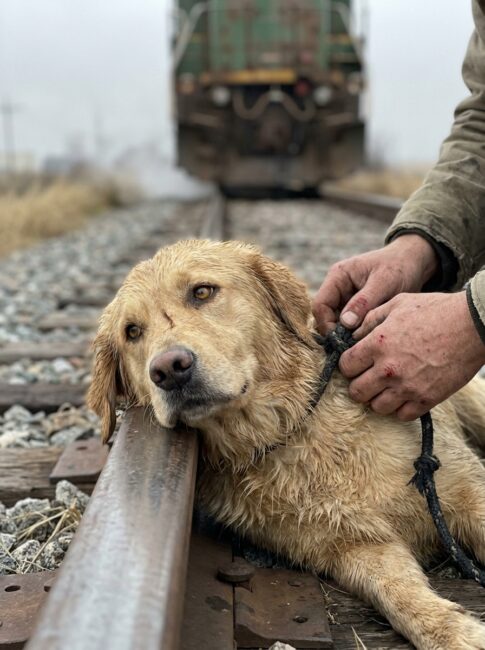
He’d been a stray, they thought. Found wandering near a strip mall out past the airport. No chip, no collar, no one looking for him. Just a polite, watchful dog who’d been on his own long enough to learn that the way you survive is you figure out what needs doing and you do it.
Here’s the small thing about Buddy that I didn’t understand for weeks.
The pile always happened at the same time. Around eight-thirty in the morning. And it always happened whether or not I’d gotten up. If I was still in bed at eight-thirty — which, then, was most days — he’d come into the bedroom and stand by the bed and look at me, and then go start the pile, and then come back, like he was checking my progress.
I thought, in my low and foggy state, that he was just an odd, anxious dog with a hoarding quirk.
I had it exactly backwards. He wasn’t anxious. He was the most purposeful creature I’d ever lived with. And it would take me until a particular gray Tuesday to understand that the dog had quietly appointed himself to a task that the doctor and the prescription and my worried sister had not managed between them.
Part 3
The weeks went the way my weeks went then, which is to say they barely went at all.
I’d love to tell you the dog fixed everything overnight. He didn’t. Depression doesn’t work like that, and anyone who’s been in it will tell you that a dog is not a cure. What a dog is, it turns out, is a reason. But I didn’t know that yet.
What I knew, those first weeks, was a lot of small failures. The dishes piling up. The blinds I didn’t open. The texts from my sister I’d leave on read because answering felt like lifting a car. The afternoons that turned into evenings without my really noticing the light had changed.
And in the middle of all of it, every morning, the pile.
Shoes. Wallet. Keys. By the door. Eight-thirty.
I started, despite myself, to interact with it. I’d come out and find it and say, “Buddy, what are you doing, buddy.” And he’d look at the pile, and look at me, and look at the door. Like he was trying to draw my attention to a sentence he’d written on the floor that I kept failing to read.
Some mornings I’d just put the stuff back. Wallet on the nightstand. Keys in the dish. Shoes in the closet. And the next morning, there the pile would be again. He was tireless about it. More consistent than I was about anything in my own life.
There was one detail I noticed and didn’t think about. Buddy never made the pile on the mornings we’d already been out. If, on a rare good day, I got up and took him out early, there was no pile. The pile only came on the mornings I hadn’t moved.
I want to tell you about the gray Tuesday, because that’s the day it broke open.
It was October. Raining, the soft constant Portland rain. I’d had a bad week even by the standards of that year — three days I’d barely left the bed, the world narrowed down to about the size of that mattress. My sister had called twice and I hadn’t picked up. I remember lying there at eight-thirty thinking, with a kind of flat, distant clarity, that I genuinely could not think of a single reason to stand up.
Not a dramatic thought. Just an empty one. I could not locate one reason.
And then I heard it. The soft clack of my keys being set down on top of the wallet, on top of the shoes, out by the door.
And Buddy came into the bedroom, and he stood by the bed, and he made a sound — not a bark, just a low, hopeful little whine — and he looked at me, and then he looked back toward the door, toward the pile.
And it finally landed.
Part 4
He had to pee.
That was it. That was the whole thing. That was the great mystery I’d been failing to read for weeks.
Buddy was a dog. Dogs need to go outside. He’d been a stray; he was, the shelter said, exceptionally house-trained, almost rigidly so — he would not, could not, go in the apartment. It was against everything in him. And the only person in the world who could open the door and take him out into the rain to do the one thing his body needed to do every morning was me.
The man who couldn’t find a reason to stand up.
So the dog had found one for me.
He didn’t know I was depressed. He had no concept of it. He didn’t know about my dad, or the job, or the narrowing. He just knew, with the simple clean logic of an animal, that the door opened when I had my shoes and my wallet and my keys — he’d watched me, those first days, gather exactly those three things every single time we went out — and that if those things were by the door, the going-out happened.
So every morning he gathered the three things that made the door open. And he put them where the door was. And he sat next to them and waited for me to do the thing he could not do for himself.
He was, in the most literal possible way, removing my excuses. Here are your shoes. Here is your wallet. Here are your keys. There is nothing left for you to look for. There is no reason not to. Please. I need you to.
I lay in that bed on that gray Tuesday and I finally understood that for three weeks, a dog had been getting me out of the apartment not to save me — he had no idea I needed saving — but because he needed to pee.
And it was the most important thing anyone had done for me all year.
I got up. I put on the shoes from the pile. I clipped his leash on, and I took him down the stairs and out into the soft October rain, and I stood on the wet sidewalk while my dog did the most ordinary thing in the world, and I cried so hard I had to lean against the building.
I thought, that morning, that I understood the whole story. A depressed man, a good dog, a reason to get up. A nice story.
I hadn’t yet understood the part that actually changed my life — which wasn’t the getting up. It was everything that the getting up turned out to drag along behind it.
Part 5
Here’s the part I didn’t see coming.
The dog only needed me to open the door. That was the whole of his plan, if you can call instinct a plan. Door opens, Buddy pees, mission complete.
But I couldn’t just open the door and stand there. We were already out. We were already on the sidewalk, in the actual world, in the actual morning. So we’d walk. A block, at first. Then two. Because once I was out there, going back inside immediately felt almost stranger than continuing.
And the walks did things to me that the dog never intended and never knew about.
There was sunlight, on the mornings it wasn’t raining — actual sunlight on my actual face, which I later read is a real, chemical, measurable thing that does something to a brain like mine. There was movement, my heart rate up, my legs working, the body doing what bodies are supposed to do. There were other people. A woman who walked her own dog at the same time and started saying good morning. The guy at the coffee cart on the corner who learned my order. Small things. Threads, thrown out into the world, that slowly started tying me back to it.
None of it was the dog’s intention. The dog wanted to pee. The dog wanted, on a good day, a sniff of an interesting fence post.
But to get the dog his ordinary morning, I had to assemble a life around it. I had to stand up. Go out. Move. See the sun. Pass a person. Come home. And then do it again the next day, because the next day at eight-thirty, there would be the pile again, patient and undeniable, shoes and wallet and keys, a small brown dog sitting beside it with his tail going, asking me for the one thing only I could give him.
The thing that saved me was not that the dog understood me.
The thing that saved me was that he didn’t — and needed me anyway.
Part 6
I sat with all of it, over that next year, and let the small things turn over in the light.
The pile only came on the mornings I hadn’t moved. I’d noticed it and not understood it. Of course. On the mornings I got up on my own, the door opened and his need was met, and there was nothing to engineer. The pile was never a quirk. It was a solution to a specific problem, deployed only when the problem existed. He was, in his way, more rational than I’d been in months.
He always brought exactly three things — shoes, wallet, keys. Not random objects. Not a toy, not a sock, not whatever was nearest. The three specific things he’d watched me pick up every single time the door had ever opened. He’d reverse-engineered the ritual of leaving and reproduced its inputs. People pay for that kind of pattern recognition. My dog did it for a pee.
He needed me anyway. That was the whole medicine, and it took me months to see it. The cruelest lie depression tells you is that you don’t matter, that nothing depends on you, that the world would roll on identical without you in it. And every single morning, a creature put three objects by a door and sat down and demonstrated, without knowing he was doing it, that this was false. That something in the world could not happen unless I stood up. That I was, to one living being, completely and non-negotiably necessary.
You can’t argue a person out of believing they don’t matter.
But a dog who needs to go out can prove it to them, one morning at a time.
I started answering my sister’s calls. I started opening the blinds. The dishes got done, mostly. None of it was fast and none of it was linear and I want to be honest that there were bad mornings still, plenty of them. But there was a floor under me now, and the floor was a fifty-pound dog with one white foot who would not, under any circumstances, let me disappear, because if I disappeared, who would open the door?
Part 7
It’s been a couple of years now.
I’m better. Not finished — I don’t think you’re ever finished with this — but better in the way that means I have a life again, with people in it and mornings I look forward to and a job I can hold.
Here’s the small thing we do, the thing that’s still true every single day.
I beat him to it now. That’s the change. Most mornings I’m up before eight-thirty, and I get the shoes and the wallet and the keys myself, and I clip on his leash, and we go.
But every so often — a hard morning, a low one, they still come — I’ll stay in bed past eight-thirty.
And I’ll hear it. The soft clack of keys being set down on top of the wallet, on top of the shoes, out by the door.
And Buddy will come stand by the bed and make his low hopeful sound and look at me, and then look toward the door.
And I get up. Every time. Because he’s asking, and because I matter to him, and because somewhere along the way “I have to, for the dog” quietly became “I can.”
He never stopped doing the pile. I think now he never will. It’s just who he is.
And on the bad mornings, I’m glad of it. Some mornings I still need someone to put my shoes by the door and remind me there’s no reason left not to.
Part 8
People ask me sometimes how I got better. They want the name of the thing that worked.
I tell them the truth.
A dog needed to pee.
He didn’t know I was drowning. He just needed me to open the door.
So I did.
Every morning. I opened the door.
Follow this page for more stories about the animals who pull us back into the world without ever knowing that’s what they’re doing.