Part 2: For Two Months a Man on Our Street Carried His Paralyzed Old Dog Outside to Watch the Sunset Every Single Evening. The Night the Dog Took His Last Breath, Ten of Us Did Something in the Dark That I Still Can’t Talk About Without Stopping.
Part 2
I want to tell you about Walt, because the man matters as much as the dog.
Walt’s wife, Eleanor, had died four years before. They’d been married fifty-one years. I remember the funeral — the whole street went — and I remember that in the worst of it, in those first raw months, the thing that got Walt out of bed in the morning, the thing people quietly said to each other, was the dog. Buster needed feeding. Buster needed his evening sunset. A grieving man who might otherwise have folded inward had a reason to get up, to go outside, to keep a routine, and that reason was a golden retriever who whined at the door at sundown.
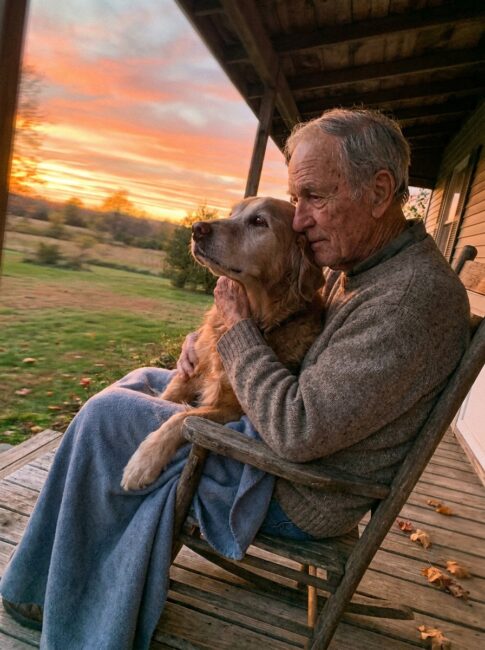
We all understood, without saying it, that Buster had carried Walt through the loss of Eleanor.
So there was a symmetry to those two months that nobody on the street missed, even if nobody said it out loud either. For sixteen years and especially through the worst four, the dog had been the thing that kept the man going. And now, at the very end, the man was carrying the dog — literally, in his arms, out to the sunset, every evening. Paying back a debt that isn’t really a debt, the way love isn’t really a debt, just a thing that flows both directions until it’s done.
Walt didn’t talk about it much. He was a private man. If you walked by while they were on the porch, he’d lift a hand, and you’d lift yours, and you’d let them be. But once, a few weeks in, my husband stopped at the bottom of Walt’s steps and asked, carefully, how Buster was doing, and Walt looked down at the dog in his lap, and was quiet a moment, and said, “He still wants to see it. Every night, he still wants to see it. So we go see it.”
That was all. He still wants to see it. So we go see it.
I think about that sentence a lot.
Part 3
The evenings developed a rhythm, and the rhythm pulled the street into it without anyone deciding it should.
It started small. People timing their evening dog-walks, without quite admitting it, to pass Walt’s house around sunset — just to lift a hand, just to be near it. The Hendersons two doors down started sitting on their own porch in the evenings, which they’d never done before. Kids who tore up and down the street on bikes all summer learned, somehow, the way kids do, to go quiet and slow past Walt’s house when the light went gold.
Nobody organized any of this. It just happened, the way a street arranges itself around something sacred without ever calling it that.
Because that’s what those evenings had become, though none of us would have used the word. Sacred. There was something about the sight of that old man and that dying dog, facing west together every evening, refusing to let go of one small daily joy even as everything else was being taken — something that made the whole street a little gentler, a little quieter, a little more aware of its own evenings.
I’d catch myself, washing dishes at my window that looks out west, watching the sky go pink, and then looking down at Walt’s porch to see the two silhouettes there, the man and the dog, facing the same direction, and I’d have to stop and just breathe for a second.
We all knew it was coming. You can’t watch a sixteen-year-old paralyzed dog be carried to the sunset every evening and not know how the story ends. But knowing it’s coming and seeing it come are different things, and none of us were ready, and I don’t think you ever are.
The evening it happened was a Thursday in late September. One of those Wisconsin evenings the whole year seems to be building toward — clear, still, the sky already promising the kind of sunset that makes people pull their cars over.
Walt carried Buster out like always.
Part 4
I was at my window. I want to tell you what I saw, because I saw most of it, and I’ve gone over it so many times that I can give it to you almost frame by frame.
Walt came out at the usual time, Buster wrapped in the blue blanket, and he lowered himself into the porch chair with the dog in his lap, facing west, the way they had every evening for two months. The sky was extraordinary that night. Banks of cloud lit up orange and rose and gold, the kind of sky that doesn’t look real.
Buster’s head was up.
I could see it from my window — the old dog’s head, lifted, facing the light. He was watching it. Even then, even at the very end, he was doing the thing he had done his whole life. Watching the sun go down.
And Walt had his head bent down close to Buster’s, the two of them cheek to cheek almost, both facing the same west, and I imagine — I don’t know, but I imagine — that Walt was talking to him, low, the way you do.
The sun went down slow and then, the way it does at the very end, all at once — that last bit of the disk sliding below the horizon, the light changing in that final instant from gold to the blue of dusk.
And in that instant, Buster put his head down.
I saw it. I saw the old dog’s head lower, gently, onto Walt’s chest, right as the last of the sun disappeared. And I saw Walt go very still.
I didn’t understand yet. I thought the dog had just gotten tired, laid his head down, that they’d go inside soon.
But Walt didn’t go inside.
The light kept fading. Dusk deepened toward dark. And Walt sat there on the porch, not moving, with Buster’s head on his chest, and he did not get up, and he did not go inside, and slowly, slowly, the truth of what I was looking at settled over me like the dark was settling over the street.
Buster had watched the sun go down, in the arms of the man who loved him, and at the exact moment it disappeared, he had gone with it.
Part 5
Here is the part I still can’t tell without stopping.
Walt didn’t move.
The sky went from dusk to dark. The streetlights came on. And Walt stayed on that porch, in the chair, in the dark, holding his dog. Not weeping that I could see. Not calling out. Just holding Buster, the way he’d held him to every sunset for two months, except now the sunset was over and so was Buster and Walt would not put him down.
I stood at my window and I didn’t know what to do. You don’t, in a moment like that. It felt like an intrusion even to be watching. But it also felt unbearable, the sight of that man alone on a dark porch holding his dead dog, and I think that’s the feeling that started moving through the whole street at the same time, house by house, the way these things move.
Because we’d all gotten used to looking at that porch in the evenings. And now it was full dark, well past when Walt and Buster always went in, and Walt was still out there, not moving, a shape in the dark holding another shape, and one by one, up and down the street, people understood what that meant.
I saw the Hendersons’ door open first. Then I was pulling on my own shoes. By the time I got across the street, others were coming too, from both directions, quiet, in the dark.
Nobody had called anybody. Nobody had organized it. It was just that the whole street had been watching that porch for two months, and the whole street understood, all at once, in the same moment, that Walt should not be sitting out there in the dark alone.
Part 6
We didn’t say anything. That’s the part that I think about most.
There were, by the end, about ten of us. We came up onto and around Walt’s porch in the dark, and nobody made a speech, nobody asked what happened — we could all see what happened — and nobody told Walt it would be okay or that Buster was in a better place or any of the things people say because silence frightens them.
We just sat down with him.
On the porch steps. On the porch floor. On the railing. In the dark. Around Walt, who sat in his chair holding Buster wrapped in the blue blanket, and who, when he realized his neighbors were quietly settling in around him in the dark, made one small sound — not a word, just a breath, the sound a person makes when they have been holding something completely alone and discover, suddenly, that they are not alone.
And then we all just sat there. In the dark. Together.
Ten neighbors. One old man. One dog who had just died watching his last sunset. All of us together on a dark porch in late September, saying nothing, because there was nothing to say and everything to be, and the thing Walt needed was not words. The thing Walt needed was exactly what he had given Buster every evening for two months: company, in the thing that mattered, asked for nothing in return.
I don’t know how long we sat there. A long time. Long enough that the night got cold and nobody left. Long enough that the moon came up. We sat with Walt and his dog in the dark until Walt was ready, and when he finally was — when he finally stirred, and looked around at all of us, these neighbors who had appeared out of the dark to sit with him — he said the only words anybody said that whole night.
He said, “Thank you for sitting with us.”
Us. Not me. Us. Like Buster was still there. And in every way that mattered, on that porch that night, he was.
Part 7
In the morning, we buried him.
Nobody organized that either, exactly. It just happened, the way the night before had happened. By the time the sun was up, there were neighbors in Walt’s yard with shovels. My husband. The Hendersons. A couple of the younger guys from down the street who were good with their hands. And we dug a grave for Buster in the one place there was ever any question of — the spot in Walt’s front yard, facing west, where the dog had watched the sun go down for sixteen years.
We buried Buster there, wrapped in his blue blanket, in the place he’d loved, facing the place the sun goes.
And then one of the neighbors — it was the Hendersons, actually — came back from the garden center that same morning with a tree. A young maple, the kind that turns gold in the fall. And we planted it right there, over the spot, so that something living would mark the place where Buster had watched his last sunset, something that would grow tall and turn gold every autumn in the exact light the old dog had loved.
Walt stood and watched us do all of it, and he didn’t say much, but at the end he put his hand on the thin trunk of that little maple for a moment, and then he went inside, and we let him be.
Part 8
Here is what happens now, and it’s the part that I think makes this worth telling.
Every evening, when the sun starts to go down, somebody on our street goes and sits under Buster’s tree.
It started the very next evening. One of us, I won’t say who, just walked over at sunset and sat down in the grass under the little maple and watched the sun go down, the way Buster used to. And the next evening someone else did. And now it’s just a thing our street does, has done for over a year, will keep doing — at sunset, someone goes and sits under that tree and watches the light go gold and then blue.
We take turns without ever scheduling it. Sometimes it’s two or three of us. Sometimes it’s a kid. Sometimes it’s Walt, who is doing better than we feared, who comes out and sits under the tree his neighbors planted and watches the sunset his dog loved.
Nobody made a rule. We just don’t like the idea of that sunset going unwatched.
One of the kids on the street said it best, actually. Said it to her mother, who told the rest of us, and now it’s the thing we all think but don’t say. She asked why people keep sitting under the tree, and her mother started to explain, and the little girl figured it out herself first.
“So Buster still has somebody to watch the sunset with.”
The dog watched the sun go down for sixteen years.
He’s still got company.
He always will.
Follow this page for more stories about the small daily joys we carry each other toward — all the way to the end, and past it.