He Brought Home an Old Labrador Who Couldn’t Climb His Stairs — So He Moved His Bedroom Downstairs to Sleep Beside Him
Frank Ellis had already turned off his bedroom lamp when he heard Walter’s nails crossing the hallway below. The sound stopped at the stairs, started again, then stopped in exactly the same place.
He switched the lamp back on.
From the landing, he could see the old yellow Labrador standing on the runner at the bottom. Walter looked up, his gray muzzle tipped toward the light, his tail making a slow sweep against the banister.
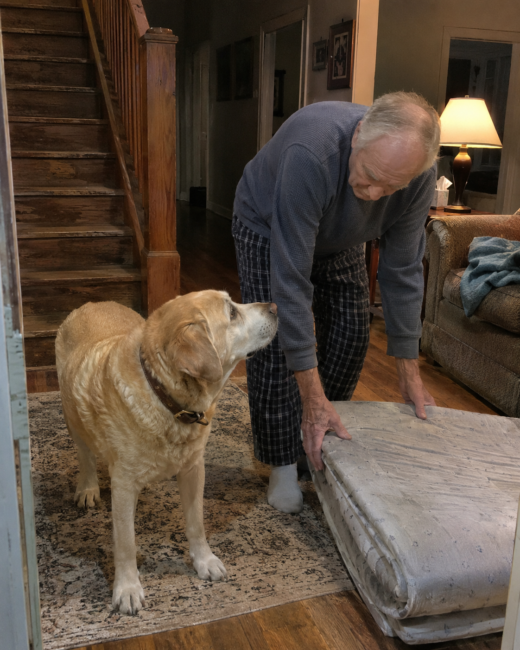
Frank had brought him home that afternoon.
At seventy-four, Frank still lived in the Ohio house where he and his wife, Ruth, had raised their daughter. Ruth had been gone two years. Her reading glasses remained in a kitchen drawer, although Frank had finally given away the coats she would never wear again.
The house was tidy, familiar, and increasingly quiet.
His daughter, Anna, had suggested a dog after noticing that he often went an entire afternoon without speaking to anyone. Frank resisted at first. He liked dogs, but he remembered the work involved, and he was uneasy about making a promise he might struggle to keep.
Eventually, he agreed to visit a local shelter.
Walter was ten, with pale golden fur and a brown leather collar someone had cleaned carefully. He rose slowly when a volunteer opened his kennel, then walked over and pressed his nose against Frank’s empty hand.
Frank rubbed the loose skin behind his ears.
The volunteer explained that Walter had arthritis, needed regular veterinary care, and did best with short, comfortable walks. His previous caregiver had become unable to keep him. There was no dramatic story attached to the introduction.
There was simply an old dog who needed another home.
Frank asked about medication, lifting him into a car, and what happened on difficult mornings. He listened while Walter stood against his knee. Before leaving, he asked whether the shelter could hold the adoption paperwork while he checked his house and arranged a veterinary appointment.
Anna helped him prepare that weekend.
They put runners over the slippery stretches of floor, moved a water bowl away from the narrow kitchen doorway, and bought a thick dog bed. Frank placed it beside his own bed upstairs, where he could reach down without getting up.
He had not thought enough about how Walter would get there.
When they came home on Monday, Walter explored the downstairs rooms at an unhurried pace. He drank, ate his supper, and fell asleep while Frank watched the evening news. Nothing about the first few hours suggested a problem.
At bedtime, Frank touched the banister and called him.
Walter approached the stairs. He placed one front paw on the bottom step, shifted his weight, then put the paw back on the runner. Frank waited without pulling the leash.
After another pause, Walter turned away.
Frank carried the dog bed downstairs, set it near the sofa, and sat beside him until he settled. Then he went up to brush his teeth. He assumed the unfamiliar house would become easier after a few nights.
But now Walter was standing below him again.
Frank came down and crouched as far as his knees comfortably allowed. Walter leaned forward, sniffed his sleeve, and followed him into the living room. When Frank stood to leave, the dog stood too.
“All right,” Frank said. “Let’s work this out.”
He considered sleeping on the sofa, but it was too short. In the hall closet, he kept a folding guest mattress for Anna’s visits. He pulled it out, spread it beside the dog bed, and fetched a pillow and the faded blue blanket from the sofa.
Getting down onto the mattress took some negotiation.
Walter watched from the rug. Once Frank had settled, the dog circled his own bed, lowered himself carefully, and stretched out with his nose near Frank’s hand.
The hallway remained quiet for the rest of the night.
Anna arrived the next morning with groceries and found the bedding still on the floor. Frank was making coffee. Walter lay across the kitchen threshold, supervising without moving.
“Dad, you can’t sleep down there every night,” she said.
Frank agreed. His shoulder had already supplied that information.
They discussed gates, different beds, and whether Walter might eventually manage the stairs. Frank called the veterinarian rather than testing the idea repeatedly. After examining Walter, the vet recommended keeping his daily routine on one level and continuing his care plan.
Frank walked through the downstairs rooms after the appointment.
The small dining room held a table, four chairs, and a cabinet full of dishes he rarely used. Since Ruth’s death, he had eaten almost every meal at the kitchen table. The dining room mostly served as a place to set the mail.
He stood in its doorway for a while.
That evening, he called Anna.
“Could you help me move the table this weekend?”
She asked where he wanted it.
“Out of the bedroom,” he said, then laughed at himself. “The room that’s going to be the bedroom.”
They measured before moving anything. Anna’s husband helped carry the dining furniture into the spare room upstairs. A narrow bed Frank already owned fitted beneath the downstairs window, with enough space for a dresser, a lamp, and Walter’s mattress.
Anna washed the curtains while Frank sorted the cabinet.
Inside a serving dish, he found a paper napkin on which Ruth had written a grocery list. He sat down and read it twice. Then he tucked it into the kitchen drawer with her glasses.
Moving rooms involved more than furniture.
He had slept upstairs beside Ruth for decades. Even after her death, the familiar ceiling and the sound of the maple branches against the window had kept that part of his life close.
On Saturday, he brought her photograph downstairs himself.
He put it on the dresser, angled toward the bed, and plugged in his old reading lamp. Walter followed him through the doorway and inspected the dog mattress Anna had placed beside the bed.
Frank sat down to watch.
Walter turned, folded his front legs, and eased onto the padding. From the edge of the bed, Frank could rest his fingertips against the dog’s muzzle without leaning.
“That’ll do,” he said.
Their evenings gradually took shape around the new room. After supper, they made a short circuit of the sidewalk, stopping wherever Walter wanted to sniff. Frank washed the dinner dishes while the dog waited on the kitchen rug.
Then they went to bed together.
Some nights Frank read. Other nights he called Anna and told her about ordinary things: the neighbor’s new fence, a bill he had finally disputed, Walter’s determination to inspect the same hedge every morning.
Walter snored through most of these reports.
There were still difficult days. Rain made walks shorter. Veterinary appointments stayed on the calendar. Frank learned to leave enough time for an old dog to rise, turn, and get comfortable instead of expecting him to hurry.
He found that the slower routine suited him.
One Sunday, Anna came to lunch and asked whether he missed having a dining room. Frank looked at the sandwiches on the kitchen table, then toward the open bedroom door.
Walter was asleep with his chin over the edge of his mattress.
“We’re managing,” Frank said.
That night, he reached to turn off the lamp. Before the room went dark, Walter lifted his head and touched his nose to Frank’s waiting fingers.
Frank left his hand there until the dog settled.
Upstairs, the old bedroom door stood open. Downstairs, beside the window, the blue blanket moved slightly as Frank turned onto his side, close enough to hear Walter breathing.