A Golden Retriever Brought a Freezing Kitten to My Door—Only Then Did I Notice His Paw
Part 2 — Bring Both Animals
I couldn’t hold a kitten and examine a large dog properly at the same time.
That was the first practical limit of the morning.
The woman at the clinic stayed on the phone while I made a padded space in a shallow box, following her directions for gentle warmth and keeping the kitten’s face clear.
I put the box beside me on the kitchen table, where I could watch it.
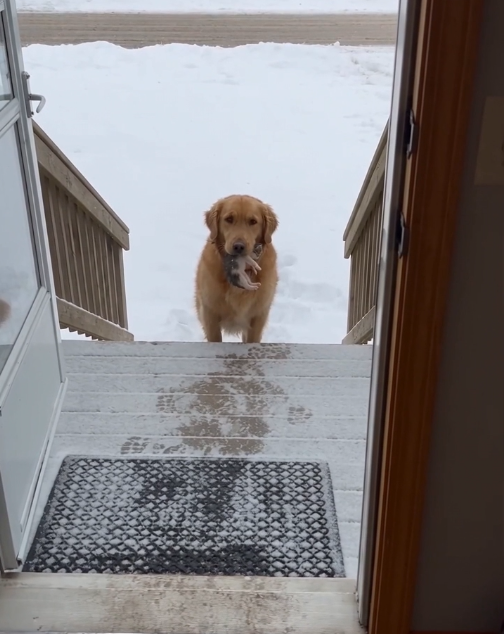
The Golden lifted his head as soon as my arms emptied.
“It’s right here.”
He looked toward the table.
Then toward me.
I placed a chair where he could see the box without having to stand on his hind legs or put his face over it. He remained on the floor while I crouched beside him.
I didn’t pull his foot toward me.
I let him smell my hand and looked at what he would show without resistance.
The fur between his toes held small hard clumps of ice. Around the pads, the skin looked irritated. One area was scraped, and the foot was warmer and puffier than the other.
I told the clinic what I could see.
The answer was simple.
Bring both animals.
My car was buried behind a ridge left by the plow, and I didn’t want to spend the next twenty minutes digging while the kitten waited.
I called my neighbor Paul.
He had already cleared his truck, and the main road to the clinic had been plowed. He checked the route before coming over.
While we waited, I offered the Golden water.
He drank, then stopped to look toward the table.
I placed a dry towel on the kitchen floor.
He stood beside it.
“Lie down,” I said.
Nothing.
I wondered whether he knew the words or whether my voice meant nothing to him.
Then I moved the kitten’s box to a secure, lower spot beside my chair, where I could still watch it.
The dog lowered himself immediately.
His injured paw extended in front of him.
He hadn’t needed a different command.
He had needed the small box within view.
I sat beside him with the phone still on speaker, listening for changes in the kitten’s breathing and trying not to touch everything simply because I was frightened.
His coat smelled of wet wool and cold leaves.
When I parted the fur at his neck, I found a blue nylon collar flattened beneath it. The ring was there, but no identification tag hung from it.
That empty ring made the morning feel larger.
Somewhere, there might be a person calling this dog by a name I didn’t know.
Or there might not.
I took a clear photograph before we left and sent it to the local animal-help contact the clinic suggested. I included my number and said the dog was receiving veterinary care.
Paul arrived carrying an old carrier from his garage.
He set it inside the door and stopped when he saw the Golden.
“That’s a big fellow to have out alone.”
I nodded.
The dog tried to stand when Paul approached the kitten.
His left foot touched the floor and lifted again.
We moved slowly.
The kitten traveled in the carrier, padded and warmed as advised. The dog rode separately, secured in the back seat, with me beside him.
He looked toward the carrier each time it made a sound.
At the first turn, he shifted his weight and gave one brief whine.
I had been thinking of him as the animal who had arrived with the solution.
Now I sat beside a cold, uncomfortable dog who couldn’t explain where he hurt or where he belonged.
At the clinic entrance, he hesitated on the wet pavement.
Paul kept the carrier steady while I stayed near the Golden.
“Your turn,” I told him.
Then I went through the door with him, slowly enough that he could keep the sore foot from taking the worst of his weight.
Part 3 — The Sound of the Scanner
The staff separated the work without separating everything the dog could see.
The kitten went into immediate assessment and warming. The Golden went onto a padded surface nearby for his own examination.
I could hear the small carrier being opened.
So could he.
His head followed the sound while the nurse checked his temperature and began drying his coat.
“He brought her?” she asked.
“Yes.”
I had started using her without knowing whether that was right.
A little later, the veterinarian confirmed it.
A young female kitten, probably around five weeks old, cold enough that warming and close observation came before any assumption that she could simply eat and recover.
They checked her for injuries too.
The fact that a dog had carried her didn’t make an examination optional.
I stood where I was told and answered the same questions again.
How long had I had her?
Less than an hour.
Had I seen where the dog found her?
No.
Had he shaken or dropped her?
Not while I watched.
Those answers sounded small beside the story forming in my head.
They were what the staff needed.
The Golden’s examination showed that he was cold, tired, and dealing with inflamed, abraded skin on the left front paw. The veterinarian checked carefully for deeper damage and explained what they would monitor as the foot warmed and the swelling settled.
I had worried about frostbite.
She didn’t make that diagnosis simply because he had been outside in snow.
She told me what she could determine now, what remained uncertain, and why a recheck mattered.
They cleaned the paw, provided appropriate treatment and pain relief, and worked out how to protect it without trapping dampness against the skin.
The Golden allowed most of it.
But whenever the kitten made a sound, his head rose.
When they moved her out of his sight, he tried to stand.
The nurse stopped what she was doing before he put weight on the sore foot.
We waited.
The kitten’s carrier was placed where he could see it from a safe distance, with staff still able to work and both animals protected.
He watched.
Then his head lowered.
That helped the examination continue without anybody having to argue with him.
I had first read his following as possessiveness.
It looked different once I saw him rest after the kitten was accounted for.
Not a claim.
An animal settling when something that had occupied his attention was no longer missing.
The nurse ran a scanner over his shoulders.
It beeped.
I hadn’t expected the sound to make me cry.
I turned away and pretended to find a tissue because of my nose.
There was a microchip.
Somebody had registered this dog.
The first number didn’t connect.
The second went to voicemail.
The clinic left a message without putting the owner’s information into my hands.
Then we waited.
The Golden slept for several minutes, his good front leg curved toward the edge of the bedding.
His face looked younger asleep.
Without the fixed attention, without the wet coat standing in points, he looked like a dog who might steal a sandwich if you left the room.
I wondered what kind of house he belonged in.
Whether somebody had an empty leash hanging by the door.
Whether they had already called the places we were about to call.
A technician came out with an update on the kitten.
She was responding to warming.
There was still a need for observation.
They weren’t promising the rest of the day yet.
I asked if the dog could stay until his person was reached and a safe plan was made.
The veterinarian nodded.
Then the receptionist appeared in the doorway.
She was holding a phone.
The woman on the other end had answered the message.
Her first question wasn’t about a bill or a chip number.
“Does he have a little split in the edge of his right ear?”
I looked down.
Beneath the damp feathering, there it was.
A small old notch I hadn’t noticed.
And then I heard his name.
Part 4 — Somebody Had Been Looking
“Henry.”
I said it quietly.
The dog opened his eyes.
His head came up, and the soft end of his tail moved against the bedding.
I repeated it.
“Henry.”
This time, his ears came forward.
The woman on the phone began crying.
That was how the strange Golden Retriever in my kitchen became somebody’s dog again.
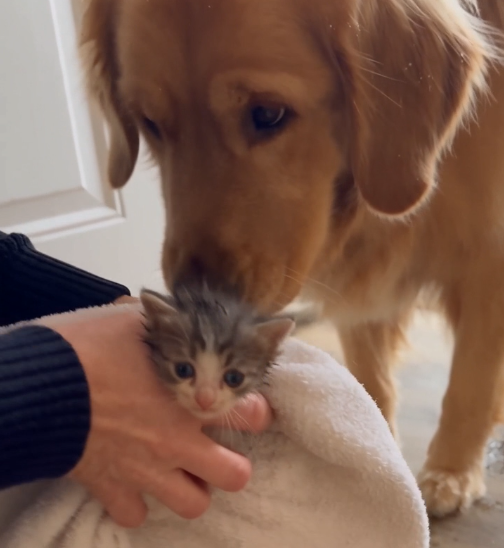
Her name was Hannah.
He was six years old.
She had been searching since the previous evening, when a heavy branch came down across part of the fence behind her new house.
New mattered.
They had moved less than a week earlier.
Henry knew the rooms, the food bowl, and the place beside her bed. He didn’t yet know the neighborhood beyond the damaged fence.
Hannah had let him into the yard before she saw what had happened.
By the time she reached the opening, he was gone.
She had followed tracks until wind and fresh snow erased them.
Then she called, posted, drove the nearby roads when conditions allowed, and asked neighbors to check sheds and porches.
She had barely slept.
I had spent the morning wondering whether anybody was looking for him.
Somebody had spent the night wondering whether anybody would open a door.
Hannah arrived with a leash, a folder of records, and an old towel folded over one arm.
The clinic verified what it needed before bringing her back.
Henry heard her voice before she reached the room.
He tried to get up too quickly.
She dropped to her knees beside the bedding.
“No, sweetheart. Stay.”
His tail moved harder.
He pushed his head against her coat.
She held the sides of his face without pulling him upright, then looked down at the protected paw.
The relief on her face changed.
“What happened to his foot?”
The veterinarian explained what they had found and what care he would need.
Hannah listened, one hand resting against his neck.
Then she looked toward the kitten’s carrier.
“He really brought her?”
I nodded.
She stood very still.
I asked whether she had a cat.
“No.”
Whether Henry knew cats.
“He’s seen them. Mostly through windows.”
She looked almost apologetic, as though she was supposed to produce a story that explained him.
There wasn’t one ready.
He wasn’t a trained rescue dog.
She hadn’t taught him to retrieve living animals.
He liked soft toys and carried a stuffed duck around the house whenever someone came home.
That was all she could offer.
It was enough.
We didn’t need to turn his life into preparation for one morning.
The kitten had been cold.
Henry had arrived with her.
Someone had opened the door.
Those things had happened without us being able to identify the exact moment one became connected to the next.
Later, Hannah showed me the photograph she had used in the missing-dog notice. Henry stood beside an unopened moving box, one ear turned inside out. She had almost chosen a better picture, then decided this one showed the notch in his ear most clearly.
She had spent the night watching her phone for replies.
I had spent the morning looking at that same ear without knowing it meant anything.
The clinic’s scanner, a returned call, and one ordinary identifying detail had connected those two pieces of the day.
Hannah folded the printed notice and put it in her pocket.
She wasn’t ready to throw it away yet.
The clinic kept the kitten for continued monitoring.
Henry could leave with Hannah once his immediate care was complete, with instructions and a follow-up arranged.
He stood when she clipped the leash to his collar.
Then he looked back.
The carrier was still nearby.
Hannah followed his gaze.
I expected her to say something sentimental.
Instead, she asked the nurse whether it would be possible for him to see the carrier before they went, without disturbing the kitten.
They allowed a brief, controlled moment from a safe distance.
Henry sniffed.
His ears relaxed.
Then he turned with Hannah.
He could leave.
The kitten hadn’t needed to leave with him.
She had needed to be somewhere he could register before the room changed again.
I watched them walk toward the exit.
Hannah shortened her steps to match his careful gait.
In the parking lot, she stopped beside the car and arranged his blanket before helping him settle.
The dog who had arrived at my house carrying something fragile was going home with someone adjusting everything around his sore foot.
For the first time that morning, I stopped worrying about who would notice him.
Part 5 — The Bowl in the Cupboard
Hannah called me that evening.
Henry was home.
He had eaten, taken his prescribed medication, and fallen asleep with his stuffed duck beneath his chin.
She sent a photograph.
There was the same broad face I had seen through the storm door, now flattened slightly against a blanket on her living-room floor.
The protected left paw rested forward.
The duck looked as though it had survived several winters of its own.
I saved the picture.
Then I checked my phone for news of the kitten.
The clinic sent an update later.
She was warmer, more responsive, and receiving the support the veterinarian thought appropriate. Her tiny size still made the ordinary things important: maintaining warmth, taking in nutrition, and showing steady progress.
I had offered to help with her care after discharge.
I hadn’t yet considered what that offer would require at three in the morning.
The next day, the staff discussed a foster plan with me.
I lived alone, had a quiet spare room, and could manage the schedule they described. I would keep records, attend follow-ups, and contact them if the kitten’s condition changed.
There would also be efforts to find where she belonged and whether any other cats needed help nearby.
I agreed.
Then I went home and looked at my spare room.
For eight years, it had been the place where boxes waited for decisions.
I made some decisions.
The old chair moved.
A low, safe sleeping area went in.
The clinic’s instructions took the place of a stack of unopened catalogs.
When Hannah heard I was preparing to foster, she offered supplies.
We stood in my kitchen that afternoon while Henry rested at her feet.
His walk had been limited to what was necessary.
She wasn’t bringing him over to perform a reunion.
She had come to collect a bag I had offered for transporting his bedding, and he was with her because a neighbor was repairing the damaged fence and moving through her house.
I asked how he had chosen my porch.
She looked out the window.
“I don’t know.”
I had left the porch light on because the streetlamp near my steps had stopped working.
My house was raised slightly, with the entrance visible from the road.
Maybe the light mattered.
Maybe the open approach did.
Maybe he had tried somewhere else first.
We would never know.
What Hannah noticed was the bowl beside my refrigerator.
It was an old ceramic one I had taken from a cupboard.
“Did you have a dog?”
“A cat,” I said.
He had died several years earlier, after a long life that ended more slowly than I had been ready for.
I had washed the bowl and put it away.
Then I kept finding reasons not to use it again.
Too much travel.
Too much work.
The wrong season.
Hannah didn’t tell me the kitten had been sent to fix that.
She looked down at Henry.
“I nearly didn’t leave him in the yard,” she said.
Her voice changed on the last word.
I understood what she was doing.
Turning one ordinary decision over until it became a verdict on everything that followed.
We talked about the fence, the branch, and what she was changing.
Then Henry sighed in his sleep.
The sound interrupted us both.
He was warm.
His paw was being treated.
A person who loved him was sitting close enough for his tail to touch her shoe.
Those facts were available now.
The others couldn’t be revised.
Hannah left a bag of kitten supplies beside the chair.
Before she went, she touched the empty bowl.
“Maybe start with the next meal,” she said.
So that was what I did.
During the first week, Hannah and I developed a way of sending updates that suited the work better than the dramatic beginning.
A photograph of a finished meal.
A number from a weight check.
A picture of Henry sleeping with the protective collar he needed to leave his healing paw alone.
Sometimes there was no photograph at all.
Just a message saying the night had gone as expected.
Those became my favorite ones.
Nothing had worsened. Nobody needed an unplanned drive. The next task was already written down.
I began setting my phone on the table instead of carrying it from room to room.
Across the neighborhood, Hannah was learning to stop waking Henry just to make sure he was resting comfortably.
We were both getting better at letting a quiet hour remain quiet.
Part 6 — He Didn’t Need to Keep Watch Forever
We called the kitten Wren.
She had a sharp little voice once she found it, and she used it whenever I misunderstood the schedule.
The found-animal inquiries and checks around the area didn’t identify a matching owner or another litter we could connect to her. People helping with the search stayed alert for a mother cat, but we didn’t pretend absence of evidence told us her whole beginning.
For the time being, she needed the next day.
Henry needed several quieter ones.
At first, his paw improved.
Hannah reported less swelling and a more comfortable step during the brief outings allowed by the veterinarian.
Then one evening, he began licking the sore area insistently.
She interrupted him gently, checked the protection, and called the clinic.
At the recheck, the skin was irritated again.
The veterinarian reviewed the plan, adjusted what was needed, and made sure Hannah knew how to keep the area protected while it healed.
No dramatic new disease appeared.
No hidden injury changed him into a different dog.
The recovery simply took more attention than a photograph of him sleeping had suggested.
Hannah sounded discouraged when she called.
“He acts normal, and then I forget.”
I knew what she meant.
Wren’s stronger voice had done the same thing to me. One lively feeding could make me feel we were finished with the worrying.
Then I would check her record and see how much of the day still depended on small, repeated care.
Henry’s rest became a routine instead of a vague intention.
Hannah gave him quieter things to do, used the protection the veterinarian recommended, and kept him away from treated sidewalks as directed.
She repaired the yard securely before depending on it again.
Friends helped with errands so she didn’t have to choose between getting supplies and leaving him unsettled too long.
I brought over a meal.
Henry greeted me from his bed.
The duck lay beside him.
I had expected him to search my hands for the kitten.
He sniffed my sleeve, accepted a gentle scratch, and settled.
That surprised me.
I had made his attention on the first morning into a permanent job.
He hadn’t.
He could care about the person visiting and still go back to being comfortable.
When he was ready for short visits again, Hannah brought him to my house by arrangement.
Wren stayed in her secure area at first.
There was no placing her between his paws for a photograph.
We followed professional guidance, gave both animals room, and kept introductions brief and supervised.
Henry watched the movement behind the barrier.
Wren watched him.
Then she became interested in a wrinkle in her blanket.
He lay down.
That was our first reunion.
Nobody cried.
The kitten attacked the wrinkle.
The dog went to sleep.
Later, during another visit, Wren approached the barrier and made a tiny sound.
Henry lifted his head.
His tail moved once.
Then he looked at Hannah.
She smiled and rested a hand on his shoulder.
I realized we were all learning a less demanding way to remember what happened.
Wren didn’t need to spend her life looking grateful.
Henry didn’t need to remain alert beside her.
They could be two animals in a warm room, each with somewhere safe to retreat.
On the walk from my door to her car after that visit, Hannah stopped to adjust the leash. Henry waited without lifting the treated foot.
She looked down, then back at me.
“Did you see?”
I had.
We had spent so long watching for what hurt that an uneventful pause now deserved to be noticed.
She didn’t ask him to walk farther to prove anything.
She helped him settle in the car and went home.
That evening, her update said he was comfortable.
Mine said Wren had fallen asleep with one ear folded against the blanket.
Neither animal knew how carefully the two messages would be read.
His paw gradually healed.
At his later check, the veterinarian was satisfied with the progress and discussed his return to ordinary activity.
Hannah sent another photograph.
Henry stood in the repaired yard, holding his old duck.
Four feet on the ground.
I compared it with the first picture I had taken in my kitchen.
Same dog.
Different weight on that left side.
The change wasn’t the kind that made people stop scrolling.
It was the one we had been waiting to see.
Part 7 — This Time, I Knew His Name
By the time Wren was ready for permanent placement, she had learned the house rules badly enough that I knew them by heart.
The curtain wasn’t a ladder.
The water bowl wasn’t something to put both front feet in.
My reading glasses were not improved by being pushed under the chair.
She was stronger, growing, and attending her appointments.
Her beginning still contained things we couldn’t explain.
Her days no longer depended on explaining them.
I adopted her when the appropriate arrangements were complete.
It wasn’t a decision made while holding a cold towel in a doorway.
It came after weeks of meals, records, cleaning, appointments, and the discovery that I could rearrange my life without losing it.
Hannah lived only a few streets away.
We kept in touch.
Sometimes Henry came with her when the visit suited both animals. Sometimes we met without him, and he stayed home with his duck and the comfortable knowledge that she returned.
He grew less interested in the kitten’s every movement as she grew more capable of making a nuisance of herself.
That seemed fair.
She liked his tail.
We made sure she didn’t turn that interest into harassment.
He had space to move away.
She had high resting places and a room where he didn’t go.
The friendship, such as it was, belonged to them.
We supplied the boundaries.
I kept the old white towel.
Not folded in a drawer as a relic, and not laid out for visitors who wanted to hear the story.
It went through the wash and returned to use.
Sometimes Wren slept on it. Sometimes I used it to dry a wet carrier.
One corner had a faint mark I could never quite remove.
I stopped trying.
The towel didn’t have to look new to be useful, and the door didn’t have to open onto an emergency to be worth opening.
By spring, Hannah had her own mug in my kitchen.
Henry had a water bowl.
We had become neighbors instead of the people from that morning.
One afternoon near the end of winter, Hannah brought him over after a walk approved within his normal routine.
The snowbanks had shrunk into gray ridges along the curb.
Sunlight reached the lower steps for the first time in days.
Henry stopped at the bottom.
I felt the old moment return before I could stop it.
The same railings.
The same golden face looking upward.
But his mouth held the duck.
His left foot was planted squarely.
Hannah stood beside him, holding the leash.
I opened the storm door.
“Well,” I said. “You can bring that one in too.”
He climbed without the slow hesitation I remembered.
Inside, he placed the duck on the mat and shook his coat, scattering a few ordinary drops across my wall.
I laughed.
It was the first mess he had made in my house.
On the morning he arrived with Wren, he hadn’t shaken at all.
I had wondered about that afterward.
Maybe the weight in his mouth had kept him still.
Maybe exhaustion had.
I didn’t need an answer anymore.
Wren appeared at the end of the hallway.
She looked at him, looked at the duck, and came closer.
We watched carefully.
Henry moved to the bed I kept for his visits.
He turned twice and settled.
Wren stopped near the toy.
Then she put one small paw on it.
Hannah reached for her phone, smiled, and put it down again.
Some moments could happen without being collected.
We made tea.
Outside, meltwater tapped steadily from the porch roof.
Henry slept with his nose resting near his good front leg, both feet loose and comfortable.
Wren carried a soft mouse into the hallway, abandoned it, and returned to the sunny patch beside his bed.
She no longer fit inside my folded towel.
He no longer needed to keep checking where she was.
When Hannah stood to leave, Henry rose and took up his duck.
Wren remained in the sun.
I walked them to the door.
The first time he came up those steps, I had opened the door because of what he was carrying.
This time, I opened it because I knew who he was.
He paused beside my hand.
I rubbed the soft fur between his ears.
Then he went home.
Follow our page for more compelling dog stories, unexpected friendships, and the everyday people who open their doors when someone small needs a second chance.