Missing His Left Hind Leg, the Shepherd Kept Running After the Car That Abandoned Him — Then a Witness Saw Where He Finally Stopped
Part 2, The Longest Seventeen Minutes
Officer Leah did not approach the Shepherd directly. She parked the animal control van thirty feet behind my vehicle, opened the side door, and placed a rubber-backed mat across the metal threshold.
The dog watched every movement.
Whenever an engine traveled along the nearby highway, his ears rose. He shifted forward, placing most of his weight over his front legs, then stopped when the sound moved away.
His missing left hind leg was not a fresh injury. The skin had healed smoothly, and short fur covered the upper portion of the old surgical area. Still, running had strained the rest of his body. His right rear leg shook, and both front paws spread wide whenever he changed direction.
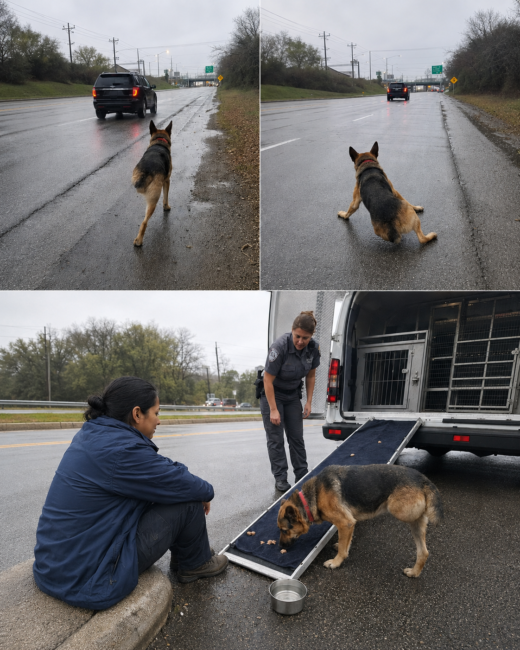
Leah tossed one piece of food onto the shoulder. The dog sniffed but did not approach. She sat beside the van door and looked away.
Five minutes passed.
I moved farther back, reducing the number of people near him. The pickup driver remained behind his truck to block traffic. No one shouted, clapped, or tried to corner the dog.
The Shepherd finally drank.
He approached the bowl in a curved path, keeping his eyes on Leah. After drinking, he ate the first piece of food and searched for another. Leah placed each piece slightly closer to the transport mat.
The practical complication was the van’s height. A three-legged dog with an exhausted remaining limb could not safely jump inside, and lifting him without consent risked a bite or another fall.
Leah extended a folding ramp and covered it with a towel for traction. The dog touched it with one front paw, recoiled at the hollow sound, and backed away.
We waited again.
She scattered food along the first half of the ramp. He placed both front paws on it but did not advance. His right hind leg trembled hard enough to move his tail.
Leah lowered the ramp angle by parking closer to the curb. Then she attached a long lead only after the dog accepted food near her hand. The lead was not used to pull him. It simply prevented another dash toward traffic.
On the second attempt, he climbed into the van one step at a time.
Seventeen minutes had passed since Leah arrived.
Inside, the dog turned toward the open door. He watched the frontage road until the door closed, then lowered himself onto the mat without resting his head.
At the shelter, staff scanned him and found a microchip registered under the name Ranger. The phone number worked. The owner confirmed that Ranger had lost his leg after an accident eighteen months earlier.
He did not request the dog’s return.
The shelter involved animal control and followed its legal hold and surrender procedures. The owner eventually signed a relinquishment form, allowing Ranger to receive care and later become eligible for placement.
Until then, the public could offer support, but no one could take him home.
That evening, Ranger stood each time a vehicle entered the shelter lot. He moved to the kennel gate, balanced on three legs, and listened until the engine stopped.
When the footsteps belonged to someone else, he returned to the rear wall.
Part 3, What the Veterinarian Saw in His Three-Legged Gait
The first examination focused on more than the missing limb. Dr. Miriam Shaw watched Ranger walk across a nonslip floor, turn in both directions, sit, stand, and lower himself onto a padded mat.
His amputation had been performed high on the left hind limb, making a traditional prosthetic device unsuitable. There was no lower segment to fit safely. His mobility plan would depend on conditioning, weight control, traction, and protecting the remaining three limbs.
X-rays showed no new fracture from the falls. The right rear knee was stable, but the surrounding muscles were fatigued. His shoulders carried more load than those of a four-legged dog, and mild stiffness had begun developing in his lower back.
None of this made him useless.
It made careless exercise dangerous.
Dr. Shaw prescribed several days of restricted activity, anti-inflammatory medication, and a rehabilitation assessment. Ranger needed short controlled walks with a support harness rather than long runs. Slippery floors, unnecessary stairs, and excess weight would increase strain.
The video brought attention faster than our staff could manage it. More than sixty adoption inquiries arrived in two days. Some applicants described Ranger as a hero before meeting him. Others promised expensive equipment that the veterinarian had not recommended.
The shelter slowed the process.
Ranger was not a symbol to be awarded to the most enthusiastic stranger. He was a dog who startled at closing car doors, strained toward moving vehicles, and stiffened when anyone touched the harness near his left hip.
The Harris family’s application arrived on the second afternoon.
Megan and Julian Harris lived in a one-story house twenty minutes from the shelter. Their eleven-year-old son, Caleb, used a right below-knee prosthetic limb after a congenital limb difference. They also had a calm eight-year-old mixed-breed dog named Tessa.
Their experience interested the adoption team, but it did not automatically make them the correct home. A child and dog sharing a visible difference was not enough. Ranger needed compatible routines, appropriate flooring, veterinary resources, and adults capable of managing two dogs safely.
The family agreed to every stage of evaluation.
Before meeting Ranger, they completed a home video walkthrough. The house had three entrance steps, but Julian offered to add a ramp. Most rooms had wood floors, so Megan measured them for nonslip runners. Tessa’s veterinary records were current.
Caleb wrote only one sentence on the family section of the application:
“I know people should ask before they help.”
The line remained in my mind because Ranger reacted poorly to hands reaching for his harness. Caleb had learned through his own experience that assistance offered without permission could feel like control.
Still, the behavior team did not begin with him.
Megan and Julian met Ranger first. They sat outside the kennel and allowed him to approach. He accepted food from Megan, sniffed Julian’s shoes, and retreated when a car door slammed in the parking lot.
Only after two adult meetings did the shelter schedule a supervised introduction with Caleb.
Part 4, The Boy Who Did Not Reach for Him
Caleb entered the visitation yard wearing jeans, a green sweatshirt, and his usual right-leg prosthesis. The device made a soft mechanical sound when he shifted weight on the concrete.
Ranger heard it before he looked at the boy.
His ears moved forward. He stood, turned toward Caleb, and watched his gait. Then he backed toward the fence when Julian moved closer.
The behavior technician asked everyone to stop.
Caleb sat on a low bench. He did not call Ranger or hold out food. He placed both hands beside him and looked toward the opposite end of the yard.
Ranger remained near the fence for nearly three minutes.
A truck passed outside. His body tightened, and he lifted his head toward the sound. Caleb stayed seated. When the noise faded, Ranger looked at him again.
The boy moved his prosthetic foot slightly to one side, creating the same soft click.
Ranger approached in a wide arc. He sniffed the ground, the bench leg, and then the edge of Caleb’s shoe. Caleb did not touch him.
After several seconds, Ranger stepped away.
That was the first meeting.
The second took place two days later. Caleb sat on a blanket while Megan held Ranger’s long lead loosely. This time, the boy rolled a treat across the ground rather than offering it from his fingers.
Ranger ate it and remained nearby.
The family’s resident dog met him during a parallel walk. Tessa stayed twelve feet away at first. Ranger watched her but did not pull. The distance decreased gradually until both dogs could walk in the same direction without staring at one another.
A direct adoption was still inappropriate. Ranger’s reaction to vehicles remained intense, and the Harris property bordered a residential street. The shelter proposed a two-week trial foster after the ramp and runners were installed.
The family agreed.
The viral attention had created another practical problem. People recognized Ranger from the video. During one shelter walk, a visitor moved toward him with a phone raised, calling him “the three-legged dog from the road.” Ranger pulled away and nearly lost his balance.
The shelter removed him from public viewing and stopped posting real-time location updates. Future meetings became appointment-only. The decision frustrated some online followers, but Ranger’s safety mattered more than maintaining attention.
His rehabilitation sessions began in a quiet room. A therapist fitted a padded support harness that avoided pressure on the healed amputation area. Ranger practiced controlled weight shifts, slow turns, and stepping across low foam rails.
At first, he moved too quickly. Speed allowed him to throw his body forward without balancing carefully. Slower movement required more control and made him uncertain.
Caleb attended one session after receiving permission. He sat against the wall while Ranger crossed the foam rails.
When Ranger hesitated, Caleb did not cheer or clap. He waited.
After the final pass, Ranger walked to him and lowered his chest onto the mat. His remaining hind leg extended to one side. Caleb placed his palm flat on the floor.
Ranger sniffed the fingers and rested his muzzle beside them.
No one declared the match complete.
But for the first time since the frontage road, Ranger heard an engine outside and chose not to stand.
Part 5, The Driveway Setback
The Harris home passed its final inspection. Nonslip runners connected Ranger’s bed, water bowl, back door, and main living area. Julian built a shallow ramp over the front steps and added textured strips for traction.
Ranger entered the house during a quiet afternoon.
Tessa waited behind a baby gate. Caleb sat at the kitchen table rather than crowding the doorway. Ranger inspected each runner, moved around the furniture, and chose a bed positioned against the wall where no one could approach his missing side unexpectedly.
The first three days were uneventful. He ate, slept, and completed short leash walks in the fenced yard. He followed Julian between rooms but avoided the front window whenever cars passed.
On the fourth morning, a dark SUV stopped near the driveway to deliver a package.
Ranger heard the engine and ran.
His support harness was attached, and Megan caught the handle before he reached the door. He twisted, slipped from the runner, and struck one shoulder against the floor. There was no serious injury, but the event reopened the behavior everyone hoped had begun fading.
For the rest of the day, Ranger paced between the front door and window. He refused the ramp and would not settle when another vehicle passed.
Megan called the shelter immediately.
The foster placement did not end. Instead, the behavior technician reviewed the home-camera footage and developed a slower vehicle-desensitization plan. The family covered the lower portion of the front window, moved Ranger’s bed farther from the entrance, and used quiet recorded engine sounds at a volume that did not trigger him.
The next stage involved standing inside while a familiar car started in the driveway. Ranger received food for turning toward Megan instead of pulling toward the door.
Caleb participated without becoming responsible for the training. He sat several feet away and read aloud while the engine idled. The boy’s voice gave the room a predictable sound, while the adults handled the leash and rewards.
Progress was uneven.
Some mornings, Ranger heard the engine and remained on his bed. On others, he stood and trembled. The family did not punish the reaction or ask him to “get over it.”
His physical rehabilitation continued too. The driveway incident produced mild soreness, so Dr. Shaw shortened his walks for several days. Ranger practiced balance work indoors and maintained a lean body weight to reduce stress on his right rear leg.
By the second foster week, he could walk to the mailbox without scanning every passing vehicle. He still watched dark SUVs longer than other cars.
The foster period was extended to six weeks.
During week four, Caleb fell while adjusting to a new prosthetic socket. Ranger startled at the sound and retreated several steps. Julian helped Caleb sit safely, then gave Ranger space.
Caleb did not call him back.
Several minutes later, Ranger approached. He sniffed the prosthesis lying beside the chair, then settled near the boy’s remaining foot.
They did not become friends because both were missing part of a leg.
They became friends because neither forced the other to recover on a schedule.
Part 6, The Applications No One Chose
The shelter continued receiving requests for Ranger even after he entered foster care. Some offered large donations. Others proposed cross-country travel. A few wanted to feature him publicly at events.
The adoption team declined to turn his placement into a contest.
The Harris family’s foster reports contained ordinary details: how long he slept, whether he slipped, which vehicle sounds triggered him, how he interacted with Tessa, and whether his remaining rear leg showed fatigue.
Those reports mattered more than the number of people following his video.
Ranger also had another choice to make. A home could be medically appropriate and still feel unsafe to him.
During the fifth week, a shelter coordinator visited without prior interaction. Ranger watched from his bed, approached after ten minutes, and accepted a treat. He then returned to Caleb’s side rather than hiding behind furniture.
Tessa had begun sleeping near him, although they used separate beds. The two dogs walked together at a controlled pace. When Tessa became excited, Ranger moved away instead of attempting to match her speed.
Caleb learned to clip the empty portion of Ranger’s harness only while an adult held the lead. Ranger learned that the click of Caleb’s prosthetic foot did not predict sudden contact.
The family created a backup plan for his long-term care. Megan’s sister agreed to help during travel. Their veterinarian reviewed the rehabilitation records. Savings were set aside for future orthopedic monitoring.
At the final evaluation, Dr. Shaw found improved muscle tone in Ranger’s right hind limb and less stiffness through his back. The missing leg would not return, and a prosthesis was still not appropriate for such a high amputation.
His care would remain lifelong.
The old owner’s relinquishment had described the disability as a burden that made Ranger impractical. The Harris family did not deny that three-legged mobility required planning. They installed runners, monitored his weight, controlled his exercise, and accepted that stairs and long runs were unsuitable.
They did not confuse love with pretending nothing was different.
On the last evening of foster care, Julian parked the family SUV in the driveway and switched off the engine. Ranger lifted his head from the living-room rug.
He walked to the covered window, listened, and returned to Caleb.
The next morning, the adoption coordinator arrived with the final paperwork. Ranger greeted her at the door, then moved back onto the runner before turning.
He had learned that a vehicle stopping outside did not always mean someone was leaving him.
Sometimes, it meant someone had come back.
Part 7, The Road He No Longer Chased
Ranger’s adoption became official forty-eight days after I found him on the frontage road. The Harris family renamed him Scout, choosing a new call name that did not erase his records or medical history.
The shelter did not hold a public ceremony. Megan, Julian, Caleb, and Tessa attended a quiet appointment. Scout rested beside Caleb’s chair while the adults reviewed medication, exercise limits, harness use, and follow-up care.
Months later, I visited their home with the animal control officer who had spent seventeen minutes earning his trust.
Scout recognized Leah before he recognized me. He approached on three steady legs, accepted a treat, and returned to the living room.
Caleb was adjusting the strap of his prosthetic limb. Scout lay nearby with his missing left side protected against the sofa. Their bodies were different, their medical histories unrelated, and neither existed to serve as an explanation for the other.
They simply preferred the same quiet corner.
Megan showed me a framed still from the shelter’s adoption photo—not the video of Scout falling. The image showed him standing on the backyard runner while Caleb waited beside the ramp.
“The person who left him saw what was missing,” she said. “We saw the whole dog.”
Later, a dark vehicle drove past the house. Scout raised his head. His ears followed the engine until it faded, but he did not run toward the door.
Caleb tapped the rug beside him.
Scout stood, crossed the room without hurrying, and lowered himself at the boy’s feet.
On the frontage road, I had watched him fall, rise, and chase a car until it vanished. In this house, he no longer had to prove he could keep up with anyone.
The people who mattered had slowed down enough to stay beside him.
Follow our page for more realistic dog rescue stories about patient recovery, responsible adoption, loyal companions, and families who recognize worth beyond physical difference.