Part 2: My 15-Year-Old Golden Retriever Is Blind and Deaf — But Every Time My Toddler Cries, He Walks Through the House to Find Her
I want to tell you what Biscuit started doing about six months ago.
Maeve was about twenty months old. She had been a baby who cried about as much as any other baby, which is to say constantly for the first six months and then in normal-sized bursts after that. She is a gentle, watchful child with her father’s gray eyes and a vocabulary that has been galloping ahead of her ability to use it. She loves Biscuit in the abstract. She has called him “Bicky” since the day she had words.
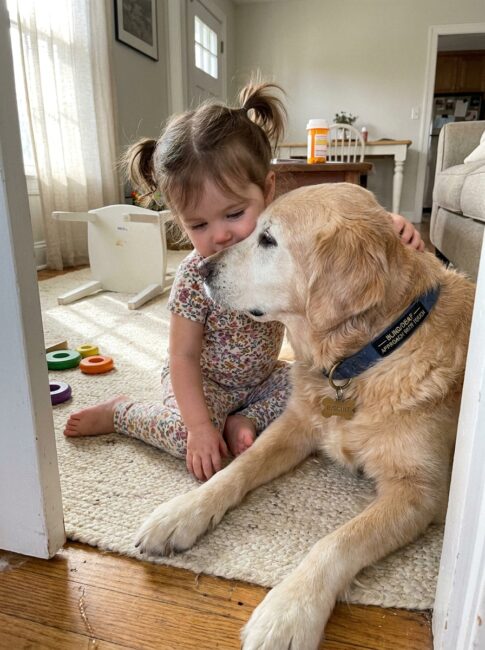
By twenty months she was old enough to fall down often. She was old enough to bonk her head on the corner of the coffee table. She was old enough to cry, very specifically, when she could not figure out how to make a stacking ring fit on a peg.
She was too young to understand that Biscuit could not hear her or see her.
The first time I noticed the thing he started doing was on a Tuesday afternoon in April.
I was in the kitchen. I had set Maeve up at her little table in the living room with a stacking-ring toy and a sippy cup of milk. Biscuit was asleep on his bed in the corner of the same room.
Maeve dropped a ring. She started crying — not a big cry, a small frustrated one, with the cup-to-her-eyes-with-fists kind of crying that lasts forty seconds and stops.
I started to walk in to help her.
I stopped in the kitchen doorway.
Biscuit had stood up.
He had stood up in the corner. His old back legs had taken a moment to straighten. His head was lowered slightly — the way blind dogs hold their heads — and his ears, which can no longer hear, were at half-mast.
He took a step forward.
He bumped his shoulder into the floor lamp beside his bed. He paused. He adjusted. He walked around the lamp.
He took another step.
He bumped his nose into the side of our coffee table. He paused. He adjusted. He walked around it.
He walked, slowly, through the middle of the living room. He did not see the area rug. He did not see the toy basket. He did not see Maeve sitting at her little table.
But he walked, with the careful determination of an old dog on a familiar floor, in a straight line right toward her.
When he got to her — about eight feet of slow, lurching progress later — he lay down. Not in front of her. Beside her. With his old body curled along the side of her tiny chair, his back against her right leg.
Maeve stopped crying.
She put one small hand into the ruff at his neck.
She picked up her stacking ring.
She tried again.
I stood in the kitchen doorway and watched a dog who could not see her and could not hear her find her, in under thirty seconds, in a room with three lamps, two pieces of furniture, and a rug that has bunched at the corner.
I called the vet that afternoon.
Our vet’s name is Dr. Imogen Levy. She has been Biscuit’s vet for nine years. She runs a small practice off Westnedge Avenue with her husband, who is also a vet, and a receptionist named Stuart who knows every dog in town by name.
I called Dr. Levy and described what I had seen.
She said, “Lara. Bring Biscuit in tomorrow. Bring Maeve. I want to see this happen.”
I drove to her clinic the next morning. I brought Biscuit. I brought Maeve. I brought a stacking-ring toy.
Dr. Levy met me in her exam room. She had cleared an extra fifteen minutes in her schedule. She had a notepad and a small video camera on a tripod.
She asked me to set Maeve up on the floor in one corner of the exam room with the toy. She asked me to put Biscuit down in the opposite corner, on a folded blanket, where he would be about ten feet from Maeve.
Biscuit lay down on the folded blanket immediately. He sighed. He closed his eyes. He looked old.
Maeve sat on the floor with her toy. She was, for about five minutes, completely calm. She stacked rings. She looked at the model of a dog skeleton on Dr. Levy’s wall.
Then a stacking ring slipped out of her hand and rolled under a chair.
She started crying.
Biscuit’s head came up.
Dr. Levy started her video camera.
Biscuit stood up. He took a moment to find his feet. He took a step toward the middle of the exam room. He stopped. He swayed slightly.
He took another step.
He walked, in a slow lurching line, in a straight diagonal across the exam room, around the corner of Dr. Levy’s desk, around the leg of her examination chair, and to within twelve inches of Maeve’s small foot.
He lay down. With his back against her side. Where he always lay down.
Maeve stopped crying. She put her hand in the ruff at his neck.
Dr. Levy turned off the camera.
She sat down on the floor of her own exam room with us.
She said, “Lara. I want to tell you what I just watched. Because I think you’re going to need to hear it from somebody other than yourself.”
She said, “Biscuit cannot hear Maeve crying. His hearing test in November was profound bilateral deafness. He’s at zero. He cannot hear you. He cannot hear me. He cannot hear her.”
She said, “Biscuit also cannot see her. His SARDS diagnosis is total. There is no light getting to his retinas. Zero.”
She said, “But he just walked across this room, in a clean diagonal, around two pieces of furniture he has never been around before today, and laid himself down precisely against the side of your daughter.”
She paused.
She said, “He is doing it through his feet.”
Dr. Levy explained it to me in plain language while Biscuit lay against Maeve’s leg and Maeve quietly stacked rings on his back.
She said, “Dogs have a sense most people don’t think about. It’s called somatosensation. It’s the awareness of pressure, vibration, and texture through the skin and the bones — particularly through the pads of the feet.”
She said, “Biscuit has lost two of his five primary senses. He’s blind. He’s deaf. But he still has touch, and smell, and his vestibular system, which tells him where his body is in space. The most important of those for what you just watched is touch. Specifically, vibration.”
She said, “Your house has hardwood floors. Your daughter is approximately twenty-six pounds. When she walks, when she falls, when she sits, when she cries — when she cries, she shakes her body. The sobbing motion in a small child sends a low-frequency rhythmic vibration through the floor.”
She said, “Biscuit can feel that vibration through the pads of his old paws even when he is asleep. The vibration of a child crying is different from the vibration of a child playing or a child walking. It has a specific signature.”
She said, “He has learned the signature. And when he feels it, he gets up, and he follows it.”
She said, “He is using his feet to do what his ears used to do.”
She said, “He’s not using GPS. He’s not using memory. He’s using vibration.”
She said, “Lara. I have been a vet for twenty-one years. I have seen a lot of senior dogs do a lot of remarkable things. I have not seen this before.”
I said, “Why do you think he’s doing it?”
She said, “Lara. He raised you. He met your husband. He met your daughter when she was three days old.”
She said, “She is the youngest member of his pack. She is the smallest. She makes the kind of distress signal a creature his age has been hardwired for fifteen years to respond to.”
She said, “He is doing what he has always done. He just has fewer tools left to do it with.”
She said, “And he is finding ways.”
I drove home from the vet’s office that afternoon and sat in our driveway for a long time before I went inside.
I thought about Biscuit sleeping on our bed for thirteen years.
I thought about him at the rescue at four months old, eighteen pounds, looking at Aaron and me through chain-link.
I thought about him in the parking lot of the hospital the night Maeve was born, lying on the back seat of our Subaru while Aaron walked in and out for updates.
I thought about all the small things I had watched Biscuit do in the past two years and three months that I had taken for being a friendly old dog and a good first child.
The way he had moved his bed three times, on his own, in the first month after we brought Maeve home — gradually edging it across the living room until it was directly between Maeve’s pack-and-play and the front door.
The way he had stopped chewing his rawhide bones in our presence after Maeve started to crawl, because he had figured out, somehow, that the chewing made her cry.
The way he had walked, three months ago, into the bathroom while I was giving Maeve a bath — for the first time in his life — and lay down on the bath mat and closed his eyes. I had thought he was just keeping me company. I realized, sitting in the driveway, that Maeve had splashed water in her own face that night and started crying briefly. Biscuit had felt the splash, the cry, and the change in her movement through the floor. He had walked in for her.
He had been doing this for months.
Possibly for over a year.
I had not noticed because I had been busy noticing my daughter.
I went inside. Aaron was home. Maeve was asleep in her crib. Biscuit was on his bed in the corner of the living room.
I told Aaron what Dr. Levy had said.
He sat on the couch.
He said, “Lara. He’s been raising her too.”
I said, “Yeah.”
He said, “He’s been raising her for two years.”
He said, “He’s been raising her with what he has left.”
He cried.
I cried.
Biscuit slept through it. He could not hear us.
His paws were resting on the hardwood floor.
That was four months ago.
Biscuit is still here.
He is older. He naps more. His back legs shake a little when he stands up. Aaron carries him up the stairs at night and back down in the morning. He eats softened food now. He has a daily medication schedule that lives on a small whiteboard on our refrigerator.
He still does the thing.
Every time Maeve cries — small cry, big cry, frustrated cry, hurt cry, woke-up-from-a-bad-dream cry — Biscuit gets up from wherever he is and walks, slowly, lurchingly, through our house to find her. He bumps into things. He has knocked over a small wastebasket and a pair of Maeve’s rain boots. He has never not gotten there.
Maeve has, in the past four months, started doing something that has split me open every single time.
When Biscuit lies down beside her after a cry, she puts one small hand on his head. She leans down. She puts her cheek against his cheek.
And she whispers to him — in her two-year-old voice, with her two-year-old vocabulary — “Bicky. I here. I here, Bicky. I here.”
She has figured out that he cannot hear her.
She has figured out that he cannot see her.
She has figured out that the way to tell him she is okay is to put her face on his face. So that he can feel her breath. So that he can smell her. So that he can know, through the pads of his cheek and the warmth of her cheek and whatever third thing happens between two creatures who need each other, that she is right there.
Aaron told me last week, after he watched her do it, “Lara. He taught her how to find people. And now she’s doing it back.”
Last Sunday afternoon I sat on our living room floor with Maeve in my lap.
Biscuit was in his bed in the corner.
Maeve was tired. She had skipped her nap. She started to cry — a small tired cry, the kind toddlers do at 3 p.m. when their bodies don’t know what they want.
Biscuit’s head came up.
He stood up, slowly. He took his moment to find his feet. He bumped the lamp. He walked around it. He bumped the coffee table. He walked around it.
He walked, in his careful diagonal, right to where we were sitting on the floor.
He lay down with his back against my hip and Maeve’s leg.
Maeve quieted. She put one hand on his head.
She leaned down.
She put her cheek against his cheek.
She whispered, “I here, Bicky. I here.”
Biscuit closed his old eyes.
He could not hear her.
He felt her.
That has always been enough.
If you want to see Biscuit now — the way he still walks through our house to find her, the way he lies down beside her every single time, the way she puts her cheek against his cheek to let him know she’s okay — I’ve shared his most recent video in the comments.