Part 2: My Daughter Had No Friends and Wouldn’t Talk to Anyone After the Divorce. Then I Started Hearing Her Voice Through Her Bedroom Door at Night — Talking to the Puppy.
PART 2
I have to tell you about that name, because I’ve thought about it every day since, and because I think Mia told me everything in that one word and I just wasn’t ready to hear it.
“Friend.”
A nine-year-old with no friends, asked to name the one creature in the world that had just been handed to her with the explicit promise that it was hers, looked at it and named it the thing she didn’t have.
I didn’t understand it that way in the car. I thought it was sweet. I thought, oh, she means the dog is her friend, which is true but is not the whole of it. It took me a year to understand that she wasn’t describing the dog. She was naming a hole. She was holding the word for the thing she was missing and putting it on the only thing that had ever arrived to fill it.
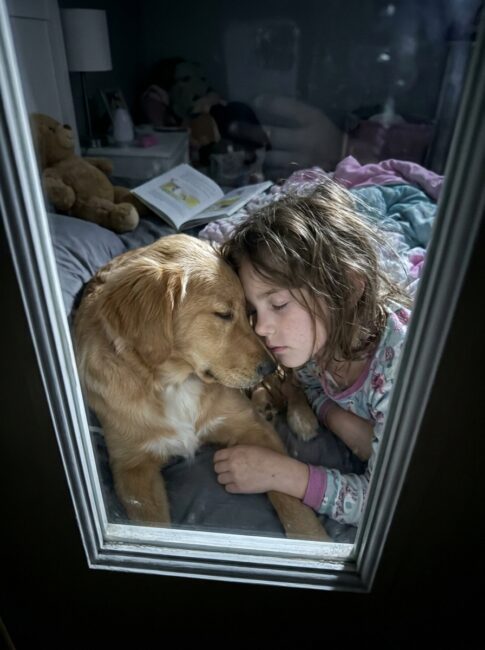
Friend was, from the start, exactly the dog Mia needed, in ways I couldn’t have engineered if I’d tried.
She was a calm puppy — Goldens can be maniacs, but this one had a stillness to her. She’d flop down next to you and lean her whole weight in and just be there. She wasn’t a dog who needed you to throw the ball forty times. She was a dog who wanted to lie close to her person and be near, which is the rarest and most valuable thing in the world to a child who has decided that being near people is dangerous.
And here’s the thing about Friend that turned out to be the whole story, though I didn’t know it yet:
Friend listened.
I mean that in the simplest possible way. When you talked to that dog, she looked at you. She held your eyes. Her ears would tip toward your voice and her head would tilt and she would, for as long as you talked, give you her complete and undivided attention, with no agenda, no advice, no “well actually,” no looking at her phone, no waiting for her turn to speak.
She just listened.
I didn’t know yet what that was worth. I was about to find out, standing in a dark hallway, with my hand over my mouth.
PART 3
The first month, the dog and Mia circled each other.
Mia wasn’t transformed overnight — that’s not how it works, and I want to be honest about it, because the version where the puppy arrives and the child blooms by Friday is a lie that makes real parents feel like they’re doing something wrong. Mia was still quiet. Still came home with the lights off behind her eyes. But she fed Friend, and walked her, and the puppy started sleeping in her room, and slowly the two of them became a unit in the small physical ways first — Mia’s hand always finding the dog’s head, the dog always finding the spot against Mia’s side.
Then one night, about four weeks in, I was walking down the hall to go to bed and I heard her voice through her door.
I stopped.
I thought, for one heart-stopping second, that she was on the phone — that she’d finally called a friend, that something had cracked open. I stood there and listened, and I realized there was no other voice. No pause for someone to answer. Just Mia, talking, low and steady, on and on.
She was talking to Friend.
And what she was saying — I shouldn’t have listened, I know that, but I could not have walked away if the house were on fire — what she was saying was everything.
She told that dog about her day. Not “fine.” The actual day. She told her about a girl named Brooke who’d said something at lunch that I won’t write down because it still makes me want to find a nine-year-old and have words with her. She told the dog she’d eaten in the library again because the library was safer. She told the dog, in the flat little voice of a kid reporting facts, that she didn’t really have anyone to sit with.
And then — this is the part that put my hand over my mouth — she told the dog she missed her dad. She said it plainly. “I miss Dad. I don’t tell Mom because it makes her sad.” She said she wished he hadn’t moved. She said sometimes she pretended he was just at work and coming home.
I stood in that dark hallway and I cried as quietly as I have ever done anything, because my daughter was pouring out her entire wounded heart eight feet away from me, all the things I had been failing for a year to get her to say, and she was saying them to a dog because the dog was the only one in her world she trusted to just listen and not need anything back.
I almost went in. I wanted to so badly — to open that door and gather her up and tell her she could tell me all of it, any of it, always.
But something stopped me, and I’m so glad it did. I understood, somehow, that if I opened that door, I would take this from her. This was hers. This little nightly confession to a creature who would never repeat it, never judge it, never get that pained careful look adults get — this was the one safe room she had built for herself in the wreckage, and if I walked into it, even with love, even with the best intentions, I would turn it back into a place where she had to manage how someone else felt about what she said.
So I went to bed. And I cried into my pillow. And the next night, I listened again. And she did it again.
She talked to that dog every single night.
PART 4
It became the rhythm of our house, though only I knew it was a rhythm.
Every night, after I said goodnight and turned off the hall light, I’d hear it start through the door — Mia’s voice, low and steady, talking to Friend. Some nights it was a few minutes. Some nights it went on for half an hour. I never listened all the way through again after that first time; it felt too much like stealing. I’d just hear it begin, hear the low murmur of my daughter unburdening herself to a Golden Retriever, and I’d go to my room and let her have it.
I started, slowly, to see changes. Small ones.
She came down to breakfast one morning and told me, unprompted, something funny that had happened in art class. It was a tiny thing. I had to work very hard not to react too big, not to pounce on it the way a starving person pounces on food, because I knew if I made it a Thing she’d retreat. So I just laughed, like it was normal, like my daughter told me funny stories all the time, and inside I was lit up like a city.
She started leaving her door open a little when she talked to Friend. Not all the way. But a crack. I don’t know if she knew I could hear. I think maybe she did, and that the open crack was its own kind of message, a door left ajar between the room where she could say things and the rest of the house where I was.
I want to tell you about Friend in all this, because I spent the year thinking the dog was just a comfort, a warm body, a teddy bear that breathed. I was wrong about that, and the wrongness is the whole point.
Friend never did anything but listen.
That sounds like nothing. It is the opposite of nothing. Think about what every adult in that child’s life did when she tried to say something hard. I, her mother, got a pained face and said “oh, honey” and tried to fix it. Her teacher got concerned and made notes. Her father, on the phone, got guilty and over-cheerful. Every single one of us, out of love, did something with what she said — managed it, redirected it, soothed it, worried about it. We made her words into a problem to be handled.
Friend did not handle anything. Friend received.
A nine-year-old said “I miss my dad and I don’t tell my mom because it makes her sad,” and the dog did not get sad, did not get guilty, did not try to fix the divorce or reassure her or change the subject. The dog put her chin on the girl’s knee and looked at her and stayed. The words came out of Mia and went into a creature who could hold them without being hurt by them, without needing Mia to then take care of her feelings about it.
For a year, every night, my daughter practiced saying true things out loud to someone who could be trusted to simply hear them.
I didn’t know that’s what was happening. I thought she was being comforted.
She was being trained. She was teaching herself, in the only safe space she had, the thing the divorce had convinced her was impossible.
PART 5
The change I could actually see from the outside came a little over a year after I brought Friend home.
It was spring. Mia was ten. And she came home from school one Thursday and said, with the studied casualness that ten-year-olds use for things that are secretly enormous, “Can Hazel come over Saturday?”
I said, “Who’s Hazel?”
And Mia said, “My friend. From school.”
My friend. From school.
I had to turn around and pretend to do something at the sink so she wouldn’t see my face. My friend. Two words I had not heard my daughter say in two years, dropped into the kitchen like they were nothing, like she’d been saying them her whole life.
Hazel came over Saturday. She was a nice kid, a little shy herself, and the two of them disappeared into Mia’s room and I heard something I’d almost forgotten the sound of in my own house — two children laughing. And Friend, I found out when I peeked, was lying on the floor between them while they played, getting petted by two sets of hands, the quiet golden hinge the whole thing turned on.
It wasn’t just Hazel. Over those weeks I watched my daughter come back into the world. She got invited to a birthday party. She mentioned a group of kids she sat with at lunch now. The lights came back on behind her eyes, slowly, and then more, until one day I realized I was looking at a different child than the silent one I’d been so frightened for — or rather, the same child, finally able to come out from wherever she’d been hiding.
And one evening, doing dishes together, I finally asked her. I’d been afraid to, the whole time, afraid of breaking the spell by examining it. But I couldn’t not know.
“Mia,” I said, careful, light. “Can I ask you something? You seem so much happier this year. You’ve got Hazel, and the other kids. A year ago things were so hard. What changed? What made the difference?”
She was quiet for a minute, drying a plate, thinking about it the serious way she thinks about everything.
And then she told me, and I have not been the same since.
PART 6
“Friend taught me,” Mia said.
I waited.
“Not like — she didn’t do anything,” Mia said, struggling to put it the way she meant it, the way kids do when they’re explaining something they understand better than they have words for. “She just listened. Every night I’d tell her everything. About school and Brooke and being lonely and missing Dad. And she always listened. She never got weird about it.”
“Weird how?” I asked, very quietly.
Mia shrugged. “When I tell grown-ups stuff, they get sad, or they try to fix it, or they get a face. You get a face, Mom. Not in a mean way. You just do.” She wasn’t accusing me. She was just reporting it, the way she’d once reported her days to a dog. “Friend never got a face. She just listened. So I could say anything.”
I held very still.
“And then one day,” Mia went on, “I figured something out. I figured out that telling people things isn’t actually hard. I always thought it was hard. But it’s not hard. It’s just — nobody was listening. That’s what made it feel impossible. Not the talking. The being heard.”
She put the plate in the rack.
“Friend listened every night for a whole year. And I got good at it. Telling things. Starting. So one day at school I just — tried it. With a girl. I told her something true, a small thing, just to see. And she listened.” Mia looked at me, and there was something in her face that was older than ten. “She listened, Mom. Like Friend. And I thought — oh. People will listen. You just have to start. I never knew how to start before. Friend taught me how to start.”
I want to be precise about what my daughter understood, at ten, that I had somehow failed to understand at forty.
Friend never fixed Mia. Friend never gave advice, never coached her, never said a single word, obviously, being a dog. Friend did not teach Mia what to say or how to be brave or any of the things I would have tried to teach her and failed.
Friend taught her how to begin.
A child convinced that opening her mouth and saying a true thing would lead to pain — a face, a fix, a burden placed back on her — needed one safe repetition. And then another. And then a year of them. She needed to practice the single hardest part, the starting, the act of letting a true thing leave your body and go toward another living creature, ten thousand times in a room where it was guaranteed to be safe, until the starting stopped feeling like stepping off a cliff and started feeling like something she knew how to do.
And then she took that one learned motion — start — and she tried it on a human being.
And it worked.
Because it was never the talking that was broken in my daughter. It was the believing that anyone would receive it. A dog who received it, every night, without fail, for a year, rebuilt that belief one quiet bedtime at a time.
Friend didn’t give Mia friends.
Friend gave Mia back the ability to believe she could be heard, and Mia did the rest herself.
PART 7
Mia is twelve now. The Golden is three.
I’d love to tell you Mia is the most popular girl in school, but that’s not the truth and it’s not even the point. The truth is better and smaller. She has a few good friends. Hazel, still. A couple of others. She’s the kind of friend who listens — really listens, the way she learned to be listened to — and other kids feel that and gravitate to it, the way you gravitate to the rare person who doesn’t make a face when you tell them something hard.
She still talks to Friend at night.
I hear it sometimes, walking past her door. Less than she used to — she has people now, she doesn’t need the dog to be everything. But on the hard nights, the nights something happened, I still hear the low murmur start up through the door, my daughter telling the Golden Retriever the things she’s working up to telling a person, practicing the start one more time in the safe room.
I leave her to it. It’s still hers.
And she talks to me now, too. That’s the thing I didn’t dare hope for. She comes and sits on my bed some nights and tells me things — real things, the lights on behind her eyes — and I have learned, finally, from a dog, how to receive them. I learned to stop making a face. I learned to just listen, the way Friend listens, to hold what she hands me without dropping my own feelings on top of it, without fixing, without managing. To let her be heard.
My daughter and a dog taught me how to be a mother to a hurting kid, and the lesson was the simplest thing in the world, and it was the only thing I’d never tried:
Just listen. Don’t make a face. Let them start.
PART 8
There’s a thing they do, still, that I’m not supposed to see.
Some nights I check on Mia after she’s asleep, the way I have since she was a baby.
And some nights I find them like this: my daughter asleep with her head resting on the dog’s head, both of them gone to the world, the moonlight coming through the window across the two of them.
Two creatures who learned how to listen, resting.
She named the dog Friend before she had one.
She doesn’t need the name to mean what it used to mean anymore.
But Friend earned it anyway.
Follow this page for more stories about the quiet ones who listen us back to life.