Part 2: My Dog Stopped Eating and Started Hiding Her Food Under the Bed. The Vet Found Nothing Wrong. Then I Followed Her One Morning and Saw Where the Food Was Really Going.
Part 2
Let me tell you about Daisy, because the kind of dog she is matters to all of this.
I adopted her from a shelter five years ago. She’d been found as a stray, thin and pregnant — though by the time I got her, the puppies had been weaned and adopted out, and Daisy was just a sweet, slightly anxious young dog looking for a person. I was, at the time, a person who needed a dog more than I knew. I’d just gone through a divorce. The house was too quiet. Daisy filled it.
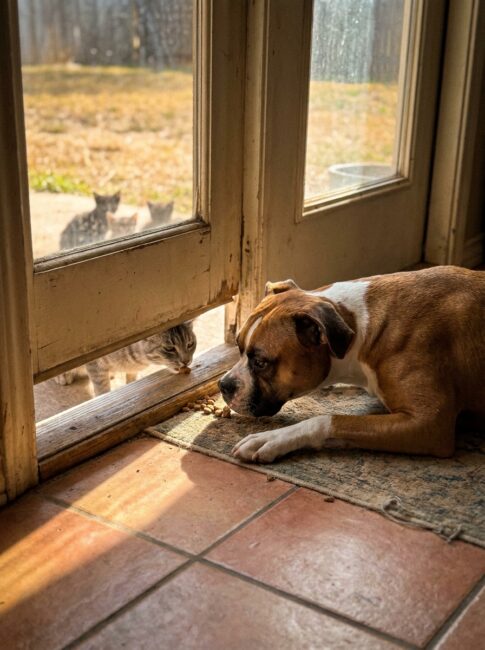
She is, and I say this knowing how it sounds, an unusually gentle animal. Not in the soft, timid way — she’s a sturdy, confident dog. Gentle in a way that’s more like attentive. She notices things. She notices when I’m sad and presses against me. She noticed, years ago, when a neighbor’s toddler wandered into my yard, and she didn’t bark or jump; she stood very still and let the baby grab fistfuls of her ears, looking back at me with an expression that clearly said handle this, please, carefully.
She has always been like that. Watchful. Soft-hearted in a way that I, frankly, used to find a little funny in a forty-five-pound boxer mix.
There’s one more thing I have to tell you about Daisy, and I didn’t connect it until everything else fell into place. She was a mother once. Before me. Those weaned-and-adopted puppies. I never thought about it much — it was ancient history, before my time with her, a thing on her shelter intake form.
I think about it constantly now.
Part 3
The tenth morning.
I put her bowl down like always, and I didn’t leave the kitchen like always. I pretended to. I made the sounds of leaving, and then I stood very still in the hall where she couldn’t see me, and I watched.
Daisy did her thing. Took a careful mouthful of kibble. And then, instead of going down the hall toward the bedroom where I’d assumed she was hiding it, she turned the other way — toward the back of the house, toward the laundry room, toward the back door that opens onto my small fenced yard.
There’s a gap at the bottom of that door. An old house, a door that doesn’t sit quite right, a gap of maybe three inches between the bottom of the door and the threshold. I’d been meaning to fix it for years. I’m glad now I never did.
Daisy went to that door. She lay down in front of it, the mouthful of food still held carefully in her jaws. And she pushed her nose to the gap.
And through the gap, from the other side, came another nose.
I came forward then, quiet, to where I could see, and I looked through the kitchen window out into the yard, and that’s when I saw them.
A cat. A thin gray cat, a mother cat — you could tell, the leanness of a nursing mother — pressed up against the other side of my back door. And behind her, tumbling in the dead grass by the fence, four kittens. Tiny. Maybe five or six weeks old. Scrawny, half-wild, hungry.
Daisy pushed the mouthful of kibble through the gap under the door.
The mother cat took it.
I stood at my kitchen window and watched my starving dog feed a stray cat and her four kittens, one careful mouthful at a time, through the gap under my back door — and I understood, all at once, everything about the last nine days.
Daisy wasn’t hiding her food. Daisy was giving it away.
Part 4
I watched the whole thing, that morning, frozen at the window, hardly breathing.
Daisy went back to her bowl. Took another mouthful. Carried it to the door. Pushed it through. The mother cat ate, and then — this is the part that finished me — the mother cat carried pieces to her kittens, the same way Daisy was carrying pieces to her. A chain of carried food. Me to Daisy to the cat to the kittens. Daisy had appointed herself the middle link in a supply line to four starving kittens she could not even reach, could only smell and hear through a three-inch gap, and she had been running that supply line for nine days, at the cost of her own body.
She was feeding them with her own meals. All of them. That’s why she ate nothing. There wasn’t enough for her and them, so she’d quietly decided it would be them.
I have to tell you what it did to me, watching that, because the skill of telling this story honestly requires it. I did not feel like I was watching something cute. I felt like I was watching something that reorganized my understanding of the animal I’d lived with for five years. I had thought Daisy was hungry and sick and broken. She wasn’t any of those things. She was the opposite of broken. She was doing the most deliberate, most costly, most selfless thing I had ever seen any creature do, and she’d been doing it silently, asking me for nothing, accepting hunger as the price.
I sat down on my kitchen floor. And I cried. Hard. The kind of crying that surprises you, that comes up from somewhere deep, the kind I genuinely had not done since I was a kid.
Daisy heard me. She came back from the door — abandoning her supply run for the first time in nine days — and she pressed her worried forehead against me and licked my face, concerned, because her person was on the floor making sounds, and even then, even caught in the middle of her secret, her first instinct was to come check on someone who needed her.
I put my arms around my thin, gentle dog and I said, into her fur, “Okay. Okay. I see them. I’ll help you. You don’t have to do this alone.”
Part 5
Here is the thing I understood on that floor, the thing that turns this from a strange story into the one I needed to tell.
Daisy was never starving herself because something was wrong with her.
She was starving herself because something was right with her — so deeply, instinctively right that it overrode her own hunger, her own body, her own survival. She had heard four hungry kittens through a gap in a door, and the mother cat unable to feed them, and Daisy — who had been a mother once herself, who knew, in whatever way a body remembers, what it is to have hungry babies and not enough — had made a decision no one taught her and no one asked of her.
She would go without, so they wouldn’t.
The vets found nothing wrong because nothing was wrong. There was no disease to detect. The hiding wasn’t a symptom. The not-eating wasn’t a symptom. They were a choice — the quietest, most private act of mercy I have ever witnessed, dressed up as a medical mystery because I couldn’t imagine my dog was simply giving her food away to strangers.
And the weight loss, the thing that had frightened me so badly? That was the cost. That was what it cost Daisy to be who she was. She had been spending her own body, ounce by ounce, to keep four kittens she’d never met alive, and she would have kept spending it, I have no doubt, until there was nothing left.
She wasn’t sick. She was generous past the point of her own safety. And there is no blood test for that.
Part 6
I went to the store that morning and bought more food than I’d ever bought at once.
I set up a feeding station in the yard for the cat and her kittens — a real one, bowls, fresh water, a sheltered corner. I called a friend who knows about strays and got advice on getting them comfortable enough to help them properly.
And I want to tell you what Daisy did when she saw me carrying food out to the yard, out the back door, to the cats she’d been secretly feeding for nine days.
She lost her mind with happiness.
She danced. This dog who’d been so somber and focused and self-denying for over a week, who’d been carrying the whole weight of those kittens alone — when she saw me put a full bowl down in the yard for the mother cat, when she understood that I knew now, that I was helping, that the burden was shared — she ran circles in the grass. She bowed. She bounced. She was, for the first time in nine days, unmistakably, completely joyful.
And then she did the thing that made me cry all over again.
She went to her own bowl. And she ate.
For the first time in nine days, Daisy ate her own meal — all of it, hungrily, the competitive eater I knew — and I understood the final piece. She hadn’t been able to eat while they were hungry. That was the whole thing. Some part of her could not sit there and fill her own stomach while four babies cried through a gap in the door with nothing. But the moment she saw them fed — really fed, by me, with enough for everyone — the block lifted. They were okay. So she could be okay too.
She only ever refused food because someone weaker was hungry. The second that stopped being true, she was herself again.
Part 7
The cat family stayed.
It took a few weeks to earn the mother cat’s trust — she was wild and wary, and rightly so — but the food held them, and the kittens were young enough to socialize, and one by one they came around. I’d intended to find homes for them. I made some calls. I took some photos.
I couldn’t do it.
By the time they were tame enough to adopt out, the four kittens had decided, completely, that Daisy was theirs. They followed her. They slept in a pile against her barrel chest. They climbed on her, ambushed her tail, used her like furniture, and Daisy — the gentlest dog I have ever known, the dog who’d starved herself to feed them — accepted every bit of it with the patient, watchful tenderness she’d shown that neighbor’s toddler years ago. She had appointed herself their guardian through a gap in a door before she’d ever touched them. She was not going to stop now that she could.
So I kept them. All of them. The mother cat, who I named Gray, and the four kittens, who got named by a niece and are called things I’m a little embarrassed by. My quiet house outside Tucson, that had held just me and a dog, now holds me, a dog, and five cats, and it is loud and ridiculous and the fullest my life has ever been.
Daisy is at the center of it. She’s back to her healthy weight. She is, as far as I can tell, completely content in a way she wasn’t even before all this — like a creature who was built to take care of someone and finally has enough someones to take care of.
Part 8
People ask me what I learned from all of it, and I always struggle to say it right.
I thought I was a kind person. I thought I understood kindness — the give-when-you-have-extra kind, the help-when-it’s-convenient kind. That’s most of our kindness, if we’re honest.
Daisy didn’t have extra. Daisy gave from what she needed. She gave until it showed on her ribs, silently, to strangers, expecting nothing.
My dog shared her own food with the ones who were hungrier than her.
She taught me about a kind of goodness I thought I already knew.
I didn’t know it at all.
Follow this page for more stories about the ones who give from what they need, not from what they have to spare — and what they teach us about the rest.