Our Saint Bernard Stole Every Visitor’s Glove — Then We Learned Why He Brought Them to a One-Handed Volunteer
Part 2, The Man Who Sat Where Visitors Stopped Walking
My name is Claire Moreno. I was forty-four that fall, and I had worked as adoption coordinator at Allegheny County Animal Services in Pittsburgh for eleven years.
I knew the sounds of our building better than the sounds of my apartment. I could tell a metal food bowl from a plastic one by the way it struck concrete. I knew which dryer squealed during the final eight minutes of a cycle and which kennel latch needed to be lifted before it would close.
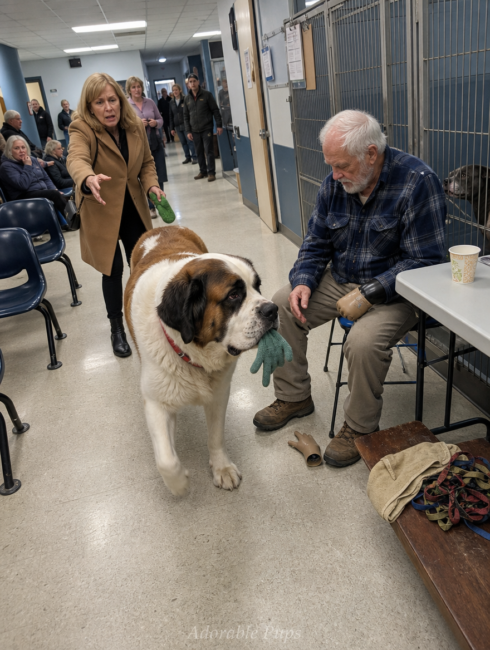
I also knew how visitors moved.
Most entered quickly, slowed near the puppies, and became quieter as they reached the older dogs. Some avoided looking inside the last kennels because looking created obligation. Others checked their phones as they turned around.
Walter sat beyond that turning point.
He began volunteering three months after his wife, Marjorie, died from a stroke. His daughter lived in Arizona and called every Sunday, but Walter said their two-bedroom row house became louder after Marjorie was gone because every pipe and floorboard had more room to speak.
He had worked thirty-eight years as an elevator mechanic. A hydraulic press took his left hand below the wrist in 1982, when he was twenty-nine and Marjorie was seven months pregnant.
Walter rarely discussed the accident. He discussed the prosthesis because children asked direct questions.
“Does it hurt?”
“Not today.”
“Can you move the fingers?”
“Not these. They’re mostly for holding a sleeve straight.”
“Can I touch it?”
“If your parent says yes.”
His old prosthetic hand was covered by a tan silicone glove molded with fingernails and faint lines across the knuckles. The color had faded unevenly, and a small split crossed the thumb. The stretched inner cuff caused it to slip when he reached forward or when a dog pulled a leash suddenly.
Walter could afford a replacement, but he disliked the fitting process and delayed appointments. He wrapped the inner wrist with athletic tape on most mornings.
The glove still fell.
Arthur noticed on his second day.
The Saint Bernard arrived on October 3 after his owner, eighty-one-year-old Mabel Sloane, entered a rehabilitation facility following a stroke. Her apartment manager cared for Arthur for nine days but could not keep a dog of his size.
Arthur was not neglected. His white chest had been brushed, his nails were trimmed, and his worn red collar carried a brass tag with his name. Yet he stopped eating after intake and slept facing the staff entrance.
He possessed the heavy, deliberate body of an older Saint Bernard. Rust-brown patches covered his back and both hips. A black mark surrounded his right ear, while the left side of his face remained white except for a few brown freckles near his muzzle. His lower left eyelid drooped enough to show a narrow line of pink.
He smelled faintly of oatmeal shampoo and old blankets.
Visitors loved him from a distance.
Up close, his size discouraged them. He leaned when nervous, placing most of his weight against a human leg, and one family ended a meeting after he drooled across the father’s pants. Another worried he would knock over their grandmother.
Walter never moved when Arthur leaned.
The first time they met, Walter sat inside Kennel 26 with his back against the wall. Arthur approached, pressed his shoulder into Walter’s right side, and remained there for thirty-four minutes.
Walter read the local newspaper aloud.
Arthur slept.
After that, Walter ate lunch beside Arthur every weekday. He brought apple slices in a metal container and gave the dog the thin pieces without seeds. Arthur began eating shelter food if Walter sat nearby.
One detail seemed small at the time.
Whenever Walter’s silicone glove fell, Arthur picked it up. He never carried it toward the laundry basket or the toy bin. He returned it to Walter’s right hand, waited for him to put it back on, then rested his chin across the man’s knee.
Walter joked that Arthur had appointed himself his “hand supervisor.”
Neither of us understood that the dog was studying what happened next.
Part 3, Seventeen Gloves and Nine Open Kennel Doors
The first stolen glove belonged to Denise Arnett, a fifty-nine-year-old emergency-room nurse who had come to meet a young Labrador.
She left with Daisy, a nine-year-old hound who had spent sixty-seven days in Kennel 35.
The sequence began when Walter’s artificial glove slipped beside the north-wing water fountain. Arthur picked it up and carried it across the aisle. Denise saw the dog holding what appeared to be a human hand and followed him.
Arthur delivered it to Walter.
Walter laughed at Denise’s expression, and she laughed too. They began talking while he fitted the silicone cover over his prosthesis. Denise mentioned that she worked night shifts and wanted a dog who would not need two hours of running before breakfast.
Walter pointed toward Daisy.
“She sleeps through the dryers,” he said. “A freight train could pass through here and she’d lift one ear.”
Denise agreed to a meeting.
Arthur waited outside the room until she completed the application.
Two days later, he took his first visitor’s glove.
Thomas Reed had spent six minutes beside a senior Golden Retriever named Captain, then walked toward the exit without asking for information. Arthur removed a gray knit glove from the side pocket of Thomas’s coat and carried it to Walter.
Thomas followed because he wanted it back.
Walter returned the glove and asked which dog had held his attention.
“I’m only looking,” Thomas said.
“So look.”
They sat beside Captain for half an hour. Thomas returned the next morning with his wife. Captain left the shelter that afternoon.
We treated both incidents as coincidence.
The third glove made me uncertain.
A woman named Priya Shah paused beside a bonded pair of Pit Bull mixes but told me she could adopt only one dog. Arthur took a yellow fleece glove from her open tote, carried it to Walter, and then walked toward the bonded pair’s kennel.
Walter did not convince Priya to take two dogs. He listened while she explained her apartment rules, called a rescue partner with experience in bonded placements, and arranged a foster meeting with Priya’s parents, who owned a fenced house seven miles away.
Both dogs left together four days later.
Arthur watched the kennel door close behind them.
He picked up the yellow glove, carried it to Priya, and released it into her palm.
By the second week, the behavior had developed a pattern.
Arthur stole one blue glove from a retired mail carrier who had stopped beside a one-eyed Beagle. He took a red mitten from a woman who had asked whether a ten-year-old German Shepherd could still climb stairs. He pulled a leather driving glove from the pocket of a widower who spent eleven minutes outside a silent Pit Bull’s kennel before saying the shelter felt too loud.
Every glove went to Walter.
Every visitor followed.
Walter returned the item, asked one or two questions, and listened longer than most people expected. He did not talk about saving dogs. He talked about floor surfaces, work schedules, grandchildren, medication, fences, elevators, and how far a person could walk in February.
He matched ordinary lives to dogs with ordinary limitations.
Arthur waited.
If the visitor agreed to a meeting, Arthur led them toward the same kennel they had paused beside earlier. If they declined, he returned the glove and walked away.
He did not beg.
That was the part our staff missed when we called it stealing.
Arthur stopped when the answer was no.
By October 19, seventeen gloves had passed through his mouth. Fourteen were returned without damage. One thin knit glove acquired a small hole near the cuff. Two remained in Walter’s desk because their owners left before we located them.
Nine dogs received serious second meetings.
Six were adopted.
One entered foster care.
The remaining two began receiving weekly visits from people Arthur had redirected.
The numbers looked connected only after we wrote them down.
Before that, we saw risk.
A Saint Bernard’s mouth can close around an adult forearm. Even gentle object-taking becomes frightening when the dog weighs more than many visitors. Our behavior consultant, Lena Cho, tested Arthur with scarves, toys, hats, and gloves placed around a controlled room.
Arthur ignored them.
She asked me to send Walter inside.
The silicone glove had been secured that morning with fresh athletic tape. It did not fall.
Arthur walked to Walter, smelled the prosthetic wrist, then sat.
Lena placed a green gardening glove on the floor.
Arthur looked away.
She wore the glove and walked past three kennels without stopping. Arthur did nothing.
Then she paused beside a shy Shepherd mix, bent slightly, and returned toward the exit.
Arthur followed.
He caught only the loose fabric at her wrist. When Lena opened her hand, the glove slid free.
Arthur carried it to Walter.
Lena’s face changed.
“He’s not interested in the object,” she said.
“What is he interested in?”
“I don’t know yet.”
Walter rubbed the split thumb of his artificial glove. “The trip.”
Arthur placed Lena’s gardening glove beside his boot.
“The glove starts the trip,” Walter said.
We reviewed his original intake form again. Mabel Sloane had listed Arthur’s commands: sit, wait, down, easy, bring, and find help.
Beside “special skills,” she had written one sentence.
Brings dropped clothing to a seated adult.
The habit came from Mabel’s arthritis. Socks, dish towels, gloves, and scarves often slipped from her hands. She had rewarded Arthur for retrieving them and placing them in her lap.
That explained why he carried soft objects.
It did not explain why he had begun removing them from visitors.
I called the rehabilitation facility. Privacy rules prevented staff from discussing Mabel’s condition, but they accepted my number and promised to give it to her family.
Three days passed without an answer.
Arthur continued watching visitors.
I began watching him.
He ignored people who rushed past the north wing. He ignored people who never entered it. He ignored visitors who stopped only to read kennel cards.
He chose those who approached a dog, stepped away, and looked back.
The look back mattered.
Arthur sometimes lifted his head before the visitor turned. If their eyes returned to the kennel, he stood.
Then he searched for a glove.
When no glove was visible, he did nothing.
Once, a woman paused four times beside a senior dog but carried no gloves. Arthur followed her to the lobby, touched his nose to her empty coat pocket, and returned to Walter without taking anything.
Walter eventually approached her himself.
She adopted the dog.
Arthur slept for most of that afternoon.
The behavior had the shape of reasoning, but I resisted that conclusion. Dogs repeat rewarded actions. They notice posture, scent, and routine. Calling it a plan felt like placing human intention inside an animal’s head.
Then Arthur made a mistake.
The visitor’s name was Howard Bell.
His black leather glove led us toward June.
Howard returned twice after their first meeting. On his third visit, June crossed the room and smelled his lowered hand. On his fourth, she rested beneath his chair.
Howard submitted an application.
The morning he came to take her home, Arthur removed the same black glove from his coat. Howard laughed and reached for it too quickly.
Arthur stepped backward.
Howard grabbed his red collar.
The lobby became silent.
Arthur held the glove without growling, but his head turned toward Howard’s wrist. Howard tightened his grip. Arthur’s body stiffened.
I moved between them.
“Let go of the collar.”
“I’m getting my property.”
“He’ll release it.”
Arthur backed into a chair. Plastic legs scraped across the floor. A child began crying near the front entrance.
Howard reached across me.
Arthur opened his mouth.
The glove fell.
His teeth never touched Howard, but the man jerked away and struck his elbow against the wall. A red scrape appeared beneath his sleeve.
The incident lasted seven seconds.
Our liability rules did not care how long it lasted.
Arthur was removed from the adoption floor before noon.
Part 4, The Report That Nearly Closed His Kennel
Arthur’s kennel changed after the incident.
He stopped sleeping beside the front gate and began facing the concrete wall. His food remained untouched until Walter came at 2:30.
Walter entered without his artificial glove. The silicone cover had torn across the cuff when he pulled it on that morning, so his prosthetic hand remained beneath his coat sleeve.
Arthur looked once at the empty sleeve.
Then he lowered his head.
Howard did not ask us to euthanize Arthur, but he filed a written complaint. He described the dog as “possessive,” “unpredictable,” and “large enough to cause severe injury.”
Our insurance representative requested a full behavior review. Until it was complete, Arthur could not interact with visitors or attend adoption events.
June went home with Howard that afternoon.
Walter watched from behind the glass door while Howard led her toward the parking lot. June hesitated at the threshold, looked back at the north wing, and then climbed into his car.
Arthur could not see her leave.
That fact stayed with Walter.
“He did the work,” he said. “He should have seen the door open.”
I reminded him that we could not assume Arthur understood adoption.
Walter looked toward the kennel.
“He understands empty rooms.”
The review began the following Monday. Lena tested resource guarding with food bowls, toys, blankets, leashes, and gloves. Arthur surrendered every object when asked. She pulled lightly on his collar while another handler offered food.
He turned his head away.
No growl.
No snap.
No bite.
Still, the glove behavior remained difficult to defend. Intent did not erase risk. A visitor could fall while following him. A child could reach into his mouth. Someone could strike him.
We needed the stealing to stop.
Walter volunteered to foster Arthur while we worked on it.
His application created another problem. Walter lived alone in a narrow row house with four steps at the entrance. Arthur weighed almost as much as he did. If the dog became injured, Walter could not lift him.
“I’ve handled elevators carrying twenty people,” Walter said. “I can handle one Saint Bernard.”
“You repaired elevators,” I replied. “You didn’t carry them upstairs.”
He did not smile.
Our foster committee postponed the decision.
On Wednesday, Walter arrived with the silicone glove repaired by silver duct tape. Arthur saw him through the kennel gate and stood for the first time that morning.
Walter sat on the floor.
Arthur pressed his head beneath the man’s right arm.
The patched artificial glove slipped free and landed on Arthur’s bed. The dog smelled it, picked it up, and placed it in Walter’s lap.
He waited.
Walter fitted it over his prosthesis.
Arthur turned toward the kennel door.
The movement was small, but both of us saw it.
Glove.
Walter.
Door.
Walter’s shoulders lowered.
“He wants me to follow.”
I opened the kennel.
Arthur led us through the empty shelter. He passed the lobby and stopped in the north wing outside Kennel 38, where Mabel had lived before Celia adopted her.
The kennel was vacant.
Arthur looked inside.
Then he walked to June’s former kennel.
Vacant.
Captain’s kennel.
Vacant.
Daisy’s kennel.
Vacant.
He visited all eight kennels connected to the visitors whose gloves he had taken.
Every one was empty.
Arthur returned to Walter’s table and placed the silicone glove beneath the chair.
He lay down beside it.
I had spent eleven years believing dogs understood departures through scent, broken routines, and missing bowls. Arthur appeared to be checking the result of each trip.
Walter covered his face with his right hand.
The false ending seemed obvious.
Arthur had stolen gloves to help dogs leave.
The shelter had punished him for it.
We thought that was the whole story.
It was not.
Part 5, What Camera Six Had Recorded Before the First Theft
Camera Six covered the north-wing corridor, Walter’s table, and four kennel doors. The recording system stored thirty days of footage before deleting old files.
I began with October 5, two days after Arthur arrived.
The first important moment occurred at 1:14 p.m.
Walter sat outside Arthur’s kennel holding a paper cup. His artificial glove slipped from his prosthesis and rolled into the aisle. Arthur reached through the lower food hatch, hooked one silicone finger with his teeth, and pulled it inside.
Walter opened the kennel and sat down.
Arthur placed the glove in his lap.
Walter put it on.
Then Walter opened the inner kennel door and led Arthur into the corridor for the first time.
The sequence repeated twice that week.
The glove fell.
Arthur returned it.
Walter fitted it onto his prosthesis.
A door opened.
On October 10, Denise Arnett saw Arthur carrying the artificial glove and followed him to Walter. Their conversation led her to Daisy. Forty minutes later, Daisy’s kennel opened.
Arthur watched all of it.
The camera revealed something else.
After Daisy left, Arthur returned to the empty kennel and smelled the floor. Then he approached Walter’s table, touched his nose to the artificial glove, and looked toward the lobby.
Two days later, Thomas Reed walked away from Captain.
Arthur watched Thomas look back.
The dog crossed the aisle, removed the gray glove from Thomas’s pocket, and carried it to Walter.
Thomas followed.
Captain’s door eventually opened.
Arthur had not merely copied a retrieval exercise from his former owner. He had changed one part of the sequence.
The glove no longer needed to fall.
He could make it available.
The seated adult no longer needed to be Mabel.
Walter could serve the same function.
The outcome was no longer returning clothing.
The outcome was opening a kennel door.
Arthur did not understand adoption contracts, landlord checks, foster agreements, or why one dog left while another remained. He understood a chain of visible events.
Glove.
Walter.
Human follows.
Walter talks.
Kennel opens.
Dog leaves.
He had built a new use from an old lesson.
Then the final recording loaded.
On October 21, fifteen minutes before Howard grabbed his collar, Arthur stood near June’s kennel and watched Howard complete the adoption paperwork. He saw Walter point toward the meeting room. He saw June’s leash placed on the desk.
Arthur took Howard’s glove only after those things happened.
He was not trying to persuade Howard anymore.
He was completing the sequence.
The dog believed the glove still had to reach Walter before June’s door could open.
Part 6, The Woman Who Taught Him to Bring What People Dropped
Mabel Sloane’s daughter called that evening.
Her name was Rebecca. She had found our messages while sorting her mother’s phone after transferring her to a long-term care room near Erie.
Rebecca agreed to a video call.
Mabel’s speech had changed after the stroke. Words arrived slowly, and her right hand remained curled against her chest. When Arthur appeared on my laptop, she leaned toward the screen until Rebecca supported her shoulder.
“Artie,” she said.
Arthur rose so quickly that his water bowl overturned.
He searched behind the laptop, checked beneath Walter’s chair, and returned to the screen. His tail struck the table leg in wide, heavy swings.
Mabel lifted her left hand.
A blue wool glove covered it.
Arthur pressed his nose against the screen.
Rebecca told us the history in pieces.
Mabel had worked as an occupational-therapy aide for twenty-seven years. After retirement, arthritis weakened her grip. She dropped laundry, mail, utensils, and clothing around the apartment.
Arthur began picking things up before she taught him.
She shaped the behavior with small pieces of toast. When he brought the correct object to her chair, she opened a door—sometimes the pantry, sometimes the balcony, sometimes the hall for a walk.
“He liked doors,” Rebecca said. “He learned that bringing something made Mom get up and open one.”
Walter looked at Arthur.
That was our first seed.
Dropped clothing had never been the final purpose. It was a request that began a chain.
Rebecca remembered another detail. Mabel volunteered for years at a small rescue group. Arthur came with her on Sundays and remained behind the desk while she interviewed adopters.
When visitors hesitated over older dogs, Mabel asked them to sit. She talked through their routines and introduced them to animals that fit the lives they actually had, rather than the dogs they imagined choosing.
Walter had unknowingly taken Mabel’s old role.
Arthur had recognized the posture before he recognized the person.
A seated older adult.
A table.
Adoption folders.
Visitors walking away from overlooked kennels.
Questions followed by open doors.
That was our second seed.
Walter’s fallen artificial glove combined the two worlds Arthur already knew. It was dropped clothing, but it belonged to the seated person who opened doors.
The first time Denise followed Arthur, the dog saw the entire old pattern return inside a new building.
He tested it again.
It worked.
Arthur was not stealing from every visitor. He was selecting people whose behavior matched uncertainty: approaching a kennel, lingering, leaving, and looking back. A backward glance had probably preceded countless conversations at Mabel’s rescue desk.
The gloves gave those people a reason to approach Walter.
Walter gave them a reason to reconsider.
The dogs did the rest.
Rebecca covered her mouth with her fingers as we explained the empty kennels.
Mabel listened without interrupting. When we finished, she looked at Arthur and said, “Still working.”
Two words.
Arthur sat.
Walter turned his face toward the wall, but I saw his jaw tighten beneath his white beard.
Rebecca offered to sign a permanent surrender so Arthur could be adopted. Mabel’s facility did not permit animals over twenty-five pounds, and her doctors did not expect her to live independently again.
“Could you bring him once?” Rebecca asked. “Before he goes to somebody?”
We drove Arthur to Erie on November 9.
Walter came with us.
Mabel waited in a ground-floor family room wearing the same blue glove she had shown on the video call. Arthur smelled her before we opened the door. He pulled once against the leash, stopped when Walter said “easy,” then entered at a walk.
Mabel held out her left hand.
Arthur crossed the room and pressed his head beneath it.
Her fingers could not close around his fur, so he leaned upward until her palm rested between his ears. He remained there while her blue glove slowly slid from her hand.
It fell onto his shoulder.
Arthur did not move.
After several seconds, he turned, caught the glove before it reached the floor, and placed it in her lap.
Mabel’s mouth lifted at one corner.
“Good work,” she said.
Arthur looked toward the door.
Rebecca opened it.
The dog did not leave. He remained beside Mabel’s chair for forty-eight minutes, his head across her feet and Walter seated on the other side.
Before we returned to Pittsburgh, Mabel gave Walter the blue glove.
“He’ll need one,” Rebecca translated after her mother struggled to continue.
Walter looked at his prosthetic hand.
“For what?”
Mabel’s eyes moved toward Arthur.
“Next door.”
Walter understood before I did.
Arthur did not need to stop helping. He needed a version of the sequence that did not frighten anyone.
Back at the shelter, Lena designed a safer routine.
Visitors would never have clothing taken from their bodies. Instead, anyone who hesitated over a dog could choose to place a clean glove in a low basket near Walter’s table. Arthur could carry it to Walter, then lead the visitor back toward the kennel they wanted to reconsider.
No pulling.
No stealing.
No surprised hands near his mouth.
The basket contained six washable gloves. Mabel’s blue wool glove remained with Walter and was never used by visitors.
The first test involved a couple named Erin and Mike Salazar. They had paused beside a twelve-year-old Golden Retriever but worried about his medication schedule. Erin placed a gray glove in the basket.
Arthur waited until Walter nodded.
He picked it up, set it on Walter’s right boot, and looked back at Erin.
She followed.
Walter discussed pill pockets, veterinary costs, and the ramp Mike could build over their two porch steps.
The Golden Retriever went home two days later.
Arthur watched the kennel door open.
He did not touch Erin’s clothing.
The new sequence worked.
Our insurer approved supervised participation after reviewing Lena’s report. Howard withdrew his complaint when we showed him the footage. He visited once with June, who entered the shelter with her tail low and left after greeting Walter.
Howard brought the black leather glove.
He placed it in the basket.
Arthur smelled it but did not pick it up.
June was already standing beside him.
No door needed opening.
The story reached a local reporter in December. Applications arrived from four states. People wanted the enormous dog who had helped overlooked animals find homes.
Arthur met six families.
He leaned politely against two. He accepted food from all six. He walked beside three children without pulling.
After each meeting, he returned to Walter’s table.
Walter never applied because he believed our foster committee had already decided he could not manage Arthur. He continued repairing leashes, wearing the silver-taped silicone glove, and avoiding conversations about what would happen when someone else took the dog.
On December 18, Arthur met a couple from Columbus with a fenced yard, experience with giant breeds, and a veterinary reference covering twenty years.
They were an excellent match.
Arthur rested at the woman’s feet during the meeting. Her husband rubbed the black patch over his right ear. They submitted an application before leaving.
Walter read it that evening.
He placed the folder on the table, removed his artificial glove, and walked into the laundry room.
Arthur watched him go.
Then the Saint Bernard picked up Mabel’s blue glove from the shelf.
He carried it past me, past the adoption desk, and through the laundry-room door.
Walter stood beside the industrial sink with his back to us.
Arthur placed the glove against his boot.
Walter did not turn.
Arthur picked it up and pressed it there again.
“Door’s already open, son,” Walter said.
Arthur looked toward the hallway.
Then back at Walter.
He was not asking Walter to open a kennel for another dog.
This time, he had selected the person who looked back.
Part 7, The Last Glove in the Basket
Walter submitted his adoption application the next morning.
The committee approved it after we arranged practical support. A neighbor owned a ramp wide enough for Arthur. Walter’s daughter paid for a pet-lift harness. Our volunteer team created an emergency contact list for transportation, grooming, and veterinary visits.
Walter did not need to lift 154 pounds.
He needed people willing to answer.
Arthur left the shelter on December 23.
Walter stood at the exit wearing a newly fitted prosthetic cover without silver tape. Mabel’s blue glove rested in his coat pocket. Arthur carried nothing in his mouth.
At the threshold, he stopped and looked back toward the north wing.
Eight kennels connected to his stolen gloves stood empty. Three held new dogs he had not met. Walter waited without pulling the leash.
Arthur turned toward the parking lot.
The door closed behind them.
They returned every Saturday at 9:30.
Walter sat at his folding table. Arthur lay beneath it until a visitor placed a glove in the basket. Then he carried the glove to Walter and waited for permission before approaching any kennel.
The routine became known among volunteers as the Second Look.
During its first year, twenty-six older, frightened, or disabled dogs received meetings after visitors had started toward the exit. Seventeen were adopted. Five entered foster care. Four remained, but each gained someone who visited again.
Arthur never stole another glove.
Every first Sunday of the month, Walter and Rebecca drove him to Erie. Mabel’s speech continued to fade, but she always lifted her blue-covered hand when Arthur entered.
He placed his head beneath it.
If the glove slipped, he returned it.
If it stayed, he remained still.
Mabel died two years later on a Tuesday morning. Walter brought Arthur to the facility that afternoon. The blue glove lay folded on her chair.
Arthur carried it to the closed door and waited.
Walter sat beside him until the winter light disappeared from the window. Then he opened the door, and they walked out together.
The glove now rests on Walter’s shelter table every Saturday.
Arthur is ten. White fur has spread across the brown patch over his ear, and he takes longer to rise from the floor. He still notices the people who look back.
Last October, a woman paused beside a one-eyed German Shepherd and walked away. Arthur touched his nose to the glove basket, then looked at Walter.
The woman stopped.
Walter lifted Mabel’s blue glove but did not offer it to the dog.
“You can come back without an excuse,” he told her.
She did.
The Shepherd left with her eleven days later.
Arthur watched the kennel door open, lowered his heavy body beside Walter’s chair, and rested his chin across the man’s prosthetic hand.
No glove had to fall.
No glove had to be stolen.
They had taught us to notice the people who looked back.
Follow our page for more unforgettable dog stories about rescue, second chances, and the quiet ways animals lead people back to one another.