Part 2: Every Saturday I Sat Outside His Kennel — Then an Old Microchip Revealed Who Titan Had Really Been Waiting For
Titan had a blue-gray coat, with a white streak down the center of his chest like someone had dragged a paintbrush across him in one clean line. A small piece was missing from his left ear, old enough to look like it belonged to another life. His shoulders were thick and solid, and when the Tucson sun came through the chain-link, his short fur shone like river stone worn smooth. His eyes were dark amber, not exactly gentle, but steady in the way of a creature comparing the room in front of him to some older memory.
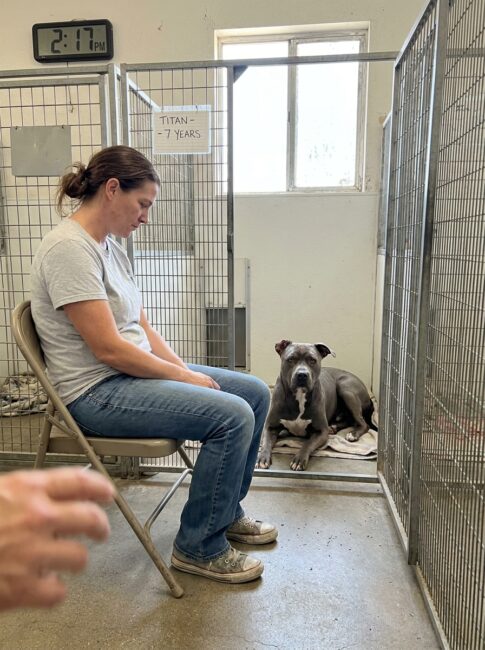
He smelled like dog shampoo, dust, and the dry heat that settles into shelter walls even when the coolers run all day.
I didn’t try to touch him at first.
I just sat there.
Read whatever book I’d brought.
Sometimes talked about stupid things from work, traffic on Speedway, or the cashier at Fry’s who changed her hair color every month.
Twenty minutes the first weekend.
Thirty the second.
By the third, Titan had started lifting his head when I showed up, but only for a second, as if he were checking whether I was really the same person or just another version of leaving.
There were two details I noticed early and filed away wrong.
First, he almost never watched my face for long.
He watched my hands.
Not the treat bag.
Not my eyes.
My hands.
Second, whenever someone in military camouflage passed the outdoor run, Titan’s whole body would go still. He didn’t growl. He didn’t bark. He just froze so completely that it felt stranger than aggression.
I didn’t understand it then.
I only thought it was some old reflex from a dog who had already lived through more than anyone had bothered to write down.
On the fourth weekend, I slid my fingers through the lowest gap in the chain-link and rested my hand on the concrete.
Titan stared at me for a long time.
Long enough for my shoulder to go numb.
Then he stepped forward once.
Stopped.
Breathed.
Lowered his head.
And touched his nose to the back of my hand.
Just one second.
Cold.
Dry.
Deliberate.
I didn’t cry.
I didn’t say a word.
I just stayed still, because I understood that some moments break if you move too hard inside them.
That week, I signed the adoption papers.
I brought Titan home to my small apartment on the east side of Tucson. He made one slow loop through the kitchen, the hallway, and the living room, then disappeared behind the washing machine in the laundry nook and stayed there for two full days.
I left water nearby.
Set food down twice a day.
Sat on the floor talking about ordinary things as if nothing unusual was happening except a large dog hiding behind a washing machine.
On day three, the food bowl was empty.
On day five, he stepped into the living room when he thought I wasn’t looking.
On day ten, I dropped my keys into the ceramic bowl by the door, turned, and saw it.
One tail wag.
Small.
Awkward.
Like his body was trying to remember a motion it had forgotten for too long.
I laughed out loud in the empty apartment.
Then he wagged once more.
The first six months with Titan were built out of tiny permissions.
He learned the sound of my car pulling into the lot and started waiting near the door when I climbed the stairs. He learned that I sang badly while boiling pasta, and that the vacuum cleaner was loud theater, nothing more. He found the exact square of afternoon light on the living room rug and folded himself into it every day as if absorbing warmth were serious work.
I learned him too.
Titan hated ceiling fans on high.
He tolerated baths but looked offended the entire time.
He would not eat unless I set the bowl down and stepped back exactly three paces.
And every night, before settling onto the blanket beside my bed, Titan would make one slow round through the apartment.
Hallway.
Kitchen.
Front door.
Bedroom.
A patrol.
I used to joke,
“Thank you, officer.”
One ear would twitch.
That was all.
The days after that began stacking up the way ordinary days do, in a way that makes people think they will last forever.
One June evening, Tucson was so hot the outside walls still gave off heat at nine o’clock. The power in my building flickered, then went out. I dragged a chair near the window for air, and Titan lay at my feet with his eyes open, ears tracking every sound in the parking lot. I ate dry cereal out of a paper cup because I didn’t feel like opening cabinets in the dark, and he kept breathing in that steady rhythm that made blackout, silence, and disorder feel small as long as we were still in the same room.
Another morning, after a shift so bad I sat down on the kitchen floor before I even took off my shoes, Titan did not climb into me the way dogs do in online stories. He just sat about two feet away and watched me until my breathing slowed. Then he took one step closer and set the heavy weight of his chin on my knee, holding it there like a doorstop.
Some kinds of loyalty are quiet.
They just stay.
Once, walking Titan past a gas station near Grant Road, we passed a young man in desert camouflage. Titan stopped so hard the leash tightened around my wrist. His ears went up. His whole body tilted forward, not threatening, more like a recognition he couldn’t hold inside.
“Hey, buddy,” the guy said with a smile, bending a little.
Titan made one low sound.
I never forgot it, because it didn’t sound irritated. It sounded like something inside him cracked and dropped.
When the young man disappeared down the sidewalk, Titan kept staring after him.
That night, he made four patrols through the apartment instead of one.
I told myself he was overstimulated.
That maybe his past involved military people, loud noises, men in boots.
I was close.
But I was still wrong about the most important part.
Around month six, I bought Titan a new bed because the old one had gone flat and carried that stale sun smell that washing never fully removes. I pulled everything out of the laundry nook, the place he still retreated to whenever summer storms rolled over Tucson.
That was when I found the fabric.
It had been shoved deep under the old pad, folded in on itself, edges frayed, corners damp from being mouthed over and over. At first I thought it was just an old rag. But once I spread it over my knees, I knew what I was holding.
A piece of military uniform sleeve.
Faded.
Frayed.
Sand-colored.
Titan stood in the doorway watching me, and his face changed. Not panic. Not defense. Waiting.
I held the cloth out to him.
Titan stepped forward, took it gently, and carried it back to his bed with the care of something carrying the last remaining piece of another life.
That night, he slept with his chin over it.
I sat on my bedroom floor for a long time, still in my scrubs, knowing I was looking at something important and not yet knowing which door to knock on to make the answer open.
The next morning, I pulled out Titan’s adoption file again.
Neutered male.
Approximate age seven.
Intake source: previous owner unknown.
Microchip: none found at intake.
That should have been the end of it.
But I work in medicine long enough to know that some things do not show up on the first scan. Some data migrates. Some traces only appear when someone is willing to doubt the first result.
At his next vet appointment, I asked them to scan Titan again.
The tech smiled the smile people use when they think they’re indulging a harmless obsession.
“The shelter usually checks carefully,” she said.
“I know,” I said. “Could you just try again for me?”
Titan stood still while the scanner passed over his shoulders, neck, and chest.
Nothing.
Then lower, slightly left of center on his rib cage.
The machine beeped.
The room changed right then.
The old chip had drifted deep enough to be missed the first time. I wrote the number down. Called the registry. Sat through three transfers, two verifications, and a silence longer than it needed to be.
At the end of it, I had a name.
Staff Sergeant Daniel Mercer.
Registered owner.
Tucson address no longer active.
Emergency contact: Eleanor Mercer.
I sat at my kitchen table with the phone in my hand while Titan lay on the floor at my feet, the faded sleeve between his paws.
There are moments when truth arrives before explanation.
This was one of them.
Eleanor answered on the fourth ring.
Her voice sounded older than I expected, careful in the way of people who already know any unknown number might carry one more cut.
When I asked if she had ever known a Pit Bull named Titan, the silence on her end lasted so long I looked at my phone screen to make sure the call hadn’t dropped.
Then she inhaled.
And started crying.
Not loudly.
Not dramatically.
The kind of crying dragged out of a place that has hurt for so long it has worn smooth.
Her son, Daniel, had adopted Titan years earlier after coming home on leave. Titan wasn’t a service dog, not officially, but everyone said he behaved like one. Daniel and Titan had lived near Davis-Monthan. Eleven months earlier, Daniel had been killed in Afghanistan when his convoy hit an explosive outside Kandahar.
After that, everything blurred.
The family handled the funeral.
Paperwork.
People coming and going.
A friend keeping Titan temporarily.
Then, during a transfer to another home, he disappeared.
They searched.
Flyers.
Posts.
Phone calls.
Vet clinics.
Shelters.
No one found him.
“How long was he there?” Eleanor asked.
I looked at Titan on the floor, one paw resting across the toe of my shoe.
“Eleven months,” I said.
She let out a sound I still hear sometimes when things get quiet.
“Oh God,” she whispered. “The exact same amount of time Daniel’s been gone.”
That was the turn in the story.
Not just that Titan had once belonged to a soldier.
Not just that the soldier had died.
The number.
Eleven months in the shelter.
Eleven months since Daniel was killed.
Titan had not stopped wagging because the shelter broke him.
Titan had gone silent because the person he was waiting for never came back.
And when I sat down outside his kennel every Saturday, Titan was not choosing me.
He was waiting one more time inside the space where Daniel should have appeared.
I brought Titan to Eleanor’s house the following weekend.
She lived in a small stucco house on the east side of Tucson, with wind chimes on the porch and a flag out front faded by the sun. When the door opened, Titan froze.
Not from fear.
From listening.
Then Eleanor said,
“Baby.”
Just that one word.
Titan hit the leash once, harder than he ever had before, then stopped right in front of her, trembling all over. Eleanor dropped to her knees on the tile entryway, both hands over her mouth, and Titan pushed his head into her chest with a sound I had never heard from him before.
Not a bark.
Not a whine.
Something breaking loose from the deepest place in him, the sound of a creature that had held on too long.
She cried into his neck.
I turned my face away.
Later she showed me photographs.
Daniel in uniform, smiling wide, one arm around Titan. Daniel sitting on the floor tying his boots, Titan staring at his hands. Daniel asleep on the couch, Titan stretched across his legs like a guard unwilling to leave his post.
In every photo, Titan was watching Daniel’s hands.
I had to set my coffee down.
Eleanor told me Daniel always talked with his hands when he spoke to Titan. Signals. Taps. Points. Commands, jokes, habits. Titan had learned that whole man with his eyes before he learned him with his ears.
Everything in my head began sliding into place.
The way Titan watched my hands.
The nightly patrols.
The stillness around camouflage.
The sleeve hidden under the bed.
None of it had been random.
Eleanor asked quietly,
“Would you think about letting him stay with the family?”
The kitchen went still.
Titan lay at my feet, the faded sleeve between his paws like a small bridge between two lives.
I wish I could say I answered beautifully.
I didn’t.
I said the truth.
“I don’t know.”
Because by then, Titan had become the sound of nails in my hallway, the warm body beside my bed during summer storms, the reason my apartment no longer echoed the way it used to. Because I was old enough to know that the right thing and the thing you can survive are not always identical.
Eleanor nodded, then rested her hand on my wrist.
“My son loved that dog,” she said. “But if Titan wanted to stay here, I think he would have come back today.” She looked down at him, then back at me. “Please keep him. He chose you because you gave him time to remember Daniel.”
I bent over that kitchen table and cried.
Not beautifully.
Not quietly.
Just a woman sitting in a grieving mother’s kitchen while wind chimes tapped softly outside, and a dog rested his head on her shoe as if holding everything still.
I thought that was the peak of the story.
But truth doesn’t stop at the reveal.
It pulls the whole past back toward it and makes you look again.
I stopped saying I rescued Titan.
I adopted him, yes.
I fed him, housed him, and sat still long enough for him to risk moving toward me.
But rescue was too small a word.
Titan was not empty.
He was full.
Full of memory.
Full of routine.
Full of a man who was gone.
I started understanding why he hadn’t watched my face. He learned people through their hands. I understood why he patrolled the apartment every night. Maybe it had once been part of life with Daniel. I understood why camouflage made his body lock up. It wasn’t always fear. Sometimes it was misrecognition. Sometimes, for one brutal second, he probably thought the person he was waiting for had finally turned the corner.
I understood something bigger too.
Titan had not stayed back in the shelter because he didn’t know how to trust.
He stayed back because he wasn’t finished waiting.
I was only the first person after Daniel’s death who didn’t try to rush him past remembrance.
After that, Titan and I started visiting Eleanor once a month.
Some days her daughter came over with Daniel’s young niece, who lined plastic horses across Titan’s back while he tolerated it with solemn dignity. Some days Eleanor brought out another old photo album. Some days nobody said much at all. Just the sound of air conditioning, a spoon against a mug, and Titan lying in the middle of people holding on to Daniel in different ways.
She gave Titan Daniel’s old stainless-steel dog bowl.
Titan sniffed it once.
Licked the rim.
Then lay beside it for a long time.
Another time she found one of Daniel’s old T-shirts in a cedar chest. Titan carried it to the car with the same gentleness he gave that faded uniform sleeve.
He slept on it that night.
But the next night, he slept beside my bed again.
That was what changed my thinking completely.
Titan was not choosing between two loyalties.
He was learning how to carry both.
Now, at 2:17 every Saturday, I still sit down on the floor with him for twenty minutes.
No phone.
No television.
No trying to stir happiness on command.
Just sitting.
Exactly the way it started outside the chain-link kennel.
Some days Titan dozes, his head against my leg. Some days he gets up halfway through, walks to the laundry nook, peers into the dark space behind the washing machine out of some old reflex, then comes back. Once a month, I take the sleeve from the wooden box on the shelf and lay it across his bed. Every time, Titan lowers his chin onto it first, stays still for a long moment, then settles down.
Not because he is trapped.
Because remembering is also a way of staying close.
Last week, I got home late after a long hospital shift, my head still ringing with phones and fluorescent lights. When I opened the door, Titan was already standing there with an old toy in his mouth, his tail moving before I had fully stepped inside.
I knelt to take the toy.
My hand brushed the white patch on his chest.
The kitchen light caught the silver around his muzzle.
He is older now.
So am I.
There will always be another voice inside his memory. Another pair of hands he once watched more closely than mine. A young soldier who never knew that after his death, the dog he left behind would sit silent in a shelter for exactly eleven months as if time itself had agreed to stand guard beside him.
But every Saturday, when I sit down, Titan no longer turns his back.
He walks toward me slowly.
Then closer.
Then closer still.
At last, he rests his chin on my knee.
And I think of a silent kennel in Tucson. Of a mother standing in her doorway saying, “Baby.” Of the way a heart can hold the dead and still leave room for the living.
Titan still remembers Daniel.
And he still walks toward me.
Both things are true.
I think that is enough.
Share this with someone who still believes patient love can outwait grief.