Part 2: Starving Dog Guarded a Broken Bread Cart for Eleven Days — Then an Elderly Vegetable Seller Opened Its Last Drawer
Part 2, The Distance Between a Bowl and a Hand
Elena arrived with a folding crate, two leads, and a volunteer named Marcus who carried everything without letting the metal pieces knock together. She stopped well outside the dog’s reach. Instead of calling to him, she watched him watch us. His eyes followed our hands, especially whenever they moved toward the drawer.
“Has anybody seen him sleep?” she asked.
I started to say yes because I had seen his eyes close. Then I remembered the trucks, the footsteps, the way his head kept coming up. I told her I didn’t know. She nodded as though an honest uncertainty was more useful than comfort. Marcus asked the neighboring vendors to give us a little space.
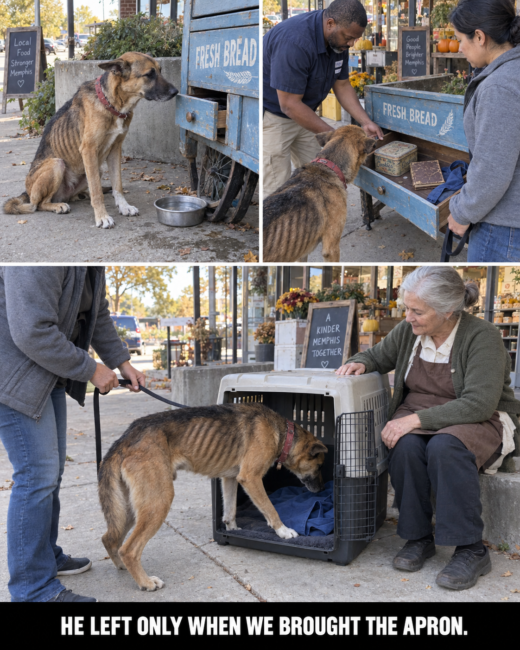
Elena explained that we could not assume he was simply stubborn. He looked weak, frightened, and protective of a familiar place. Getting close without making him feel trapped would take patience, but leaving him there indefinitely wasn’t an option either. There was urgency without shouting. I had forgotten those two things could belong together.
We moved my lowest folding chair near the planter, several feet from him. I lowered myself slowly and set my cane flat instead of leaning it where it might fall. Elena placed water within his reach, then stepped back. He waited until her shoulders turned away before lowering his muzzle. The water made small clicking sounds against the bowl.
A customer tried leaving a whole sausage beside him. Elena thanked her and quietly took it away. The clinic would guide his feeding; we weren’t going to solve days of poor intake with a pile of rich food. What we needed from the market right then was shade, space, and fewer good intentions arriving at once.
I stayed in the chair. I talked about collards because I didn’t know what else to say to a dog. I told him my sister planted too many every year. I told him one customer always squeezed my tomatoes as if the truth might come out. His ears moved when I spoke, though his eyes stayed on the gate.
After a while, he settled on his chest. One white paw rested against the broken wheel. The position looked almost comfortable until I noticed how often he lifted his head, fighting the weight of it. Elena crouched sideways, still distant, and slid a folded towel onto the pavement. He did not move toward it. She let that be enough.
Marcus asked about the bread seller. I knew him as Mr. Joe. Most of us did. He came on busy mornings, wheeling rolls and little hand pies between the permanent stalls. His license and paperwork belonged to the office’s records; none of us carried his last name around in our heads. I felt the small disgrace of that.
The office manager, Denise, came over with a vendor folder. The cart had been moved out of the main walkway after a medical emergency eleven days earlier. Denise had been away that week; the relief attendant had written “ambulance called” beside a time and never recorded where it went. The man’s contact number rang unanswered.
“He fell?” I asked.
“Someone said he couldn’t speak properly,” Denise answered. “We don’t have anything confirmed.”
The dog lifted his head at the sound of a cart rolling nearby. For a moment, he tried to stand. His rear legs shook, and Elena shifted closer without reaching. When he settled again, Marcus steadied the bread cart with a wooden block, keeping clear of the dog’s face. The damaged wheel stopped clicking.
That tiny silence changed something. The dog looked at Marcus, then at the wheel, and finally rested his chin on his white paw. I hadn’t realized the cart had been rocking each time a truck passed. He had been keeping watch beside something that would not even stay still.
Elena laid a loose lead where he could see and smell it. We were closer to getting him out, but not close enough to hurry. While he rested, Denise noticed a number painted beneath the cart’s handle. She checked her folder, then looked toward the drawer.
“There might be an emergency contact in there,” she said. “But first, let’s make sure he knows we aren’t taking it away.”
Part 3, What the Drawer Held
We did not open the drawer by reaching over his head. Marcus and Elena worked out where each of us would stand, and the dog decided, slowly, how much of that arrangement he could tolerate. I stayed beside the planter, talking in the same unremarkable voice. He drank again. That felt bigger than any answer in the folder.
Elena let him approach her hand rather than bringing it to his face. When he sniffed and turned away, she stopped. A few minutes later he accepted the loose lead without struggling, but when Marcus shifted beside the cart, the dog tightened again. We waited for his body to soften before doing anything else.
The drawer stuck halfway. Marcus eased it forward while Elena kept the dog at a comfortable distance, with room to retreat. Inside were paper bags, a tin once used for butter cookies, and a small notebook with a cracked brown cover. There was also an apron folded around a spare collar. Everything smelled faintly of old flour.
The dog leaned toward the apron. Elena placed it on the towel, away from the wheel, and he took one uncertain step after it. Then another. He lowered his nose into the cloth and stood there, breathing. We could not know what he understood. We could see that the familiar fabric gave him somewhere else to put his attention.
Denise opened the tin. A few crumpled bills lay under a scatter of coins. Not enough to explain eleven days of guarding, if you measured guarding in dollars. The notebook held something that looked more promising: a name written inside the cover, Joseph Mercer, and a telephone number labeled “sister.”
There was a loose photograph, too. Joseph sat on a porch step with the same dog, fuller through the shoulders, his white paw laid across Joseph’s boot. On the back someone had written, “Joe and Buddy, Easter.” I said the name softly. The dog’s ears shifted toward me. When I said it again, he looked directly at my face.
Buddy. A name we could give back.
Denise stepped away to make the call. Marcus lifted the notebook out so the drawer could close safely before the cart was moved. It fell open in his hands. On the page were short lines in pencil: “Two rolls, school kids.” “Mrs. Green, knee bad.” “Night shift lady, three pies.” Each had an amount beside it.
At first I felt embarrassed for having looked. A person’s debts were private. Then I saw the word written after the amounts. Not “paid.” Not “later.” In the same cramped hand, beside one line after another, Joseph had written “Forgiven.” Some entries had dates months apart. Others were so old the pencil had faded into the paper.
Marcus closed it. “We should let his family see this.”
I nodded, but something had already caught under my ribs. There was a line about a woman with a green cane. Two rolls, a cold Tuesday, no charge carried forward. I had once forgotten my wallet and promised to return. Joseph had waved me away, and somehow the promise had slipped out of my life.
Beside me, Buddy tried following Elena toward the crate. At its doorway, he stopped and looked back. The notebook was not going to rescue him. We still had to do the ordinary work: secure transport, help a weak dog without hurting him, find a place where he could rest. I folded Joseph’s apron more neatly inside the crate.
Buddy put his white paw on the edge and paused. Elena kept the lead slack. Marcus steadied the crate. When Buddy stepped in, his nails scraped softly against the base, and I had to look away for a moment because I had imagined that sound going on forever beside the broken wheel.
Denise came back as Elena secured the door. She had reached Joseph’s sister. Her name was June. Her brother was alive, in a hospital across town, and she had been trying to find out what happened to his dog.
“He keeps asking,” Denise said. “Even before the words started coming back, he kept trying to ask.”
Part 4, The First Night Away
I rode beside Buddy’s crate in Marcus’s van, my cane between my knees. Elena had arranged for the clinic to see him, and June had given permission for us to bring him in and begin care while she traveled over. The cart stayed behind, blocked securely beside the planter. Denise promised it would be there when we returned.
Buddy stood for the first few minutes, turning whenever the van slowed. We had padded the crate and laid the apron where he could reach it. I kept my fingers outside and talked without expecting a response. At the third stoplight, he lowered himself carefully. His nose remained against the cloth all the way to the clinic.
The examination took longer than I expected. The veterinarian, Dr. Patel, listened to the history, checked him over, and asked what we knew about his meals before Joseph’s emergency. Not much. We could report scraps eaten at the market and visible weight loss; we could not turn our guesses into a medical record.
She found him underweight, dehydrated, and exhausted, and recommended keeping him for monitoring, fluids, blood work, and a controlled feeding plan. She didn’t promise that a meal and a night’s sleep would fix everything. His weakness could not be judged safely from a photograph or from the number of days we thought he had waited.
I asked whether he had been starving himself to guard the cart. Dr. Patel looked through the kennel door before answering. Stress could interfere with eating, she said. So could feeling unable to leave a familiar place. We knew he had received some food. We didn’t know every hour of those eleven days. She left room for what we couldn’t know.
That afternoon, June arrived carrying a tote bag and the tired expression of someone who had learned several hospital corridors by heart. She was Joseph’s younger sister and lived outside the city. He had been working independently, brushing off her questions about slowing down. After his stroke, it had taken time to identify him and reach her.
His wallet had been in an apron pocket, left at the cart when he collapsed. The phone tucked in the drawer was dead. June had found him after reporting that she could not reach him, but by then several days had passed. Her first concern had been whether he would survive. Then she had started asking about Buddy.
“He thought somebody had him,” she said. “I told him I was looking.”
She showed me a picture on her phone of Buddy asleep under Joseph’s kitchen table. He wasn’t a plump dog even then, but the difference was plain. His collar fit in that photograph. Here, in the kennel, it looked as if it belonged to a larger animal.
June asked whether she could leave the tote. Inside was one of Joseph’s unwashed shirts. A technician arranged it with the apron after checking that Buddy wasn’t chewing fabric. He sniffed the sleeve, pressed his muzzle against it, and stayed there. June sat on the floor outside the kennel, saying his name without asking him to do anything.
I nearly apologized to her about the ten days. Then I realized an apology meant nothing if I used it to make her comfort me. I told her what I had done and what I wished I had done sooner. She listened. “You’re here now,” she said, and I accepted that as a place to start, not a pardon.
Before leaving, I asked about taking him home. Dr. Patel wanted to see how he managed overnight. Elena’s rescue could arrange support, and June would discuss longer care once Joseph’s needs became clearer. Nobody handed him a new life across a counter. We had to build one that would actually hold him.
The clinic called after supper. Buddy had accepted a small meal and was resting, though he startled whenever the outer door opened. The technician had moved him to a quieter spot. I wrote those two facts on the back of a seed invoice: ate; quieter spot.
For eleven days, I had counted how long he stayed. That evening I began counting what might help him leave.
Part 5, The Names We Recognized
Buddy remained at the clinic while the staff watched his response to care. I visited when they said a quiet visit might help, bringing nothing edible and asking before I opened the kennel door. His recovery belonged to small measurements: a meal finished, water taken, enough steadiness to stand without immediately sitting again.
On my second visit, he came forward far enough to sniff my skirt. He didn’t wag or lean against me. He simply stayed near the door after I sat down, and I resisted the urge to make the moment larger. June had given Elena permission to coordinate a temporary placement with me when he was ready.
At home, my back room had a washable floor and no steps between it and the little fenced yard. Marcus checked the gate and fixed a loose latch. I bought a low bed after asking what size would suit him. It seemed strange to prepare for someone who had never chosen me, but a room could be ready without making a claim.
June brought Joseph’s notebook to the market that afternoon. She had read it at the hospital while he slept. There were nearly two hundred entries across several years, some identifying people by names, others by jobs or the circumstances Joseph remembered. Most amounts ended with that same word. June said he had always preferred to call it keeping accounts.
I asked if we could show people a few pages. Not put their private troubles on display; just let them see what he had been doing. June considered it, then agreed to a quiet gathering, with the book staying in her hands. Later, Joseph would decide whether any of it became public. The difference mattered.
I carried my folding chair into the central aisle and asked the nearby vendors to come over when they had a moment. Nobody abandoned a paying customer. Nobody made a speech. They gathered in aprons with flour on their cuffs and change still in their palms. June opened the notebook, and I mentioned the woman with the green cane.
“That was me,” I said. “I never went back.”
Mrs. Green touched the edge of the page without taking the book. Her knee operation had kept her away from work longer than expected. Joseph had dropped rolls at her stall when she returned. He’d said they were yesterday’s, although she remembered the warmth coming through the bag. She had believed him because she needed to.
A young man from the loading crew recognized “school kids, blue backpacks.” He and his brother had once cut through the market on their way home. He asked about the date and went quiet when June showed him. Denise recognized the night-shift woman as a cleaner who bought vegetables on her way to the bus.
Not everyone found an entry. Enough people did that the notebook began to feel less like one man’s record and more like a part of the market we had walked past. Some remembered paying him later. Some remembered trying. June pointed to places where Joseph had written “paid” so we wouldn’t pretend every sale had been a gift.
“He ran a business,” she said. “He just made room.”
We started with practical questions. What expenses were waiting? Who could speak to the hospital’s social worker with June’s permission? Who could help with Buddy’s bills? Denise kept a record of contributions, and two vendors counted the money together. Joseph’s insurance would handle part of his treatment, but there were costs and lost income beyond it.
By closing, people had given what they could. The scrap collector returned with an envelope and asked for measurements of the cart. He knew a carpenter who might rebuild it. June thanked him, then said her brother’s recovery wasn’t certain enough to plan a return to work. He answered that a new cart could wait as long as Joseph needed.
That evening I went back to the clinic. Buddy was resting with his chin on the apron, his white paw stretched toward the kennel door. I told him about the money, then stopped because money meant nothing to him. Instead, I sat still until his eyes closed.
For once, a person stayed until the dog slept.
Part 6, Learning That Leaving Was Allowed
Buddy came home with me after three nights at the clinic, along with written instructions, a follow-up appointment, and a number to call if his condition changed. June paid the deposit from the market fund, and Elena made sure I understood the plan. Care had a schedule now, rather than depending on whoever passed the broken cart.
He inspected the back room without lifting his tail. He sniffed the door seam, the water bowl, the folded apron on his bed. Then he settled on the floor facing the exit. I put my chair nearby and read a gardening catalog aloud. We spent our first evening learning how little either of us needed to say.
The next morning, he followed me as far as the kitchen doorway. I stopped, so he stopped. I moved, and he moved. It took me an embarrassingly long time to realize that my constant checking might be making the walk harder. When I went about my business normally, he came into the kitchen and lay beside the table.
His appetite improved gradually. I used the food and portions the clinic had specified, kept notes, and discouraged visitors from sneaking him treats. A thin dog makes people want to offer everything they have. Keeping him safe sometimes meant disappointing kind people, including my sister, who arrived with enough roast chicken for a family reunion.
On his fourth evening at home, a delivery truck rattled outside. Buddy rose too quickly, lost his footing on a loose mat, and scrambled toward the back door. He stood there shaking, then refused his next food offering. I called the clinic instead of deciding it was only nerves. They asked questions and advised a recheck when he remained unsettled.
Nothing in that visit suggested the sudden catastrophe I had imagined, but Dr. Patel reminded me that he was still rebuilding strength. We removed the loose mat, laid secure nonslip runners, and reduced the commotion around his room. Progress hadn’t disappeared. It had shown us where the house still asked too much of him.
June visited with updates from Joseph. His speech was improving, though finding words tired him. One side of his body needed rehabilitation, and nobody could give her an exact timetable. She showed him short videos of Buddy eating or resting. The first time he managed Buddy’s name clearly, she called me from the parking lot and cried without apologizing.
I wanted to take Buddy straight to the hospital. Elena asked me to slow down. A weak dog in a noisy, unfamiliar building might find the visit difficult, and there were hospital rules to consider. June worked with the care team. We waited until Joseph had transferred to rehabilitation and staff could arrange a brief outdoor meeting.
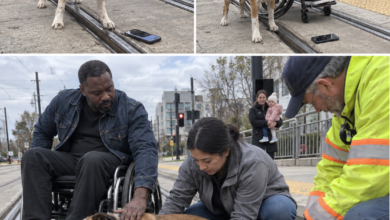
The meeting happened three weeks after Buddy left the market. He was still lean, though his steps were steadier, and he traveled in a secured crate with his familiar bedding. I walked him into a quiet courtyard on a lead. Joseph sat in a wheelchair with June beside him, his hands resting unevenly on a blanket.
Buddy stopped several feet away. Recognition did not look like a movie. He lifted his nose, shifted his ears, and took a slow step forward. Joseph said his name. Buddy approached the wheelchair, sniffed a shoe, then pressed his black muzzle against Joseph’s left hand. His tail moved low and carefully.
Joseph tried to bend toward him. June steadied the blanket, and I kept the lead loose enough for Buddy to choose his distance. There was no jumping, no excited circling. He stood between the wheelchair and my knees while Joseph rested his fingers in the fur behind his ear. Both of them tired quickly.
We kept the visit short. I feared Buddy would panic when it was time to leave, but June gave him the shirt Joseph had worn, and I guided him back toward the van with pauses. He looked over his shoulder twice. That night, he ate and slept in my kitchen.
He could leave Joseph for an evening now because someone would help him find Joseph again. I could not explain that to him. I could only keep making it true, one ordinary visit at a time.
Part 7, A Place Beneath the New Cart
The new cart took longer than the market expected. The carpenter refused to guess at what Joseph would be able to manage, and June refused to let a gift become a deadline. They waited until his rehabilitation team could help him think through practical limits. Nobody needed him selling bread to deserve the cart.
Meanwhile, Buddy’s world expanded by small distances. He learned the path to my clothesline, the shady place beside the kitchen step, and the cupboard where his food lived. At his follow-up appointments, the staff tracked his weight and adjusted his care. His ribs became less prominent over weeks. His old endurance took longer to return.
Elena arranged short visits to the market before opening, when the aisles were quiet. The first time, Buddy went directly to the loading gate. The old cart was still there, stabilized beneath a cover. He sniffed the wheel and stood beside it, ears moving toward every sound. I waited without pulling him away.
Then Denise set his familiar mat near my vegetable stall. I walked over, sat down, and opened my thermos. After a minute, Buddy followed. He left the broken wheel standing by itself. We stayed fifteen minutes that morning, long enough for him to rest and short enough to leave before the trucks arrived.
The vendors wanted to feed him, of course. We made a plan before their generosity undid his progress. I kept responsibility for his meals and appointments while June handled decisions with Joseph. Other people contributed food to an agreed supply and helped with walks. “Everybody’s dog” would mean many helpers and a named person responsible, not nobody noticing an empty bowl.
Mrs. Green kept fresh water at her stall. Marcus took the early walk on mornings my knees were bad. The young loader with the blue-backpack memory saved a clean place beside his chair. Buddy accepted them in his own order. Some days he wanted company; some days he stayed on his mat and let the market happen around him.
Joseph came home to June’s ground-floor house after rehabilitation, with more therapy ahead. Buddy stayed with me until they had settled, then began spending afternoons there. The first overnight, June sent a photograph: a brown dog asleep beside a low bed, one white paw touching the blanket that hung over its edge.
Nobody in the photograph was guarding anything.
In late November, we wheeled the rebuilt cart into the market. Its blue paint was close to the old color, but the wheels were wider and the handle could be adjusted. It had a brake Joseph could reach while seated. Inside the bottom shelf, the carpenter had made space for a removable dog mat, clear of every moving part.
Joseph ran his hand along the drawer. He wasn’t ready to work a regular day, and we told him the bread could wait. His sister had brought a few wrapped rolls for the gathering anyway. Buddy sniffed beneath the cart, turned twice, and lay down. For the first time, the sound of its wheels had brought him somewhere he could rest.
June returned the notebook to Joseph that morning. He sat with it for a while, turning pages slowly. When we asked about displaying it, he worried people would feel exposed. We agreed to cover identifying details. With his permission, a carpenter mounted the open book behind glass near the market entrance, with the private names concealed and the repeated word left visible.
There was no list of donors beside it. Joseph had asked for that. Anyone who needed to see where the fund went could speak to Denise, but the entrance wasn’t going to become another ledger of who owed whom.
I stood beside him while Buddy slept under the new cart. “He guarded that broken thing for eleven days,” I said. “We opened the drawer thinking we’d find money. We found nearly two hundred debts you’d already forgiven.”
Joseph looked down at the dog. It took him a little time to answer. “Did somebody feed him?”
I told him yes, and that somebody always would. Then I pulled my chair into the shade beside his, close enough that Buddy’s white paw rested against both our shoes.
Follow our page for more stories about rescued dogs, the people who stay beside them, and the quiet work of bringing each other home.
Part 1, Version 2 — Everyone Called Him Mean
People called the dog vicious because he guarded a ruined bread cart, but by the time I saw his ribs and trembling legs, I wondered what our distance had cost him.
The scrap collector stopped his truck beside the market gate and asked me whose dog it was. I said he belonged to the man who sold bread. The collector asked where the man was. I opened my mouth and discovered how little a person can know about someone she has greeted for years.
I’m Ruth Bell, seventy-four, and I sell vegetables at a neighborhood market outside Memphis. I knew the bread man’s first name was Joe. I knew he tied his paper bags with string because the handles tore. I knew his dog had one white left front paw. Until that morning, I had treated those things as knowing them.
The blue cart had been tipped against a planter for eleven days. Its wheel was bent underneath, and the little drawer wouldn’t shut properly. The dog sat between the wheel and the gate, brown coat dusty, black muzzle pointed toward the lane. His red collar hung loose. Every delivery truck made him rise, then settle when it passed.
I first noticed the broken cart the morning after an ambulance came through. I hadn’t seen who went into it. Someone said Joe had gone to the hospital; somebody else thought a relative had collected him. The market office had only a brief incident note. We passed those fragments around until they sounded like answers.
I brought water and food. I called the office and left a message with a rescue. Other vendors tried helping, too, but the dog growled whenever a hand went near the drawer, and the cart stayed where it was. He ate after people backed away, sometimes leaving half the food when footsteps returned.
In eleven days, nobody had managed to make him safe. That included me.
The collector crouched a little to inspect the damaged wheel. The dog stood, braced himself, and gave a low warning. Then his hind legs trembled so hard he sat without meaning to. I saw the ridge of his backbone, the hollow behind his shoulder, and a patch of white on his chest rising with each quick breath.
“Leave it,” I told the collector.
“I can’t leave it forever, ma’am.”
“Then give me today.”
He looked at the dog again and agreed. I called another rescue, staying on the phone until a woman named Elena had the address and understood that he was visibly weakening. She asked us not to corner him. The collector moved his truck away and brought water from the tap behind the flower stall.
I sat on my folding chair near the planter, far enough away that the dog stopped staring at my hands. The market smelled of damp cardboard and coffee. A loose bit of metal beneath the cart clicked whenever a truck passed. Each click lifted his head, even when his eyes were closing.
“You could lie down,” I said, though I had no right to tell him what he could do.
He lowered his chin an inch, then lifted it when the collector returned. This time I noticed that he wasn’t watching the man’s boots. He was following the hand that rested briefly against the drawer. Under its edge, a strip of blue cloth had been folded with deliberate care.
I had thought the cart was empty. I had thought the dog stayed because he didn’t know where else to go. Now, watching him drag his tired body closer to that narrow drawer, I realized we hadn’t understood even the shape of his waiting.
The rescue volunteer was already on her way when I noticed what his eyes kept following, and opening that drawer would change every question we had been asking about him.
Part 1, Version 3 — The Chair I Finally Moved
I fed the skeletal dog beside our market’s broken bread cart for ten days before realizing that leaving a bowl was easier than asking why he never followed anyone away.
On the eleventh morning, I moved my chair. That sounds too small to be the beginning of anything, but until then my chair had stayed behind my vegetable table, where I could watch him without changing the shape of my day. This time, I put it beside the planter and sat within a few yards of him.
My name is Ruth Bell. I was seventy-four, with a green cane, a bad knee, and a stall outside Memphis that made just enough to keep me arguing with the price of seed. The dog knew my footsteps. He lifted his head when I approached, then looked past me toward the loading gate.
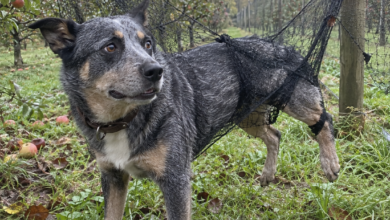
He was a brown shepherd mix, black around the muzzle, with a crooked white patch on his chest and one white front paw. Dust had flattened the fur along his back. His collar was red, frayed at the buckle, loose enough now that I worried about it catching on the cart.
The cart had belonged to Joe, the bread seller. Blue paint, paper bags, a little drawer he always tapped shut with his hip. Now one wheel lay crooked beneath it. The cart leaned against concrete, and the dog sat in the narrow triangle of shade underneath the handle. His ribs showed when he breathed.
An ambulance had come eleven days earlier, while I was away collecting produce. We learned afterward that Joe had been taken to a hospital. Nobody I asked knew which one. The market office had an unanswered phone number. People said a relative was probably handling things, a sentence that let the rest of us return to our tables.
I put down water every morning. Some evenings, I left food before locking up. He ate a little, but a person stopping near the cart could pull him away from the bowl instantly. He would stand over the broken wheel, trembling through his back legs, and growl if they reached toward the wood.
The first rescue number I called hadn’t produced a visit. I should have tried again sooner. I can tell you my stall was busy and my knee hurt, but neither explains why his empty nights became ordinary to me. On that eleventh morning, he struggled to rise, and I could no longer pretend we had time.
A woman named Elena answered at another rescue. She asked careful questions and said she would arrange help. I stayed beside him after hanging up. Somewhere behind us, a vendor shook a tablecloth. The snap made the dog flinch. He recovered his position against the wheel as if even that small retreat needed correcting.
The scrap collector arrived before Elena did. He had been asked to remove the damaged cart. I stopped him with my cane planted on the pavement, then apologized for sounding sharp. He said he had a dog at home and could wait. Instead of backing his truck closer, he parked down the lane.
“What’s in the drawer?” he asked.
I said I didn’t know.
He brushed the drawer’s wooden edge while inspecting the cart, and the dog gathered himself immediately. Not toward the man’s face or his pockets. Toward that one hand. Beneath the drawer, I could see a corner of folded blue fabric, clean along the edge that had been protected from dust.
There was something inside. Perhaps only old bags, perhaps something that smelled familiar. But for ten days I had walked past a question, filled a bowl beside it, and called that an answer. I stayed in my chair as the dog lowered his head, his white paw still touching the wheel.
I thought the drawer might tell us where his owner had gone, but I wasn’t prepared for what its worn little notebook would reveal about the people standing around us.