The Blind Old Beagle Slept Beneath the Bus Ticket Counter at 5:40 Every Morning — Six Drivers Needed to Know Who He Was Waiting For
At 5:40 every morning, the blind old Beagle crawled beneath our ticket counter, rested his cloudy eyes near the cold tile, and waited for a bus driver who no longer came to work.
The first person to notice him was Dana, the driver assigned to Route 16. She arrived at Portland’s Harbor Street Transit Center before dawn, carrying coffee in one hand and her inspection clipboard in the other. Rain ticked against the terminal windows, the fluorescent lights buzzed overhead, and buses idled beyond the glass with the heavy, uneven breathing of large sleeping animals.
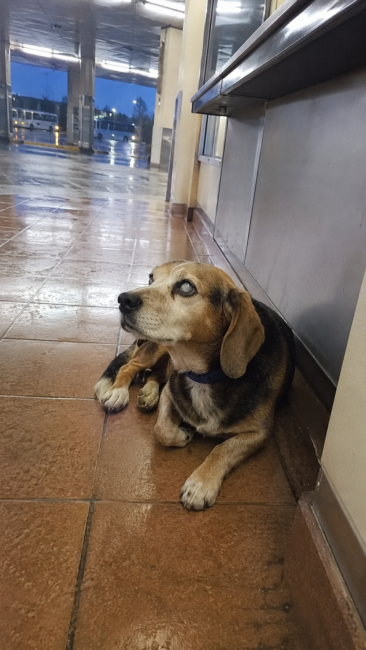
The Beagle was curled beneath the closed ticket counter.
He was old, probably twelve, with a faded tricolor coat, a broad black saddle, a white chest shaped like a half-moon, and a small notch in his left ear. Both eyes were covered by smooth, milky blue-gray clouding. When Dana’s boots approached, he raised his head toward the sound but looked several feet to her right. Then he lowered his chin again, as though he had already learned that looking would not help him understand who had arrived.
Dana left half a breakfast sandwich within smelling distance. He waited until she moved away before eating it.
The next morning, he returned at exactly 5:40.
By the fourth morning, six drivers knew about him. Someone placed an old rubber mat beneath the counter. Someone else brought a water bowl. I began unlocking the side entrance ten minutes early because the dog waited outside in the rain until he heard the familiar metal shutter roll upward.
What none of us understood was how a nearly blind dog crossed the bus lanes without being struck. He followed engine vibrations, curb edges, exhaust smells, and the rhythmic warning beeps from reversing vehicles. More than once, a driver found him standing inches from an active lane, his nose lifted while buses moved around him.
We tried taking him somewhere safer. The moment anyone reached toward his collar, he recoiled, circled clockwise until his shoulder found a wall, and flattened himself against it. Food could guide him several feet, but never into a crate or behind a closed gate. If we blocked the ticket counter, he waited beside Bay Six instead.
Always Bay Six.
At first, we assumed the warmth from the building drew him inside. Then Dana noticed what happened whenever a Route 6 bus pulled into the terminal. The Beagle rose, walked toward the air-brake hiss, and stood with his tail held low but moving once or twice. He inspected the driver’s shoes, listened to the voice above him, and returned beneath the counter.
He was not waiting for any bus.
He was checking every driver.
On the eighteenth morning, I found him resting beside a paper food tray before anyone had offered him breakfast. The tray was old and rain-softened, probably carried inside beneath his paw or caught against his coat. A handwritten route number had blurred across one corner, but the retired drivers recognized the blue grease-pencil line beside it.
“That was Leonard’s mark,” one of them said.
Leonard Morales had driven the first Route 6 departure for nineteen years. His bus had left Harbor Street at 5:47 every weekday—seven minutes after the Beagle arrived beneath our counter. Leonard had retired suddenly six weeks earlier after becoming ill during a shift. There had been no farewell breakfast, no final route, and apparently no way to explain his absence to the dog who still arrived before his bus.
I called the number dispatch had for Leonard’s daughter. Before I could finish describing the Beagle, the woman on the other end stopped speaking.
Then she asked one question.
“Does he have a notch in his left ear?”
That was when we realized Leonard had not merely tossed scraps to a random stray. He had been trying to earn the blind dog’s trust for almost a year—and something had happened on the final morning neither of them reached the terminal.
Leave the word 540 below if you want to learn what happened to Leonard—and why the Beagle kept risking the bus lanes to wait beneath that counter.
Part 1 — Teaser Version 2: Six Drivers and an Empty Route
Six bus drivers watched the blind Beagle return before sunrise for eighteen mornings, but none understood why he inspected their shoes and walked away whenever they spoke.
I managed the early ticket counter at Harbor Street Transit Center, where mornings began with wet pavement, burnt coffee, and the hydraulic sigh of buses lowering toward the curb. At 5:40, seven minutes before the first Route 6 departure, an elderly tricolor Beagle appeared from the alley and followed the terminal wall until his nose reached our door.
Both of his eyes were cloudy blue-gray.
He could detect the bright terminal windows, but he could not see the doorway clearly. If the door opened silently, he walked past it. If I rolled the metal shutter upward, he turned toward the rattle, entered cautiously, and curled beneath the same section of the ticket counter.
The dog carried no tag. A worn blue nylon collar circled his neck, and a small notch marked his left ear. His white muzzle made him look older than his stiff but determined gait suggested. Whenever a stranger tried to touch him, he lowered his head, stepped backward, and circled clockwise until some solid surface stopped him.
We began calling him the 5:40 Beagle.
Dana from Route 16 brought boiled chicken. Marcus from Route 11 supplied a rubber mat. Helen, who drove airport transfers, placed a shallow water bowl against the wall so he could find it with his whiskers. Three other drivers checked the active lanes before moving their buses because the dog sometimes crossed toward Bay Six when he heard an air brake release.
Why would a blind animal return to one of the most dangerous places in the terminal? Why did he refuse the warm maintenance office yet sleep comfortably beneath a public counter? And why did every male driver receive the same examination—nose near the boots, head tilted toward the voice, then a quiet retreat?
The answer appeared during a rainy Monday rush.
A substitute driver pulled into Bay Six and opened the door. The Beagle woke instantly. He walked faster than we had ever seen him move, following the engine’s vibration until his front paws reached the curb. The substitute stepped down, and the dog smelled his black uniform shoes.
For one second, his tail moved.
Then the driver spoke.
The Beagle froze, turned away, and returned beneath the ticket counter with his head lower than before.
“That dog is looking for somebody,” Dana said.
We reviewed staffing changes from the previous two months. One mechanic had transferred. Two dispatchers had changed shifts. Three drivers had taken vacation. Only one person connected to the first Route 6 departure had disappeared from the schedule entirely.
Leonard Morales had driven that route for nineteen years. He was sixty-eight, quiet, reliable, and known for carrying plain chicken sandwiches he rarely finished. Six weeks earlier, Leonard had suffered a medical episode while preparing for work. His daughter had collected his belongings, and his retirement became effective before he could return.
When I mentioned Leonard’s name, the Beagle lifted his head from beneath the counter.
We tested it again.
“Leonard.”
His ears moved forward. He stood, searched toward my voice, and began smelling the floor.
The reaction was small, but every driver saw it.
I contacted Leonard’s daughter, Elena, expecting her to know about a pet left behind. Instead, she told me her father had never owned a dog. His apartment did not allow one, and since his illness he had been completing rehabilitation across town.
Then I described the Beagle’s faded coat, cloudy eyes, blue collar, and notched left ear.
Elena became quiet.
“My father called him Scout,” she finally said. “He said the dog would come close enough to eat, but never close enough to be taken somewhere safe.”
Leonard had fed Scout outside the terminal for eleven months. Each morning, he arrived at 5:40, placed food beneath the counter, and sat several feet away until the blind dog finished. He had planned to bring a rescue worker on his last scheduled Friday.
He never made it to work that morning.
Yet Scout had kept their appointment every day since.
We believed bringing Leonard back would solve everything. But when Elena explained what her father could—and could not—do after his illness, we understood that reuniting them might be harder than rescuing Scout from the bus lanes.
Write SCOUT below if you want the next update and the moment Leonard heard that his blind morning companion was still waiting at 5:40.
Part 2 — The Route He Could Still Hear
Elena explained that Leonard had suffered a mild stroke in his apartment shortly before leaving for work. He had recovered his speech and much of his movement, but balance problems kept him from driving, and fatigue limited how long he could remain outside. He was temporarily living with her in a one-story home while attending rehabilitation.
“He asks about Scout every morning,” she said. “He thinks the dog stopped coming when he stopped bringing food.”
I looked beneath the ticket counter. Scout had pressed his white muzzle against the rubber mat and appeared asleep, although one ear moved whenever a driver entered. The dog had not stopped coming. If anything, Leonard’s absence had made the appointment more important.
We arranged a meeting for the following morning, but the terminal’s safety supervisor refused to let Leonard wait in the active boarding area. Scout’s blindness made the environment dangerous, and six weeks of feeding had not made him comfortable with restraint. If the reunion startled him, he could bolt directly toward the moving buses.
We converted an unused customer-service room beside the lobby into a quieter space. The room had one door, a nonslip floor, and no furniture except two chairs. We laid Scout’s rubber mat beneath the counter as usual, then created a short scent trail from the mat to the room using tiny pieces of warm chicken.
Leonard arrived with Elena at 5:32.
I recognized him from years behind the wheel, but retirement had changed his posture. He walked with a cane, placing his right foot carefully, while Elena stayed close enough to help without holding his arm. Leonard wore the same brown weatherproof jacket visible in his old employee photograph.
He asked us not to call Scout immediately.
At 5:40, the metal shutter rose.
Scout entered from the rain, water darkening his black saddle and dripping from his long ears. He found the rubber mat, smelled the food, and paused. The pieces led away from his usual resting place.
He followed three of them.
Then Leonard cleared his throat inside the customer-service room.
Scout stopped so abruptly that his paws slid slightly on the damp tile. His head lifted, his cloudy eyes aimed toward the empty wall, and his nostrils opened and closed as he tested the air. Leonard said the same words he had apparently used for months.
“Morning, Scout. Bus leaves in seven.”
The Beagle took one step toward the voice.
Then a bus released its brakes outside. The sharp hiss echoed through the lobby, and Scout turned toward Bay Six. He walked away from Leonard, crossed the ticket area, and stood beside the terminal door as though the familiar sequence required him to check the bus before anything else.
Leonard remained in the room. He did not call again or pursue him.
Scout listened to the engine idle, smelled the air around the doorway, and returned. This time, he followed every piece of chicken until he reached the customer-service room.
Leonard sat sideways in the chair, keeping his hands low. Scout approached his shoes, smelled each one, and tilted his head toward his voice.
The tail moved once.
Leonard’s fingers tightened around his cane, but he did not touch him. Scout circled clockwise, found the room’s wall, and settled three feet away.
That was as close as he came.
It would have looked like rejection to anyone expecting a dramatic reunion. To Leonard, it was progress. Scout had eaten near him for nearly a year without allowing contact. Choosing to remain in the same closed room was the longest conversation the two had ever shared.
When Leonard left for rehabilitation, Scout returned beneath the counter.
The next morning he arrived again at 5:40.
The reunion had not ended his waiting, because Leonard had never been Scout’s owner. He had been the most reliable point in a world Scout could no longer see, and one familiar visit could not replace eleven months of routine.
If we wanted to remove him from the terminal safely, all six drivers would have to help make the rescue feel like part of that routine rather than the end of it.
Part 3 — Six Drivers, One Routine
The shelter behavior coordinator visited Harbor Street that afternoon. From a distance, she watched Scout orient toward footsteps, recoil from an approaching hand, and use his nose to trace the counter’s base. She could see the clouding in his eyes but would not name its cause without a veterinary examination.
Her immediate concern was the bus lane.
Scout had memorized a path from the alley to the terminal door, but construction crews were scheduled to move a temporary barrier within four days. A blind dog depending on curb edges and echoes could walk into the lane if even one landmark changed. We did not have weeks to build trust.
The coordinator suggested a structured feeding plan. Only six familiar drivers would provide food. Each would use the same phrase Leonard had used, place the bowl along a fixed indoor route, and step away. The route would gradually move Scout from beneath the ticket counter toward the customer-service room, where a large travel crate would remain open and covered on three sides.
The crate became our first obstacle.
The moment Scout smelled its plastic threshold, he backed away and circled until his shoulder reached the wall. We removed the door, covered the base with the rubber mat, and stopped trying to guide him inside. For two mornings, food stayed six feet from it.
At 5:40, Dana said, “Morning, Scout. Bus leaves in seven.”
At 5:42, Marcus moved the bowl one foot.
At 5:45, Helen sat near the room without speaking.
The drivers’ schedules overlapped for only a few minutes, yet each contributed one predictable sound. Dana’s key ring clicked against her belt. Marcus shuffled his left boot because of an old ankle injury. Helen carried a metal thermos that tapped softly against her bag. Scout began identifying them before they spoke.
He still searched every Route 6 driver.
When the bus arrived, he left his food, approached the doorway, and inspected the driver’s shoes. Each unfamiliar voice caused his ears to lower. Then he returned to the counter and finished eating.
On the third morning, Leonard came back. He sat beside the open crate while Scout followed the feeding route. This time, Scout approached within a foot of his cane. Leonard rested one hand on his knee and continued speaking about ordinary things—the rain, a detour on Burnside, the bus mirror that always rattled in cold weather.
Scout lowered his body onto the edge of the rubber mat.
Leonard did not touch him.
The following day, Scout placed his front paws inside the crate to reach the bowl, but a luggage cart struck a wall in the lobby. The bang made him recoil. He ran toward the terminal door, misjudged the opening, and bumped the side of his muzzle against the frame.
There was no visible wound, but the collision frightened him. He refused the crate for the rest of the morning and waited outside in the rain rather than return to the customer-service room.
That was our first setback, and it came directly from what his cloudy eyes prevented him from anticipating. The coordinator reminded us that progress with a blind, wary dog was not a straight path. A single unexpected sound could change how safe an entire room felt.
We moved the luggage carts, placed a padded barrier along the doorframe, and reopened the familiar route. Nobody shortened the distance by grabbing his collar.
Scout returned the next morning.
He entered at 5:40, found the mat, and stood there for nearly a minute. Dana used the familiar phrase. Leonard answered from inside the room.
Scout followed their voices.
He stepped into the crate with all four paws, ate two pieces of chicken, then backed out. We did not close the door.
The fifth morning, he remained inside for eleven seconds. The sixth, he turned around and lay down with his nose facing the opening. Leonard sat three feet away, and for the first time, Scout rested without keeping a wall against his shoulder.
The safety supervisor gave us one more morning before the construction barrier moved.
Our plan depended on Scout entering the crate again, tolerating its door, and allowing us to carry him through a terminal whose sounds had guided him for months.
There was no guarantee he would do any of those things.
Part 4 — The Last Morning Beneath the Counter
Rain arrived before sunrise on the final morning, blowing sideways beneath the terminal canopy. Scout appeared from the alley soaked across his back, moving more slowly than usual. He found the outer wall with his shoulder and followed it until the shutter began to rise.
At 5:40, he entered.
The six drivers were present, but we kept them separated along their normal routes instead of forming a crowd. Dana stood near Bay 16. Marcus checked the lobby door. Helen waited beside the customer-service room. The other three drivers remained near their buses so the terminal sounded as ordinary as possible.
Leonard sat beside the open crate.
Scout crossed to the rubber mat and shook rain from his coat. His milky eyes caught the ceiling light but did not follow anyone accurately. He smelled the floor, located the first piece of chicken, and began moving toward Leonard’s voice.
“Morning, Scout. Bus leaves in seven.”
Scout reached the customer-service room just as Route 6 pulled into its bay. The brakes hissed. He stopped, turned, and began walking back toward the door.
We had expected that.
The new Route 6 driver stepped down from the bus but did not call to him. Instead, she walked inside, removed her wet uniform jacket, and placed it beside the crate. Leonard had worn that same style of jacket for nineteen years. It carried the smells of rain, vinyl seats, diesel residue, and the terminal’s industrial detergent.
Scout reached it and investigated every fold.
Leonard spoke again.
The dog followed the scent and voice into the crate. He ate one piece of chicken, turned around, and lowered his chest onto the mat. His rear legs remained tense, ready to push him backward.
Helen moved toward the crate door. Scout heard her shoe scrape and lifted his head. She stopped. Leonard continued talking while she waited for his breathing to slow.
When Scout lowered his chin again, Helen moved the door several inches.
The hinge clicked.
Scout sprang up and backed into the covered end of the crate. His paws scraped the mat, and a low frightened sound came from his throat. Leonard did not tell him to stop. He kept his voice even and placed another piece of chicken near the threshold.
For several seconds, Scout pressed himself against the crate wall.
Then he smelled the food.
He took one careful step forward. Helen moved the door another few inches, paused, and waited. Closing it required nearly four minutes. No one celebrated when the latch finally settled. We simply covered the front with a breathable blanket and allowed Scout to listen.
Transport created another problem. The rescue van could not enter the active bay because construction equipment blocked the service lane. Four of us had to carry the crate nearly ninety yards beneath the covered sidewalk while buses loaded around us.
We coordinated each movement aloud. The crate stayed level. Leonard walked beside us with Elena, speaking whenever Scout’s paws shifted against the plastic floor.
At the van, Scout refused water but accepted a piece of chicken through the crate door. His breathing remained fast. The rescue coordinator secured the crate with two straps, and Leonard sat in the passenger row where Scout could hear him during the drive.
Halfway to the clinic, Leonard stopped speaking.
Scout rose and pressed his nose against the crate opening.
Leonard said, “Still here, buddy.”
Scout lowered himself again.
At the clinic, staff carried him through a side entrance to avoid barking dogs in the waiting room. They opened the crate inside a quiet examination space, but Scout would not come out. We waited for the veterinarian, dimmed the lights, and removed every unnecessary person.
Leonard sat on the floor despite Elena’s concern about his balance. He rested his cane beside him and began describing the Route 6 schedule as though they were still beneath the ticket counter.
Scout stepped out after twenty minutes.
He smelled Leonard’s shoes, circled once, and lowered himself beside the retired driver’s knee. When Leonard placed the back of his hand on the floor, Scout moved close enough for his whiskers to touch it.
He did not accept a stroke.
But he did not retreat.
After eleven months of breakfast meetings and eighteen mornings beneath an empty ticket counter, Scout had finally allowed Leonard’s hand to remain inside his safe space.
Part 5 — What the Cloudy Eyes Meant
The veterinarian began with what she could observe. Scout’s eyes were covered by dense, bilateral blue-gray clouding. He reacted to bright changes in light but did not follow silent hand movements. He navigated by scent, sound, whisker contact, and remembered boundaries.
After a full examination and ophthalmic testing, she diagnosed mature cataracts in both eyes, along with retinal degeneration that had likely progressed over time. Cataract surgery alone was unlikely to restore useful vision because the retina could no longer transmit a dependable image.
Scout would remain blind.
The news did not change who he had been beneath the counter, but it changed what kind of future we needed to build. He required a fixed environment, verbal warnings before touch, protected stairs, regular eye-pressure checks, and people willing to let him learn routes gradually.
His cloudy eyes were not painful at that visit. There was no ulceration, infection, or dangerous pressure. The clinic would continue monitoring them because older blind dogs could develop complications, but no emergency procedure was needed.
The veterinarian estimated that Scout was between eleven and thirteen years old. His stiff first steps were consistent with age and months of sleeping outdoors, but he remained able to walk comfortably after warming up. His bloodwork showed mild dehydration and the nutritional effects of inconsistent meals rather than a separate severe disease.
The rescue placed him with an experienced foster named Nina, a fifty-eight-year-old library assistant who lived in a quiet one-story house ten minutes from Elena. Nina had fostered two blind dogs before. She prepared one room with nonslip runners, a low bed, padded corners, and bowls that would never change location.
Scout’s first night did not resemble the peaceful photographs people expect after a rescue.
He paced clockwise along the room’s perimeter, stopping whenever he encountered unfamiliar furniture. He ate only after Nina left. When the furnace started, he pressed his body behind the bed and remained there for almost an hour.
At 5:30 the next morning, Nina heard him stand.
By 5:40, Scout was at the front door.
He smelled the gap beneath it, listened for buses that were miles away, and tapped one paw against the floor. Nina sat several feet behind him and played a short recording Leonard had made.
“Morning, Scout. Bus leaves in seven.”
Scout turned toward the voice. He searched the room, found no one, and returned to the door.
The recording calmed him, but it could not replace Leonard’s scent or presence. For the first week, Scout waited by that door each morning. Nina did not drag him away. She placed breakfast nearby and allowed the routine to end on its own.
Leonard visited every third day as his rehabilitation schedule permitted. He always wore the brown jacket and used the same greeting. Scout began meeting him near the living-room runner, first from several feet away and later close enough to inspect his cane.
On the fourth visit, Leonard sat on the floor and placed his hand beside his leg.
Scout approached.
His nose touched Leonard’s knuckles. He recoiled slightly, waited, then returned. Leonard moved two fingers along the white fur beneath his chin.
Scout’s body stiffened, but he did not circle toward the wall.
The touch lasted less than three seconds. It was the first Leonard had managed in nearly a year.
That evening, Scout slept with his chin resting on the sleeve of Leonard’s brown jacket after Elena left it beside his bed. The jacket was not a cure for blindness or fear. It was simply a familiar landmark that remained after the voice went home.
For several weeks, recovery continued through small repetitions. Scout learned the route from bed to water, water to yard, and yard to Nina’s kitchen. His waiting at the front door shortened from forty minutes to ten.
Then, one early-morning delivery changed the sound outside Nina’s house and sent him searching for the terminal again.
Part 6 — The Morning He Returned
A city bus had never used Nina’s residential street before. Road construction diverted one past her house at 5:38 on a Tuesday morning, close enough for the engine vibration to rattle the front window. The brakes released with the same long hiss Scout had heard at Harbor Street.
He woke immediately.
Nina had opened the fenced side yard moments earlier, expecting him to follow his usual scent-marked path. Instead, Scout turned toward the front of the house, pushed through a utility gate that had not fully latched, and reached the driveway.
Nina saw him before he reached the sidewalk.
She did not chase. Running footsteps could drive him farther toward the sound, so she called his name, used Leonard’s phrase, and tapped the metal buckle of his leash against the porch rail. Scout stopped near the curb with his cloudy eyes aimed past the bus.
“Morning, Scout. Bus leaves in seven.”
He turned toward her.
Nina approached from the side, clipped the leash to his blue collar, and guided him inside. The episode lasted less than a minute, but it showed us that Scout’s old route still lived inside every familiar sound. His progress had not erased the habits that once kept him connected to Leonard.
The rescue added a second latch to the gate and fitted Scout with a lightweight harness so pressure would not pull at his neck when he became disoriented. Nina practiced an emergency recall using Leonard’s phrase and the sound of a small metal thermos—the closest safe imitation of the terminal noises he trusted.
Leonard’s own recovery was progressing. He could walk short distances with a cane and had begun spending weekends at Elena’s home. Her fenced yard and one-story layout could be adapted for Scout, but she and Leonard refused to rush.
They attended handling lessons. Leonard learned to announce touch before clipping the harness. Elena marked doorways with textured mats. Food and water remained fixed. A dog walker agreed to cover the afternoons when Leonard’s fatigue was strongest.
Scout began trial visits lasting two hours, then half a day.
During the first overnight stay, he paced after the lights went out and searched for Nina’s hallway runner. Leonard slept on the couch rather than move him again. At 5:40, Scout stood beside the front door.
Leonard put on his brown jacket, clipped the harness, and led him into the fenced yard. They walked the perimeter together, Leonard using his cane and Scout following the soft tap beside him.
Afterward, Scout returned inside and ate breakfast.
He did not wait at the door.
The second overnight went better. On the third, Scout found the water bowl without tracing every wall. His cloudy eyes remained unchanged, but his recovery was visible in other ways: ears no longer pinned at each unfamiliar sound, breathing that settled sooner after surprise, and a body willing to rest without pressing against a barrier.
Three months after his rescue, the adoption coordinator approved Leonard and Elena’s application. Leonard would be Scout’s primary person, while Elena remained responsible for transportation, veterinary care, and exercise on difficult days.
Before the paperwork was finalized, the six drivers requested one carefully managed visit to Harbor Street.
We worried the terminal might pull Scout back into his old waiting pattern. Instead, Leonard arrived with him at 6:20—after the first Route 6 bus had already left. Scout walked on his harness beside Leonard, crossed the quiet lobby, and found the rubber mat beneath the ticket counter.
He smelled it for a long time.
Then he turned away and followed Leonard’s cane toward the door.
Part 7 — 5:40 at a Different Door
Scout never regained his sight, and no one asked him to behave as though he had. His home remained consistent: the same runners, the same bowl positions, the same fenced route into the yard, and the same spoken warning before a hand reached near his cloudy eyes.
Leonard’s mornings also found a new rhythm.
At 5:40, his alarm played a quiet chime. Scout lifted his head from the bed beside Leonard’s chair, listened as the cane touched the floor, and followed him toward the kitchen. Leonard prepared two breakfasts—oatmeal for himself and measured senior food for Scout.
Sometimes Scout still inspected the shoes of male visitors. Occasionally, an air-brake hiss on television made him search toward the door. Those behaviors grew shorter with time because a familiar voice now answered from the same room.
The six Harbor Street drivers continued their early routes. Beneath the ticket counter, the rubber mat remained for several weeks before we moved it to the staff room. No other dog arrived to sleep on it.
Leonard brought Scout back only once more, during a quiet weekend. The Beagle smelled Bay Six, the counter, and the place where chicken had appeared for eleven months. He stood beneath the fluorescent lights with his milky eyes turned toward the familiar sounds.
When Leonard said, “Time to go home,” Scout followed.
There was no dramatic farewell. His tail moved once, his nose touched Leonard’s shoe, and the two of them walked toward Elena’s car at the careful pace both had learned.
The dog who once risked active bus lanes to keep a 5:40 appointment still wakes at that hour. He simply waits somewhere else now—beside the retired driver who finally has time to remain after breakfast.
Follow our page for more grounded rescue stories about overlooked dogs, patient helpers, and the quiet routines that slowly turn uncertainty into home.