The Doberman Would Not Let Shelter Staff Touch His Torn Blanket — When a Veterinarian Lifted It Whole, a Freezing Kitten Was Curled Against His Belly
Part 2 — A Warning Mistaken for Anger
We temporarily called the Doberman Mercer because he had been found near Mercer Avenue. The name was practical, not evidence of his past. No microchip appeared during the first scan, and his collar offered no identification.
The kitten was provisionally called Pip.
We could see that Pip was dangerously cold, but only a veterinarian could determine what else was wrong. The kitten’s orange-and-white coat was damp and clumped. Its ribs moved in short, shallow breaths. One white forepaw rested against Mercer’s rust-colored abdomen.
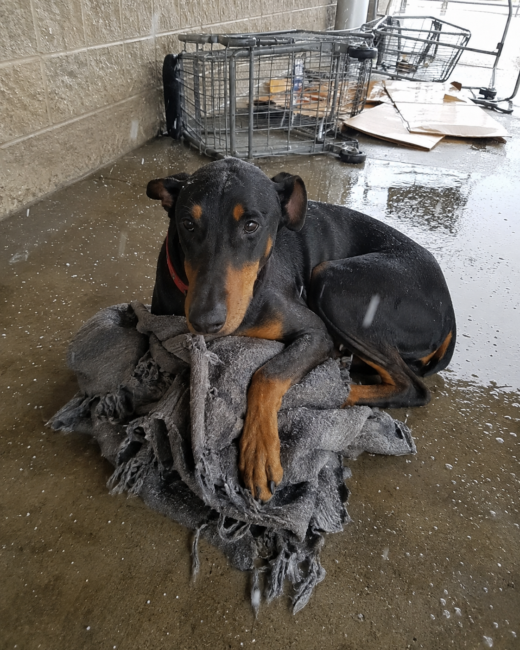
To examine Pip, we had to move closer.
Mercer had already communicated that direct hands near the blanket were unacceptable. His warnings were controlled, but exhaustion could shorten the distance between warning and defensive action.
Elena asked everyone except Luis and me to leave.
We placed portable barriers around the warming board, giving Mercer a protected corner without trapping him. Luis prepared a soft slip lead but kept it on the floor. I continued rolling food toward Mercer rather than offering it from my hand.
He ate slowly.
His eyes never left Elena.
She slid a warm towel beside Pip without touching the kitten. Mercer smelled it, pressed his nose against the fabric, and allowed the towel to remain.
That was the first object he accepted near the life he was guarding.
Elena then placed one hand flat on the floor. She did not reach over Mercer’s head. She moved in from the side where he could see every finger.
His lips tightened.
She stopped.
When his mouth softened, she advanced an inch.
The process took almost ten minutes.
Pip’s condition did not give us unlimited time. A severely chilled kitten should be warmed gradually before being offered a full meal, and rough handling could worsen breathing or glucose instability. Yet rushing Mercer could create a second emergency.
The obvious solution was sedation.
It was also not the first choice. Mercer was underweight, cold, medically unassessed, and protecting an animal pressed against his body. Sedating him before determining his condition could carry avoidable risks.
Elena changed the goal.
Instead of removing Pip, we would move both animals and the blanket together into the treatment area.
Luis clipped the slip lead only after Mercer voluntarily put his head through the loop for food. The dog startled when it tightened, then froze. Luis immediately loosened pressure.
Mercer looked down at Pip.
Pip shifted weakly.
The Doberman lay down again.
We positioned the warming board beneath the entire blanket and secured the fabric so no fold could tighten around the kitten. Mercer remained on top, his body forming a curve rather than placing weight directly over Pip.
Four people lifted the board, one at each corner.
Mercer growled once when the floor moved beneath him. I kept my voice low and continuous, not because words carried special meaning, but because predictable sound gave him one less change to process.
The board traveled twenty feet to the treatment room.
Pip’s temperature registered well below normal. The kitten was dehydrated and lethargic, with pale gums and blood glucose low enough to require careful correction under veterinary direction.
Mercer’s temperature was also low, though not as severely. His body-condition score was below ideal. His paw pads were abraded, and road salt had irritated the skin between his toes.
He had been using a body already depleted by cold and hunger as Pip’s only heat source.
We placed a circulating warm-air blanket around the outside of the torn gray fabric. Mercer watched it inflate slightly. He smelled the new air, then lowered his head.
Elena touched Pip’s back through the towel.
Mercer did not lift his lip.
She moved her fingers beneath the kitten’s chest.
His head rose.
Then Pip pushed its face into the warm towel.
Mercer watched.
For the first time, he allowed a human hand to support the kitten’s weight.
Part 3 — Lifting the Blanket Whole
Separating them immediately would have made treatment easier for the staff and harder for both animals.
Pip needed direct warming, measured glucose support, fluids, and a full examination. Mercer needed his paws cleaned, his temperature monitored, and enough distance from human hands to avoid overwhelming him.
Elena designed the room around both needs.
A low recovery pen was divided by a secure mesh panel. Pip’s warming chamber could sit on one side while Mercer remained close enough to see and smell the kitten. The opening between them stayed closed until we understood whether Mercer’s behavior was gentle attachment or generalized guarding.
The first challenge was transferring Pip.
Elena folded the warm towel beneath the kitten while the original blanket remained under Mercer. She lifted no more than an inch.
Mercer stood.
His body became rigid, but he did not lunge. He followed the kitten’s movement with his nose, touching Pip’s head whenever the towel paused.
We moved them together across the board. Pip reached the warming chamber first. Mercer stayed beside the open door while Elena placed the kitten inside.
When the clear door closed, Mercer searched the edges.
He nudged the latch.
He paced once along the mesh divider, returned to the door, and lowered himself with his nose against the vent.
The blanket had never been the thing he valued.
We could now observe what staff had mistaken for possession. Mercer did not guard the empty fabric after Pip was moved. He left it on the board and followed the kitten.
The blanket had been shelter, insulation, and scent. It mattered only because Pip was inside it.
Pip warmed slowly. Elena checked temperature at controlled intervals rather than trying to heat the kitten rapidly. A small amount of glucose solution was applied according to the treatment plan. Warmed fluids followed once Pip was stable enough.
No one offered a large bottle immediately.
A cold, weak kitten may not swallow safely, and feeding before adequate warming can create more problems than it solves.
Mercer accepted his own bowl only after Pip made a faint sound from the chamber. He ate several bites, stopped, checked the vent, and returned to the bowl.
His paws required treatment. Salt and grit had lodged between the pads, leaving the skin red and tender. Luis placed a shallow pan of lukewarm water near him.
Mercer stepped backward.
We did not force his feet into it.
Luis dipped a towel, wrung it nearly dry, and laid it on the floor. Mercer smelled it. When he stepped onto one corner, Luis rewarded him. Over several minutes, the dog allowed each paw to rest on the damp towel long enough to loosen debris.
The Doberman who had warned us away from the blanket was now choosing to place vulnerable feet near the same hands.
The practical complication emerged when Pip’s temperature improved enough for a closer examination.
The kitten appeared to be five or six weeks old, younger than we first guessed. It had no obvious fracture or open wound, but its abdomen was slightly round, its coat carried flea dirt, and dehydration had made the skin slow to return when gently lifted.
Pip also struggled to coordinate swallowing.
Elena could not yet determine whether that came from exhaustion, low glucose, chilling, or another underlying problem. The kitten needed continued monitoring and possibly tube feeding by trained veterinary staff if it could not eat safely.
Mercer reacted each time Pip was handled.
He did not threaten the clinic team. He stood at the divider, ears forward, nose working rapidly. When Pip returned to the chamber, Mercer lay down.
The pattern suggested vigilance tied to the kitten’s movement, not indiscriminate aggression.
By late afternoon, Pip’s temperature had reached a safer range. The kitten lifted its head and produced a small, rough cry.
Mercer stood so quickly that his water bowl tipped.
Pip turned toward the sound of his nails.
The kitten pressed one white paw against the clear chamber wall.
Mercer placed his rust-colored paw on the floor directly outside it.
They could not touch.
They remained aligned that way until Pip fell asleep.
Part 4 — The First Night Apart by Six Inches
Pip stayed in the clinic overnight. Mercer remained in the adjoining recovery pen, separated by six inches, acrylic, mesh, and veterinary caution.
The distance looked small.
To Mercer, it was enough to prevent sleep.
He rested for fewer than three minutes at a time. Each time Pip shifted or a machine sounded, his head rose. He walked to the divider, smelled the vent, and returned to the same spot.
Staff dimmed the room and covered three sides of the pen. We left the side facing Pip open.
At midnight, Pip’s blood glucose fell again.
The kitten had begun licking a small amount of recovery formula but could not consume enough to maintain energy. Elena placed a feeding tube using appropriate veterinary technique and delivered a measured amount while monitoring for complications.
Mercer watched from behind the divider.
His mouth tightened when Pip cried.
Luis sat beside him without touching.
“Easy,” he said quietly.
Mercer did not understand the sentence, but he heard the unchanged tone. After Pip settled, Mercer lowered his chest to the floor.
The first night’s setback was not dramatic. It was a number on a monitor moving in the wrong direction and a kitten too tired to correct it alone.
Pip stabilized before dawn.
Mercer finally slept with his nose against the divider.
The next morning, bloodwork supported dehydration and poor nutritional status but revealed no immediate organ failure. A fecal test identified intestinal parasites, common and treatable but significant in a kitten this small. Fleas had contributed to mild anemia.
Treatment had to be staged around Pip’s size and condition. The kitten received carefully calculated parasite control only after adequate stabilization. Feeding continued in small, frequent amounts.
Mercer underwent his own examination once he could be handled without escalating fear.
His underweight condition did not justify unlimited food. Staff divided his nutrition into several modest meals to avoid gastrointestinal distress. His paws were cleaned and protected with veterinary balm. He showed mild stiffness in his rear legs, likely related to cold and exhaustion, but radiographs were not indicated based on the initial examination.
His red collar had rubbed a bare line along the underside of his neck. We removed it and preserved it in his file.
No microchip was found.
Animal control opened the required stray-hold process and circulated found-animal notices without publishing details that could allow an unverified person to claim them casually.
No one came forward.
We could not prove where Mercer and Pip had met. Their shared exposure suggested they had traveled together for at least part of the night, but no camera covered the loading area before the delivery driver arrived.
We did not claim that they had been deliberately abandoned together because the evidence ended where our imagination began.
What we could document was simpler.
Mercer had been found in freezing rain.
Pip had been inside the blanket.
The kitten’s body temperature was dangerously low.
The space against Mercer’s abdomen had been noticeably warmer than the outer folds.
He had stayed.
On the second afternoon, Elena opened a small supervised access panel between their spaces. Pip remained inside a padded basket. Mercer wore a loose lead held by Luis.
The Doberman approached slowly.
He smelled Pip’s head, neck, back, and tail in sequence. Then he touched his nose to the kitten’s white paw.
Pip crawled toward his chest.
Mercer looked at Luis, then at Elena. His body remained soft. No food or toy was present to complicate the interaction.
Elena allowed thirty seconds.
Mercer lay beside the basket.
Pip pressed its face into the rust-colored fur above his foreleg.
The kitten chose the same warm place it had known under the blanket.
When the access panel closed, Mercer did not bark. He returned to the divider and waited.
That was the first sign that he could tolerate separation without believing it meant disappearance.
Part 5 — A Family Without Matching Species
After the stray hold ended, North Harbor Animal Rescue accepted medical and foster responsibility for both animals. The organization agreed to treat them as a bonded pair provisionally, with ongoing behavioral assessment rather than turning one dramatic discovery into a permanent label.
Dogs and cats can form close relationships, but crisis proximity does not always predict safe household behavior. Mercer’s protectiveness needed evaluation around food, handling, movement, and recovery.
Their foster home belonged to Camille Reyes, a forty-six-year-old veterinary technician with experience managing large dogs and neonatal kittens. She converted her heated laundry room into two connected spaces.
Mercer had an orthopedic bed, water, a crate with the door secured open, and a covered retreat. Pip had a warming pad beneath half of a small pen so the kitten could move away from heat when needed.
A secure mesh gate separated them.
For the first hour, Mercer stood beside it.
Pip slept in a fleece nest.
Camille sat on the opposite side of the room and read a paperback without looking directly at either animal. She did not bring Pip to Mercer to create a photograph. She allowed both animals to determine their distance.
At 7:40 that evening, Mercer stepped away from the gate and drank water.
At 8:05, he ate his meal.
At 8:31, he chose the orthopedic bed instead of the floor beside Pip.
That choice mattered. Protection had kept the kitten alive, but recovery required Mercer to learn that rest was no longer abandonment.
Pip gained weight slowly. The feeding tube was removed once the kitten could swallow adequate formula and softened food independently. Parasite treatment continued under veterinary supervision.
Mercer gained less than a pound during the first week because Camille increased calories gradually. His digestion remained stable, and his paw irritation improved.
They spent short periods together twice a day.
Pip climbed over Mercer’s front legs, bit the edge of his ear, and attempted to disappear beneath his chest. Mercer responded by turning his head away or moving to the opposite side of the pen.
Those small acts were important.
A safe relationship includes the ability to leave, not only the willingness to stay.
During the third week, Pip developed loose stool and stopped gaining weight. Repeat testing showed that the parasite burden had not fully cleared. The treatment plan was adjusted, hydration monitored, and access to Mercer reduced temporarily so staff could track the kitten’s intake and output accurately.
Pip cried behind the divider.
Mercer paced.
The behavior returned so strongly that Camille slept in the laundry room the first night. She did not open the gate simply because the sound was difficult to hear.
She placed Pip’s used fleece near Mercer’s bed and rewarded him whenever he settled. The kitten remained visible through the mesh.
Mercer skipped breakfast the next morning, then ate at noon.
By the third day, he could sleep while Pip received medication.
He was learning that care could look like distance.
Pip improved over the following week. Its abdomen became less rounded, energy increased, and the orange-and-white coat began to lift cleanly from the body rather than lying in damp clumps.
The kitten discovered toys.
A felt mouse rolled beneath the gate into Mercer’s space. He smelled it, picked it up with extraordinary care, and placed it beside the mesh.
Pip reached both forelegs through the openings.
Mercer moved the toy closer.
Camille recorded the interaction for the rescue’s behavioral file. What mattered was not that Mercer “gave” the toy in a human sense. The observable fact was that he handled it gently, showed no guarding, and remained relaxed while Pip reached near his mouth.
The torn gray blanket had been washed only after small sections of its scent were preserved on clean fleece squares. Most of the fabric could not be saved; it contained road salt, grease, and moisture trapped deep in the padding.
Camille kept one clean corner.
When she placed it between their beds, Mercer smelled it and walked away.
Pip fell asleep on it.
The blanket had completed its work.
Part 6 — The Man Who Sat Outside the Gate
Adoption applications began after Mercer had spent seven weeks in foster care and Pip had cleared its parasite tests.
The rescue did not advertise them with language suggesting Mercer had nearly attacked staff. He had displayed warning behavior around a vulnerable kitten in an unfamiliar environment. That history mattered, but so did the fact that he consistently allowed handling once trust and safe procedures were established.
They needed a home comfortable with a large dog, a young cat, structured introductions, separate feeding, and continued training.
Several applicants wanted Mercer because the story made him sound heroic.
Some wanted Pip but not the dog.
The rescue declined both kinds.
A suitable application came from Thomas Avery, a fifty-eight-year-old widowed respiratory therapist living in a one-story house outside St. Paul. He had previously owned two Dobermans and had raised cats for most of his adult life.
Thomas did not begin his first visit by touching Mercer.
He sat outside the foster-room gate with his hands resting on his knees. Mercer watched him from the orthopedic bed. Pip chased a plastic spring along the mesh.
After twelve minutes, Mercer approached.
He smelled Thomas’s shoe, trouser leg, and left hand. Thomas kept his fingers still.
Mercer returned to his bed.
“That’s enough for today,” Thomas said.
He did not ask the dog to perform gratitude.
During the second visit, Thomas joined Camille on a structured walk. Mercer moved beside him without pulling but checked behind every few yards. Pip remained safely indoors with another caregiver.
Mercer became restless after six minutes.
Thomas did not insist on completing the planned route. They turned back.
On the third visit, he fed Mercer in the kitchen while Pip ate behind a closed gate. He removed both bowls afterward and waited before opening the barrier.
There was no rushing, grabbing, or competition.
The trial placement began in January.
Thomas prepared two sleeping areas, three gates, a dog-free shelf system for Pip, and separate feeding rooms. The torn blanket corner traveled in a sealed bag but remained unused unless either animal showed stress.
On the first night, Pip slept in a secure kitten room. Mercer rested outside the door.
At 2:10 a.m., Thomas found him awake with his nose against the threshold.
He placed a bed nearby but did not open the door.
At 3:00, Mercer climbed onto the bed.
By dawn, his head rested six inches from the door rather than against it.
The next afternoon, Pip and Mercer shared the living room under supervision. Pip climbed onto the back of the sofa, then dropped beside Mercer.
The Doberman stood and moved away.
Pip followed.
Mercer moved again.
Thomas redirected the kitten with a toy, giving the dog space. That ordinary intervention helped more than forcing closeness for the sake of their story.
During the second week, a winter storm struck the windows. Sleet rattled against the glass in a sound similar to the morning Mercer was found.
He began pacing.
Pip ran beneath the dining table.
Mercer found the kitten and stood over it, body stiff, scanning the room. The old protective pattern had returned.
Thomas lowered the blinds, turned on quiet radio, and guided Mercer toward his bed using previously practiced cues. He did not remove Pip by reaching beneath the dog.
Pip came out when the room quieted.
Mercer settled after eleven minutes.
The event showed that recovery did not erase the weather stored in his body. It also showed that he could leave the guarding position when offered a predictable alternative.
The adoption was not finalized that week.
The rescue extended the trial, consulted a behavior professional, and reviewed the storm episode. No aggression had occurred, but Mercer and Thomas needed a plan for future triggers.
Three more weeks passed.
Mercer began choosing his bed during heavy rain. Pip learned to use elevated resting places. Thomas practiced gate routines until neither animal rushed the opening.
Only then did the rescue approve the adoption.
Both names remained.
Mercer and Pip went home together.
Part 7 — What the Blanket Became
By spring, Mercer weighed seventy-nine pounds. His ribs could still be felt but no longer counted from across a room. The skin between his paw pads had healed, and the faded red collar had been replaced by a properly fitted dark green one.
Pip grew into a narrow-faced orange-and-white cat with one white forepaw and a habit of sleeping in places designed for someone much larger.
The favorite place was Mercer’s bed.
Sometimes Mercer shared it. Sometimes he stepped onto the rug and left Pip alone. Their bond had changed from emergency dependence into a relationship with room for choice.
Thomas kept the clean corner of the gray blanket in a drawer. He did not place it on display or build a story around an object that had once been soaked with freezing rain.
On the anniversary of their rescue, Camille visited.
Pip met her at the door. Mercer remained behind Thomas until he recognized her scent, then approached with a loose body and quietly accepted a scratch beneath the collar.
Camille sat on the floor.
Pip climbed into her lap.
Mercer lay beside them, not over the cat, not between Camille’s hands and the cat, simply close enough for Pip’s tail to rest across his foreleg.
Thomas looked at the two animals and repeated the sentence he had written on his adoption form:
“If one was willing to survive the cold for the other, I would never make safety mean losing each other.”
That evening, sleet began tapping against the windows.
Mercer lifted his head.
Pip left the windowsill, crossed the room, and settled against his abdomen. The Doberman looked toward Thomas, released a long breath, and lowered his chin.
There was no torn blanket beneath them.
There was a dry bed, a warm room, and a man sitting nearby who knew when to reach forward—and when to leave his hands still.
The dog once labeled aggressive no longer had to protect warmth from strangers.
He could finally sleep inside it.
Follow our page for more grounded dog-rescue stories about loyalty, second chances, and the quiet bonds that survive even the coldest nights.