The Old Saint Bernard Refused Every New Bed and Slept Against the Shelter Door — On Night Nineteen, the Camera Captured the Signal His Owner Had Promised to Give
Part 2, The Man Who Asked for Six Days
My name is Rachel Moreno. I was forty-one that winter, divorced, and working the overnight shift because the silence suited me better than going home to an apartment where my seventeen-year-old daughter no longer lived full-time.
I had worked at North Star for nine years. I knew the sounds dogs made when they were frightened, injured, angry, overstimulated, or simply exhausted by unfamiliar hands. Moose made none of them.
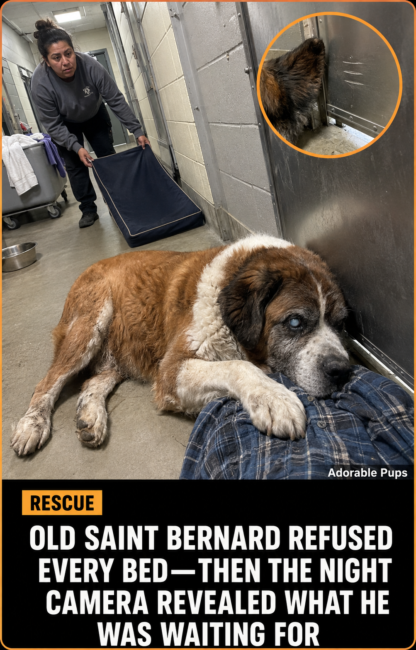
He waited without wasting energy.
Arthur’s temporary boarding file gave us only the outline of their life together. He had adopted Moose from a county shelter when the dog was seven. Arthur’s wife, June, had died from ovarian cancer six months earlier. Moose had been surrendered by a family moving into housing that prohibited dogs over eighty pounds.
Arthur weighed 137 pounds at the time.
He chose a dog heavier than he was.
“He stood in the back and didn’t come forward,” Arthur told me during intake. “Everybody wanted the younger ones. I figured he and I had that in common.”
Moose’s medical records showed arthritis in both hips, reduced hearing in his left ear, a harmless fatty lump beneath his chest, and early cataracts. Arthur had written the medication schedule in block letters on an index card.
7:00 A.M. — CARPROFEN WITH FOOD.
6:00 P.M. — JOINT POWDER.
10:00 P.M. — HALF CUP WATER, NOT FULL, OR HE ASKS TO GO OUT AT TWO.
Below the schedule, Arthur had added another line.
DON’T CLOSE A DOOR BETWEEN HIM AND A SLEEPING PERSON.
I noticed it during intake.
I failed to ask why.
Arthur had also packed two tennis balls, though Moose showed no interest in chasing them. One had been cut open and filled with cotton so it would make no sound when dropped. The other carried three black marks made with a permanent marker.
Three again.
The details seemed like the private oddities every old dog and owner collect: a favorite bowl, a wrong way to fold a blanket, a word that means something only inside one kitchen.
On Moose’s second night, I saw how carefully Arthur had built their routine.
At 9:55, Moose stood before I reached the kennel. He walked outside, relieved himself, and returned without sniffing the fence. At 10:04, he drank from his bowl. At 10:07, he circled the bed once but did not climb onto it.
Then he went to the door.
I rolled the bed closer. Moose placed his nose against my wrist, not resisting, and waited until I stepped away. He caught the edge of the navy cover with his front teeth and pulled the bed backward.
Not violently.
Deliberately.
He cleared the gap beneath the door, turned in a slow circle, and lowered his right ear toward the opening.
That became twist seed number one, though I did not know it then: Moose was not choosing the coldest place. He was choosing the only place where air and sound passed beneath the barrier.
On the third afternoon, a volunteer named Kelsey tried sitting on the orthopedic bed with him. Kelsey was twenty-three and believed most problems could be solved by patience and freeze-dried liver.
She patted the foam.
Moose placed one paw on it.
Kelsey offered a treat.
He stepped up with his second paw, ate the liver, and backed down. Then he walked to the door and touched the lower hinge with his nose.
“He isn’t afraid of the bed,” Kelsey said.
“No.”
“He just thinks he’s supposed to be somewhere else.”
The scheduled day of Arthur’s surgery arrived. I called Fairview Southdale Hospital at 10:30 a.m., then again at 4:15. Privacy laws kept the staff from confirming his presence. I left our number with a patient liaison and asked that Arthur call when able.
At 8:12 that evening, Arthur called us himself.
His voice sounded thin. Traffic moved behind him, and a public-address system announced something I could not understand.
“They moved me,” he said. “Friday morning now.”
“Are you already at the hospital?”
“Almost.”
“Moose is doing fine.”
Arthur released a breath that rattled at the end.
“Is he sleeping?”
“He’s watching the door.”
Arthur did not answer for several seconds.
“Keep the bottom clear,” he said.
I looked at the gap beneath Kennel 14.
“Why?”
“Air travels there.”
The line crackled.
“Arthur?”
“Three taps,” he said. “He knows I’m up when I tap three times.”
The call ended before I could ask anything else.
That was twist seed number two.
Moose did not understand heart valves, surgical schedules, or temporary boarding forms. He understood a narrower pattern Arthur had repeated enough times to make dependable: a closed door, a human beyond it, and three knocks that meant the human was standing again.
When the knocks did not come, Moose stayed at his post.
Part 3, Nineteen Nights Beside the Gap
Arthur’s surgery was supposed to last four hours.
By Friday evening, we had heard nothing.
I told myself hospitals ran late. Saturday morning, I called Fairview again. Sunday afternoon, I sent an email to the patient liaison. On Monday, I drove to the address Arthur had written on his form and pressed the buzzer for Apartment 2C.
Nobody answered.
The building manager, Glenn Hoffman, knew Arthur by name but would not let me inside. He confirmed Arthur had left Thursday morning carrying a small duffel bag. A volunteer driver from a senior transportation service had been scheduled to collect him at 7:30.
“Was he alone?” I asked.
“He’s always alone.”
A woman opened the door across the hall. She was sixty-eight, with silver hair tied in a low knot and a newborn photograph tucked into the corner of her mirror.
“My name is Mei,” she said. “I’m the one who usually watches Moose.”
Arthur had written Mei’s phone number on the boarding form. One digit was wrong.
She had spent a week in Duluth helping her daughter and returned the night before. Arthur had not called her. His newspaper remained outside the door. The building’s mail carrier had pushed envelopes through the slot until they formed a fan across the entryway.
Glenn performed the welfare check while we waited in the hall. Arthur was not inside. His bed was made. His brown winter coat and cane were missing. The seven-day medication organizer stood open beside a coffee cup.
Moose’s food bowl held three pieces of kibble.
Mei covered her mouth with two fingers.
“He never leaves food in that bowl.”
She showed me a photograph on her phone. Arthur sat on the apartment floor with his back against the kitchen cabinet. Moose lay across his legs, his huge head resting beneath Arthur’s hand. A doorframe appeared behind them.
“Moose sleeps there every night,” Mei said. “Half in the bedroom, half in the hall.”
“Not on a bed?”
“Arthur bought three. Moose moved all three.”
The similarity should have answered our question. Instead, it deepened it. Moose had not developed the doorway behavior at the shelter. He had brought it with him.
Mei told us about Arthur’s health. Severe aortic stenosis had left him short of breath and dizzy. He sometimes stopped halfway up the stairs and pretended to check the mail until his heart settled. Moose adjusted his pace without being told.
On grocery mornings, Arthur gripped the dog’s harness with his free hand. Moose took each stair one at a time. If Arthur paused, Moose stood sideways below him, creating a broad wall against a fall.
Arthur had never called him a service dog.
“He said Moose was just nosy,” Mei told me. “That was Arthur’s way of refusing help.”
Back at the shelter, Moose’s routine tightened. He began saving part of his breakfast. He carried three pieces of kibble to the door and placed them beside Arthur’s shirt. He did not eat them until evening.
The old dog still went outside. He still accepted medication. He even leaned against Kelsey while she brushed the mats beneath his chest. His body remained in the shelter.
His attention stayed in the hallway.
On the ninth night, a winter storm dropped seven inches of snow over Minneapolis. Wind pushed powder beneath the exterior service door and cooled the laundry corridor. Kennel 14 lost heat whenever the furnace cycled.
I placed a thermal mat beneath Moose.
He stood.
I slid it beneath his chest again.
He moved two feet away and returned after I removed it. The mat changed how the floor transmitted sound. Moose could no longer feel footsteps through his sternum.
That was the first time I understood the position itself mattered more than discomfort.
We installed a second camera close to the floor.
The footage showed details the ceiling camera missed. Moose did not stare at the door through the entire night. He rested, sometimes deeply. His paws twitched. His breathing slowed.
Then a vibration passed through the hallway.
His right ear lifted first. His nose followed. If the sound came from a rolling laundry cart, he lowered his head within four seconds. If it came from shoes on tile, he stood and sniffed beneath the gap.
Three sounds affected him most: a metal cane tip, a left shoe dragging slightly behind the right, and three knocks spaced less than a second apart.
Arthur’s walking pattern.
On the eleventh day, Mei brought the coat Arthur had left at the dry cleaner before his surgery. Moose pushed his nose into the wool until his breath darkened the fabric. He carried the coat to the kennel door and laid it over the flannel shirt.
For the first time, he refused dinner.
Dr. Simon Hall, the veterinarian who visited North Star twice a week, examined him the next morning. Moose had lost four pounds, but his heart and lungs sounded stable.
“Stress can make an older dog stop eating,” Simon said.
“He eats if I sit beside the door.”
“Then sit beside the door.”
I began taking my paperwork to Kennel 14.
At midnight, I balanced intake forms on my knees while Moose lay with his chin two inches from my boot. At 2:16, he stood, touched the hinge, and listened.
The exact time troubled me. Arthur had not promised to return at 2:16. The shelter had no scheduled activity then. Why did Moose rise at the same minute every night?
Mei supplied the answer.
Arthur’s first major cardiac episode had happened at 2:16 in the morning fourteen months earlier.
She did not tell me the full story yet. She only said Moose had awakened her by throwing his body against Arthur’s bedroom door until the old wood split near the latch.
“Arthur would be dead without him,” she said.
I looked at Moose through the kennel glass.
The dog had not moved.
We expanded our search. Mei contacted Arthur’s cardiology clinic. I called the senior transport service. The driver assigned to Arthur remembered arriving at 7:31 Friday morning and finding the apartment empty.
That meant Arthur had left before the scheduled ride.
A city traffic camera near Chicago Avenue gave us the next clue. At 6:52 a.m., a man matching Arthur’s description appeared at a bus stop four blocks from his apartment. Snow blew across the road. He carried a brown duffel bag and leaned on a brass-handled cane.
At 6:58, he sat down.
At 7:01, he slid sideways from the bench.
A bus blocked the camera for forty seconds. When it moved, two strangers were kneeling beside him. An ambulance arrived at 7:09.
The number on the ambulance belonged to a service that usually transported patients to Hennepin County Medical Center, not Fairview Southdale.
We called Hennepin.
Again, nobody could confirm a patient without the correct authorization.
I left Moose’s name, Arthur’s address, his birth date, and my phone number with a social-work office. Mei did the same. We waited through three more days.
No call came.
On day fifteen, the shelter director, Denise, asked me into her office. Temporary medical boarding could not remain open without an owner contact. Moose needed a legal status so we could authorize continuing treatment and consider a foster placement.
“We cannot keep pretending six days hasn’t become nineteen,” she said.
“He did not abandon the dog.”
“I don’t believe he did. Belief doesn’t create paperwork.”
She had prepared an emergency-custody form.
I did not sign it.
That afternoon, an older woman named Evelyn Shaw visited the shelter. She had owned Saint Bernards for thirty-two years and recently lost her last one. She lived in a ranch house with heated floors, a fenced yard, and no stairs.
She sat inside Kennel 14 for forty minutes without touching Moose.
He eventually placed his head against her knee.
The sight should have brought relief.
Instead, I watched the door.
Evelyn could offer every comfort Arthur could no longer guarantee. Moose accepted her presence, ate from her hand, and allowed her to massage the stiff muscle above his hip.
When she stood to leave, Moose returned to the gap.
“I can foster him,” she said. “But I won’t ask him to stop waiting.”
That night, I placed Evelyn’s application beside the emergency-custody form. At 1:37 a.m., I began filling out the first page.
The shelter phone rang at 1:43.
Part 4, Three Taps from Room 612
The caller identified herself as Lena Brooks, a speech-language pathologist at Hennepin County Medical Center.
She asked for Arthur’s birth date, address, and the name of his dog. I answered all three.
Then she said, “Arthur is alive.”
My pen rolled off the desk.
Lena explained what had happened in fragments because parts of the timeline remained uncertain. Arthur had collapsed at the bus stop before his scheduled transportation arrived. Paramedics found no wallet in his coat or duffel bag. Someone had taken it during the confusion or before the ambulance arrived.
He reached Hennepin as an unidentified patient with severe chest pain, low blood pressure, and an irregular heart rhythm. Imaging showed a small ischemic stroke, likely caused by poor circulation during the cardiac event.
Emergency surgery repaired his failing valve.
The procedure succeeded.
The stroke took his speech.
Arthur spent four days in intensive care, six days in a cardiac unit, and eight days in neurological recovery. Sedation, postoperative delirium, and expressive aphasia prevented him from giving staff a reliable name or address.
A pharmacy card inside his duffel bag eventually identified him as A. Bell. An exhausted admissions clerk entered him as Andrew Bell, not Arthur.
Our calls never reached his chart.
Arthur understood most spoken language, but he could not shape the words he needed. When nurses gave him a pen, his right hand produced tight loops. When they offered an alphabet board, he became exhausted before completing a phrase.
He repeatedly selected the letters M, O, O, and S.
Staff assumed he was spelling the animal.
Then he selected N, O, R, T, H.
A nurse searched for a Minnesota sports team. Another believed he was confused about geography. Lena arrived on day eighteen and asked him to build the message through actions instead of words.
Arthur tapped the bed rail three times.
Then he pointed toward the floor.
Lena placed a laminated sheet of common pictures in front of him. Arthur touched a dog, a door, and a bed.
Three times, in the same order.
Dog.
Door.
Bed.
Lena searched online for Minneapolis shelters with “North” in their names and found a public notice we had posted asking for information about Arthur.
She called.
“Can you bring the phone near Moose?” she asked.
I carried it into the kennel hall. Denise followed. Kelsey, who had been sanitizing bowls, stood at the far end holding a yellow dish towel.
Moose slept with his good ear beneath the door.
I put the call on speaker.
Arthur’s breathing came through first—slow, uneven, close to the microphone. A hospital monitor pulsed in the background. Wheels crossed a hard floor.
Moose’s ear moved.
Lena said something to Arthur. Metal struck metal.
Tap.
Moose opened his eyes.
Tap.
He lifted his head.
Tap.
The Saint Bernard rose in one awkward motion. His rear feet slipped, recovered, and pushed him into the door. He pressed his nose so hard beneath the gap that the skin above it folded.
Arthur tapped again.
Moose answered with one deep bark.
The sound rolled through the shelter. Dogs woke in three kennels. A hound began baying. Kelsey dropped the towel.
Moose did not bark a second time.
He listened.
Arthur’s breath broke over the speaker. Lena moved the phone closer to him. A weak sound emerged—not a word, only the first open vowel of Moose’s name.
Moose lowered himself beside the phone.
For the first time in nineteen nights, he placed his head somewhere other than the door.
He rested his muzzle beside the speaker and closed his eyes.
We arranged a hospital visit for the next afternoon. Moose needed veterinary clearance and a bath. Kelsey brushed two grocery bags of loose fur from his coat. Denise found a red therapy-dog bandanna with no writing and tied it loosely around his neck.
At 2:20 p.m., I led him through the rehabilitation entrance.
The hospital smelled of hand sanitizer, coffee, and overheated air. Moose disliked the polished floor, so maintenance workers laid six rubber runners from the elevator to Room 612.
He walked the entire path without stopping.
Arthur sat in a wheelchair beside the window. Surgery had narrowed him. His hospital gown hung from his shoulders, and a purple bruise covered the back of his left hand. His hair had been cut short around a line of adhesive near his neck.
Moose reached the doorway.
Then he stopped.
Everyone expected him to run.
He did not.
He stared at Arthur from eight feet away. His nose moved, but his body remained still. The old man’s scent had been altered by antiseptic, medication, oxygen tubing, unfamiliar soap, and nineteen days without the wool coat Moose knew.
Arthur raised his right hand.
It shook.
Moose took one step and stopped again.
Arthur looked at Lena. She placed his brass-handled cane across his lap. Paramedics had recovered it from the ambulance after Lena contacted the transport service.
Arthur turned the cane and struck its rubber tip against the wheelchair frame.
Tap.
Moose’s ears lifted.
Tap.
His front legs began to tremble.
Tap.
Moose crossed the room.
He did not leap. His hips could not have managed it. He walked directly between Arthur’s knees and pressed his forehead beneath the old man’s chin.
Arthur folded around him.
One hand found the loose fur at Moose’s neck. The other remained on the cane. His mouth opened, but the word would not come.
Moose stood without moving for eleven minutes.
A nurse entered to check Arthur’s blood pressure and stopped in the doorway. Lena turned toward the window. I looked down at the rubber floor runner where three wet drops had fallen from Arthur’s face.
The story seemed complete.
Arthur had survived. Moose had waited. The signal had crossed a hospital phone and brought them back together.
Then Arthur tried to transfer from the wheelchair to the bed.
Moose moved before the nurse did.
He stepped sideways, blocked the open doorway with his body, and refused to lie beside Arthur until the cane struck the floor three more times.
That was when Lena asked the question none of us had considered.
“Rachel, has he been waiting for Arthur—or has he been keeping watch over him?”
Part 5, What Happened at 2:16 A.M.
Mei gave us the answer two days later.
She came to the hospital carrying a small wooden box Arthur kept beside his bed. Inside were Moose’s adoption papers, veterinary receipts, June’s wedding ring, and an index card dated fourteen months earlier.
The card contained six lines in Arthur’s handwriting.
2:16 A.M. — CHEST PAIN.
MOOSE HIT DOOR.
MEI CALLED 911.
PARAMEDICS 2:28.
DOCTOR SAID TEN MORE MINUTES WOULD HAVE MATTERED.
DON’T LOCK BEDROOM DOOR.
Mei sat across from us in the rehabilitation lounge and described the night.
Arthur had gone to bed early after shoveling snow from the front steps. Moose slept across the bedroom threshold, as he always did. At some point, Arthur closed the door because cold air from the hallway bothered his feet.
At 2:16, he woke with crushing pressure beneath his sternum. He tried to stand and collapsed between the bed and the wall.
Moose heard him fall.
The dog scratched the bedroom door, but the latch held. He barked until his voice changed, then threw his shoulder against the wood. The first strike woke Mei across the hall. The second split the frame. On the third, the latch plate tore loose.
Moose reached Arthur but could not open the apartment’s exterior door. He returned to the hallway and struck it with his body until Mei used her spare key.
She called 911.
While they waited, Moose lay across Arthur’s legs. When paramedics lifted Arthur onto a stretcher, the dog followed them to the stairwell and blocked the landing until Arthur raised his cane.
Three taps.
Moose stepped aside.
Arthur spent four days in the hospital. After returning home, he began tapping the bedroom floor three times whenever he woke during the night. The sound told Moose that the motionless human behind the doorway was conscious.
Nobody formally trained him.
Arthur never gave the behavior a command.
Moose learned a function.
A closed door could hide a fallen person.
Silence after 2:16 could mean danger.
Three taps meant the person beyond the barrier was awake.
At North Star, Moose was not merely waiting near the route Arthur would use to return. He was repeating the position that once allowed him to hear Arthur fall. The kennel gap carried scent, air, footsteps, and vibration from every part of the service hallway.
The orthopedic bed blocked that channel.
Moose pushed it away because comfort interfered with the job.
The thermal mat dulled vibrations.
Moose rejected it because it made the floor harder to read.
He aligned his right ear with the gap because the left one no longer caught low sounds.
He rose at 2:16 because that was when Arthur’s body had failed before.
Each strange choice returned to the same night.
Arthur had told him to hold the door when he left the shelter. To us, it sounded like an affectionate phrase between an old man and his dog. To Moose, it described a task he already knew.
Stay at the barrier.
Listen for the body beyond it.
Do not stand down until the three taps come.
Arthur had not meant to leave him on duty for nineteen days.
His promise trapped Moose inside a routine built from the worst night of their life together.
When Lena explained this to Arthur, his lower lip tightened. He tried to write with his left hand because the stroke had weakened his right. The first two attempts were unreadable.
On the third, he printed four words.
I MADE HIM WAIT.
Lena placed her hand over the paper.
“You survived,” she said.
Arthur shook his head.
He pointed at Moose, then at the hospital door.
The dog lay across the threshold, good ear turned toward the bed.
Arthur struck the floor three times.
Moose’s head lowered.
For the first time since the visit began, his muscles loosened.
That was the deeper truth inside the night-camera footage. Moose was not counting days. Dogs do not measure nineteen nights the way humans do. He was waiting for the event that ended every watch he had completed since Arthur’s first collapse.
The three taps.
Nothing else told him Arthur was safe.
Part 6, The Long Way Back to the Same Door
Arthur could not leave the hospital with Moose.
His sternum needed time to heal. The stroke had weakened his right side and left him unable to climb the seventeen steps to Apartment 2C. His rehabilitation team estimated six to eight weeks before he could live without daily support.
North Star extended Moose’s medical boarding.
The emergency-custody form remained unsigned.
Evelyn withdrew her foster application but offered her house for daytime visits. “He already belongs somewhere,” she said. “He just needs help keeping his place.”
Moose began visiting Arthur three afternoons each week. The first visit lasted twenty minutes. The second lasted forty-five. By the fourth, he could sleep beside Arthur’s wheelchair while therapists worked on language exercises.
Lena built speech sessions around the dog.
She placed photographs on a board: bowl, leash, door, bed, cane, Moose. Arthur pointed to objects while trying to form their names. “Door” came first. “Cane” arrived two days later.
Moose’s name took eleven attempts.
“Mmm,” Arthur said.
Moose lifted his head.
“Mo.”
The dog stood.
“Moose.”
Arthur’s voice was rough and incomplete, but the word existed.
Moose crossed the therapy room and placed his muzzle against Arthur’s knee. Arthur closed his eyes, then tapped the cane once against the floor.
Moose waited for the other two.
Arthur smiled.
Tap. Tap.
The hospital permitted Moose to attend balance sessions. He walked beside the parallel bars while Arthur practiced transferring weight onto his right leg. Whenever Arthur’s knee buckled, Moose stopped.
The dog did not brace him. His joints could not safely carry the force. He simply stood within Arthur’s view, broad and quiet, while the therapists did the physical work.
Arthur completed three extra steps whenever Moose waited at the end of the bars.
The shelter changed too.
Denise moved the orthopedic bed out of Kennel 14 and cut a strip from an unused rubber mat, placing it along the wall without covering the door gap. Moose began resting one shoulder on it.
We installed a low sound monitor near the door so overnight staff could hear changes in his breathing. I stopped trying to persuade him that the back corner was safer.
He had told us what he needed.
On February 12, five weeks after the collapse, Arthur suffered a setback. Fluid collected around one lung, and doctors moved him back to the cardiac floor. Moose arrived for a scheduled visit and found Room 612 empty.
He stopped in the doorway.
His good ear turned toward the hall.
I felt the old pattern return before he moved. His body tightened. His nose dropped toward the floor. He began pulling toward the elevator.
“Moose,” I said. “Arthur is upstairs.”
The word meant nothing useful. Upstairs could not tell him whether Arthur was conscious.
A nurse called the cardiac floor. Arthur was awake but receiving treatment. Visitors could not enter.
Lena asked the nurse to place a phone beside his bed.
We lowered our phone to Moose.
Three taps came through.
The Saint Bernard sat.
He remained beside the empty room for twenty-three minutes, then followed me back to the elevator.
That small crisis confirmed what we had learned. Moose did not need Arthur’s face, scent, or location. He needed the signal associated with a living, responsive body.
The three taps did not mean come to me.
They meant you can rest.
Arthur’s apartment created another problem. The building had no elevator. Glenn, the manager, offered to move him to an open ground-floor unit, but the rent was $260 more each month. Arthur lived on Social Security and a modest pension from thirty-four years repairing city buses.
He could not afford the increase.
Mei started a neighborhood collection without telling him. The shelter posted no dramatic appeal and shared no hospital photographs. We described only the need: an older resident recovering from surgery required accessible housing where he could remain with his senior dog.
A retired mechanic covered the security deposit. The owner of the corner grocery paid the first month’s difference. Evelyn bought two wide rubber runners for the floor. Kelsey’s father built a low ramp over the rear threshold.
Nobody called themselves a rescuer.
They carried boxes.
Arthur’s belongings moved downstairs on March 2. We placed his bed against the west wall and left the bedroom door attached but removed the latch plate. Moose’s orthopedic bed went across the threshold, half in the bedroom and half in the hall.
Arthur returned home on March 11, sixty-two days after he left.
A rehabilitation van stopped beside the curb at 10:24 in the morning. I stood inside the apartment with Moose while Mei waited near the building entrance.
The Saint Bernard heard the cane before the door opened.
Tap.
His head rose.
Tap.
He stood.
Tap.
Moose crossed the apartment faster than I had seen him move in months. He reached the exterior door and stopped with his nose against the seam.
Arthur entered using a four-wheeled walker. The brass-handled cane rested in its basket. His right foot dragged half an inch during each step.
Moose did not jump. He walked backward in front of Arthur, watching his knees and adjusting his pace to the walker.
They reached the bedroom.
Arthur sat on the edge of the bed. Moose remained in the doorway.
The orthopedic cushion touched all four of his feet. He sniffed the navy cover and looked at Arthur.
“Bed,” Arthur said.
Moose stayed standing.
Arthur tapped the wooden floor three times.
The dog turned once and lay down.
He placed his chest on the cushion, his hips in the hallway, and his good ear toward Arthur’s bed.
Moose had finally accepted the new bed.
We had only been putting it in the wrong place.
That evening, I remained until Arthur took his medication. Mei filled the refrigerator. Kelsey left a paper bag of dog treats on the counter. Snowmelt ticked against the window.
At 9:58, Moose walked outside.
At 10:04, he drank half a bowl of water.
At 10:07, he returned to the bedroom threshold and lowered himself onto the navy cushion.
Arthur set the cane beside his bed.
“Home,” he said.
Moose’s tail moved once against the floor.
Part 7, The Three Knocks Before Sleep
Ten months have passed since Arthur returned to Powderhorn Park.
His speech still slows when he is tired, but he can hold a conversation if people give him time. He walks with the brass-handled cane indoors and uses the wheeled walker for longer distances. The scar beneath his collar has faded from red to pale pink.
Moose is twelve now.
His left eye has clouded further, and he needs help getting into Mei’s car. He weighs 142 pounds, steals bread if Arthur leaves it near the counter, and refuses every tennis ball except the silent one filled with cotton.
He sleeps on the orthopedic bed.
The bed remains across the bedroom doorway.
Arthur could move it against the wall. He does not. Every night at 10:07, Moose turns once on the navy cover and lowers his good ear toward the room.
Arthur reads until his eyes grow heavy. Before switching off the lamp, he reaches for the cane.
Tap.
Moose opens one eye.
Tap.
His chin lowers.
Tap.
The eye closes again.
Arthur calls it their evening report.
On Wednesdays, I bring groceries after my shelter shift. Moose meets me at the door, searches the hallway behind me, and returns to Arthur once he decides I came alone.
North Star kept the footage from the nineteen nights, but we do not use it in fundraising videos. Arthur watched it once. He sat through every hour at high speed, his hand resting on Moose’s neck.
When the recording reached 2:16 on the nineteenth morning, Moose stood on the screen and touched the door.
Arthur paused the video.
“He worked,” he said.
I waited.
Arthur’s fingers tightened in the white fur.
“I was gone. He worked.”
The night camera had shown an old dog sleeping on concrete. We had seen abandonment, grief, discomfort, and refusal. Moose had been doing something more precise.
He was maintaining the last task Arthur gave him.
Hold the door.
Listen for life.
Rest only when the signal comes.
North Star now asks every temporary-boarder one extra question: “Does your dog have a strange routine connected to your health?” The answers have changed how we care for animals whose behavior once looked irrational. One Golden Retriever needs a bathroom light left on. A German Shepherd sleeps beside an inhaler case. A Pit Bull will not eat until she hears her owner’s morning alarm recording.
Moose taught us to ask before correcting.
Last Tuesday, Arthur called me at 2:19 in the morning. I answered expecting an ambulance, a fall, or another hospital room.
He spoke slowly.
“Moose didn’t get up.”
My feet reached the floor.
“Is he breathing?”
“Yes.”
“Is he responsive?”
Arthur released a short laugh.
“He slept through my bathroom trip.”
In the background, the cane struck the floor three times.
Moose’s tail thumped once.
Arthur wanted me to understand what had changed. For the first time in years, the dog had heard movement beyond the doorway and decided he did not need to stand guard.
He trusted the taps would come.
Arthur no longer promises Moose that he will always return. Neither of them needs a promise that large.
He gives him three small sounds before sleep.
Moose listens.
Then both of them rest.
Follow this page for more unforgettable dog stories about quiet loyalty, second chances, and the promises animals keep long after humans lose the words.