A Boy Stole a Loaf From a Bakery and Ran—Then the Owner Found Him Sharing It With a Dog Beneath a Highway Bridge
PART 2
The man behind the pillar pushed himself upright when the boy approached.
He was in his early forties, with short hair, a trimmed beard and an olive work jacket layered over two faded shirts. A gray blanket covered his legs, while a canvas tool bag served as a pillow against the concrete.
Rusty placed the bread beside his hand.
“Eli,” the man said. “Where did this come from?”
The boy did not answer.
Nora stepped into the opening between the pillars. The man looked at her flour-marked sleeves, then at the paper sleeve still wrapped around half the loaf.
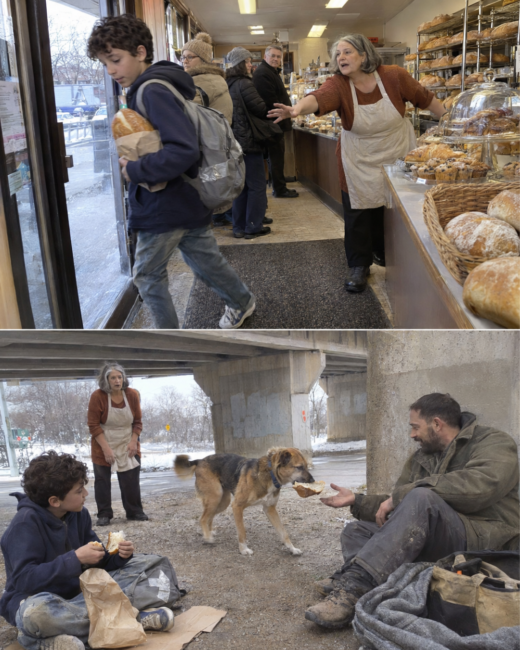
Understanding reached his face before she spoke.
“He took it from my bakery.”
The man closed his eyes.
“Give it back.”
Eli held the remaining half tighter. “Dad, you haven’t eaten.”
“I told you not to bring me anything.”
The word “Dad” changed what Nora thought she had followed beneath the bridge.
The boy was not sharing stolen bread with a stray dog. Rusty had carried the food to Eli’s father.
Nora kept several feet between herself and the dog. Rusty stood beside the man, glancing between her and Eli. His cloudy left eye did not follow movement as precisely as the right, but his posture remained alert.
“What’s your name?” Nora asked the man.
“Marcus Walker.”
Something in his voice felt familiar. Nora studied his face, but the overpass shadow and beard hid the memory.
Marcus picked up the uneaten bread and held it toward her.
“I’ll return it.”
“I can’t put it back on the shelf.”
“Then I’ll pay when I can.”
Nora looked at Eli. “How long have you been doing this?”
The boy’s eyes stayed on the ground.
Marcus answered first. “He hasn’t.”
“Yes, I have,” Eli whispered.
Every morning for one week, Eli had stopped at the bakery before school. On the first two days, customers left portions of muffins or toast on outdoor tables. After that, he began carrying bread from his aunt’s apartment.
That morning, there had been none left.
Marcus’s expression tightened. “Your aunt is feeding you.”
“She is. I came for you.”
Eli had been living with his aunt Rochelle since Marcus lost their apartment. Marcus had told his son the arrangement would last only a few days. Three weeks had passed.
Rusty remained with Marcus because Rochelle’s landlord prohibited dogs. Marcus refused to surrender him after the dog had stayed beside him through the job loss, eviction and move beneath the bridge.
Nora understood enough to know that calling the police over one loaf would not solve what was in front of her. That did not make the theft acceptable.
“You should have asked,” she told Eli.
“I thought you’d tell me to leave.”
“I might have asked questions. That isn’t the same thing.”
Marcus handed her the loaf. As he extended his arm, the jacket sleeve pulled back, revealing an old burn scar across his wrist.
Nora remembered seeing that scar beside a set of wrenches years earlier.
She looked at him more closely.
“Have you ever worked on a bakery door?”
Marcus’s hand stopped.
PART 3
Marcus studied Nora as if the question required caution.
“What bakery?”
“This one. Nine years ago, before I opened.”
Recognition appeared slowly.
“The roll-up door in the alley,” he said. “The chain kept jumping.”
Nora remembered him now.
Three days before Maple Street Bakery’s first opening, the rear security door had jammed halfway down. The contractor who installed it wanted an emergency fee Nora could not afford.
Marcus had been repairing a loading gate at the grocery store next door. He examined Nora’s door during his lunch break, reset the chain and replaced a bent guide.
When she asked for an invoice, he refused.
“Buy my kid a cinnamon roll when he’s old enough,” he had said.
Eli had been a toddler then.
Nora looked from Marcus to the boy. “That was you.”
Marcus glanced at the loaf in her hand. “It was a small repair.”
“It kept me from delaying the opening.”
He shrugged, but his shoulders remained tense beneath the olive jacket.
Marcus had worked for the same commercial-door company until the previous November. A warehouse contract ended, the company reduced staff and he lost his job. Two months later, an injury from temporary demolition work left him unable to lift heavy equipment for several weeks.
His savings disappeared into rent, medical bills and the truck payment.
The truck was repossessed first.
The apartment followed.
Marcus sent Eli to Rochelle’s home before the eviction notice expired. He told the boy he had found a temporary room through a coworker. In reality, the room was available for only four nights.
He had been beneath the overpass since then.
“Why didn’t you tell him?” Nora asked.
Marcus looked toward Eli. “Because he has school, a bed and a door that locks. He doesn’t need to sleep here because I failed.”
Eli’s voice broke through the steady traffic noise.
“You didn’t fail me. You disappeared.”
Marcus lowered his head.
Rusty picked up the bread again and placed it against his boot. He did not eat until Marcus tore off a small piece and offered it from his palm.
Nora noticed an empty plastic container beside the blanket. Another container held only a thin layer of water.
She had believed Rusty was searching the neighborhood for food. The dog had been returning to Marcus each time he found something.
Nora did not describe this as a plan or proof of human reasoning. She could only see the repeated action: Rusty carried food back, waited beside Marcus and ate after he did.
“Does your aunt know you’re here?” Nora asked Eli.
“She thinks I’m at the library before school.”
“Today is Saturday.”
Eli rubbed one sleeve across his nose. “She thinks I’m with a friend.”
Nora removed her phone.
“I’m calling her. You’re not in trouble with the police, but an adult needs to know where you are.”
Marcus started to object, then stopped. Keeping Eli’s visits secret was no longer protecting him.
Rochelle arrived twenty minutes later in house slippers, a winter coat and an expression that moved from fear to anger before settling into exhausted relief.
She hugged Eli, checked his hands and turned toward Marcus.
“You should have called me.”
“I didn’t want him losing the room because of me and Rusty.”
“You decided for everyone.”
Marcus accepted the words without defending himself.
Nora placed the bread between them. “Eli still owes for this.”
Rochelle reached for her purse.
Nora shook her head. “Not from you.”
Eli looked up.
“You come to the bakery after school on Monday,” Nora said. “You apologize, and we decide how you can make this right without missing school.”
Then she turned to Marcus.
“Do you still know how to fix a hinge?”
PART 4
Marcus initially refused to return to the bakery.
“I’m not taking charity because my son stole from you.”
“I didn’t offer charity,” Nora replied. “The rear storeroom hinge is pulling out of the frame. I need someone to assess it, and I pay for work.”
Marcus looked toward the overpass shadows. His tool bag contained hand tools but not the drill and replacement fasteners he would need.
Nora offered to supply the materials and pay the standard hourly maintenance rate through the bakery’s payroll system. If he could not repair the door safely, she would still pay for the inspection.
The arrangement had limits.
It was one job, not a promise that Nora could solve his housing, employment or family situation. Marcus would have to arrive sober, work during business hours and allow someone else to handle anything requiring lifting beyond his current medical restriction.
“I can do the hinge,” he said.
“Then come through the front door tomorrow at eight.”
Rochelle took Eli home. She also agreed to keep Rusty for one night after speaking with her landlord, provided the dog remained only until Marcus completed the repair and found another arrangement.
Rusty did not willingly enter her car.
He planted his paws beside Marcus’s blanket and pulled backward when Rochelle shortened the leash. Marcus stopped her before the collar tightened.
“Give him a minute.”
He placed the folded blanket on the rear floor of the car. Rusty sniffed it, circled the open door and climbed in on his own.
Nora watched the dog choose the familiar object rather than being dragged from the bridge.
Before leaving, she gave Marcus a bag containing soup, two sandwiches and dog food. He tried to refuse that too.
“This isn’t wages,” she said. “It’s dinner. You can accept dinner and still get paid tomorrow.”
Marcus finally took it.
The following morning, he arrived at Maple Street Bakery at 7:52.
He entered through the front door.
His clothes were clean, his beard trimmed and the canvas tool bag hung from one shoulder. Rusty walked beside him wearing the same blue collar, while Rochelle and Eli waited in her car outside.
Nora had cleared a small table near the storeroom and placed the required materials on top. Beside it stood a fresh bowl of water.
Rusty approached the bowl, sniffed it and looked toward Marcus before drinking.
Marcus inspected the hinge. The screws had been repeatedly tightened into damaged wood, so another set of ordinary screws would fail.
He removed the loose hardware, reinforced the frame and installed a through-bolt with a backing plate. Then he adjusted the door so its weight no longer pulled sideways.
The work took three hours.
Nora tested the door repeatedly. It closed without scraping.
She paid Marcus for four hours, including the inspection and cleanup. He counted the bills, then placed the price of the stolen loaf on the counter.
“That part belongs to Eli,” Nora said.
“He’ll pay me back.”
“No. He needs to return and face what he did.”
Marcus hesitated before putting the money away.
Nora wrote down the number of the building manager who maintained the neighboring storefronts. She had already told him Marcus’s repair was sound, but she did not promise employment.
“He needs someone for small maintenance calls,” she said. “You’ll have to speak for yourself.”
Marcus folded the paper into his wallet.
Behind him, Rusty finished drinking and lay beside the worktable instead of the exit.
PART 5
Eli came to the bakery after school on Monday.
He stood in front of the counter wearing the same navy hoodie and backpack. Rochelle waited near the door but did not speak for him.
“I stole the bread,” he said. “I knew it wasn’t mine, and I ran when you stopped me.”
Nora asked why he had not requested help.
“I thought if I told anyone about Dad, they’d take me away from Aunt Rochelle or make him give up Rusty.”
Nora did not tell him that fear excused the theft.
She also did not assign an eleven-year-old to work in a commercial kitchen. Instead, Eli used money Marcus had paid him for organizing and cleaning their stored belongings. He placed the exact price of the loaf beside the register.
Nora printed a receipt.
Then she gave him another loaf in a paper bag.
“This one is paid for,” she said. “Take it home and share it at the table.”
Marcus’s single repair led to an interview with the building manager. It was not a full-time job, but the manager hired him for three maintenance calls that week.
Marcus documented each repair, arrived when promised and declined work that exceeded his lifting restrictions. By the end of the month, the manager offered him twenty-five hours a week, with the possibility of more.
Housing took longer.
Marcus spent two weeks in a low-cost motel while Rochelle continued caring for Eli. Rusty stayed with him, but the change in routine made the dog restless. He paced near the motel door each morning and ate only after Marcus returned from work.
A veterinary examination arranged through a local low-cost clinic found that Rusty was underweight and had reduced vision in his cloudy left eye. He did not need a dramatic rescue procedure. He needed regular meals, parasite prevention, monitoring and a stable place to sleep.
Marcus followed the feeding schedule and stopped giving him large amounts of bread.
Six weeks after the theft, Marcus qualified for a small one-bedroom apartment. The building allowed dogs with a deposit, which he paid from his maintenance wages.
Eli remained with Rochelle during the school week while the adults worked out a gradual transition. He began spending Saturdays with Marcus rather than secretly visiting the overpass.
Rusty adapted more slowly than Eli.
During the first week, the dog repeatedly carried pieces of kibble from his bowl to the bedroom doorway and left them near Marcus’s work boots. Marcus initially worried that he was refusing food.
The veterinarian explained that Rusty’s appetite and weight were improving. The behavior appeared connected to the routine he had developed beneath the bridge: collecting food and keeping it near Marcus.
Marcus stopped moving the pieces immediately. He allowed Rusty to finish at his own pace.
At Maple Street Bakery, Nora hired Marcus for routine maintenance one morning each week. The arrangement was written, scheduled and paid.
Rusty sometimes accompanied him when the work did not involve unsafe equipment.
Nora kept the water bowl beside the worktable.
One Tuesday, she noticed Rusty drink before checking where Marcus stood.
It was a small change, but it had not happened before.
PART 6
By early summer, Marcus was working nearly full time. The bakery remained one of several locations on his schedule rather than becoming the center of a debt he could never repay.
Nora preferred it that way.
She did not introduce him to customers as a man she had rescued. She called him the maintenance technician and discussed invoices, door clearances and repair dates.
Eli completed the school year without missing another morning. He spent weekdays with Rochelle until Marcus’s apartment passed the family-services review required for him to return permanently.
The process frustrated Marcus, but he followed it. He had already learned that protecting Eli did not mean hiding every difficulty from the adults able to help.
Rusty gained six pounds over several months. His cloudy left eye remained unchanged, but he moved through the apartment and bakery more confidently once the layouts became familiar.
One rainy morning, the bakery’s rear roll-up door jammed halfway down.
Nora found Marcus examining the track while Rusty rested beside the worktable. The failure resembled the problem Marcus had repaired nine years earlier, but this time he did not work through lunch for free.
He diagnosed the damaged roller, ordered the correct part and submitted an invoice.
When the repair was complete, Nora paid it.
Eli arrived after school carrying a wheat loaf he had purchased with money from helping Marcus sort hardware and sweep their apartment storage area.
He placed it on the bakery counter.
“Can Rusty have some?”
“Not much,” Marcus said. “He has his own food.”
Eli tore off a small approved piece. Rusty took it but did not eat immediately. He walked toward Marcus’s worktable, where the familiar water bowl waited.
For a moment, Nora expected him to place the bread beside Marcus’s boots as he had done in the motel.
Instead, Rusty drank from the bowl, returned to Eli and ate the piece beside him.
The dog no longer needed to carry every bit of food to someone hidden from view.
That afternoon, Nora found the old invoice from the bakery’s opening week. Marcus’s name appeared at the bottom with a handwritten balance of zero.
She showed it to him.
“You really didn’t charge me.”
“You were opening a business with a door that wouldn’t close.”
“And now?”
Marcus looked toward the repaired roll-up door. “Now you can afford the invoice.”
Nora laughed once and filed the new bill as paid.
Marcus picked up his tool bag. Rusty stood beside him, while Eli held the bakery door open.
They left through the front.
PART 7
A year after the stolen loaf, Eli entered Maple Street Bakery on another cold Saturday morning.
He no longer waited outside the window. He walked to the bread rack, selected a wheat loaf and carried it openly to the register.
Marcus stood near the storeroom, tightening the final screw on a cabinet hinge. His company name—Walker Door and Maintenance—was printed modestly on the invoice beside him.
The business was small. He remained its only full-time employee, while the building manager supplied most of the work.
It was enough to keep their apartment, maintain his truck and care for Rusty.
The old dog rested beside the worktable. His left eye was still cloudy, and his worn blue collar had been replaced with a padded one carrying updated identification.
The water bowl remained in the same place.
Nora rang up the bread. Eli paid, accepted the receipt and waited for Marcus to finish.
Before they left, Nora placed two breakfast sandwiches in a bag. Marcus checked the amount on the receipt before accepting it.
“They’re paid for,” she said. “Staff breakfast.”
Rusty rose when Marcus lifted his tool bag. Eli held the front door while the dog walked through first.
Nobody ran after them.
On the sidewalk, Eli carried the loaf against his jacket, but this time it was visible above his folded receipt. Marcus walked beside him, and Rusty stayed between them.
Inside the bakery, Nora rinsed the water bowl and returned it to the worktable.
It was ready for Monday.
Follow the page for more grounded dog stories about quiet loyalty, accountable choices and ordinary people who decide to open the right door.