A Young Man Kicked Over an Old Shepherd’s Water Bowl at a Cemetery—Then the Dog Ran to One Grave and He Fell to His Knees
PART 2
The name carved into the stone was Daniel Joseph Reed.
Mason stopped so abruptly that the carnations struck his leg. Beneath Daniel’s name were his years of birth and death, followed by a single line identifying him as a county rescue technician.
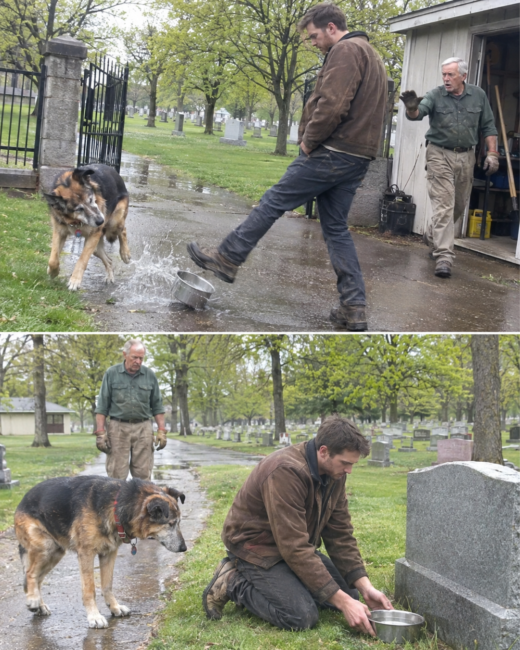
The Shepherd remained pressed against the base of the grave.
Mason looked from the dog to the faded water-rescue patch hanging from his collar. Daniel’s patch had been shaped like that. Mason remembered seeing one on the kitchen counter after his brother complained that the Velcro backing no longer held.
“Where did he get this?” Mason asked again.
Walter approached carefully, avoiding the dog’s right side.
“Daniel gave it to him.”
Mason shook his head. “My brother didn’t have a dog.”
“He did for almost two years.”
The statement landed more quietly than the news of Daniel’s death had seven months earlier. That call had been filled with voices, instructions and the repeated phrase “flood response.” Walter’s answer contained only an old dog lying beside a stone.
The Shepherd lifted his head when Walter said Daniel’s name.
Walter waited, then called, “Scout.”
The dog’s bent ear rose. He pushed himself upright and walked to the groundskeeper, confirming the name through action before Walter explained anything else.
Daniel had found Scout during an overnight storm response in June 2023. A culvert near an abandoned warehouse had flooded, trapping the dog behind branches and plastic debris.
Daniel’s team was returning from another call when he noticed movement near the drainage opening. They removed the debris, brought the exhausted dog out and had him checked at an emergency clinic.
No owner was found.
Scout already had an old injury in his right hip and knee. The veterinarian estimated that he was at least nine years old. Daniel took him home after the required stray-hold period.
“Why didn’t he tell me?”
Walter gave Mason a level look. “He tried.”
Mason remembered a photograph Daniel had sent of a muddy black-and-tan dog wrapped in a rescue blanket. Mason had replied with a joke about Daniel collecting every problem he found at work.
He had not asked what happened afterward.
Daniel worked overnight shifts, so Walter watched Scout on those evenings. The groundskeeper lived in a small cottage behind the cemetery and had known the Reed brothers since their parents were buried there.
On difficult mornings after a night shift, Daniel would collect Scout and walk him through the cemetery before driving home. The dog learned the paths, the gate and the sound of Walter opening the maintenance shed.
After Daniel died while helping evacuate two people from a vehicle trapped in floodwater, Walter brought Scout to the funeral.
Scout had returned with him almost every day since.
Mason looked toward the entrance. The overturned bowl was no longer visible from the hill, but the scrape of metal still seemed to hang in the air.
“He comes to this grave every day?”
“Most days. He lies here for a while, then follows me while I work.”
Mason knelt near the stone. The movement made Scout back away until Walter stood between them.
Mason did not reach for him.
He placed the carnations beside Daniel’s name, then looked at the muddy water collecting around Scout’s paws. The dog had not drunk since the bowl spilled.
“I’ll get his water.”
Walter did not praise him. “The spigot is beside the shed.”
Mason walked back down the hill, retrieved the bowl and rinsed the dirt from it. A shallow dent marked the side where his boot had struck.
He filled it and carried it with both hands.
At the grave, he set the bowl several feet from Scout and sat in the wet grass.
“Daniel,” he said, looking at the stone rather than the dog. “I came back.”
Scout’s bent ear lifted again.
After a long pause, he limped forward and drank.
PART 3
Walter allowed Mason to sit beside the grave until the afternoon light began to fade. Scout drank only half the water before returning to the headstone.
Mason wanted to ask why nobody had told him about the dog. The question formed several times, but each version sounded like an accusation against people who had remained when he left.
After the funeral, Mason had given Walter the keys to Daniel’s rented house.
“Take whatever needs taking,” he had said. “Donate the rest.”
Then he drove back to Des Moines and stopped answering most calls connected to Cedar Rapids.
Walter had used the keys three days later.
He expected to find spoiled food, work uniforms and unopened mail. Instead, he found Scout lying beneath the kitchen table with Daniel’s rescue jacket between his front paws.
The dog’s food bowl was full. His water was nearly gone.
Walter sat on the kitchen floor for forty minutes before Scout allowed him to attach a leash.
“You told me to take whatever needed taking,” Walter said. “He needed somebody.”
Mason looked toward Scout. “I didn’t know he was there.”
“You didn’t go inside.”
There was no anger in Walter’s voice, which made the truth harder to avoid.
The groundskeeper explained that Daniel’s coworkers had tried contacting Mason about Scout. One left a voicemail. Another sent a message with a photograph.
Mason had deleted the voicemail without listening to the end. The photograph remained buried in an unread message thread.
At the time, he believed avoiding Daniel’s house would keep the funeral from following him home. Instead, his absence had transferred every practical decision to other people.
Walter had taken Scout to his cottage. The dog ate little during the first week and paced whenever a rescue vehicle passed on the highway.
The cemetery became the only place where he settled for more than a few minutes.
Walter did not claim Scout understood death or the meaning of a grave. He described only what he could observe: the dog followed Daniel’s old walking route, stopped beside the headstone and remained there until Walter resumed work.
Mason noticed a pale abrasion along Scout’s right hip where the fur had thinned.
“Is that from lying on the stone?”
“No. It’s pressure from favoring that leg. The clinic has been watching it.”
Scout’s old joint injury had worsened over the winter. Walter gave him medication with breakfast, limited his time on steep ground and kept a folded pad in the maintenance shed.
He was managing, but the cottage’s four wooden steps had become difficult.
“Why didn’t you find him another home?”
“I tried a senior-dog group. They offered to place him with a foster family.” Walter looked at Scout. “He stopped eating the first night away and scratched at their door until his paw bled. We brought him back the next morning.”
Mason initially heard the failed placement as proof that Scout belonged at the cemetery. Walter corrected him.
“It proves we moved too quickly. It doesn’t prove this is the only place he can live.”
Walter was sixty-eight. His hands had begun cramping after long hours with pruning tools, and the cemetery board planned to hire a new groundskeeper the following spring. He could not assume Scout’s daily care indefinitely.
Mason stared at the dented water bowl.
“I could take him.”
Scout looked up at the sound of his voice but did not approach.
Walter shook his head. “You cannot kick over his water, discover who he belonged to and take him home before sunset.”
“He was my brother’s dog.”
“And for seven months, he has been my responsibility.”
Mason’s jaw tightened, then relaxed.
Walter was right.
Scout did not become Mason’s simply because Daniel’s name appeared on the grave. The dog had routines, medication, physical limitations and a justified reason to avoid him.
“What would I have to do?”
“Come back tomorrow,” Walter said. “Bring nothing. Don’t call him. Don’t touch him. Help me clean the bowl, then sit where he can see you.”
Mason looked toward Daniel’s headstone.
“And after that?”
“If you return, we decide the next step after that.”
PART 4
Mason returned Sunday at nine in the morning.
He brought no treats, toys or leash. Walter handed him a brush and directed him to the maintenance sink, where the dented bowl waited beside a bag of grass seed.
Mason washed it until the remaining dirt released from the seams. He tried pressing out the dent, but Walter stopped him.
“Leave it.”
“Why?”
“So you remember what one impatient second can do.”
They carried the bowl to the gate and filled it. Scout watched from beneath the maple near Daniel’s grave.
Mason spent the next hour helping Walter collect branches brought down by the storm. He did not approach the dog. At ten-thirty, Scout came to drink while Mason stood twenty feet away.
That became the first rule of the following weeks: Scout decided the distance.
Mason began driving from Des Moines every Saturday. When his work schedule permitted, he came on Sundays too.
At first, Scout moved away whenever he heard Mason’s boots on gravel. By the third visit, he remained beside Walter. By the fifth, he accepted a piece of prescribed food placed on the ground, but only after Mason stepped back.
Walter did not treat these changes as evidence that the dog was ready to leave.
He taught Mason Scout’s routine. Medication came after breakfast. Walks lasted fifteen minutes on level ground. The right hind leg became stiffer in cold rain, and the dog disliked anyone standing over him while fastening the leash.
Mason attended Scout’s veterinary appointment with Walter.
Dr. Elena Park reviewed the X-rays and explained that Scout had chronic arthritis associated with an old pelvic injury. Treatment could reduce discomfort but would not restore a normal gait.
She adjusted his medication and recommended a ramp, nonslip flooring, a supportive bed and gradual strengthening exercises.
Mason’s apartment allowed dogs, but it was on the third floor without an elevator.
“I can carry him,” Mason said.
Dr. Park shook her head. “He may tolerate being lifted during an emergency, but carrying him up several flights every day is not a practical long-term plan.”
Mason considered moving Scout into Daniel’s former house. The lease was paid through the end of summer while the estate remained unsettled.
Walter gave him the keys he had left seven months earlier.
Inside, the house smelled faintly of dust and cedar detergent. The kitchen table remained where Scout had hidden beneath it. Daniel’s rescue jacket hung on the back of a chair because Walter had been unable to move it.
Mason found a red leash in a drawer, veterinary receipts in a folder and a folded note taped inside the pantry door.
The note listed Scout’s medications, feeding times and Walter’s telephone number. At the bottom, Daniel had written: “If I’m stuck on a call, Walt knows what he needs.”
Daniel had not prepared the note for death. It was an ordinary backup plan for long shifts.
That made it more difficult to read.
Mason sat on the kitchen floor.
He had spent months telling himself Daniel’s death was an event too large to approach. Yet his brother’s life had also consisted of small arrangements—measured food, morning walks and a telephone number left where someone could find it.
Mason decided to request a transfer to his company’s Cedar Rapids branch. The move would reduce his pay and delay a promotion he had pursued for two years.
He did not present that sacrifice to Walter as proof of goodness.
He simply completed the application.
Two weeks later, the transfer was approved.
Mason repaired the loose back step at Daniel’s house, installed a low ramp, placed nonslip runners from the door to the kitchen and purchased a supportive bed recommended by Dr. Park.
Walter inspected everything.
Then he gave Mason one condition: Scout would visit for an afternoon before any overnight stay was considered.
Mason agreed.
When Scout entered the house, he did not explore. He walked directly beneath the kitchen table and lowered himself onto the floor where Walter had found him.
Mason sat across the room.
Three hours passed before Scout came out.
PART 5
The first afternoon visit ended without Scout approaching Mason.
Walter considered that acceptable.
“He entered, rested and left without panicking,” he said. “That is progress.”
The visits continued twice each week. Walter drove Scout to the house and remained nearby while Mason prepared food, administered medication under supervision and waited through the dog’s long pauses at doorways.
On the fourth visit, Mason made a mistake.
Scout stopped halfway down the ramp when a delivery truck released its brakes in the street. Mason tightened the leash to prevent him from backing away.
The dog dropped low, twisting toward the pressure.
Mason released the leash immediately and sat on the porch step. He waited until Scout’s breathing slowed, then moved aside and gave him the full width of the ramp.
Scout returned to the house on his own.
Mason expected Walter to cancel the transition. Instead, the groundskeeper asked what he had learned.
“That keeping him safe doesn’t mean forcing him forward.”
Walter nodded. “Remember it next time.”
The first overnight visit occurred in late May, six weeks after the cemetery encounter.
Walter brought Scout’s medication, the red leash and a worn gray blanket from his cottage. Mason expected the dog to sleep on the new orthopedic bed.
Scout chose the floor beneath the kitchen table.
Mason left the bedroom door open and slept on the couch.
At 1:40 a.m., he woke to the sound of nails scraping against a runner. Scout stood in the hallway, uncertain where to go. Mason turned on a small lamp but did not approach.
He placed Daniel’s rescue jacket beside the new bed and returned to the couch.
Scout sniffed the sleeve, circled the bed and lay down.
In the morning, Mason found him there with his muzzle resting across the faded water-rescue patch.
The overnight stay had gone well, but Walter still did not agree to a permanent transfer. Scout needed to show that he could eat, rest and follow his medical routine without the cemetery being immediately available.
A week later, Mason attempted a second overnight visit. A thunderstorm arrived shortly after midnight.
Scout paced from the kitchen to the front door, breathing rapidly. He refused food and scratched once at the wood.
Mason assumed the house reminded him of Daniel’s final flood response. He nearly drove him back to the cemetery.
Instead, he called Walter.
“Check the right hip,” Walter said. “Storm pressure makes the joint worse.”
Mason observed rather than guessing. Scout’s limp was more pronounced, and he repeatedly shifted away from the injured side.
Dr. Park’s after-hours service confirmed the prescribed steps: give the approved medication with food, limit unnecessary movement and call again if Scout could not settle.
Mason spread the gray blanket beside the couch and placed the water bowl within reach. He sat on the floor without touching the dog.
After forty minutes, Scout lowered himself onto the blanket.
The problem had not been a symbolic memory Mason could solve with the right words. Scout was physically uncomfortable and needed practical care.
By morning, he was resting.
Walter arrived at seven and found Mason asleep against the couch while Scout lay three feet away.
The groundskeeper checked the medication log, water level and untouched section of breakfast.
“You called instead of improvising,” he said.
“I didn’t know what he needed.”
“That’s why you called.”
At the end of June, Walter and Mason agreed to a thirty-day trial placement. Scout would live at Daniel’s house while continuing his cemetery visits three mornings each week.
Walter retained a key and remained the backup caregiver.
When he unclipped the red leash in the kitchen, Scout walked beneath the table as usual.
This time, he came out before Walter reached the front gate.
PART 6
The trial month did not turn Mason into Daniel, and Scout never behaved as though one brother had replaced the other.
Their routine developed on its own.
Mason rose at six, prepared Scout’s medication and waited near the back door while the dog decided when to use the ramp. He returned at lunch because his new worksite was only eight minutes away.
On cemetery mornings, Scout stood beside the truck before Mason lifted the ramp into place. He still needed time when the metal surface was wet, but Mason no longer pulled the leash.
At Riverside Memorial, Scout followed the center path to Daniel’s grave.
Mason usually carried the water bowl.
He and Walter began spending Saturday mornings repairing what wind and weather disturbed. They reset plastic flower holders, removed broken branches and cleaned mud from the lower edges of headstones.
Walter refused to let Mason treat the work as punishment.
“If you’re here only because you feel guilty, you’ll disappear when guilt gets quieter.”
Mason returned anyway.
In August, a strong windstorm passed through Cedar Rapids. The following morning, the cemetery was scattered with branches, artificial flowers and overturned decorations.
Mason arrived before Walter called him.
Scout moved among the rows while the two men worked. Near the upper hill, they found a heavy arrangement blown against Daniel’s headstone.
Mason set it upright and noticed the faded rescue patch had fallen from Scout’s collar.
He searched the grass, expecting to find it near the grave.
Scout was carrying it.
The dog approached Mason with the cloth patch held loosely between his teeth. He stopped outside arm’s reach and placed it on the ground.
Mason remained still.
Scout had never brought him an object before.
Walter watched from several yards away. “Don’t grab it.”
Mason lowered himself onto one knee and waited.
Scout sniffed the patch, then looked toward Daniel’s stone. Mason spoke his brother’s name.
“Daniel.”
The bent left ear lifted.
Scout stepped forward.
He did not place the patch into Mason’s hand. He rested one front paw beside it and leaned his shoulder lightly against Mason’s knee.
The contact lasted only a few seconds.
It was enough.
Mason attached the patch securely to Scout’s collar with a new metal ring. He did not replace the old scratched identification tag or polish away its wear.
That afternoon, Walter gave him a folder containing Scout’s veterinary records and the signed transfer documents from Daniel’s estate.
The ownership paperwork could have been completed earlier, but Walter had waited until the trial period showed the arrangement was stable.
Mason read every page before signing.
Scout’s address became Daniel’s old house, now leased in Mason’s name. Walter remained listed as an emergency contact, and Riverside Memorial remained part of the dog’s weekly routine.
Later that week, Mason placed the dented galvanized bowl near his back door. He had purchased newer bowls for meals, but he kept the old one for water.
Scout hesitated when he first saw it.
Mason filled it, stepped away and sat on the porch.
The dog drank, then lay near his boots.
The bowl no longer belonged only to the moment Mason had lost his temper. Its dent remained, but it now stood where Scout could reach it every day.
PART 7
By October, six months had passed since Mason’s first return to Riverside Memorial.
Scout’s arthritis had not disappeared. He still favored his right hind leg, and cold mornings required shorter walks. The ramp remained necessary, as did medication and regular veterinary monitoring.
His life had changed without pretending that age could be reversed.
Three mornings each week, Mason drove him to the cemetery before work. Scout visited Daniel’s grave, rested beneath the maple and followed Walter during the first round of maintenance.
On Saturdays, Mason stayed longer.
He pulled weeds from the edges of family plots, reset flower vases after storms and repainted the gatekeeper’s shed. Walter taught him which old markers required professional repair rather than enthusiastic hands.
Mason never again referred to Scout as an animal blocking the entrance.
One cool morning, they found a woman standing outside the cemetery gate. She was carrying flowers and appeared uncertain about entering because Scout stood near the path.
Mason approached from behind the shed.
Before, he might have called the dog sharply or pulled him away. Instead, he clipped on the red leash, waited for Scout to turn and guided him several feet to the side.
“He won’t bother you,” Mason told the woman. “He’s visiting someone too.”
She nodded and entered.
Mason noticed that the galvanized bowl was nearly empty. He carried it to the spigot, rinsed out two fallen leaves and filled it with clean water.
The dent in its side caught the morning light.
He brought it back to the gate, set it down carefully and waited until Scout finished drinking.
Then they walked together toward the upper hill.
At Daniel’s grave, Mason replaced a small arrangement the wind had tilted. Scout lowered himself against the granite, while Mason sat nearby with both hands resting loosely on his knees.
He said his brother’s name once.
Scout’s bent ear rose, but this time he did not remain beside the stone.
He stood, crossed the narrow space and settled against Mason’s leg.
Near the entrance, the bowl remained upright.
Follow the page for more grounded dog stories about loyalty, accountability and the small actions through which broken trust is patiently rebuilt.