Part 2: They Had a Room for My Ninety-One-Year-Old Mother, but None for Her Old Dog—So She Kept Her Suitcase Closed for Two Years
Part 2 — The Dog Who Knew the House
Long before I argued for a place for Teddy, I had argued that Mother needed to leave her house. I usually began those conversations standing up, holding something that seemed to prove my point: an untouched grocery bag, a repair estimate, a calendar with another appointment squeezed into it. Mother answered from her kitchen chair, with Teddy asleep beneath the table. We kept having different conversations while believing we were having the same one.
I talked about steps and laundry. She talked about the life that fit around her feet. Neither of us was wrong, but we were both getting tired of being translated badly by the other.
Teddy had arrived when he was a puppy small enough to sleep inside a laundry basket. Mother had been eighty. She had trained him with an attention to routine that made my own housekeeping look improvised. His food stayed in a sealed container. His leash hung on the low hook by the back door. When she said “Wait,” he usually waited, although he believed the rule required further discussion whenever cheese was involved.
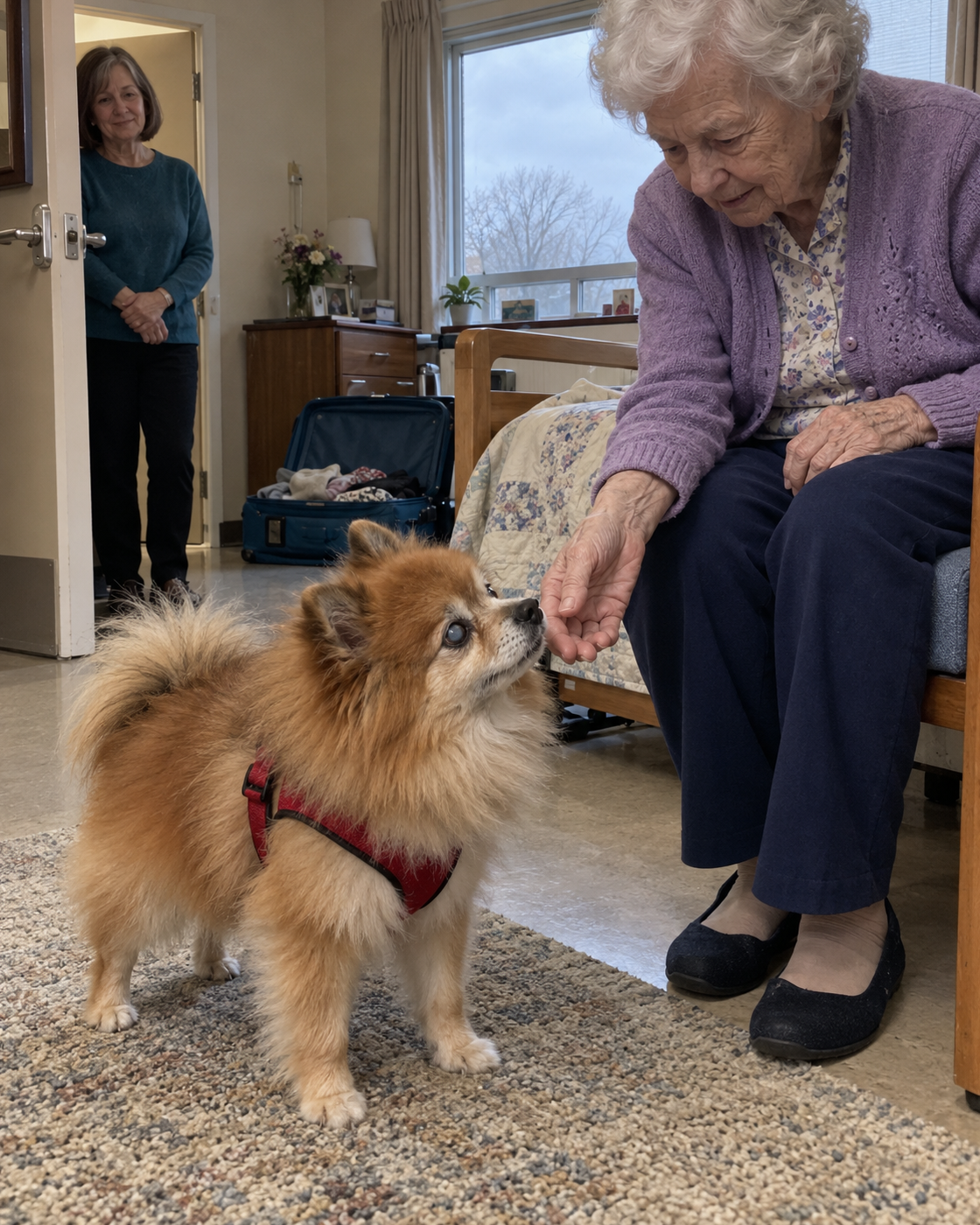
By eleven, he had slowed. His veterinarian had confirmed a cataract in his left eye, and we kept his follow-up appointments. He still found his way confidently around familiar furniture, but we announced ourselves before reaching toward him and left his routes through the house clear. Mother never moved his water bowl to make room for visitors. The visitors learned to step around it.
He preferred sleeping on the cream bed with the flattened edge. I had bought a newer one, deeper and softer, and he had investigated it before returning to the old one. Mother said I did the same thing with my shoes. She was right about that too.
The change in their household came quietly. Mother began asking me to carry the food container. Then she asked whether I could handle the evening walk when I visited. During longer walks, Teddy was happier with a few slow minutes of sniffing than with the routes he used to take. Their needs were changing together, though loving him remained easy for her.
Doing everything else had become harder.
One Thursday, I arrived early and found his breakfast measured into its dish, waiting on the counter. Mother was sitting nearby, resting before she bent to put it down. Teddy sat patiently in the place where the bowl always appeared. I lowered it for her, and he ate without looking up.
Mother watched me do the smallest thing in the world. Then she asked whether I was going to use it against her.
That question stayed with me longer than any untouched laundry. I told her no, and for that morning I meant it without an argument hiding behind the word. I made coffee, sat down, and asked what she wanted help to look like. Teddy finished breakfast and placed his chin against her slipper while she thought.
“I want to stop being frightened of falling,” she said. “I want somebody nearby. And I want him.”
There it was, her whole request in three sentences. She understood the appeal of a room where someone could answer a call, meals would arrive, and the broken back step would become somebody else’s concern. She simply could not picture that room without Teddy in it.
I asked permission to speak with the nursing home again. This time, I promised to describe what she actually wanted. She agreed, then corrected one detail before I reached for my phone: I was to ask for help keeping them together, not tell strangers that she would refuse care forever.
The administrator, Mrs. Hale, invited me to bring the question to her office. I arrived with a photograph of Teddy and a folder thick with explanations. She looked at the photograph first. In it, he sat beside Mother’s shoe, his small face tilted upward and his red harness a little crooked beneath his fur.
“Who takes care of him on a difficult day?” she asked.
I started saying that Mother had always managed. Mrs. Hale waited. I stopped, understood what she was asking, and gave the answer that mattered now.
“I do. And I need to show you how that would work.”
She opened a fresh page in her notebook. For the first time, our conversation included a place where Teddy might sleep.
Part 3 — The Questions Behind the Answer
Mrs. Hale did not change the rule during that meeting. She explained the concerns she would need to bring to the board: other residents’ allergies and fears, staff responsibilities, shared spaces, the dog’s welfare, and the possibility that Mother might need more assistance later. I had expected resistance to sound cold. Instead, it sounded like somebody asking what would happen at two in the morning.
That made it harder to dismiss and more useful to answer.
I went home with no promise and a list. Mother listened while I read it aloud. Teddy sat between us, pressing his nose against the edge of the folder whenever a page moved. When I reached the question about a backup caregiver, Mother said my cousin Ruth would need to be asked properly. We could not volunteer her simply because she had once watched Teddy over a weekend.
Ruth said yes after we talked through the actual commitment. She lived fifteen minutes from the proposed nursing home, knew Teddy’s routines, and could keep him during an emergency. I agreed to cover his expenses and arrange daily help beyond what Mother could comfortably do. We put those promises in writing, with phone numbers that people would actually answer.
The veterinarian gave us a current assessment and a record of his care. She also reminded me that moving could unsettle an older dog. Permission to bring him was only the beginning. He would need familiar things, a quiet place, consistent handling, and time to learn a new layout. Mother listened to that advice as carefully as she had listened to every question about herself.
“Then we take his old bed,” she said.
Eight months sounds like one long argument when it is reduced to a sentence. Living through it meant smaller stretches: a meeting postponed, a question answered, another question arriving, a hopeful call followed by a week with nothing to report. During that time, we increased the help Mother received at home. We did not leave her managing alone while we waited for an ideal answer.
Teddy adjusted to the extra people better when Mother introduced them. He would stand near her, watch the visitor with his good eye, then move forward if she held out her hand. One aide learned to pause inside the door and say his name before walking past. Soon he greeted her by inspecting the bag containing her lunch. Trust had its ordinary signs.
At a later meeting, a board member asked what would happen if Teddy barked. I wanted to answer that he hardly ever did. Instead, I admitted that strange sounds sometimes startled him and described how we would respond. We would give him space, learn what bothered him, and consult his veterinarian if his behavior changed. We would not ask a whole floor to endure distress while insisting love should be enough.
That answer helped more than the photograph had.
Mother also insisted on attending one conversation. I worried the trip would tire her. She said they were discussing her life and she could sit down while they did it. Teddy stayed with Ruth that afternoon. Mother wore her good cardigan, rested her hands on the table, and listened until Mrs. Hale asked what she most wanted the board to understand.
“He doesn’t need everybody to love dogs,” she said. “He needs a place to belong while I get help.”
No one applauded. A man across the table wrote something down. Someone asked about cleaning supplies, and we returned to details. I remember appreciating that. Her request had become something they could work on.
The approval came with a trial period and clearly assigned responsibilities. Teddy would remain Mother’s companion, not a resident expected to entertain everyone. Certain common areas would stay pet-free. His care would be reviewed, and we would respond promptly if he or anyone nearby was struggling. Mother would have a room where his bed could sit safely away from the route to the bathroom.
When I called her from the grocery store parking lot, she asked me to repeat the part about him staying overnight. I did. She asked it once more, slower, as if checking the measurement of something precious.
Then she said, “Bring the suitcase down when you come.”
That evening, Teddy watched us fold two cardigans beside his bed. This time the suitcase remained open. Mother reached down to rub the fur behind his ears, and I saw her shoulders settle before she began deciding which photographs to take.
Part 4 — Two Beds Beside the Window
Mother packed Teddy’s things with the seriousness other people reserve for jewelry. His food container came first, then the red harness, the bowl with a small chip in its painted edge, and a toy whose original animal species nobody could confidently identify. She rejected a new blanket because the old one already belonged to him. I folded it without arguing.
At the nursing home, a staff member helped us bring everything inside before Teddy entered. We wanted his familiar bed ready in a quiet room, not sliding around beneath boxes while people stepped over him. Mother rested on a chair near the doorway. I held his leash loosely while he looked at the floor ahead, his good eye following every movement.
He stopped when a cart passed down the corridor. His ears lifted. Mother said his name, the same way she said it when supper was ready, and lowered her hand. I placed his bed near the chair. He sniffed its edge, shifted forward, and touched her fingers with his nose.
That was our arrival photograph, though nobody took it. A woman waiting. A dog deciding. The rest of us learning to let a minute take as long as it needed.
Inside the room, Teddy walked carefully along the wall. He examined the wardrobe, the underside of the chair, and the strip of carpet beside Mother’s bed. We kept the arrangement simple, with clear paths and familiar objects. When he returned to Mother, she leaned down slightly and let him smell the sleeve of her lavender cardigan.
“Same sleeve,” she told him. “Different address.”
He settled for a while. I unpacked clothes, put photographs where Mother could see them, and wrote the care contacts where the staff had asked us to keep them. In the late afternoon, I took him outside for a short walk, then brought him back for his meal. He ate part of it and left the rest. We noted it, watched him, and avoided turning every unfamiliar behavior into a story about what he must be thinking.
When I left that evening, he followed me to the room’s doorway. Mother called him back. He came, and I told myself the hard part was over.
The phone rang before I reached home. A nurse named Denise explained that Teddy kept walking toward the room’s closed door and returning to Mother. He had started whining. Mother was trying to comfort him, but she had also tried to get up more often than was comfortable because she thought he needed another walk.
“She’s asking whether you should take him home tonight,” Denise said.
I pulled into a parking lot. Through the phone, I could hear Mother saying she did not want him to be unhappy because of her. All those months of insisting they should stay together, and his distress could still make her offer to part.
I went back. Denise had made sure Mother was comfortably seated and Teddy was safely in the room. We checked his immediate needs and followed the plan we had discussed with his veterinarian. There was no reason to force him to explore, greet people, or settle on our schedule.
Mother looked at me when I came in. “He keeps looking for the door at home.”
Maybe he was. Maybe he was listening for me, or reacting to the unfamiliar hallway. I could not know. I sat in the second chair and let him approach. He sniffed my shoes, returned to Mother, and stood against the side of her chair.
Denise adjusted the evening routine with us. We reduced interruptions, kept the room quiet, and allowed more time before expecting him to rest. I stayed through his next short outing and until he lay down. Mother kept her hand low, close enough for him to find without having to climb.
Eventually, Teddy rested his chin on the flattened edge of his bed. His ears still moved at corridor sounds, but his body stopped preparing to follow every one.
I did not leave with a grand speech. I told Mother when I would return, told Denise what we had observed, and stood quietly at the door for a moment. Teddy opened his good eye, looked at me, and then turned his face toward Mother’s slippers.
She watched him settle before she looked up at me. “Leave the bed where it is,” she whispered.
Part 5 — Learning Which Door Was Ours
For the first week, Teddy measured the nursing home by the distance between Mother and the room’s door. When I arrived, he greeted me warmly, then looked behind my legs. When I took him for a walk, he hurried on the return until we reached the stretch of corridor he did not yet recognize. There he slowed and studied each doorway, waiting for the sound that told him which one was ours.
Mother began talking before we reached it. She might be telling Denise about the weather or reading a newspaper headline aloud. Teddy’s ears would turn, and his pace would change. He walked toward the voice he knew, careful on the unfamiliar floor, and Mother waited for him with her hand lowered beside her chair.
We did not leave the adjustment entirely to him. I brought a runner that lay flat and did not slide. Staff helped us position it safely so it marked a short, clear route between his bed and the doorway without creating a hazard. His water stayed in one place. His bed stayed in another. People announced themselves before coming close on the side where his sight was limited.
At his follow-up examination, the veterinarian found no new problem explaining his unsettled behavior. We kept watching his appetite, comfort and routines, and she helped us think through changes without assuming every difficulty came from his age. His left eye remained cloudy. Familiarity was improving his confidence; his vision had not magically returned.
Ruth took several walking shifts so I could keep working. At first, Mother apologized every time either of us clipped on the leash. Ruth finally asked her to choose between two routes instead of apologizing. Did Teddy prefer the sheltered path beside the building or a short visit to the quiet courtyard?
Mother considered the weather and chose. It gave her a decision she could still make for him, and Teddy got the slow sniffing time he wanted. We were learning to help without taking over every part of the relationship.
There were practical mistakes. I brought a food bowl that was easier to wash but noisier when it moved. Teddy disliked the scrape against the floor. We put it on a stable mat. A well-meaning visitor leaned over him to pet his head, and he retreated behind Mother’s chair. After that, I asked visitors to let him approach first and accept his answer when he stayed where he was.
Mother enforced that rule more firmly than I did. “He doesn’t owe you a visit,” she told a cousin, then offered her a peppermint so nobody could mistake the boundary for a family feud.
By the second week, Teddy had learned the sound of the evening staff member who brought Mother her fresh water. He would lift his head, watch her enter, and settle again. One night, Denise sent me a brief message saying he had eaten his supper and curled up before the television program ended. I read it twice in my own kitchen, where I had been keeping my phone beside the sink.
It was the first ordinary report I had wanted all day.
Mother changed in ways I could describe without making claims larger than the evidence. She began choosing clothes the night before. She asked whether the courtyard would be open after lunch. She told me the name of the woman who liked to sit near the window at the end of the corridor. Sometimes she sounded tired. Sometimes she sounded irritated. She sounded increasingly occupied with the life in front of her.
Teddy became part of that life without being made its entertainment. He slept through activities he had no interest in. He chose to watch people from beside Mother’s chair. When a resident asked to meet him, we arranged it quietly, with enough room for him to move away.
One afternoon, I arrived while Mother was telling a neighbor about the puppy he had been. Teddy lay at her feet, his red harness hanging on the same low hook we had brought from home. I waited until the story ended before interrupting.
Mother looked up and smiled. “He knows this room now,” she said.
Then Teddy stood, walked past my open hands, and went to his water bowl. He no longer needed to check every arrival before taking care of a small need of his own.
Part 6 — The Afternoon We Had to Listen Again
A month after the move, I brought Teddy back from a walk during a busy change in the afternoon routine. A maintenance cart stood near our usual route. Someone opened a door behind us, and something metal clattered onto the floor. Teddy startled, turned too quickly, and scrambled for his footing before I could guide him onto the runner.
He recovered his balance without falling. But when we reached Mother’s room, he went straight behind her chair and stayed there. He would not follow me out again when I tried a short, calm invitation later. His ears flattened at sounds he had begun to tolerate the previous week.
I felt an old panic returning in a new form. After all our work, I imagined one frightened afternoon becoming the reason someone said the arrangement could not continue. Mother noticed me trying too hard to sound cheerful and asked me to sit down.
“He’s had a bad day,” she said. “Let him have it.”
We informed staff, checked for signs of discomfort, and arranged veterinary advice. The examination did not reveal an injury. The plan was patient and practical: quieter routes, familiar support, fewer demands, and observation for changes. We did not force him through the same corridor to prove he could manage it. His comfort mattered more than defending our success story.
Mrs. Hale visited to discuss the incident. I had prepared a list of everything that had gone well. She asked about Teddy first. Was he resting? Was he eating? What changes would make his day easier? I realized she was trying to solve the present problem while I was trying to win the meeting we had held months earlier.
We chose a quieter walking time and a route with fewer moving carts. Ruth and I took turns until Teddy was comfortable again. Mother kept her hand available, and he kept choosing whether to come to it. The second evening, he emerged from behind her chair to investigate the sound of his food container. The following morning, he followed Ruth to the door.
Progress returned in portions too small for a headline.
During that same period, another resident’s daughter asked Mrs. Hale about bringing in her father’s cat. She had seen Teddy’s bed when she passed Mother’s room. I met her in the courtyard and answered what I could, including the difficult parts. I told her about the first night and the startled afternoon. Keeping a pet with its person required more than winning an exception; somebody had to keep showing up when the arrangement became inconvenient.
She nodded. Her father had been asking about his cat every evening. She wanted to know where to begin.
Mother did not become a campaigner with speeches and a schedule. She did something more like herself. When residents asked about Teddy, she told them how long they had been together, what he liked, and who helped with his care. She never promised that every animal could live in every room. She did say asking was worth the trouble.
Over the next eighteen months, nine other residents at that home were approved to bring their own pets into individually planned arrangements. They arrived at different times, with different needs and different families providing help. Some wanted quiet companionship in their rooms. Others enjoyed a supervised visit to the courtyard. There was no parade of animals through the dining room and no expectation that everyone should participate.
I remember a man sitting beside a cat carrier, waiting while its occupant decided to emerge. Mother watched from several chairs away, with Teddy curled near her shoes. She smiled at me without saying anything. We recognized the patience in that doorway, even though this one belonged to somebody else.
Staff noticed conversations beginning around familiar animals. A resident who had stayed in her room chose to sit outside with her own small dog. Another asked his daughter for photographs of a pet he had loved years earlier. These were things we could see and hear. We had no evidence that Teddy or the new arrangements caused a reduction in anyone’s medication, and decisions about treatment remained with each resident’s clinicians.
What I could say was smaller and certain: Mother now had people she expected to see tomorrow. Teddy had places where he knew he could rest. Neither fact needed to become a medical claim to matter.
Part 7 — What Stayed Beside Her Bed
Eighteen months after moving day, Mother still checked Teddy’s bowl before asking me whether I wanted coffee. She was ninety-two by then, and he had turned twelve. His muzzle had more silver in it, and his walks were shorter. We kept his veterinary appointments and adjusted his care when his needs changed. The cloudy left eye remained cloudy. The red harness had been replaced with another that fit him comfortably.
His old bed remained beside her chair.
I had offered to replace that too, but Mother reminded me of the laundry basket, the new bed he had refused at home, and the first night in this room. The flattened edge still held the shape of his chin. We kept it clean and comfortable, and when he wanted the rug instead, the rug was his choice.
By then, my visits had stopped feeling like inspections. I still checked supplies and care notes. I still asked questions. But I also sat down long enough to hear about somebody’s granddaughter, a disappointing dessert, or the bird Mother had watched outside the window. Teddy sometimes greeted me and sometimes remained asleep. I had learned to accept both as signs that I belonged there without having to interrupt everything.
One afternoon, I found Mother helping a new resident decide where to put a dog bed. The woman was worried it would make her room look crowded. Mother suggested trying two places before choosing. Teddy waited beside her while the other woman’s daughter moved the bed, then moved it back again.
“You can change your mind,” Mother told her.
I stood in the corridor with a bag of clean cardigans and remembered how many conversations we had once held as though accepting help meant surrendering that right. Here was Mother offering it to somebody else, as casually as making room at a table.
Later, I asked whether she regretted anything about the move. She thought for a while. She missed her kitchen window. She missed deciding when the washing machine would run. She missed having her own back step, even the troublesome one. I let her finish without turning those losses into an argument that we had chosen badly.
Then she looked down at Teddy.
“I don’t spend the evening wondering where he is,” she said.
That had been the fear beneath the closed suitcase. She could bear changes she understood. She could mourn the house and still accept a room where help was near. What she had resisted was the unnecessary empty space beside her at the end of the day.
I sometimes think about the care plan I brought to the first meeting. Its pages have been revised since then. Phone numbers changed. Walking times changed. Responsibilities became clearer through use. The document that mattered was never the first impressive folder I carried through Mrs. Hale’s door. It was the plan people were willing to keep adjusting around two living beings.
Teddy did not know any of that. He knew the low hook where his harness waited. He knew the sound of Ruth’s steps, the place where his water stood, and the voice that greeted him when he reached the room. When he wanted Mother’s hand, he stood near her chair and lifted his face until she noticed. He had a reliable way to ask.
On the evening of Mother’s birthday gathering, visitors came in small groups so the room never grew crowded. Teddy spent most of it sleeping. After the last guest left, I helped put away cards while Mother rested. The blue suitcase sat on top of the wardrobe, empty except for a spare blanket. We had not needed it for a departure in a long time.
I asked whether she wanted the light left on near the door. She said the small lamp would do. Teddy woke when I moved, stretched carefully, and walked toward Mother. She lowered her hand. He touched it with his nose, then circled once on his bed.
For a moment, she kept her fingers just above his fur. Then she settled back, watching him tuck his chin into the worn edge. I waited until both of them were comfortable before saying goodnight.
At the door, I looked back. Mother’s slippers stood side by side beside Teddy’s bed, exactly where he would find them when he woke. There was nothing packed between them anymore.
Follow our page for more dog stories about patient care, familiar hands, and the people who keep making room for the companions they love.